Heavy cream is useful.

Of course I did not grow up in a household where heavy cream was a kitchen staple, because no one cooked seriously in our household, and on the rare occasions we needed whipped cream, we purchased a can of the totally awesome Reddi-Wip, which was not only good to eat but crazy fun to dispense. Now that I am who I am, however, there are often occasions when I need heavy cream for cooking, and so I’d say 50% of the time, if you open our fridge, you’ll find a carton of heavy cream around.

I have very strong feelings about what brands of heavy cream are acceptable. I am very loyal to Farmer’s Cow heavy cream, which I feel is both high quality and affordable. Anything with weird gums added to it is not acceptable, but I admit that we wind up with it in the house a fair amount because that’s what’s easiest to find. Stuff from Smyth’s Trinity Farm or Arethusa Dairy Farm is also wonderful, but it’s a lot more expensive. Basically, I raise or lower my standards depending on what I’m planning to use the cream in, and I can live with that. Right now we’ve got a carton of the medium-undistinguished-but-okay Guida heavy cream. I bought it to make something very specific a few days ago, and I made it, but now I can’t recall what it was. Oh: whipped cream, to go with strawberry shortcake.

I only whipped up about 3/4 of a cup of the cream that night, so right now we’ve got a fair amount of it in the fridge waiting to be used up. If I haven’t used it in a day or so, I will pour it into an ice cube tray and freeze it, because I’ve learned that adding a cube or two of cream to a number of things is a very good idea (more on that later, some day), but in the meantime, last night I had a small heavy cream epiphany.

I had had a very complicated day. Usually when this happens I try very hard to ensure that even if the day is very busy, by four o’clock or five o’clock — 6 p.m. at the latest — I am at home and organizing dinner. That did not happen yesterday. What did happen was that in the one hour and fifteen minutes when I was home, mid-day, I had the presence of mind to assemble and bake a meatloaf and wash a lot of Romaine lettuce and arugula, so that when my daughter and husband and I all got home between 6.30 and 7 o’clock, it wouldn’t be too difficult to assemble dinner. All we’d have to do is reheat the meatloaf — if we felt like it — and assemble a salad. (Yes, I forgot about the starch aspect of the meal. More on that momentarily.)

So at 6.30 my daughter and I were on a bus headed home after a long afternoon downtown and I was texting my husband saying “we’re on the bus, we’ll be home soon” and he wrote back to ask if he should heat up the meatloaf; he’d just gotten home. I said Sure, and added, “I just realized I forgot to prep a starch. You could put on a pot of rice maybe.” When we got home, fifteen minutes later, the meatloaf was heating gently in the oven and a pot of instant mashed potatoes was being assembled on the stovetop: all was well. Except I’d also forgotten about making salad dressing.

We’ve been eating a lot of salads lately, which is most unlike me. I generally take a hard stance against salads: I think they’re a waste of time. Rabbit food. I don’t care. But because my daughter turns out to love lettuces of all types, so long as they’re not too bitter, I’ve gotten in the habit of serving them. Usually I just throw on some oil and vinegar and call it a day, but sometimes I get a little more ambitious. Last night, my interest was not in being ambitious, but avoiding the same old oil and vinegar thing again. I opened the fridge to see what I might have that would make a nice salad dressing and I saw the heavy cream and I thought, “Well, I could make some kind of creamy salad dressing for a change?”

I took a bowl and poured in maybe a quarter cup of cream, and then I began to whip it. When it started to thicken, I put in a teaspoon of garlic powder, a little cayenne, some salt, and a splash of tomato vinegar, and I kept whipping. In about 30 seconds we had a thick but pourable salad dressing that was really, really delicious, strong enough to stand up to the arugula I’d snuck into the salad bowl (my daughter carefully picked it out and gave it to her father). It was so delicious that after the salad was gone, my husband folded some of the dressing into his mashed potatoes. It took almost no effort to make this salad dressing and it tasted like it required planning and real expertise: in other words, this was a very good trick to have figured out. I don’t know what took me so long. It’s obviously totally 101, but I guess sometimes it’s the really obvious stuff that slips by us.

The Reluctant KonMari: Or, how to be crazy without actually being certifiable, and why being a little crazy can be useful

The Life-Changing Magic of Tidying Up by Marie Kondo came out in the U.S. a couple years ago and there was a phase when it seemed as though all of my friends were talking about it, with derision and not a small quantity of defensiveness. I spoke of it, too, remarking that surely the woman who wrote it was a nut job, but also suspecting that my friends took me to be not that far removed from Marie Kondo. In my circle, I’m regarded as The Crazy Cleaning Lady, which is not much better than being a Crazy Cat Lady.

But I didn’t read the book; I wasn’t willing to buy it to find out just how unreasonable the KonMaris were. (By the way: I think it should be Konmaristes, to lend it a little flair, but I guess that extra flair goes against the spirit of KonMari, in which there are no frivolities, no extras. But Konmaristes sparks joy in me, so there.)

However, I was recently at the public library, which is a wonderful place for KonMaristes, because you can borrow books and then return them, so you needn’t clutter your home with so many books. I was standing there at the New Non-Fiction section when I noticed The Life-Changing Magic of Tidying Up and I thought, “Well, look. Here’s my chance.” So I took the book and started reading it on the bus ride home. By page 38 I had jotted down a number of thoughts. That evening my husband accused me of having bought the book as a way of, I don’t know, casting aspersions on his sterling character. I refuted this by asserting that I had borrowed the book from the library; that I had no plans to buy it; and that I was by no means commenting on his character (when we first crossed paths with this book a couple years ago in a bookstore, I held it up to show him, and he stuck his nose in the air and said, “I could have written that”). I was merely trying to keep up with this cultural movement. In the middle of reading, I suddenly glanced at the coffee table on which I was resting my feet, and began to speedily  re-stack all the crap on it so that it was, yes, tidier. It still had the same amount of crap on it, but the crap was Knolled, which even I know is better than just having crap all over the place.

Reading Marie Kondo does something to you: you become instantly aware of all of your shortcomings. I guess that could be construed as life-changing, except that most of us are already aware of our shortcomings. So I’m not sure how beneficial this really is.

Moreover: It was quickly clear to me that Marie Kondo is indeed a nut case. But she is a very impressive nut case: she’s the rare bird who’s taken her neuroses and channelled them into a highly profitable enterprise. All of her character flaws — and they are many, if I can judge from her text — are turned, by her book, in her book, into virtues.

From the time she was very young, she was a compulsive tidier. She didn’t want to go play outside, as a schoolchild; she wanted to stay in and tidy the classroom. When at home, she’d tidy her family’s house. As a youth she threw away bags of things that didn’t belong to her, but to her siblings and parents, because she felt they were unnecessary. (It didn’t matter what they thought. If I’d pulled this kind of stunt, as a child, I am positive my parents would have either permanently lost their voices from screaming at me, or had me committed.) In my circle, here in America, a girl like this would probably be analyzed and medicated and turned into something else. In Japan, she grew up just as she was, and found work that took advantage of her compulsions. In her late 20s, her book was published in Japan; now she’s 31 and has a six or seven month old baby, and I imagine her life is…. less tidy than it was. But I assume she’s made a lot of money.

The book is both laughable and valuable. I’ll be brave and admit that. I wanted to be able to just dismiss Marie Kondo entirely, but the fact is, there are some sensible observations in there. I gritted my teeth when I got to bits that suggested little ways of organizing stuff that are, in fact, methods or systems I use on a daily basis. It irked me that I was doing anything that Marie Kondo would describe as “correct.” She is not an easy writer to love, Marie Kondo: she’s written a book that, I feel, were it a book on tape, the narrator would be whoever the young Japanese lady version of Mr. Rogers is. A lot of people love Mr. Rogers, I know; but I don’t, and I never did. He bored me. He annoyed me. And that’s the voice I hear in Marie Kondo: this slow, soft-spoken, very reassuring voice, telling you that you really can get rid of all the things you don’t need. Except with Marie Kondo, there’s something I read as smugness. I’m sure there are people who find it calming or encouraging; they don’t feel that they’re being scolded. They feel they’re being moved to become better people. But I’m pretty much okay with being who I am already. I don’t want to be soothed into having only thirty books in my house. (That’s what she finds acceptable, in her home: thirty books.) I am confident that she would say I should get rid of my LPs and the few CDs I own (I have maybe 100 CDs). And my visceral reaction to this is twofold:

  1. I need to tidy the coffee table; and
  2. I want to play Ramones albums really loudly. Messy house, messy music.

But here she is, blithely insisting that you can do it. That I can do it. That women, even more than men, should be tidy, because to be sloppy is unfeminine. Women own far, far too much clothing. A hundred pairs of shoes is too many.  And that, furthermore, if you KonMari your house, the odds are actually good that you will lose weight!

This is the kind of thing that makes me lose my mind. We don’t just have to be tidy, we have to be skinny and tidy. Really, the only way for some of us to achieve that would be to become addicted to amphetamines, but wouldn’t that be a bad thing? (Don’t argue with me.)

Many of the women I know who’ve discussed KonMari have mentioned that the technique is basically an impossible proposition for anyone with small children, and this is, if you ask me, a cold, hard fact. Having a child means giving up, at many levels, on calm and order in one’s household. One of my friends told me that Marie Kondo had a baby a few months ago and that she gave an interview on NPR more or less recanting, saying, “Mothers, fathers, you’re right, this is all bullshit.” But I am unsatisfied. Partly because I haven’t heard this interview, myself, and partly because what I really think is that Kondo is either going to simply have a nervous breakdown after some months of motherhood, or her child is going to grow up to be a lunatic as the result of living with a woman who cannot tolerate the slightest bit of untidiness in her home.

This is a woman who wants us to thank our handbags and briefcases, when we empty them out at the end of the work day. She thinks we have time to do these things, in addition to the inclination. I can tell you: when my daughter was very small, and leaving the house took 20 solid minutes of preparation, it also took 20 minutes to unload. I had to put down the groceries I was carrying in addition to the diaper bag and then I had to undo the Ergo baby carrier and put the baby someplace safe. Then I had to get the groceries into the fridge as fast as I could, before the baby began to scream because she was pissed off. Remembering to get the yucky diapers stored in the diaper bag into the trash was another essential activity. If I myself needed to pee, that was another matter that needed attention, and since I didn’t wear diapers, I gave it higher priority than my daughter’s need for a new diaper. At no time did I find it feasible to unpack bags entirely and thank them for their loyal service. If I could get through a day without discovering a spilled bottle of formula lying somewhere, and do a load of laundry, and cook dinner and serve it to us by 7.30 p.m., and get the baby bathed and fed and into clean clothes, and keep the house reasonably clean (as opposed to tidy: a distinction I feel is vitally important, and which is not fully explored in Kondo’s book), then I was doing great. 

At the same time, I want to give credit where credit is due. Some of Kondo’s suggestions for tidying are a) reasonable and b) do-able. I know this because some of them are things I hit on myself a few years ago. One that stands out in my mind is what I think of as “the shoebox trick.” This is a very simple matter. The idea is that there are certain places in the house where one will naturally have collections of small things that are both needed at that location and hard to keep tidy on a shelf or countertop. The place where this became an issue, for me, was the bathroom. Our bathroom does not have a ton of well-designed storage. What we have is a cabinet under the sink, and a tall but stupidly deep and narrow linen closet. I’ve had to put thought and effort into working with what I have without spending any money on fixing the problem.

So it dawned on me, after a while, that the way to keep most of our personal hygiene products reachable, and organized, was to put as much of it as possible in shoeboxes that can live hidden under the bathroom sink. I will grant that it’s not a pretty arrangement under there, but on the other hand, we know where everything is, and it’s kept clean and dry, which god knows it would not be if it were all living on the bathroom counter (as if there’s room for it there). Bottles of shampoos and tubes of unguents that for whatever reason must be stored upright, and cannot fit correctly into shoeboxes, are all kept in a large silicone bucket that’s also under the sink. As I say, this isn’t an extremely attractive storage solution, but it is a solution, it works, and it didn’t cost me anything in particular, because I already had the shoeboxes and the silicone bucket, which I acquired in the days when I had to soak filthy baby clothes in something, and which was clearly a very good investment.

Another shoebox trick, which I don’t currently use, but which I have in the past, is the “use a shoebox lid to corral oil bottles in the kitchen so that they’re kept neat and won’t gunk up the shelf.” If you trim down a shoebox lid so that it serves as a kind of sliding tray in a cabinet (depending on your cabinets, you may not need to trim it at all, come to think of it; I did, though), you can keep your oil and sticky-things bottles there and not be in a constant state of low-level horror at the condition of your kitchen shelf, which grosses you out every time you reach for a bottle of oil.

I can personally attest to the value of this system, because as a matter of fact, during the days when I was chewing over this essay, I had occasion to rediscover its value. It wasn’t in the kitchen; it was in the bathroom. As I explained above, while I keep many items corralled in shoeboxes under the sink, there is a basket on a shelf in the (very deep, very narrow, hideously designed) linen closet. It is a wicker basket with a fabric lining and for five years I’ve kept it next to a stack of towels. This wicker basket is where I have traditionally kept packages of bandages and tubes of Neosporin and other first-aid type items. My husband has also viewed it as a catchall for all bathroom items. I’ve tended to let this slide and not let it get to me, but one morning this week I needed a certain shape of Band-Aid to put on my foot because I had a terrible blister that I wanted to protect. I fished around for the box of Band-Aids and couldn’t find the shape I wanted, which was annoying because I knew I had that shape, somewhere. Not able to see into the basket — the shelf is higher than my eye level — I finally pulled the basket down and brought it into the bedroom so I could put it on the bed and see what was in there. What I found was that many items were covered in this layer of slightly oily unidentifiable crud. And the fabric lining of the basket was also soaked in that same crud. Clearly, a bottle or tube of something had leaked or oozed in there, over a long period of time, and now, as a result, I had a big, vile mess on my hands.

I sighed heavily and emptied the basket. I put everything on the floor and took the fabric liner and added it to the laundry pile. I found the bandage I wanted and took care of my foot, muttering things like, “There goes my goddamned morning.” I was annoyed, but resigned: this wasn’t a problem that could wait, because summertime is the season when we need that kind of stuff organized the most. Summer is precisely when we get blisters, stupid huge bloody scrapes on knees, and so on. To not be able to lay hands on a  clean bandage when we need it is a problem, and procrastination was not a good idea.

So later in the morning, after I’d taken the kid to camp, I came home and poured myself an iced coffee and set to work. It took me a solid two hours to get that basket sorted out. But with the help of four shoeboxes (scavenged from hither and yon in the house, mostly my daughter’s bedroom) I was able to essentially clean up the whole mess. I relabeled all the boxes so that my husband will not be able to complain that he can’t find anything. I threw out a few suspicious looking bottles, and nearly-empty cough drop bags, and some other miscellaneous crap, but I never did figure out what that oozy film was from. No matter: because everything that was in there has been dealt with, the problem will not recur.

Got that, people? This problem will not recur.

At dinner I announced to my family, “Something gross oozed all over the wicker basket in the bathroom, and it took me two hours to get everything straightened out today, and I have changed the storage system in the bathroom. Go take a look, and do not let it happen again.” My husband looked dismayed — and a touch guilty — and said, “uh-oh, what leaked?” “I don’t know,” I said ominously, “but it will not happen again.”

Marie Kondo applies this level — and deeper levels — of excruciating attention to every category of thing in her home. And there are times when it’s not a big deal to adopt her system, and it works: her famous rolled sock drawer, for example. She is correct that balling up socks is a bad idea because it trashes the socks (renders the elastic in them shot before its time). Rolling them up and standing them up on their sides, like cylinders, in the sock drawer really does make a huge amount of sense. So, dandy. Rolling t-shirts might be fairly reasonable, but it’s a judgment call, I think. I don’t have drawers deep enough to do things like keep my jeans rolled. Perhaps if I took a closet and outfitted it with nothing but very deep drawers and a grid of shelves, such that my closet resembled the wall of a Gap store ca. 1992, I would be able to pull off the kind of clothing system that Kondo has in mind. But since I have no closet, really, to dedicate to my clothes; and since I have a lot of clothes; I do only the best I can. This usually means that my sweaters (probably 50 sweaters) are kept neatly folded in a Rubbermaid bin; my pants are also kept (folded) in a Rubbermaid bin. Button down shirts are hung; skirts are usually folded in a small dresser. Dresses are hung, unless they are wool or another fabric that would be harmed by being hung for an extended period of time, in which case, they are folded.

My point being not that anyone should emulate my clothing storage system — because it SUCKS UTTERLY — but rather that in general we’re all just doing the best we can. In my case, I regard it as a major victory if clothes aren’t thrown on the comfy chair in the bedroom. (I’ve never been someone who threw clothes on the floor. They’ve never accumulated on the floor. Always on a chair. Even when I was little and I had a beanbag chair: the clothes would accumulate on the beanbag chair, which was really a problem because you could lose clothes in the dent in the beanbag chair and then NO UNDIES and you’d finally dig them out and they’d be all sad and crushed-looking. I have to admit, it’s better to put clothes away and not on chairs.) Doing the best you can doesn’t require thanking your shoes for their service on a daily basis. It doesn’t require throwing out 85% of your belongings in the name of having a tidier living space. It requires knowing your limitations and accepting them. And living with people who can deal with that.

 

Another Perfect Summer Dinner, Discovered

Recently I had a problem, which was that I had to cook dinner for the three of us and I really didn’t feel like it and, what’s more, I was determined to not go to the store to buy ingredients. In other words, whatever I came up with, it had to be done with whatever I might have in the house. Around mid-day I realized that if I was willing to put a little bit of effort into it, I did, in fact, have everything needed to make a tomato pie, which is a lovely summer meal.

So I resigned myself to the idea that, come five o’clock, I’d be assembling biscuit dough and then spending fifteen minutes assembling the pie and then I’d be baking it.

The one aspect of this that I was looking forward to was, I’d had the idea that instead of using the cheeses I usually put into tomato pie, I’d use the log of honey goat cheese that someone gave me a couple weeks ago. (It was part of a gift basket I received.) It seemed to me that if I made a pie with that cheese and thin slices of tomato and some red onion, it could be really very good.

But, while poking around online to see if anyone else had ever done something similar, I stumbled on a website that talked about a variant of what I had in mind, and it sounded so good, I thought, “Screw tomato pie.” The site I was on, Culinary Covers, listed this as a Tomato Scallion Shortcake, and apparently it’s really a Smitten Kitchen recipe. I’ve read the Smitten Kitchen cookbook and genuinely don’t remember this — though it is the lovely item shown on the cover of the book —  but it doesn’t matter. The basic idea was that you’d re-configure a shortcake so that instead of being a sweet dessert, it became a savory dish. This was so brilliant I was pissed at myself for not having thought of it (or noticed it as a good idea) years ago. I glanced at the Culinary Covers write up of the recipe. It looked to be pretty much the biscuit recipe I generally use, so once I had that taken care of, the rest of this was a snap.

This savory shortcake was so good my husband and I were actually surprised. Our first bites were a little skeptical, but by the end we were literally looking at the bowl that held the whipped “cream,” wishing there was more. The last time we had a home-cooking experience like this was the first time we made Cincinnati chili. “Weird,” we both said, at first bite. “I need MORE,” quickly followed. And Cincinnati chili has been a standard of ours ever since. I predict the same will happen with the savory shortcakes.

They’re not enough to serve on their own for dinner, sadly. So on the side, I served succotash (frozen corn, a little chopped onion, garlic, and fresh okra, cooked with a little hot sauce and some heavy cream; no one liked it but me, but that is totally okay, because I loved it), and a green salad (lettuce, pea shoots, vinaigrette, beloved by my family, primarily because it wasn’t succotash).

But let’s focus on the important thing here, which is those savory tomato biscuit things. Having done this once, I now know precisely how to do it even better the next time I do it, and there will be a next time.

The Important Part:

Biscuits with Sweet Whipped Goat Cheese, Tomato, and Red Onion

Start by doing two things:

1. Take a 4 oz. log of goat cheese out of the fridge. I used a honey goat cheese, but you could use a plain goat cheese and add your own honey to taste. The cheese needs time out of the fridge to soften. It’ll be perfect by the time you’re putting the biscuits in the oven.

2. Assemble biscuit dough. I usually like to make a very basic biscuit dough, because it’s easier than fiddling with bells and whistles. If you like bells and whistles, go for it. But the down and dirty basic biscuit means, you get a large bowl and blend in it, with a fork, about two cups of flour, 2-3 tablespoons baking powder, and about 3/4 tsp. salt. Before you get your hands dirty, and you will, pour into a measuring cup about 1 cup of milk. Clear a workspace where you can cut out biscuits; get a biscuit cutter out, and a rolling pin, and set them aside. Cut 5 tbs. of cold butter into smallish pieces and then drop them into the mixing bowl and with your fingers rub the butter into the flour mixture until it feels, as everyone always says, “like coarse meal.” You don’t want any large lumps of butter remaining. If it takes you a while to achieve this, then let the flour and butter rest in the fridge for a few minutes before proceeding. You want that stuff to be nice and cold before you proceed.

When you are assured that the flour/butter combination is not melty at all, then stir in the milk with a wooden spoon. Combine these ingredients and then when it’s pretty much a cohesive mound of dough, turn it out onto a lightly floured countertop. Give it a few kneads — not many — to make sure that there are no hidden pockets of dry flour in there, then roll out the biscuits and bake them in a 425° oven for about 13 minutes. Maybe you want your biscuit tops a little more golden, in which case, leave them in longer. I sprinkled the tops of these biscuits with parmesan cheese last night, which was great, but I now realize I should have brushed the biscuits with an egg wash first, and next time I hope to remember to do that.

The next thing you do, which is so easy it’s stupid, is you make the whipped goat cheese “topping.” You could do this by hand but I used my stand mixer because I could and because I knew I had to work on two other side dishes while the topping was coming together. Pour about 1/4 cup of heavy whipping cream into the stand mixer, put on the whisk attachment, and make whipped cream. When it’s starting to form stiff peaks, add the softened goat cheese, and let it whip. If it seems a little dense to you, you can pour in some more cream. I suppose the consistency of the finished product is a matter of taste. I really enjoyed the idea of eating something that looked like regular whipped cream but had a trick up its sleeve, so I wanted it to be really fluffy and floppy, and I added a little cream as I went along — but start with 1/4 cup, not too much. I mean, you can always add more cream, but you can’t take it away.

Once that’s taken care of, get a spatula and transfer the whipped cheese into an attractive small serving bowl.

Slice, as thinly as you can, some really nice tomatoes and some red onion. “Paper thin” wouldn’t be out of line here.

When the biscuits are cooked to how you like them — they should be nice and tall, easily split — you make little sandwiches out of them. You can do closed or open faced, as you wish. Think of it as a clotted cream and strawberries or strawberry shortcake situation. What we did was, we slathered the whipped cheese onto the biscuits and then draped the sliced vegetables on top of them and then we gobbled it all up. The honeyed cheese and the red onion were fabulous together. If you made lots and lots of these biscuits, little bitty ones, you could serve them as an hors d’oeuvre at a nice dinner or at a cocktail party. But I think we’d rather have large biscuits and just turn into total hozzers and eat vast quantities of them all by ourselves. We’ll be doing this come Shabbat this week. If I can serve nachos at Shabbat — Shabachos, we call them — then I can damned well serve savory shortcakes. Amen.

My Daughter thinks I’m an ordinary housewife. She’s too young for the truth.

My daughter’s school year is winding down and as such the days are filled with Big End of Year School Events. Among them was a recital: she participates in an extra-curricular choir, and all the children were scheduled to stand up at 3.30 in the afternoon in their finery (black tie) and sing Baroque cantatas.

I’m kidding. They wore clothes pretty much like they wear everyday, and they sang the kind of simple rounds that little kids always seem to learn in school.

My daughter loves her music teacher, who is a young woman I’ll call Ms. Kneecap. She’s had trouble with her leg this year and it required her wearing a series of braces and things to keep her leg in certain positions. Most recently I saw her wearing a black and white checkerboard knee brace and though this was not the most sympathetic reaction, the very first thing I said to her when I saw it was, “Oh my god, that’s so cool, it’s like Rick Neilsen’s guitar!” Fortunately, she’s a good egg, so instead of snapping, “What is wrong with you, you heartless jerk?” she laughed. I quickly added, “I don’t know if you know who Rick Neilsen is.” She said, “I totally know, and you’re totally right!”

As I helped my girl get her crap together from her cubby, Ms. Kneecap came over to me. She leaned in and said, “I don’t know if I should tell you this, but your daughter said the funniest thing in class today.”

She told me that she had, during class, out of pure curiosity, asked the kids, “What do your parents do for work?” In my daughter’s classroom, the answers range fairly widely, as these things go, but it is certainly the case that the overwhelming majority of parents a) work and b) work at fairly high levels of skill and knowledge. There are quite a few college professors. There is one woman who runs a high end makeup artist business — she gets called in to do photo shoots for actors and is not exactly running your small-town Curl Up & Dye shop. And in the middle of all this, my daughter described me as “an ordinary housewife.”

This is, on the one hand, completely true. I am a housewife. But on the other hand? Fuck that shit.

I laughed to Ms. Kneecap and said, “It’s true, I’m a housewife.” She said, “Is that true? Because, it’s funny, I thought you were a writer!”
I think she genuinely had me confused with a friend of mine who is also a stay at home mother and who has a novel that came out last week, but — who knows.

What I do know is, I said, “I don’t know how ordinary I am, but I’m definitely a housewife.” And when I was thinking about this, later that night, I dug up her email address from the depths of my inbox, and I sent her a link to my Housebitch post. “You don’t have to read this if you don’t want to,” I wrote to her, “but you might find it of interest.”

The next time I saw her, we were crossing paths in the stairwell, each of us in a genuine hurry, but she grabbed my arm and said, “I loved your” — she paused; she caught herself before using bad language at school — “your blog,” she ended, rolling her eyes at herself. I laughed and rushed to get my daughter.

“But where,” asked my friend the novelist, when I told her this story, “where did your daughter learn the phrase ‘ordinary housewife’?”

Drinking Vinegar: A Public Apology to My Mother

A few years ago we went to visit my mother, who informed us that she had gotten into the habit of drinking vinegar. We told her she was out of her mind and she insisted she was not, that she bought special cider vinegar that is meant to be used in drinks, and that we were wrong.

Well, I don’t know about “special cider vinegar,” but I want to say formally that my mother was right, I am wrong, and not only is vinegar in drinks really good, it is in fact a time-honored beverage, not exclusively the province of fermented food trend whackadoos; and I would urge anyone who is very thirsty on a hot summer day to dose their seltzer (or glass of ice water) with a little carefully selected vinegar.

It was after I had mocked my mother for a while that I remembered that back in the colonial era, people used vinegar in drinks all the time: they were called shrubs. I pulled out some of my cookbooks and started reading and thought, “Ok, I’m wrong, this isn’t merely a stupid food trend, this has been a thing for a long time. I just wasn’t thinking about it.” I decided to try drinking vinegar for myself. The thing to remember is, despite the way it sounds, it’s not that you’re going to pour yourself a tall glass of white vinegar and drink it. It’s that you will be adding a very small amount of vinegar to a large glass of water or seltzer. If you think of it as a variant on adding a spike of bitters to your Manhattan, it makes sense.

So I took a little bit of cider vinegar and added it to a glass of seltzer. And lo: it was delicious. It sharpened the drink, truly making it more refreshing. The astringent quality of the vinegar was delicious. Then I kept reading, and realized that if so inclined, one could really go to town with this. As it happened, in the freezer, I had half a bag of frozen raspberries, which had originally been purchased at my daughter’s request for making smoothies (a fad she tired of after one smoothie, thank god). I got out the bag of totally freezer-burned raspberries and set to work. It was easy to cook up the raspberries with white vinegar and let it sit around for a few days. The resulting vinegar was bright pink. I put some of it into an old jam jar plain, and to a second jar of it I added a little sugar, just for the hell of it. Both of these things were excellent additions to tall glasses of seltzer — the unsugared one was also useful in making salad dressings. “Fruit vinegar is good to have around,” was the moral of the story.

Over the past winter, we happened to be in Madison, Connecticut one awful, sleety afternoon, and I noticed that there seemed to be a twee little shop that sold only vinegar. Because I’ve been having a hard time locating bottles of Mutti tomato vinegar (about which more some other time), I said to my family, “I wanna go in there, they might have tomato vinegar.” Everyone rolled their eyes at me but we dragged ourselves into the shop. I went directly to the man behind the desk and asked, “Do you sell tomato vinegar?” He had probably fifty different vinegars for sale, but he had no idea what I was talking about. I felt bad for having stymied the guy, and so when he offered to let me sample other vinegars he did have in stock, I said, “Sure.” The three of us walked around with the shopkeeper, dipping our tongues into these tiny plastic shot glasses; he’d put maybe a teaspoon of vinegar into each one. And though I thought the place was silly…. well, it was really interesting how different the vinegars tasted. And there were a couple where I immediately thought, “This would be really, really good on [fill in the blank].” I decided I would buy two vinegars, not because I needed them really, but because I felt bad that the guy was spending so much time leading us around the store; if he didn’t make a sale, he would be pissed, and I would feel terrible. Furthermore, I genuinely thought, “This stuff will make our food better.” It was a somewhat affordable luxury. I prepared myself mentally to spend about $20 on bottles of ludicrous vinegar.

My daughter wanted me to buy the chocolate vinegar, but I selected a fig vinegar, which is very dark and thick and looks almost like chocolate syrup, and a peach vinegar, which is white and thick, very different in character from the fig. We took our bottles home and almost immediately, I began to use the fig vinegar in the kitchen, all the time. I used it in salad dressings, I used it in marinades, I used it mixed with sweet vermouth to deglaze the pot I was searing a pot roast in. It was so good in winter cooking, I (once again) conceded that I had been wrong to make fun of the stuff.

The peach vinegar, however, sat in its bottle all but untouched. I had this idea that I would use it in chicken marinades in the summer. But it was my daughter who recently insisted I pull it out and use it. I’d walked her home from school, late in the afternoon. She’d had a long day at school, and then we’d been on the playground for an hour, and the temperature had climbed to almost eighty degrees — unusually warm for May. Her face was pink from running around. “How about when we get home I’ll fix you a glass of ice water,” I said. She nodded, but asked me if I’d add some peach vinegar to the water.

I thought, “My daughter is a genius.”

We went home and I poured her a glass of ice water with maybe half a teaspoon of peach vinegar in it, and then I made myself a tall one using seltzer. “How is it?” I asked her, as she guzzled hers down; I was still adding ice to my glass. “Perfect,” she said, gasping. I took a long sip from my glass, and said, “Oh my god, that is GOOD.” “More, please,” she asked, putting her glass on the counter next to me.

Since then, with dinner every night, I have consumed a beer stein filled with seltzer and ice with a teaspoon of peach vinegar mixed in. It is, right now, almost the only thing I want to drink at all. If I were just slightly more obsessed, I would start working on making my own peach vinegar (I am not going to do this, I have to draw lines somewhere). Instead, I think we may all decide it’s worth it to go back to Madison and hit up the twee little vinegar store for another bottle of peach vinegar. And maybe this time we’ll try the chocolate vinegar, too.

The Pros and Cons of Picnics

The Hausfrau is, pretty much by definition, someone who wants to avoid the Great Outdoors. If I have to be near nature, it has to be under controlled circumstances, or there will be hell to pay: I become very unpleasant to be around, very quickly, if those needs are not met. One, there must be proper bathrooms within easy walking distance. Two, there are certain creature comforts that must be brought along for the duration. These include, but are not limited to: good food; appealing reading material; and something comfortable to sit on that separates my tush from nature. I don’t require sunscreen. I don’t require a tent (though maybe I should). I don’t see what’s so appealing about being uncomfortable, and it always seems to me that being outdoors equates to being uncomfortable. I have never gone on a hike, and I plan to keep it that way.

However, I have a child, and that child finds picnics delightful. So does her father. Over the years, as a result, we have developed a pretty solid system for picnicking. There are different versions of our picnics; we select which version we’re doing based on where we are going. And the quantity of preparation involved depends entirely on which type of picnic is anticipated, and how long we will be away from home.

The short, easy version of a picnic is what my daughter and I do when we have lunch in the courtyard of our apartment building. This is the most bare-bones picnic I do, which should alarm you. Supplies include:

Large, easily laundered blanket or tablecloth; cloth napkins; an entree; a crunchy snacky thing to have on the side (e.g. potato chips or similar); something light, juicy, and crunchy to eat, like sliced cucumbers or grape tomatoes; some cold fruit; beverages; some small sweet thing for dessert; reading material. The blanket is carried outside and spread out by my daughter while I stand holding a tray on which everything else is stacked. A picnic like this generally lasts about an hour, maybe 90 minutes if we decide to lie down on the picnic cloth and just read for a while after eating, or if my daughter decides to go look for praying mantises while I lie down and read. Cleanup is simple. Everything is stacked back onto the tray, and the blanket is rolled up, and things are carried back into the house.

A more involved version of this picnic is the setup we use when we go to the pool to spend a few hours. Depending on the time of day, we either need to bring lunch and snack with us, or snack and dinner. Either way, the above list is (minus the tray) packed into a large tote bag with some carefully arranged additions: the drinks might, for example, be packed into Ziploc bags containing ice. This keeps the beverages and everything else cold, which is important on a hot summer day, but keeps the entire enterprise still highly portable, which is also important because we take the bus. The two of us have to be able to carry all of our stuff comfortably for a distance equal to roughly two blocks. That’s not so far, but I can promise you that carrying a heavy cooler two blocks would be no fun. So: bigass tote bag, and bags of ice (which serve a dual purpose, because you can use the ice water, if you want to, to rinse hands, cool foreheads, or even drink, if it comes to that).

If my husband is joining into the picnic things will become even more elaborate, because then we usually have the luxury of being driven to the picnic location. If we are headed to a beach, then a beach umbrella is involved. Using a car means we can use the cooler and the tote bag, or even two coolers (one for food, one for drinks).  It means things are likely to get pretty elaborate.  Food that requires plates, forks, knives, food that will be cooked on-site on a grill. Ziploc bags of food will be prepped and sealed up for safe travel — marinated steak or chicken; sliced veggies on skewers; the various components for a salad to be assembled upon arrival. Salad dressing goes into an old spice jar or an old jam jar, depending on how much dressing is needed. All forks, knives, and spoons are packed into their own Ziploc bag, so they’re clean when we sit down to eat; and after we eat, when they’re dirty, they go back into the bag to be carried home for washing without getting other things all gunked up while in transit.

Often, it is necessary to have sharp knives with us when we are having this kind of picnic. Sharp knives require special packing effort. Because we are not professional chefs, we don’t have one of those snazzy rolls for safely toting knives around, but I’ve managed to come up with a fairly acceptable homemade system, which involves using dishtowels to wrap the knives up, and rubber bands to secure the little bundles. So long as only my husband and I unwrap them, it works fine (our daughter knows to not help unpack those items).

It is smart to bring a light plastic cutting board or two on a serious picnic. Something thick enough that you can safely use it on the ground, if you have to — not just one of those flexible plastic mats that seem so perfect for picnics because they’re so light and take up so little space. They’re also so light they’ll blow away in a strong breeze. Leave those at home and get something a little sturdier and pack it into the tote bag. If you’ve got a nice loaf of bread you want to slice to eat with the meal, you don’t want to cut it on the birshit-covered picnic table, do you? And after you’ve covered the birdshit covered picnic table with a cloth, you still don’t want to use the cloth as a cutting board. Bring a cutting board.

Cloth napkins are preferable to paper napkins because they’re also not so likely to blow away in the wind while you’re at table/on picnic blanket. That said, it is smart to bring along at least part of a roll of paper towels, because they can be really useful. Paper towels — which I almost never use at home — are the kind of thing that takes almost no effort to pack, and doesn’t seem like a big deal, and you think, “eh, it doesn’t matter, the napkins will be fine.” And if you leave them at home, everything is fine until you run into trouble (you need to clean up some big mess/want to drain something/want something disposable to rest a bacteria-laden object on) and don’t have anything appropriate.  And then you find yourself asking the air around you, “Does anyone have any paper towels?” So do yourself a favor and just pack some paper towels. If you don’t want to carry a whole roll, just tear off ten or so towels and pack them into something that will keep them clean, dry, and unrumpled. If you don’t use them on this jaunt, you can keep them safe for the next outing.

Stacks of paper plates are a good idea if you can’t have proper place settings. Some people have plastic dishes they use for picnics; I admire that but we don’t have any and I’ve yet to convince myself to invest in any, but am definitely not taking my proper plates to and fro for picnics. I know that it’s not environmentally friendly to use paper plates, but sometimes in life we make compromises. Mine is using the occasional small stack of paper plates. Sue me. Similarly, I don’t have a supply of plastic cups I reserve for picnics. We drink cans of seltzer or bottles of beer from the can or bottle, and call it a day. Wine drinkers; you’re on your own, I have no sage advice for you.

So you haul all this stuff to the place where you will be picnicking. If you’re going to cook, you set up your on-the-road mise en place. Someone mans the grill while someone else sets the table: tablecloth goes down first, whether it’s on the ground or on an actual table. Anchor the corners of the tablecloth with heavy-ish objects that everyone will need as the meal progresses — cans of seltzer, or bottles of condiments; the bag of cutlery can anchor one corner until the contents are pressed into use.

You set the table in such a way that it’s comfortable. You want everyone enjoying the meal to be able to enjoy the meal; no one should sit down to eat and not know where their napkin is, or where their fork is. Just because you’re eating outside, it doesn’t mean you have to live like animals. You don’t have to have dirt in your food. And you don’t need special gear, those fancy picnic basket sets (or not so fancy ones, even) that look so charming. Believe me, I think they look charming, too, but I’m convinced they’re more trouble than they’re worth. Most of us have what it takes to haul our stuff to a picnic without investing $30, let alone $150, on special picnic gear. You own serving spoons; bring a few with you so that you’ve got a way to serve your green salad and your fruit salad with different implements. You don’t want vinaigrette on your watermelon and blueberries, do you? No, you don’t. So just pack some spoons. Pack some tongs. If you’re going to do this, do it right.

Because — and this is crucial — I know it seems as though you’re preparing for Armageddon, when you’re packing up. But when you come back home, there won’t be as much stuff, because most of it will have been eaten. And then it’s just a matter of washing up. If you used paper plates, well, you threw those out already, right? It’s a matter of silverware and serving utensils, maybe a couple of trays, your cutting boards, the bowls you packed your salads in… it’s really not so bad. Now that we have a dishwasher, it’s pretty easy for me to just carry the tote bag of dirty stuff to the dishwasher and load the machine straight from the bag. Leftovers are already in bags or plastic tubs ready to go into the fridge. The tablecloth goes into the laundry with the napkins (and the beach towels and bathing suits that probably have to be laundered anyway). And if you never had to open your packet of paper towels, really, you’re ahead of the game for the next outing.

The really fun part of planning a picnic, as I learned from Laurie Colwin years ago, is the same thing that’s really fun about attending a picnic: the food. That is what I’ll talk about next: the food.

Summer Laundry: The Season has Begun

I write this at 9.15 in the morning on Wednesday. This is important information, believe it or not.

Normally, my week starts with Laundry Day. Monday is Laundry Day. There are usually two or three loads of laundry done that day, washed, dried, folded, and put away, ideally by 2.30 p.m. Some weeks, I have a second, smaller Laundry Day toward the end of the week, on Thursday or Friday, but it’s not written in stone. It depends on how vigorously active the household has been. How much of a mess have I made in the kitchen, such that we really need more towels washed? How big a mess did my daughter make of herself when she ate spaghetti and meatballs for dinner? Did my husband spill pan sauce on his shirt and pants when he offered to help out on Wednesday night?

So it pays to be flexible, when thinking about laundry.

I did laundry two days ago, on Monday. I thought we were set for the week. But somehow, between Monday and right now, Wednesday morning, the laundry basket — which is tall and capacious — became utterly filled with clothes that needed washing. So when I got home this morning, after taking my daughter to school, I took a look and started sorting. Sure enough, there’s a big load of whites and a big load of darks accumulated, and the situation isn’t going to improve any if I let things sit for a couple of days. I turned on the washing machine and threw in a load of whites. Then I went downstairs and took the leftover coffee and instead of heating it up in the microwave, I added some coffee ice cubes, milk, and sugar, and made the first iced coffee of the season. I am now sitting on our balcony, drinking iced coffee and listening to the washing machine, wondering, “How is it we already have so much laundry and it’s only Wednesday?”

It took me about two sips of iced coffee to realize: we’ve hit Summer Laundry Mode.

People with children will probably know, immediately, what I mean. Because a normal person would think that laundry rotations would stay constant throughout the year. You only wear so many socks, so many pants, so many shirts in the space of a week, unless you’re someone like Michelle Obama or Madonna, whose costume changes I imagine happen pretty much hourly. But the reality, even for non-celebrity types like us, is fluid and usually seasonal in its ebb and flow. In wintertime, one does less laundry than in the summertime, because children play outdoors less and the clothes do not require as much laundering as a result. (I suppose if you allow painting in your house, or other types of messy childish fun, this axiom will not hold; but since I am a Wholesome Play Fascist, who does not permit painting in the house, it works for me.) It’s true that wet, snowy clothes have to be laundered, especially if they get kind of muddy in the course of events — a common occurrence during New England winters — but in general, a pair of jeans can be worn numerous times by a child before it has to be washed. Shirts can be worn more than once, because they are hidden under sweaters, and so don’t get dirty on first wearing. And sweaters, unless doused in something gross, can be worn many, many times between launderings (though you do have to remember to not put wool sweaters in the dryer, which is a nuisance). In other words, the big things get numerous wears before washing, and what accumulates in the basket is little stuff: my daughter’s underwear and socks. The grownups’ under wear and socks. And those don’t take up a lot of space in the laundry basket, though they do add up.

But come fine weather, it’s another story. That’s when the child plays outside all the time. She tumbles in the grass outside; she goes digging in the sandbox at the playground; she climbs trees; she crawls through hedges looking for the praying mantis that she saw go hide in there. She eats ice cream and gets some on her shirt. All this, plus the usual paint smear from a school art project and, of course, the traditional spaghetti and meatball stains. It means that every day involves at least one shirt or dress, and sometimes two, and on a really hectic day (there might be birthday party to dress up for) maybe three different ensembles. This morning, for example, she put on a dress to wear to school and then went downstairs to eat breakfast: peanut butter on toast. When I stepped out of the shower, she was standing there telling me a complicated story about something I don’t even remember; what I do remember is I looked at her and said, “What’s that crud on your dress?” She looked down and said, “Peanut butter.” I said, “Go change your dress. You can’t wear it to school. You’ll get near some kid with a peanut allergy and they’ll have to go to the hospital because you made them sick.” So that was one dress already rendered unfit for wear before 8 a.m. today.

In fairness, come nice weather, grownups create more laundry too. We sweat through our clothes as we walk to work, as we schlep the groceries home, as we ride the bus and accidentally sit down in something, I don’t even want to know what, that was on the bus seat. Our clothes often cannot be worn twice either. Not if we want to maintain cordial relations with anyone, anyhow. My husband’s jogging clothes must be frequently laundered, or I’ll have to abandon ship entirely. And other things get added to the laundry pile more frequently in the summer, big things: the blankets and cloths we use when we go on picnics, those get laundered after use, because I’m skeeved out by the idea of not laundering them (ticks! general filth! yuck!). Organizing a summer picnic is one of the few activities that all three of us view as hugely entertaining. So it’s not like I’m going to say, “I’m sick of laundering blankets: no more picnics!” And those of you who are saying, “well, why do you need to have a picnic blanket anyhow? Who cares, can’t you sit on the grass?” — I don’t want to have a picnic with you. We like it this way; we believe in it; we think the picnic is almost an art form; and if we can’t do it right, we’re not going to do it at all. And we have to do it, because we just do. So don’t give me tsuris. Just believe me when I say: it’s more laundry.

Complicating matters further: we occasionally (ok, frequently) go to a swimming pool in the summertime and last summer I learned that it was not good enough to have two bathing suits for the child, two bathing suits for me, and one towel per person. We all have to have multiples of these things, because I cannot keep up with the laundry if we don’t have multiples. It is not fun to put on a rinsed-out-maybe-but-still-distinctly-wet bathing suit. You have to plan ahead. I now have three bathing suits, my daughter has five, and I think we need one more beach towel for me to really feel like we’ve got all the bases covered. Even so, I know I am going to spend the summer doing laundry every 36 hours or so. (My husband also needs another bathing suit, but I am not permitted to try to solve this problem for him, so he’ll just have to suffer with his wet bathing suit all summer long.)

So I’ve got a long summer ahead of me. There will be some summer camp sessions (guaranteed to produce a high laundry count), and lots of picnics, and a lot of bathing suits. There will be a lot of ice cream making, even more ice cream consuming, and somewhat less in the way of spaghetti and meatballs, but more in the way of messy tomato sandwiches. Fortunately, I am capable of planning ahead. I will buy extra laundry detergent the next time it’s on sale. I’ll be ready. Today, however, I’ll just do these two small loads of laundry. Since I got an early start on it, I’ll be done by 2.30. As my daughter says, Easy peasy lemon squeezy.

Some New Terminology in the Field of Domestic Life: The Hausfrau, by Another Name…

Bear in mind, this is all off the (freshly ironed) cuff:

I recently had occasion to hear a woman describing the less-than-delightful first time she met her husband’s ex-girlfriend. The woman (wife) had instinctively made the move to take the high road and not let fear or jealousy of her husband’s past color meeting this person. The ex-girlfriend obviously had no such instincts: When the wife extended her hand and said, “Hi, it’s nice to meet you after hearing so much about you!” the ex responded by not shaking hands and saying, “Oh, what a nice little housebitch you’ll be!”

Which is not an auspicious beginning for much of anything. Except for this:

I’d never heard the term “housebitch” before and on hearing it, I thought, “Wow, that is not a nice thing to say,” and then immediately afterward, “But why does it have to be that way?”

Concerned that I was not grasping the most accurate meaning of the term, knowing I’m not exactly up on current (or even decade-old) slang, I Googled “housebitch” to see what was out there. Naturally, Urban Dictionary rose to the occasion. “Housebitch” is not a term that has any positive connotations, in current/recentish usage. It’s been understood to mean Someone who’s been whipped by life such that all that they’re good for is housework. I gather that the term is particularly insulting when applied to men. But I think that should change. Much as the gay community reclaimed “queer,” and as other groups have taken back pejorative terms to use as statements of group and identity pride, I will say that strong willed women who are housewives should feel free to declare themselves housebitches. I realize that many will be uncomfortable with this. They will be angered by this, because “bitch” is not always perceived as, like, a positive term.

To which I say: If sounding slightly unpleasant is what it takes to convey that, even if you’re a stay at home parent, you’re not a doormat, then so be it. The housebitch, as I see her, is a housewife who is actually pretty good at coming up with dinner for five on a night when you thought it would be dinner for three. The housebitch is a skilled problem-solver. The housebitch is annoyed when the kid spills paint water on the kitchen floor, but has a pile of towels nearby to be used precisely for mopping up this kind of mess. The housebitch has systems for the household that work. The housebitch is someone who knows that it’s smart to own a pair of scissors that can be taken apart for washing, that you always keep a Sharpie in the kitchen drawer, and isn’t afraid of taking apart the vacuum cleaner when it starts making a weird noise. Ten years ago, the kids might have called this having mad housewifery skillz.

A lot of women are reluctant housewives who defensively take pride in being crappy at it because they’re rebelling against the Donna Reedism that they think is part and parcel of being a housewife. They are women who had children and found themselves at home all the time and feel daunted by it and so they do the best they can. That’s fine. The reluctant housewife isn’t likely to embrace housebitchery as I’m envisioning it here, though bitching about housework may be a primary activity. But this may be a mistake: the reluctant housewife who’s pulling it off even half-way well should embrace the moniker housebitch and claim it with pride. Because if she’s still getting shit done, that counts.  If she’s doing it while still wearing her old Fluevogs? Hell yes.

But what about the people who find themselves unexpectedly at home with children and who turn out to be good at it? And whose brains do not, in fact, melt into applesauce as the result of being a housewife? And who say to themselves, “Ok, this has some bad moments, but overall, I can do this shit?” You can be a competent housewife and a sentient being. You can be a housewife and a not-vapid person at the same time. You can be a housewife without being someone who identifies with the current stereotype of the woman who’s holding a microfiber cloth in one hand and a glass of wine in the other hand. You can be a housewife — and be good at it, even — without giving up your own fractious identity.  This has been said before a thousand times, but I don’t think it’s ever been said while connecting this idea to housebitchery. And this is a real linguistic opportunity, which I am grabbing, the way my husband will reflexively grab another brownie before bedtime, just because they are there.

To me, the word housebitch conveys: Someone who’s taking care of the household (making sure that daily life isn’t a total shitstorm; that the kid/s is/are alive and reasonably content at the end of the day; taking care of laundry in reasonable fashion, and making dinner most if not all nights of the week; you know how this list could go on and on) while retaining her former personality. The housebitch is not defaulting to an artificially sweet and light mode because she feels like she has to turn into Donna Reed when she wakes up in the morning. The housebitch hasn’t forgotten who she was before. She’s recognizing that she’s using parts of herself that perhaps didn’t have an application until this time, and making the most of that application. You, Housebitch, can be someone who does a good job of keeping house without sacrificing the things that make you who you are (unless, I suppose, your inner you is just a massive slob, in which case you might have to reconsider). You can be a housewife, and maintain the title respectably, without going off an emotional deep end and winding up as someone who cleans the baseboards with Q-Tips. And yes, I’ve met someone who did this. (She also refinished all the woodwork in an early 20th century house, bit by bit, over a ten year period, and did a job so good that no one would ever guess that all that woodwork had once been slathered with white paint: so we have to admit that the compulsive types have their virtues, in the context of housewifery: when they tackle a job, they tackle a job.)

The housebitch is an intensely domestic person who is frankly ok with that; and who combines that sensibility and skill set without losing her essential sense of self. It may or may not have always been part of her essential self, but it is part of her now,  and she does it on her own terms and often with considerable élan. You can be a housewife without letting a lowest-common-denominator version of housewife take over your personality, your sense of who you are, or, importantly, losing your sense of humor about your day to day life.

It probably helps, to be honest, if in your life Before Housewifery, you were already aware of being something of a difficult character. You have to be self-aware. So I will come clean here (no housekeeping pun intended):

Yes: more than once, people have told me that I was not a fun, easy-to-be-around person. Yes, a boyfriend dumped me once for someone who was “more fun” than I was. I can’t say I was surprised to be described as “not fun.”  Likewise, the word “bitch” has definitely been applied to me. It’s ok. I’m not afraid of it. I have my priorities. I have better things to be afraid of.

Since becoming a parent? I’m definitely even less “fun” than I used to be. I’m the kind of person who will lie on the couch and read a book until 9 o’clock on Saturday night and then go to bed. Going out would mean having to deal with other people, and other people usually suck. (There are exceptions, but those exceptions are almost never in bars or out carousing on Saturday night.) Even wholesome activities, like taking my child on wonderful hikes up the local mountains so that she can experience… dirt, or something? That isn’t going to happen. I didn’t give a crap about nature when I was 25, and I don’t give a crap now that I’m 45. I won’t pretend to give a crap because it’s the trendily virtuous thing to do. I’d really rather stay home and take care of the laundry and listen to music.

But all my life, I’ve also been someone who liked being at home and making “home” a nicer place. My mother remembers my endlessly making “nests” under coffee tables, when I was small; I’d set up a pillow and a blanket and a stack of books and crawl under the table and spend hours under the table, reading, napping, or, probably, just staring at the underside of the table. And I think back on that and go, “Well, that’s a fine afternoon, isn’t it!” The nesting instinct, which supposedly only hits women hard when they’re very pregnant, is clearly essential to my nature, and I suspect that most housebitches would read that sentence and nod.

Not everyone with that instinct is a housebitch full time: there are also part-time housebitches. People have jobs, and they can curtail your ability to get too wrapped up in the minutiae of every last detail. I get that. Housebitchery does involve picking one’s battles. You could be working out of financial necessity or out of emotional necessity. I have a friend who embodies many fine housebitch qualities — she will make dinner for ten out of a can of tuna, a can of beans, and a box of ziti, I swear to God — but she really believes she’d lose her mind if she didn’t go to work somewhere every day. Maybe I’m wrong, but I think she feels she benefits from having her time organized in that way, and she feels it makes her more productive on both home and work fronts, because she knows that the hours at each are finite. She loves home and she loves her family but she doesn’t really get much satisfaction out of doing housework and so for her, she splits her time up in a way that works for her and her family. When she is at home, she is at home with a vengeance, and displays domestic competence that leaves me awed. But I think she feels that if she became a housewife, she would sink into a morass of emotional oatmeal and lose her sense of who she is.
I suspect she finds me mystifying in this regard. She and I had spent years discussing the minutiae of running a household but neither of us ever expected me to become a housewife. When I became one, and turned out to not mind it so much, she seemed kind of awed, and said she could never do it. The way time expands and contracts when you are at home with a baby all day, every day, is very difficult for a lot of people, and I can’t say I thought it was fun, but it didn’t throw me the way I thought it might. It turned out I was good at figuring out how to keep things going under those circumstances. I cooked dinner, I took a shower every morning, the baby grew big and got her first pair of shoes.
I complained when things annoyed me, and lost my shit a few times, but overall, I was temperamentally well-suited to staying home with a baby, and I was good at running the household: making sure we didn’t run out of milk, making sure of a thousand little things. I can’t say I felt called to it, the way people feel they’re called to the priesthood, but it was not the stretch I’d thought it would be. Kind of the opposite, in fact.  

There were foremothers, I am sure. Perhaps the fact that I spent my youth reading Peg Bracken and Shirley Jackson’s Life Among the Savages over and over again prepared me for this life. Bracken and Jackson were women who, in today’s terms, we wouldn’t describe as housewives, but they definitely knew the drill. Most of the great housebitches, I suspect, are women you’ve never heard of — and neither have I — because they toil in anonymity. Maybe they don’t accomplish things that make them famous in the big world. They’re just grousing through their days with as much good humor as they can shake together. The washing machine still emits that funny smell. The dog has to go to the vet. But it’ll be okay, because the housebitch isn’t going to let it bring her down. The washing machine will either gets its shit together (by virtue of the housebitch attacking it with vinegar and Borax) or get replaced. The dog will get to the vet one of these days. In the meantime, dinner will be pretty good, and when everyone goes to bed, they will climb into beds that were nicely made that morning…. The housebitch will prevail, without shame, with pride in her abilities to take care of this shit. She may have to crack her copy of Home Comforts to look up how to deal with getting Gorilla Glue off the countertop, but she will prevail.

And, here, ye shall read her words, and ye shall find succor. And maybe a brownie.

The Problem of the Pencil Sharpener

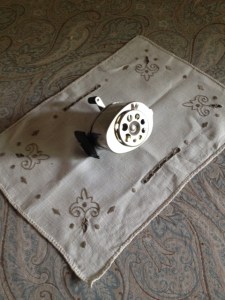
In 2002 my boyfriend and I bought a house together and shortly after that we got married. Sometime soon after that, he bought a pencil sharpener. He bought, in fact, this very pencil sharpener. It is the kind of pencil sharpener that many of us had in our households when we were little kids. Our responsible parents installedPencil Sharpener them in sensible locations: in the doorway near the kitchen closet, in the basement near the workbench, and so on. They installed pencil sharpeners so that everyone in the household would know what to do when a pencil got dull and needed to be sharpened. You would go to the pencil sharpener — which was not too high up on the wall, but placed in such a way that both adults and school-age children could use it — and sharpen your pencil. It wasn’t a big deal, really, but it was definitely fun. Everyone knows that pencil sharpeners are fun. And then there’s the pleasure of using a freshly sharpened pencil.

My husband and I are both fans of pencils, freshly-sharpened pencils in particular, and we have strong feelings about what types of pencils are best. We’re kind of snobs about it, in my opinion — perhaps my husband would protest and say, “I’m not a snob about pencils!” but let me tell you: anyone who mail orders boxes of pencils so that they only have the kind of pencil they like best is definitely a snob about pencils — and part of that is caring about how the pencil is sharpened. We agree that for on-the-go sharpening, the small metal jobs you get at art supply stores are necessary (and I keep one in my wallet). We agree that the plastic ones you find at drug stores and the like are inevitably mediocre; supermarket ones with the little plastic enclosures that catch the shavings are useless. You’re better off just having the naked metal sharpener and holding it over the wastebasket when you’re using it.

So we were both very pleased with ourselves when we got this pencil sharpener. The problem was, we could never figure out where to install it. So we lived in that house for a decade — ten years, folks — and never installed it anywhere. It lived on a shelf in the pantry for that whole time, unused. Much loved, mind you, but unused.

When we moved house in 2011, I carefully packed everything on those pantry shelves. Tiny glass bottles that got dug out of the backyard during the misguided attempts at gardening; strange salt and pepper shakers that were given to us as wedding gifts; a jar of silver polish; a can of Nevr-Dull, which is terrifying stuff but really, really effective for cleaning metal; the iron that my husband acquired at the Hadassah in Boston; the pencil sharpener. These items, and more, were packed into a large Rubbermaid bin and hauled over to the new apartment, and because we no longer had a pantry, and we no longer had shelves on which to store these items, they’ve stayed in the Rubbermaid bin for five years now. I’ve had occasion to take out the can of Nevr-Dull (we got a copper coffee table and decided to polish it, which is a whole other story), but the rest of the stuff’s just been sitting there all this time.

But a few days ago, readers will recall, I had occasion to pull out the iron, which now, by the way, lives in a bucket near the washing machine. And in pulling out the iron, I stumbled on the pencil sharpener, which is a thing we’ve all been thinking about a lot because our daughter is now at an age where she does a lot of homework and can sharpen her own pencils. For three years she’s been doing homework and in all those years we’ve been relying on the pencil sharpener I carry in my wallet. It’s fine; my wallet is usually handy. But frankly, it’s also annoying that every time my daughter does homework, I have to reach for my wallet. “We should really install that pencil sharpener,” I’ve said to my husband probably once a month for the last two years. “Yeah,” he’s said. “I’d install if if I knew where it was.” “It’s in a box in the basement,” I’d always say helpfully. There the conversation would end, because, of course, while he could go to the basement and look for the pencil sharpener in the Rubbermaid bin, this is really my domain, and he doesn’t encroach on my Personal Space that way.

However, when I saw the sharpener sitting there next to the iron, I seized the moment and cannily took both useful items upstairs, out of the basement. That evening I said to my husband, “I found the pencil sharpener, we should figure out a place to install it.”
“Cool,” he said. “Yeah, we should think of a place.”

The pencil sharpener, in all its well-built glory, has been sitting on the kitchen table uselessly for about a week now. I’m taking bets on how long it will sit there. And I’m trying to think of a good place to install it. We have no kitchen closet. There is no workbench in the basement. So far, it’s looking like the only practical option is rather unappealing aesthetically: on the kitchen wall above the garbage can. Which is also next to the toaster, and the countertop where we do most of our kitchen prep work. It’s not a great location for a pencil sharpener, but it’s the one place that makes sense.

Probably when the sharpener gets installed we should do two things: one, pour ourselves a couple of drinks to recover from the shock, and two, have a giant party to celebrate. Anything that’s taken that long to achieve — we’re talking 15 years now — is worth celebrating.

Ironing: The Serious Version

Having re-built a small ironing board suitable for ironing hankies and napkins, as I did a few days ago, is all well and good. I find, however, that my ironing needs are, sadly, still not met on the home front.  The fact is, sometimes one needs to iron big things like tablecloths. Or, at any rate, I do. The problem became, um, pressing, because I recently had occasion to use a number of very high quality antique tablecloths from my collection, and was advised strongly by a woman who deals in antique textiles that to send these to a dry cleaner’s would not only be hideously expensive but also be a pretty sure-fire way to guarantee that I’d soon be the owner of a number of trashed antique tablecloths. Pricing out what it would cost to dry-clean these items, I realized that even if I could be assured the pieces would be returned to me intact, I’d be paying more than $100, and probably more like $250, to have these things cleaned. Which is ridiculous. Turns out that a lot of places calculate the cost of cleaning tablecloths by the square inch — so the bigger the cloth, the more they nail you to the wall, because, of course, the reason you’re looking into having these things dry cleaned in the first place is because you can’t deal with it yourself…. they know they’ve got you.

“Okay,” I said to her, “so what should I do? I want to use these things and have them not look like utter crap.”

“You bring them to the store when you’ve used them and we’ll wash them and then you can use the rotary iron to iron them,” she said.

I thought she was kidding, but she wasn’t, and so this week I brought a bag of tablecloths to the English Building Market and we laundered them and then she showed me how to use her rotary iron. It is a Miele iron, not unlike this, and it is a beast. Now, I went and read the Amazon reviews of the Miele rotary iron I linked to and someone observed “The Miele doesn’t do a bad job at all; in fact, if I’d never seen an ironing machine before, I’d have been quite impressed.” Count me in the “quite impressed” category. It took me about half an hour to get the hang of using it comfortably, but once I got it, it was pretty easy — I mean, given that I was doing these tablecloths with all kinds of cut work and scalloping and complicated things that made the job difficult. If I had been working with easy things, like linen dishtowels or cotton hankies? This would have been beyond awesome. Carol told me that she finds it relaxing to just sit and take care of things that have to get ready for the store; she’ll sit down with her basket of napery and a glass of wine (white, I assume) and just plow through the stuff. I can totally believe it. I’m jealous of her, in fact.

An interesting thing about reading reviews of the Miele rotary irons online is the realization that even in this day and age, there are people who really want their clothes, their napkins, and their bedsheets just so. I mean, I thought it was just me and Carol, but no, there are other lunatics like us out there. This fascinated me because as best I can tell, none of my friends will even admit to owning and iron, let alone using it. And the idea of wanting to use a rotary iron is a mockable offense, not something people would nod about understandingly.

Obviously, Carol uses the Miele for her work — she is, after all, a seller of vintage linens — but there’s no question in my mind that there are people who would use this thing and get their money’s worth out of it in their homes. I mean, people besides myself. They’d be crackpots, yes, and possibly people would mock them at cocktail parties. But they’d feel they’d made a wise investment in the Miele iron, and they’d have gorgeous hankies, to boot.

As we washed the dinner dishes last night, I remarked to my husband, “If I had a few thousand dollars lying around and could justify spending the money, I would totally buy one of these things.”

“Really?” he said, surprised. “That’s what you’d spend money on?”

Even I was kind of surprised. I don’t know what to say, except, I have a crush on the Miele rotary iron. So maybe when I win the lottery, I will not only have a regular-size ironing board built into the wall near the washing machine in my apartment, but I will also have the builder carve a small closet into the wall where I can store the Miele rotary iron, so I can pull it out to use whenever the mood strikes me. As I sit here typing this, I’m actually looking thoughtfully at the closet across the room from me, wondering, “Could we bust through the wall right there, and….”

but I don’t have time to finish this thought. There are three loads of laundry —  none of which require ironing — waiting for me to fold them and put them away.

Blog at WordPress.com.

Up ↑