One Night of Making It Up As I Went Along

The other day was a snow day. Schools were closed and I had to spend a lot of  time getting things done despite also having to keep my daughter entertained, or at least keep her from either braining herself while playing and see her through to the end of the day. The weather was sufficiently unpleasant that I carved my list of errands to a bare minimum and once we were home at noon I said, “OK, that’s it, we’re not leaving the house again today.”
One challenge was dinner. Well, to be honest, lunch was a bit of a challenge: neither of us ever ate a proper lunch. We got home and grazed our way through the day. A few grapes, some peanut butter on toast, some pistachios. It wasn’t really so great. I knew I had to come up with a better plan for dinner. While I’d gone to the store and bought milk and eggs and a head of lettuce, I hadn’t bought anything obviously delicious for dinner, like a chicken. I had this vague faith that I could make us dinner without spending any money on new ingredients.
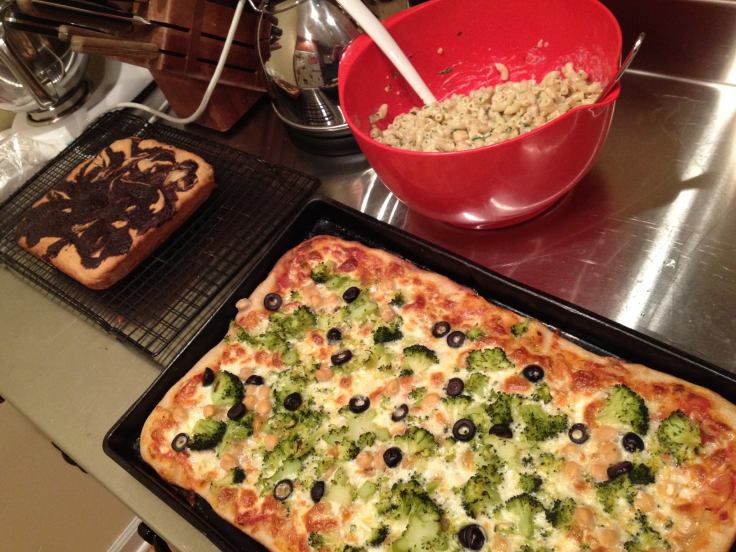
Once home I opened the fridge and thought. There was, I knew, a Ziploc bag in the freezer that had enough dough for one pizza. If I thawed that out and figured out some toppings, that would be half the battle there. A tub of leftover red sauce from Sunday night, when I made stuffed shells? Excellent. A few ounces of mozzarella that miraculously hasn’t yet gone moldy? Great. Leftover boiled broccoli? Fabulous. I had a can of black olives and a can of chickpeas.
“OK,” I said to my daughter. “We’re going to have a broccoli, olive, and chickpea pizza, and a chickpea and macaroni salad on the side.”
“YUM!” said my daughter of infinite faith.

So dinner was thus assembled: the pizza looked great. I made up a pasta salad by taking a spoonful of pickle relish, some parsley, and some capers, and mixing them up with mayonnaise. I boiled the half pound of elbow macaroni that was sitting in a jar in the pasta cabinet (yes, I have a pasta cabinet), drained a can of chick peas, and put that all together. It smelled pretty good, even if it didn’t look particularly attractive.

I had baked, during the afternoon, a pan of what I thought would be peanut butter/chocolate marbled brownies (this done because I wanted to bake something with peanut butter, but I also wanted to use up some of the leftover chocolate babka filling that’s been taking up space in the fridge a few weeks). The pan of brownies looked great, though when we cut into it we could see that it looked more cake-like than brownie-like. My husband wasn’t too impressed. “Too dry,” he said. “It’s like a cake,” I said sadly. “But it’s ok. I’ll fix the next batch.”
Because a peanut butter/chocolate anything isn’t going to go wanting for consumers, I’m not feeling too bad about this particular flop. Our daughter thinks it’s wonderful, and she can I could easily eat the whole pan up within two days.
So the moral of the story is, once again, if you give your leftovers in the fridge some thought, or even a negligible amount of thought, you too can wind up with a meal that looks like this: Dinner Feb 8 2016


The Terrifying, Death-Defying Feat of Making Chicken Soup

On a date in January I will not name, I roasted a chicken for dinner. No big whoop. Came out fine. We consumed roughly half of the chicken that night, and put the rest of it, still on the bone, in a Ziploc bag, and put that in the fridge. I had this idea we’d make chicken sandwiches for lunch the next day, and then I’d use the carcass to make stock.

Not sure what happened the next day, but we didn’t make the sandwiches, and the chicken stayed in that Ziploc bag for a bit longer than I intended. Partly out of my own apathy, and partly because we got sidetracked by a vast quantity of beef shanks that overtook the fridge for a few days. It’s my fault. But after ten days, I noticed the bag of chicken and I thought, “Ok, I’ve really got to do something with that. On the other hand, it’s been ten days. Is this bird viable?”

So I opened the bag and gave it a good sniff. Everything smelled fine. I took a piece of white meat off the bird and tasted it. Tasted fine. I took the bird from the bag and began to separate off the nice meat that would look pretty in a soup. It didn’t have that slimy feel that bad meat has; everything seemed dandy. But I was worried. Was I about to unwittingly create a nice, big pot of hot poison, which I would then serve to my family as chicken soup?

To assuage my fears, I sent a message to a friend of mine who’s a former professional cook-turned-nurse. “Hey,” I said. “If, like, three days go by, and you don’t see any posts from me on Facebook, it’s cause I’m dead ’cause I made chicken soup out of a chicken that was too old.” She wrote back, “What’s going on?” I explained the situation — ten day old roasted chicken, plans to make stock — and asked, “is this just,  categorically, a bad idea?” She wrote, “it’s probably going to be fine, I’d do it myself, but probably you shouldn’t do it. But go ahead.”

Maybe my mother should stop reading here. Or just skip to the last paragraph.

So I made stock. I boiled the carcass, hard, for just over ten minutes. It was in the pot with two heads of celery (see previous entry on Celery Problems, which were solved in part by putting a whole lot of celery into the freezer) and some onion and peppercorns and a lot of parsley stems and some mushroom stems…. the vegetable parings and old bits that I always bag up and throw in the freezer to use when I’m making stock. The leftover half baked potato in the fridge, that went into the pot too. I brought all of this to a vicious boil and then simmered it for a couple of hours and when it was cool enough to me to get near the pot, I dealt with it. The pile of dead veggies and bones went into the trash, and the remaining liquid was decanted into bowls and jars to cool in the fridge. I tasted it, before I put everything away, and it was fine. “All right!” I thought.

But come five o’clock last night, when it was time for me to really start making the soup, I worried. Was I really about to give everyone food poisoning? I tasted the white meat I had reserved from the morning. No, it was fine. So I filled a pot with the chicken broth, and began to slice and dice fresh things to add to the pot. One huge carrot, peeled and chopped finely; one half a red onion, peeled and chopped finely; half a bunch of parsley, well-rinsed and minced; and one leftover roast chicken breast, chopped. To be on the safe side, I brought the pot to a hard boil again, and cooked the hell out of the meat, but then I just let it simmer gently until my husband came home from work. Then I added some leftover rice (from the night before; don’t worry, it wasn’t ancient rice). Our daughter, sitting on the couch, crooned to herself “soup smells goooooooooood” while she read her Calvin & Hobbes book, and my husband said grimly, “Soup for dinner?” “And bread, too,” I said. “I bought some nice bread.”

I took a block of cream cheese out of the fridge to let it come to room temperature before dinnertime. At seven o’clock we all sat down to eat, and we consumed that entire pot of soup. There was nothing leftover. The entire loaf of bread was gone, too. I seldom don’t make enough food for dinner, but last night was one of those rare occasions; having finished everything on the table, my husband was reduced to digging around in the cabinet for something else to eat. He eventually found a bag of potato chips and polished those off.

I then spent the rest of the evening wondering, “So, is anyone going to throw up?” But no one did. And we all woke up this morning feeling fine. No one got food poisoning. But at the same time: I think I’m going to not let myself play so fast and loose with the chicken carcasses from now on. There’s a difference between being thrifty and being dangerously stupid. I walked that fine line this week, and I’m not proud of it, but I learned my lesson. From now on, my motto will be: get the meat off the bone and freeze the bones. Or else.

The End of the I Hate to Housekeep Book: On Hosting Parties


IMG_5489

In my years as a mother, I have frequently turned to the I Hate to Cook Book when seeking reassurance in regard to birthday parties for small children. There are a lot of good tips and ideas in there. Not hacks, people: tips and ideas. And this chapter, Chapter 12, the final chapter of the housekeeping book, is to some degree a grownups-only rehash of a lot of the ideas in Bracken’s cookbook. She says this herself; she knows that her fans will recognize cleverness no matter how many different times it is rephrased. She knows that we know about her Hootenholler Whiskey Cake, we know about faking our way through a chicken curry dinner, we know about serving Irish Coffee for dessert. (I never DO serve Irish Coffee for dessert, but I know that in a pinch, I can do it. I mean, if I’m suddenly not in the mood to make a pear cake out of three slowly rotting pears I happen to have on the counter.)

But this chapter, in the I Hate to Housekeep Book, is important in a way that I find is seldom addressed in your Real Simple magazine articles about Getting Ready for Your Homemade Sushi Hoedown, or your Superbowl Sunday Soiree, or whatever kind of party you find yourself in the position of hosting at your house. Everyone knows that you don’t want to serve your guests a meal at a table that’s still covered with sticky spots from the time your wee angel spilled grape juice, and everyone knows that it’s sort of preferable to have the bathroom in decent shape (i.e., it shouldn’t look like you just bathed the dog in there). I like to think that, as civilized people, we keep our toilets reasonably clean, our sinks reasonably clean, and so on.

It is pleasing to have the place where the food is being presented be, well, presentable. If it’s your dining table, either wipe the sticky crud away or cover it with a tablecloth. If you’re like me, you use the kitchen counter as a staging area. We have a very long kitchen counter which serves as the “buffet” when we have parties, and I like to have that counter be a) cleared of clutter and b) wiped clean before I put platters of food out. Because it’s depressing to serve food off a dusty counter which is also home to the stacks of unpaid bills and overdue library books. Unpaid bills and library books are put into a grocery bag and shoved into a closet until the party’s over, and then it comes back out and is put back on the counter, where the stuff sits until I deal with it or until my husband gets so annoyed at my not dealing with it that he deals with it, whichever comes first.

Where Bracken really makes herself valuable is in pointing out the stuff that you’re likely to forget about. One forgettable housecleaning task that she emphasizes — by putting  the whole paragraph in italics — is this: WIPE DOWN YOUR TELEPHONE BEFORE THE PARTY.

I know, you’re going, “huh?” Because some astonishing percentage of people no longer have landlines anymore. Wipe down the phone? Why would you clean your phone before a party? Well, I’ll tell you: there are still, in the 21st century, in the days of cell phones, still good reasons for you to clean your telephone before having company over. Because, even though folks have cell phones, someone might need to use your landline anyhow. Maybe their phone battery dies, and they want to call a taxi. Maybe their cell phone battery dies, and they need to call the babysitter to say they’ll be running late. These reasons, which were reasonable in Bracken’s day, remain reasonable now, and it doesn’t matter whether or not you have a cell phone: the fact is, you should still keep your landline phones clean. Because they look disgusting after a while. Spit and grease and dust and crud accumulates on telephones like you wouldn’t believe.

“But my friends would just charge their phones or borrow someone else’s cell phone,” you say.  All well and good. But you know what? It is my own experience — and maybe this is just because we not only have a landline, but we have an interesting collection of old telephones here, and grownups and children both enjoy playing with them — that it is good to keep the phones cleaned, because even if they don’t need to use a phone, strictly speaking, people seem to find it fun to pick up a phone and pretend to talk into it. Which means it’s worth it to not have it be disgusting. So take a cloth you’ve dampened with a little rubbing alcohol, for god’s sake, and just wipe down the phone. Handset, dial, side, the little bits where the handset rests. Just wipe it down. Then look at the cloth, and see the schmutz on it? You can thank me later.

Bracken’s explanation of why you should clean the phone is also where we find one of my favorite bits in this entire book: “You know how often the telephone is used at a party — to check babysitters or call taxis or — depending on how good the party is — to say Hiya Booper Ole Socks to somebody’s old college chum in Akron, Ohio.”

Having recently re-read this paragraph, I’ve begun to address our cat by saying, “Hiya Booper Ole Socks.” He doesn’t react to this at all, but my daughter finds it uproariously funny.

The thing about the phone, though, reminds me of a point I’d like to make, all on my own, which I don’t think Bracken mentions anywhere, but maybe she does and I just don’t remember, which is this: while you’re busy wiping down the phones, you might want to give a swipe at things like the light switches and light switch plates in the house, and the doorknobs, and the bits of door right around the doorknobs in your house. Because those are things that get astonishingly disgusting while you’re busy leading your life. And no, you don’t think about it, precisely because you’re living your life, and what’s more, it’s YOUR filth, so you don’t really care. I get that. I would feel the same way, more or less. But when you’ve got people coming over — and maybe one or two of the guests are people who might someday be instrumental in your getting a new job, or helping you get your kid into college, or something, or, you know, maybe you just LIKE THEM AS PEOPLE AND WANT TO KNOW THEM AND BE FRIENDS WITH THEM, without any ULTERIOR MOTIVE (it could happen) — as I say, when you’ve got people coming over, it’s kind of nice to not have the people get skeeved out when they go to turn on the bathroom light.

I want to add: you don’t have to do this kind of fine-tuning to the entire house, at least, I don’t insist on it. But I will say that if the place you live in is anything like mine — say, there’s a first floor where people tend to congregate, and hardly anyone except small children (who are walking filth anyhow) will go upstairs — you want the living room, the dining room, and the guest bathroom (or the one bathroom, if you have only one) to be presentable. You want the phones in the public spaces to be not-disgusting-to-behold. It doesn’t matter if the floors are filthy, because the evening’s event will only make them filthier. You might vacuum the rug beforehand if you think people will be sitting on the carpet, but other than that, why bother? There’s no point in having your house be utterly spotless right before a party. But yes, there are certain things that should be as clean as possible. Fortunately, this isn’t hard, and it requires no fancy cleaning supplies (as we’ve already learned, almost nothing really does, no matter what Mad Ave tells you), and you, too, can host a humdinger of a party without breaking a sweat. You might break maybe a glass or two, but that happens. (And when you do, I think you can get up shards of glass by pressing slices of soft bread onto the floor, or something like that. I forget.)

 

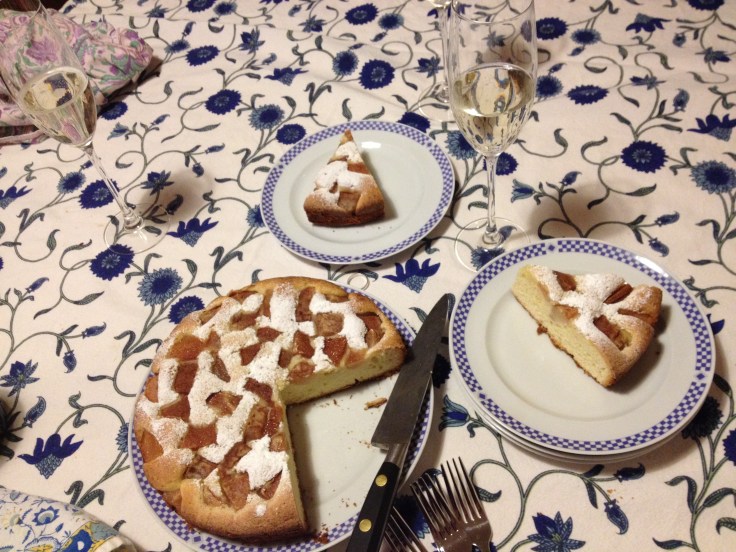
Better-Than-Mimi’s Pear Cake

IMG_6124

Last week I bought three pears because they smelled really good and it seemed like a good idea. I figured I could slice them up and give them to my daughter for her afternoon snacks. It turned out this was an error on my part: she would not eat the sliced pear, and the whole enterprise began to look like a bust. Saturday, it snowed like crazy, and I noticed the sad sliced pear in a little plastic tub in the fridge, and the two starting-to-look sad pears on the counter, and I thought, “I will bake a pear cake.”
Somewhere I have a recipe for a chocolate pear cake, which I know I’ve made and liked, but I couldn’t remember where it was, so I decided to be lazy and just do a Google search for a pear cake recipe that sounded plausible. The first thing I landed on was a recipe from a blog that I guess All Food People already follow, by a woman named Mimi Thorisson. Ms. Thorisson’s blog, Manger, is very elegant, just like her, and as my friend Bakerina put it, “She’s like the perfect goddess in Laurie Colwin’s chapter on Kitchen Horrors.” To use a phrase my husband employs now and then, She is the opposite of us.
But the cake recipe looked decent. So I made it, with one major alteration to the ingredients, and one total overhaul regarding cooking time, because it appears that Ms. Thorisson’s oven is some kind of magical French oven that will bake cakes in literally half the time an American oven will take to achieve the same end.

Ms. Thorisson’s recipe calls for:
3 ‘very’ ripe pears – peeled & cut into chunks
150 g/ 1 & 1/4 cup plain flour, sifted
150 g/ 3/4 cup caster sugar
1 tsp baking powder
30 g/ 1/4 cup corn flour (corn starch)
1 pinch salt
90 g/ 1/3 cup + 1 tbsp butter (slightly melted)
3 eggs
Icing sugar (to sprinkle/ decorate on cake)

The technique is simple. In a mixer, you combine the eggs and the sugar and whip them until they’re light. In a separate bowl, you’ve whisked together the other dry ingredients (flour, baking powder, cornstarch). In a small bowl, you’ve nuked your butter so that it’s just starting to melt. You add the flour mixture to the eggs, whip it to combine, and then add the butter last. It’s a little backwards seeming, compared to other cakes (where you’d normally cream the butter and sugar together and then add the eggs and then add the flour last) but whatever; it works fine. I had a feeling this cake would be too plain as is, and so I added to the flour bowl about a teaspoon of vanilla powder; I am very glad I did, because the cake wouldn’t have tasted like much without it.
Once you have your batter set up, you scrape it into a prepared cake pan (a 9″ cake pan buttered lightly and lined with a round of parchment) and lay atop the batter chunks of very soft fresh pear. (I would not recommend using canned pear with this.) Ms. Thorisson advises us to bake the cake for 30 minutes at 350 degrees; at the 30-minute mark, I decided Ms. Thorisson is on drugs, because the cake was nowhere near done. In the end, I baked the cake for just over an hour — maybe an hour and seven minutes. This is a pretty significant difference, and I don’t know how it never gets noted at Manger. (It is mentioned in one of the comments, but Ms. Thorisson hasn’t altered her instructions at all, which is not great.)
The cake that results – if you add the vanilla and bake for the proper length of time — is delicious. It is not very fancy looking, the way I made it; it could look fancier, if you made the effort to place the pears more delicately. It does get dressed up significantly if you sprinkle some powdered sugar on top of the cake, as she suggests. In fact, when I served the cake to a dinner guest, he assumed it was a store-bought cake, and was astonished that I’d made it myself.
My husband made whipped cream to serve with the cake, and this was very nice indeed; after the fact, we realized that it would have been a nice touch to whip a teaspoon or so of pear eau-de-vie in with the cream. Not enough to flavor it heavily, mind you, just enough to give the cream a touch of perfume. My daughter, who, we’ve learned, is no fan of pears, announced as she ate the cake that I had taken her least favorite fruit (who knew?) and “transformed” it into one of her top five fruits. So this was worth doing.
But bake the cake for an hour, people.
If you want to see the original recipe, and comments, please go here: http://mimithorisson.com/2012/04/24/italian-pear-cake/

or ignore the link, and know that I’ve given you everything you need to know, minus feeling guilty that you are not as perfect as Mimi Thorisson.

“Eye makeup always shows that you’re trying hard.”

The illustration that heads this chapter of Peg Bracken’s I Hate to Housekeep Book is one of my favorites. It captures so perfectly how so many women I know feel about their lives. They are one thing in their heads, they are another thing in terms of their activities, and their kids see some fraction of each of these things and are pretty much terrorized by the whole shebang. I am lucky in that my kid somehow grasps that I look like one or another thing, from day to day (or more than one thing, depending on what I’m wearing) and yet remain the same person, [Redacted], all the time.

IMG_5488

I am pretty sure that part of why my daughter knows who I am so clearly is that I apparently look pretty much the same no matter what’s going on, or 99% of the time, anyhow. I have clothes — I have a lot of clothes, actually — and while some are more dressy-uppy than others, the fact is, I always look like myself, recognizably so, every day. I have relatively few modes of attire, perhaps because I do not ever go to a gym.

A friend of mine pointed out a couple years ago that I do a good job of maintaining the look that The Preppy Handbook described as “punk prep.” This is, sadly, more or less accurate. Sometimes the punk dominates slightly over the prep; sometimes the prep dominates ever so slightly. But overall, the effect is that I am recognizable as [Redacted] no matter what’s going on. The black wrap dress I wear to fancy dinners out is the same black wrap dress I wear on Mondays when the weather is nice: in each case, I accessorize it with a pair of cowboy boots. I tend to not wear the clunkier combat boots when attending a more formal event… but you never know, because with the right coat, it might look great. Details may change — earrings, lipstick. But it’s totally normal for me to take my daughter to school in the morning and have someone remark, “Don’t you look fancy! Do you have a meeting today?” and for my response to be, “No, I’ll just be going home and cleaning the bathrooms and doing laundry; it’s Monday.”

I have some rules about what I wear, and while they are flexible in some ways, they are highly inflexible in others. It comes down to this: everything I wear has to fit at least one, and preferably more than one, of my aesthetic standards. I am not interested in fashion, per se; I am interested in projecting a certain persona, and in being comfortable. If an article of clothing does not fit my sense of who I am, it doesn’t enter my closet; similarly, if it reflects the person I’d most want to be, but is hideously uncomfortable, it will not enter my closet. Furthermore, I seldom wear sneakers in public, but when I do, I will not wear sneakers that might be worn during actual athletic enterprise.
But the system I live by would not work for Peg Bracken, at least not in the time when she was writing this book. This chapter is filled with advice that strikes me as having been fundamentally sound but that was designed for a world that doesn’t exist anymore. Or, at least, it doesn’t exist where I live. She worries for her readers about what to do with clothes that are out of fashion; she has advice about how to learn to set your own hair — this is from an era when it was normal for women to go get their hair done once a week. Maybe someone still does that, but no one I know personally. She recommends having wigs because they’re a practical solution to hair problems. Maybe they are; I don’t know. (Neither she or I are talking about wigs to be worn by people going through chemotherapy; that’s an entirely different matter. Bracken’s wig advice is for the average woman who just feels her hair doesn’t look perfect. As Johnny Slash would say: Totally different head.)

In today’s world, peoples’ (women’s) ideas about How They Must Look are so varied and faceted that Bracken’s advice tends to just confound rather than encourage. We live in a sloppy era, for one thing. For another, these days women can wear all kinds of things in public that Bracken, at the time she was writing, couldn’t have imagined would be worn by respectable people, in public, ever. I don’t just mean t-shirts that say crass things. I mean, these days, a woman can walk down the street wearing blue jeans and a pair of work boots and a leather motorcycle jacket, and be regarded as actually well-dressed. This couldn’t possibly have been the case for Peg Bracken. That woman would have been regarded as a whole lot of interesting things, but well-dressed would definitely not have been one of them. We have options that simply didn’t exist a few decades ago.

BUT: There are elements of this chapter that could definitely be reassuring to the sort of woman who doesn’t particularly like thinking about clothes, or makeup, or hair, but at the same time doesn’t want to embarrass herself horribly every time she leaves the house. The paragraphs that open this chapter — the first few pages, really — are very kind and gentle for that sort of person. It’s a better-humored version of one of those books or TV shows that advise you what you should or shouldn’t wear because you’ll look stupid or fat or old or some other bad thing. Bracken’s nicer about the whole enterprise, though, because she knows her audience is probably very easily cowed. She points out to her  readers that if you’re someone who cares about clothes and how you look, you don’t need her advice: you already know what you’re about, what you want to wear, and how to do it effectively and economically. If you’re someone who doesn’t care at all, then you don’t care, and good on you. Bracken explains the truth: It’s the woman in the middle, who cares maybe a little most of the time, but who, when facing dire circumstances, will suddenly care a lot, and then be doomed to misery because she doesn’t know how to handle the situation. She’s very calm and reassuring to that in-the-middle woman. In fact, she has moments of being downright au courant, such as right here, when, having spent a few paragraphs advising her readers on how to select clothes that will make them appear slimmer, she then becomes a fat activist:

“You see, we continue to bump into a philosophic point: perhaps looking skinny isn’t the be-all and end-all. Which brings us right up to the matter of whom you’re dressing for — yourself or your audience.”

You might be dressing for both. But the odds are pretty good that if you are, you’re one of those people who cares about clothes in the first place, in which case, you’re fine, you didn’t have anything to worry about in the first place, and you can enjoy reading this chapter just for the fun of Bracken’s writing, which is as light and effective as ever.

Now I’m kind of wondering, If Peg Bracken saw me walking down the street, what would she make of my clothes? Today I’m wearing narrow jeans, a shetland wool sweater with a crew neck, and a pair of cowboy boots. Basically I look like Fran Lebowitz, ca. 1978. This is just fine with me, and if that’s not good enough, then tough.

(I bet Peg Bracken and Fran Lebowitz would have gotten a real hoot out of each other. I bet Fran Lebowitz knows the I Hate to Cook Book backwards and forwards.)

Laundry Competence: or, This Time it was My Fault

I’m not going to say which member of our family has a tendency to leave little paper-wrapped bits of ABC chewing gum in their pockets, but I will say that more than once I’ve had the unhappy experience of laundering things with such items left in the pockets, and it would be fair to say that no one benefits from this process.

As such, I’ve gotten pretty good at making sure pockets are empty before be-pocketed articles of clothing go into the washing machine.

But this weekend, I missed something. And when the laundry emerged from the dryer, I noticed these odd little cinnamon-red smudges all over the laundry. I thought, “What the hell?” For one thing, how had I managed to put these smudged items into the dryer before I noticed the smudges? But more importantly: what had made these marks?
It was after I dumped all the ostensibly clean, and actually dry, laundry onto the hallway floor that I found the culprit: a now-empty tube of Burt’s Bees Tinted Lip Balm. In other words, the fault was mine. What I think is that the lip balm was in a pocket (or, possibly, it got knocked off the top of the dryer into the washing machine, when I was putting the laundry in), and that it made it through the washing process all right, but that in the dryer, it melted and oozed through the seam at the cap and got all over everything. Because the cap was still on, you see. But the tube of lip balm was shockingly empty.

I laundered that load of laundry two more times, with massive doses of Oxy-Clean. One undershirt is still marred, as is a vintage Peanuts bed sheet I’d given a household member as a gift. The new white washcloth I’d had in that load is stained a nice, even pink (but the pink is fading, I noticed today, when I laundered it a fourth time). Why it was even in a load of dark laundry is beyond me, but these things happen. That, I’m taking philosophically.
But the fact that I let this happen annoys me even two days later. When I discovered the problem, I swore so loudly that my daughter went downstairs, where my family was getting ready to go out together on a little errand, and she said to them in a low voice, “You better just go out to the car; Mama’s about to get really angry. Trust me, I know.” (This was reported to me, later, by my husband, who was amused by her skill at reading her mother’s moods.) I’ve apologized to my husband for pock-marking one of his undershirts, but added that because I’m fairly good about separating the lights from the darks, the worst-possible scenario did not come to pass. This would be the scenario in which all of our white towels, white undershirts, white kitchen linens, and white bedding is all smudged with Burt’s Bees Red Dahlia Lip Balm, a product I fully endorse, though I don’t recommend running it through the laundry.

I did two more loads of laundry today (the aftermath of having family visit from out of town) and there were no disasters. Tomorrow, I’ll buy another lip balm, and this time I will make sure it never goes in a pocket or on top of the dryer.

Kitchen Competence: The Update

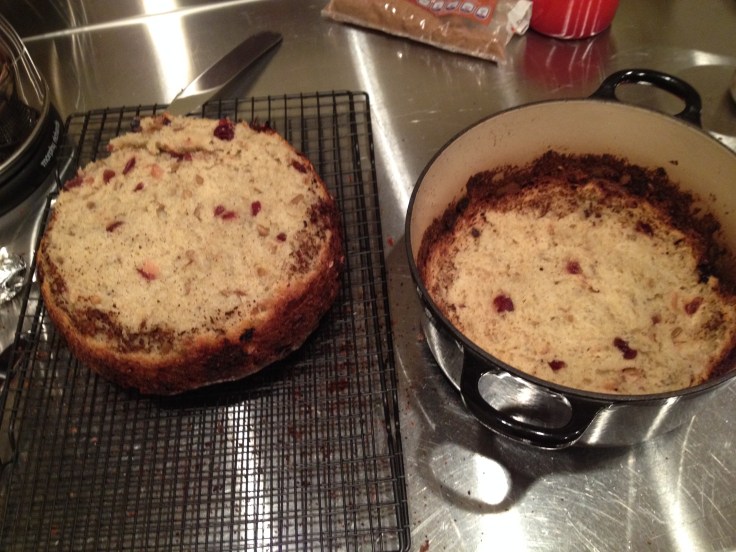
This is the result.
IMG_6149

Last night I took care of the last steps to prepare this dough to bake. I kneaded it one last time — very sticky stuff, I had to use a dishrag to get my hands clean — and I set the dough into a pot to rise overnight in the fridge, as per the King Arthur Flour directions for their No-Knead Harvest Bread, which was one of the recipes I was taking as a model. This morning, when I went to make the coffee, I took the pot out of the fridge and set it on the counter to come up to room temperature (or closer to). When I was back home after taking my daughter to school, I did as King Arthur said: I put the pot, covered, in a cold oven, turned the oven to 450 degrees, and baked it for 45 minutes, after which point I took off the lid. I baked until it registered 205 on a thermometer (actually, it said 206°) and then I tried to get it out of the pot.

Well, here, we ran into trouble. This thing did not want to leave its house. It was a like taking a cat to the vet. “I know what’s happening next, and I don’t like it, and I’m staying here.” In the end I had to take a plastic knife and shove it all around the edge of the bread to separate it from the pot, and when I turned the pot over to shake out the bread, it came out, but, as you can see, it left the bottom crust of the bread behind in the pot.

So this isn’t a complete success. It’s not a very handsome product. However, it occurred to me immediately that this bread would make a fabulous stuffing, and so if we don’t want to eat a mangled, ugly loaf of cranberry-sunflower seed bread, we will happily consume it alongside a roasted chicken.

I’m now eating a slice of this bread with some butter. It’s pretty good. I think the solution to baking this is one of two things: 1. line the bottom of the baking pot with parchment paper, don’t just rely on the pot being greased to do the trick; or, two, bake it as a messily-shaped loaf on a big cooky sheet, again with parchment underneath it. Because I can already tell this is worth making again, even if I messed it up this time.

Kitchen competence: a process

For several years now I’ve regarded myself as basically competent in the kitchen. Not at a professional level, to be sure, but a respectably decent home cook. I’m not going to ever make Beef Wellington (to my husband’s chronic disappointment) but nor am I fazed by making a four-layer coconut cake; I have a spice rack sufficiently well stocked that I can, if I want to, lend people some star anise or a half cup of chili powder at the drop of a hat. Had you asked me, at age 25, “Will you ever be that kind of person?” I would have laughed uncontrollably, but look, here we are.

Last night I had a moment of realization along these lines: I can, if I want to, probably make pretty much anything that I buy in a store. Case in point: a loaf of cranberry-pecan bread.

I made chicken soup for dinner last night. This is a story for another time, and one that maybe my mother shouldn’t read, because it will upset her too much, but anyhow: I made chicken soup for dinner, and because soup and nothing else for dinner is a sad and wretched state of affairs, and because I was too lazy to make cornbread or biscuits to go with the soup, I went to Romeo’s (the Italian grocery store nearby) and bought a loaf of cranberry-pecan bread. This bread is made by a local company called Chabaso. I used to work for the owner of Chabaso, who also owns a bookstore/cafe in town called Atticus. When you work at Atticus, you get a free meal for each shift you work (or you used to, anyhow; I assume it’s still true), and as a result you get to be very familiar with the Chabaso bread offerings. You become so familiar with them, in fact, that you never want to eat them again. But the bread was pretty good. I was fond of the plain ciabatta loaves (which have gone downhill since the days when I worked in the bookstore, I’m sorry to say — they seem to’ve changed their recipe or something) and of the cranberry-pecan bread.

I always regarded the cranberry-pecan loaf as a really impressive loaf of bread. It was always delicious, and it had things in it that I wouldn’t normally like (such as cranberries; I’m domestically famous for my dislike of cranberries) but somehow it was a perfect bread for so many different kinds of sandwiches. I made turkey and cream cheese sandwiches; avocado sandwiches; tomato and roast beef sandwiches. But it would never have occurred to me that I could bake a loaf of it myself.

Last night, however, as we polished off the loaf of bread, I decided to have a gander at the brown paper wrapper the bread came in and see what the bread was really made of. I read the list of ingredients, which you can find here http://chabaso.com/breads/loaves/cranberry-pecan-loaf

and I realized that I had, in fact, sitting there in my kitchen almost everything I’d need to bake a loaf of this bread myself. And since a loaf of this bread costs close to five dollars, it seemed to me that it’d be worth investigating. So this morning I took out my jar of yeast and I read the list of ingredients again and I went online and read a few recipes for cranberry-pecan breads, thinking, “I can approximate this.” The fact that I have no pecans in the house is not a problem; I will toss in a few sunflower seeds to add the nutty quality.

I’ve combined yeast, salt, honey, water, and three different grains (barley flour, unbleached white flour, and fine-ground cornmeal) and made a sticky dough with them. Because I’ve used barley flour and cornmeal, I’ve put in considerably more water than the recipes I found called for — cornmeal, in particular, is thirsty stuff. I’m going to let this rise for a very long time. When it’s risen to my satisfaction, I’m going to knock it down and knead in the dried cranberries and sunflower seeds, and I’ll shape it. Then I’ll let it rise again and bake it. I have a feeling that the resulting loaf will not be as stupendous as the Chabaso bread, but I bet it’s going to be very good indeed — worth making again.

Of course, I may be speaking too soon. This may be a total disaster. It may be that I’m making nothing more than a really fine batch of squirrel chow*, here. But I don’t think so.

*Squirrel chow: when I’ve baked something that’s such a disaster that it can only be used to feed the squirrels in the park

Remembering stuff. Or not.

IMG_5487

Chapter 10 of the I Hate to Housekeep Book is all about remembering things. Information. Data. Stuff. How to remember things that, presumably, you’d really prefer to forget, because they aren’t that interesting, really, but the fact is, you’re a grownup, so you’d better remember it. Like, you’re the one who’s supposed to buy lightbulbs and milk and cat litter, and there’ll be hell to pay if you forget, so you’d better do it.

So this chapter is filled with amusing little tricks for remembering stuff. And it’s a fun read. But it’s not really so useful in this day and age, where, you know, if you want to remember something, you can send yourself an email or a text message or write a iNote or, if you’re feeling all analog, attach a Post-It note to the windshield of your car.

Some of the things in this chapter are things I wish I did, because they strike me as cool sounding. For example, I wish I wrote notes to myself on the mirror using a bar of soap. But I don’t do that. I’ve got stuff to remember, and I’ve got bars of soap, but somehow, it’s never seemed like that was the particular method that would most help me. Perhaps if the thing I needed to remember was “FLOSS TEETH.” Then writing on the bathroom mirror in soap (or lipstick, another handy writing implement) might make sense. But then I’d have to clean the mirror, and it’s annoying enough without adding lipstick to the problem, because removing lipstick from anything is a real nuisance.

Fortunately I don’t need to be reminded to floss my teeth. I need to be reminded that I have to show up at a board meeting at 5.30. So I put it in my calendar, and, generally speaking, I then worry so much about what has to be organized in time for the board meeting, there is zero chance of my forgetting to show up. I show up, and I show up, and I show up. I always pick up the kid at school on time, even when it’s a half day at school and most people seem to’ve been unaware, discovering it at the moment they’re waving bye-bye to the kids at the school playground at 8.35 in the morning — when the teachers say, “See you at 12.50!” and everyone gets that unmistakable look on their face…. those are people who didn’t write on their bathroom mirrors or send themselves emails about the school calendar.

There is stuff I forget, to be sure. I don’t want anyone to think I’m some kind of paragon of virtue. I can’t ever remember how many pints are in a gallon, for example. Anything to do with measuring, once we’re beyond “three teaspoons equals one tablespoon” — I’m out. So I have to look things up all the time. However, I have a few reference books I keep around for this kind of thing. The Joy of Cooking tells me all the kitchen equivalents stuff, and is always correct. For anything else, there is the internet. Or my husband.

Bracken devotes a lot of time to how to remember things that I guess we’re supposed to remember, but I don’t care to, like the order of the planets, or the names of all the Presidents of the United States. This is stuff normal people learned in elementary school, I gather; somehow, none of it entered my brain, ever. I’m always astonished when I meet someone who can name all the planets; what normal, average person, would want to know that? Well, I guess a lot of them do. But not me. On the other hand, I can recite all the words to “American Pie,” so, ok, fine. We all pick what matters to us, and that’s what we remember. In my case, I’ve memorized song lyrics, movie dialogue, and the perfect recipe for a loaf of white sandwich bread. That’s good enough for me. And it would probably be enough for Peg Bracken, because she kept this chapter pretty short.

The Magic of Loose Change: When Being a Lazy Hausfrau Pays Off

The washing machine and dryer live on the second floor of our apartment (it’s a row house apartment), on the landing. This is not exactly aesthetically pleasing, but it is convenient as all get-out so I don’t let it get to me too much. When we first moved in here, I hung two matching shower curtains on a rod in front of the machines in an attempt to obscure the view, but they’re not quite long enough, and anyhow, it’s annoying to slide curtains back and forth all the time. So what we have is matching curtains hanging in front of these machines and obscuring nothing at all. (I could buy longer curtains, but that would involve effort and spending money, so it’s never going to happen. Let’s move on.)

The washing machine is a top-loader and, hence, nothing ever rests on top of it, but the dryer is a front-loading machine, and is permanently covered with things: stacks of clothes that I mean to do something with, some day (sew a button back on, donate to some worthy cause), small tins that hold the things I don’t have a better place for (tubes of lip balm, collar stays, ponytail holders, buttons that fell off things that need to be sewn back on). There are also often a couple of books there, and maybe some coupons I clipped from the back of the cardboard boxes the toothpaste came in. Usually you can find some cellophane wrappers for things that got unwrapped while standing there and should have been put in the trash but didn’t, in addition to old receipts (should have gone into recycling, but didn’t) and little random bits of metal like the broken pulls of zippers or bent-into-uselessness barrettes (also should have been recycled, but weren’t). Inevitably, this is also where there are random coins have been put as I emptied pockets just before doing a load of laundry.

This week, I had a day where I engaged in some fitful housecleaning and among other tasks, I straightened up the top of the dryer. It is still covered with things, but now there are somewhat fewer cellophane wrappers and broken barrettes. I learned that there was precisely $1.69 in change on top of the dresser. Since this is a genuinely useful amount of money (it’s enough for one bus ride downtown), I took the money and put it into my wallet.

Some days later — today — I took my daughter downtown with me. We had a plan. We would go to the fancy grocery store and purchase some of the fancy things we can’t get anywhere else in town (duck bacon, vanilla powder) and a can of coffee; we would go to an art supply shop where my daughter had a gift card to use (a gift I’d given her for Chanukkah); and then we’d go to the public library. First we went to the grocery store, where I bought the three items on my list plus an issue of Cook’s Illustrated. I did not buy the Chimpanzee Puffs Cereal my daughter found tempting, nor did I buy another little jar of tea tree oil salve, which I found tempting. At the art supply store, my daughter picked out a small plastic wind-up toy in the shape of a fish, of which I don’t quite approve, and a small two-sided slate chalkboard, of which I do approve. The fish cost $4.00 and the chalkboard cost $5.40. I had explained to her that she had $10 on her gift card, and that she had to be careful to not pick out more than $10 worth of merchandise. She is pretty good about this kind of thing, so I was not worried at all about her nudging me for more money. But then we both remembered that she doesn’t have any small, skinny chalks at home. The only chalk she has right now are the big fat kind that are great for drawing on the sidewalk, but which would be annoying to use on the little hand-held chalkboard she was buying.

I said, “I tell you what, let’s go get a box of chalk, I’ll pay for it. It’ll be fine.” She looked a little worried. “Is chalk expensive?” she asked. “It’s not so expensive,” I said. So we picked out a little box of chalk and went to the cash register. She gave the cashier her gift card, and the cashier rang up our items. “Ok, the total is a little over,” she said. “How much?” I asked. I could see my daughter looking very worried. “It’s $11.64 with tax,” she said.

I said, “Sweetie, it’s a miracle. I have, I happen to know, exactly $1.64 in my change purse.” I counted out the coins. “How do you know that’s what you have in your change purse?” she asked. And I explained about how I’d taken the coins from on top of the dryer and put them in my wallet. “It was $1.64,” I said. “So $1.64 plus your ten dollar gift card means we’ve got exactly $11.64. The dryer paid for the chalk. It’s a miracle!”

Everyone smiled.

The moral of the story is, If you let yourself be slovenly for just the right length of time, sometimes it will, literally, pay off.

On a related note:

https://www.washingtonpost.com/news/parenting/wp/2016/01/14/the-real-reason-marie-kondos-life-changing-magic-doesnt-work-for-parents/

Blog at WordPress.com.

Up ↑