I Don’t Give a Damn about My Baguette Reputation

A couple weeks ago I took my daughter to school and after she went inside I was standing on the sidewalk chatting with a friend. Another parent, the father of my daughter’s best friend, came trotting over carrying a big plastic bag. “Here,” he said, “This is for you.” “Hey, thanks!” I said. Inside the bag were two of those perforated baking trays you’re supposed to use to make baguettes, and a big heavy rolling pin.

“My mother gave these to us,” he said. “We’re not going to use them. We think you will.”

“Okay,” I said. “I guess I can learn to make baguettes. I mean, I’ve never made baguettes, but probably mostly because I never had any of the special trays you need in order to make baguettes.”

“Problem solved,” he said.

So one of these days I’m going to look into making baguettes. In the meantime, I’m still making my usual Pullman loaves and listening to Joan Jett; and the trays have been put to work helping to corral wrapping paper in the Surprise Drawer at the end of the kitchen.

The Thin White Duke: on baking a coconut cake in a white stoneware pan while mourning David Bowie

Two days ago, a friend of mine who bakes a little sent me a sad email. She explained to me that she owns a Bundt pan and has never baked a successful cake in it. She was wondering if the fault was hers or the pan’s. I said, “huh, I don’t know. How about I try to bake a cake in it and we’ll see how it comes out?”
So yesterday she dropped it off at my house. She left it on the front stoop, where my husband found it. “Uh, someone’s left a Bundt pan here,” he said. “Oh, right! That’s for me!” I said. “Naturally,” he said, handing it to me.

The first thing I realized was that this was not a metal pan, which is what I’d expected. N had sent me a photo of the pan, and I could see it had a white interior, but I’d assumed it was some kind of white enamel over a metal pan. No: this was a stoneware pan, an entirely different kind of thing. “Gosh,” I said. “I wonder if you have to use this differently from a metal pan.” I spent a while Googling about Bundt pans, and stoneware, and didn’t find any conclusive information to help me out. I sent messages to a handful of the best bakers I know; no one had anything to say, really, except “good luck!”

N had theorized that the cakes she’d made had failed possibly because of weak baking powder, possibly because of improper handling of the batter, or possibly out of just not being very skilled as a baker. I guessed that the baking powder might be a culprit – old baking powder is definitely a problem for the peripatetic baker — but had told her my own experience was that when there was trouble with a Bundt pan, it was almost always  to do with pan preparation (i.e., not enough of it)  and then rushing too fast to get the cake out of the pan. Bundt cakes can take forever  to cool to a temperature where you can safely get them out of the pans.

This morning, staring at the pan while I drank my coffee, I said to my daughter, “You know, this is kind of a small pan.” She said, “It looks big to me.” I said, “No, look. Compare it to the pan I usually use to bake cakes like this.” I pulled my Bundt pan out — it’s a metal one we got as a wedding gift, a Calphalon pan. Very heavy. I measured water into the pans and discovered that my Calphalon pan is a 10 cup pan and the stoneware pan a juvenile 8 cup. “So I can’t use a regular Bundt cake recipe in this unless I somehow scale it down,” I thought. Since I am not so great at math, that struck me as a dicey proposition. I was confident that I could fake my way through scaling down, but… I wanted to be a little more precise, under these circumstances.

So when I got my daughter off to school, I came home and hunted around for a cake that called for an 8-cup pan (like a loaf cake) and for which the ingredients were all at hand and none very expensive. While I’d normally do a pound cake in a Bundt pan, the fact is, I didn’t want to use that many eggs in something I knew might fail. I found in a book a recipe for a chocolate whiskey cake that called for an 8 cup pan, and thought, “Perfect!” but realized that if I made a chocolate cake, I wouldn’t be able to gauge how the batter browned as it baked, so I went back to the hunt. After a little hunting online, I settled on an Epicurious recipe for coconut cake that would only use a few eggs, a scant amount of flour (2 cups), and a couple of sticks of butter.

I prepped the stoneware pan very thoroughly, with butter and flour. I toasted the coconut carefully, I creamed the butter perfectly before adding the sugar; I did not fiddle with the recipe at all. The batter was very thick and it didn’t fill the pan even halfway; I thought, “Well, this will be a sad little cake, won’t it,” as I evened the batter and put the pan in the oven.

I had to bake it for 30 minutes longer than the recipe said to bake it, but after 90 minutes the cake was done. I let it cool and then apprehensively moved to shake it out of the pan. What I learned is that while I will be quite vicious in whacking the bottom of a metal Bundt pan, it’s hard to feel you can really let loose on a stoneware pan. Fortunately, the cake released after only a moment or two of smacking the pan with the palm of my hand. The cake wasn’t very tall or impressively grooved — the pan just isn’t designed to make the kind of sharp shapes we usually like to see in a Bundt — but the cake had come out correctly.

So I will report to N that the problem isn’t the pan, it’s her, basically. I feel kind of bad about this, but the truth is I bet that if she were meticulous about pan prep, and sure of her baking powder, she’d pull off a cake no problem. I don’t want to put her at fault, obviously, but it’s clear that one CAN bake a decent cake in this.

The next question, though, is, Do you really want a stoneware Bundt pan? I mean, if you had to buy a cake pan, would you want it to be made of stoneware? N had bought this pan because she thought it was pretty and because she, like me, is wary of non-stick coated pans. (I don’t like them; they make me nervous, and I don’t trust them.) She figured stoneware was a safe-ish bet. I suppose in terms of food safety it is, but I think, given the very pale browning on this cake, and the way the pan feels so delicate, anyone looking for a cake pan is much better off going with metal. And if you are skeeved out by buying a new pan because all you can find is non-stick, then go to the junk shop or the local vintage stuff store and find an old one that doesn’t have the coating. I know where I live, there’s a store downtown that specializes in vintage furniture and housewares and their baking supplies are amazing. You can get good cake tins for $3-7 a pan, depending on the size and the brand. I realize that a lot of people worry about aluminum and health issues; for the purposes of baking, I don’t view it as a big problem. (If anyone wants to pick a fight with me and explain why I’m nuts, go ahead.)

Bundt cakes have a reputation for being difficult. I’m reluctant to admit this, but I think the reputation is earned. It’s one of those cooking challenges where it’s not that any aspect of it is actually particularly hard, but that so many recipes for Bundt cakes involve many steps and large quantities. Pound cakes, which make beautiful Bundt cakes, require vast quantities of eggs, and usually you have to separate the eggs and process them separately. You have to do this separately from the creaming-the-butter-and-sugar together step. Which also takes a long time, because so much butter and sugar are involved. And if you have only one mixer bowl (good luck to you if you’re doing all of this whipping and creaming by hand), you have to do the egg white whipping first, because that way you save yourself the agony of creaming the butter and sugar and then transferring them into another bowl and  then washing the bowl to do the egg whites in, because you can’t whip egg whites in a bowl that has any fat or grease in it. It’s aa process, in other words, a long, painstaking process, and it requires real physical strength even if you’re using a stand mixer.

So it’s all the more important that the equipment you use not give you tsuris. This stoneware pan is handsome. It worked. But in the end, it’s only going to make my friend’s life harder. Because it’s white, it’s hard to see whether or not the pan has been properly prepped. Because it’s a weird size, it’s hard to find pound cake recipes that will fit in it. Because it’s stoneware, it’s not really going to conduct heat for baking the best cakes. In the end, I’m going to return this to N along with a hunk of cake and a note saying, “Keep this pan to use to make a pretty table centerpiece, or to use as a novelty baking dish, but don’t use it to bake Bundt cakes. Get a metal Bundt pan, if you must, and be done with it.”
The finished cake today is a shallow cake, not the high, handsome, dramatic cake many of us have in mind when we think “Bundt cake.” But it’s a tasty, light coconut cake. A Thin White Duke. I don’t know if David Bowie particularly liked coconut cake, but this one goes out to him.

Wasting Time and Ingredients: My New Hobby

Today I vowed I was going to get the last of the holiday-type baking done. I had grand plans.

Now it’s 2.15 and I’m conceding the race; I’m also thanking God that because I have leftover Cincinnati chili in the fridge, I don’t really have to worry about cooking dinner, because if I try to make anything else today I am positive it won’t come out right.

I was going to make caramel-covered shortbread. This is the kind of thing I can normally do almost in my sleep. Because I couldn’t resist messing things up, I decided to try a new shortbread recipe, and I have to say it is a very good recipe but boy you have to watch those pans like a hawk because the cookies will burn in a nanosecond. (The trick is to use oatmeal you’ve whizzed up in the food processor and confectioner’s sugar and cornstarch along with the flour and butter. The result is wonderful thing very similar to an English digestive biscuit.) I found the recipe at the Serious Eats website but I’m not going to bother posting a link because I basically ignored the recipe beyond thinking, “Oh, adding oat flour, that’s a good idea.” Go find whatever shortbread recipe you like and take out a little bit of the regular flour. Substitute in two parts oat flour and one part cornstarch for whatever amount of white flour you took out. Whizz everything together in the mixer for an incredibly long time. It seems like this will never turn into a cohesive dough but after about ten minutes in the mixer at medium speed, it will come together. This is a very soft dough, you have to be gentle with it, but the texture of the baked product is wonderful.

The caramel, however, was my downfall. I’m not going to say too much about it but I will tell you that it is imperative that you pay attention to this detail. After you have dissolved your sugar in your water, and cooked it until it is the shade of gold you want, and you are ready to add in your vast quantity of heavy cream — do NOT just pour the heavy cream into the pot assuming that all is well.

Because I currently have, sitting on my stove, a big Le Creuset pot filled with caramel made with cream that’s gone bad. I am taking this pretty well; I haven’t thrown anything in anger. I’ve washed all the other dishes and things that need washing, I’ve wiped down the counters, I’m ready for the next thing. But I can’t yet just pour this into the trash. I’ll wait till five p.m. today, I think, before I admit total defeat. And tomorrow I will make caramel with a can of sweetened condensed milk, which, in my experience, is never, ever off.


Baking Can Be Discouraging

Even when you think you’ve got it nailed, even when you are sure you can get it right, things happen.
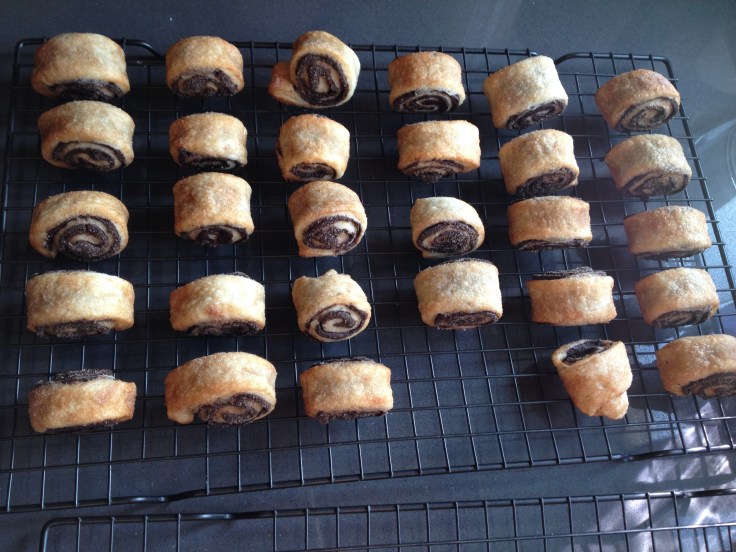
The other day, I thought I had rugelach down. I produced these. They looked perfect and they tasted perfect.

IMG_5887

Then this morning I made more rugelach. Granted, the filling was slightly, slightly different. But I used the exact same technique and this is what happened.

IMG_5923

The good news is twofold. One: the burnt chocolate filling smells and tastes great. Two: no one in my family will mind eating these.
The bad news is, the failure means I had to come up with something else to bake, fast, to mail to people this week. Fortunately, I was able to put together the Chocolate Crunch Shortbread from last weekend’s Wall Street Journal, and I’ve baked them, and they came out of the oven looking the way they’re supposed to. So I can wrap and ship this afternoon, once they’ve cooled.
I think I’ll stop baking for a couple of days. I think I need a break.

This one is my husband’s favorite.

Chapter 8 of The I Hate to Housekeep Book, “The Rest of the Pea Patch,” addresses some pretty mundane matters, but it has some of the best lines in the whole book, and a few really good pieces of advice. Oddly, I come to it after a moment of great domestic minginess. Today is a dark day — it looks like it’s going to rain soon — and I’ve spent the morning waiting for a large delivery of groceries, receiving it, and then putting the groceries away. Needless to say, despite ordering $160 worth of stuff, I forgot to order a large jar of mayonnaise and I also forgot cottage cheese and eggs, so I’ll be heading out to the store this afternoon anyhow. On the bright side, though, all the canned goods were delivered, and those are the things I hate carrying the most. One conserves energy where one can. IMG_5685

Having received said delivery and put it away, I thought the thing to do was go upstairs and tackle Chapter 8, here, but on getting to the top of the stairs, I noticed I’d left the hall light on downstairs. Though I didn’t feel like trotting back down — I’d set up my workspace, I was ready to go — I thought, “No, I’ll feel guilty if I leave that light on. I’m wasting energy. Even if it’s JUST ONE LIGHTBULB.” So I went down, flicked the switch, and came back upstairs feeling very virtuous. And sitting down with Chapter 8, I see that I was being a very good girl indeed: Mrs. Bracken would approve. Chapter 8, you see, is, in large part, about saving on your electric bill.
Peg Bracken is a big fan of knowing what you’re spending on things that seem like little things but surely do add up. There’s much talk of kilowatts and fuse boxes and having a man show you how to do this or that, and having a man call the electric company when you have a problem, because men get taken more seriously over the phone. I don’t dispute any of this, personally, but there’s no question it could be a bit of a turn-off to the more adamant of the feminists who’d pick this book up today. Regardless, for those of you who want to pay attention to energy consumption, there’s probably a good deal of validity found here, though of course appliances and our notions of energy-efficiency have evolved dramatically in the last fifty years.

There’s one tip in this chapter — and when you get down to it, Chapter 8 does seem a bit random in its selections — that I’ve always meant to take on, but have never done, which is that every room in the house should have a Useful Box. In my own case, I think every room would be a bit excessive, but you basically have to take her point. Bracken’s useful box is an old cigar box, or tin, or shoebox, in which you keep the following items: a pair of scissors; a roll of cellophane tape; a pencil; a ballpoint pen; a notepad; spools of thread in black, white and beige, each with a needle (ok, I’d skip that one, personally); and a nail file (GOD yes, an emery board SHOULD be in EVERY ROOM in the house).

The point of the Useful Box is, obviously, that these are things one always needs, and at the moment one needs them, one shouldn’t have to trot downstairs or upstairs or to anywhere, really, more than three paces, to get to them. We keep our fingernail clippers in the bathroom, which makes sense, for the most part. Except, the place I am, 95% of the time, when I need a nail clipper, is in the kitchen. I don’t know why it’s taken me so long to figure this out, but a few months ago I began to keep a nail clipper (and an emery board) in the box on the kitchen table where I keep postage stamps and spare keys. Now, when I need to trim a nail that I’ve messed up while cooking, I can do it without leaving the kitchen. I felt like a genius, when I figured out that I could do this. I mean, no one’s stopping me from spending $2.50 on another nail clipper; and I can keep it wherever I want! It’s small; it’s not bothering anyone. But it saves me a lot of time and effort, having the clipper right there. So, bully for me. I am sure Bracken would approve.

Bracken points out that the Useful Box is even good to have in the bathroom, and I have to agree. Some day, when I am a good person, I will arrange for a Useful Box to live in the bathroom. I do have a roll of Scotch tape in there, and a pair of scissors; but the scissors are the ones I use to cut my daughter’s hair, and I probably shouldn’t use them for more heavy-duty messy jobs. Similarly, in the bathroom’s useful box, if I were really good, I’d keep a really long pair of tweezers, because they are useful for fishing things out of the drain, like disgusting clogs of hair which we should really be grateful for, because they trapped the nice earring that I just dropped down the drain. Don’t ask me how I know this, by the way, just take my word for it.

There is a very long section in here on the matter of ashtrays, which would have been a pressing domestic concern in Bracken’s era, but is no more, since pretty much no one smokes anymore. At least, no one smokes inside the house. I have attended more than one PTA-based party and noticed small covens of guests huddled outside on the back deck smoking cigarettes, but I’ve never seen anyone openly smoking indoors. The day of the ashtray has come and gone. It’s a shame for the fans of mid-century modern design, because some of those ashtrays were pretty cool looking items, though I’m more of an Art Deco person, myself. I wonder if people will start to collect ashtrays again but use them for something different, like holding their jewelry or as candy dishes or something. Except I don’t know anyone who keeps candy dishes around, what with people caring about diets and stuff like that. On the other hand, people do smoke pot legally these days. Maybe the shelter magazines have articles about Bringing Back the Ashtrays. I wouldn’t know, since I don’t read shelter magazines, but if anyone reading this has links they want to share, feel free.

Speaking of ashtrays: The last paragraphs of Chapter 8 advise us on what to do with our fireplace in the seasons when we’re not using it. (The fireplace is, of course, really nothing more than a very, very large ashtray. The issue, of course, is that while you can always just wash an ashtray and put it away, you can’t just wash and put away your fireplace.)
I get that fireplaces are seldom the most fascinating things to behold, when there’s no fire burning in them (and even then, I don’t find them that interesting, though I do find them a source of angst, because I worry about the house burning down). Our current residence has a fireplace, and it gets used maybe five times a year, but I really don’t spend any time wondering, “how can I figure out how to make that gaping hole look better between April and November every year?” If I decided to get artsy about making the empty fireplace look nice, my husband would probably think I was off my rocker and trying to kill us all. So I don’t worry about the fireplace. Frankly, I’ve got better things to do with my time, like perfecting rugelach.


I declare Rugelach Victory.

It has taken several tries to get this right, and some of the attempts have been dismal, but I think it’s been a worthwhile enterprise, figuring out the right combination of recipes to make the rugelach of our dreams. These will not make everyone happy. There is no jam, there are no nuts. There is no trick. However, the winning combination is this:

You use the rugelach dough recipe from the green Gourmet cookbook, slightly altered (this is basically a brick of cream cheese and two sticks of butter, blended till smooth and then combined with flour and a few other things), and then you make a chocolate filling along the lines of the one given by Yvonne Ruperti at Serious Eats. I say “along the lines of” because it isn’t that I followed her directions precisely, but they were the guidelines I used to figure out proportions.

In previous attempts at rugelach, I’ve found the dough inevitably had annoying flaws. It was too crumbly, or too leathery, or not sweet enough — many rugelach recipes have no sugar in the dough at all, which mystified me. I asked my friend Susan, “Why is this?” and she reasoned that it’s because the cookies are rolled in sugar before baking. I guess that’s fair, but the fact is, I never liked these no-sugar-in-the-dough cookies much, and my friends and family found them lackluster as well.

So this time around, I added about 1/3 cup granulated sugar to the dough. We thus had: one brick of cream cheese, 2 sticks of butter, blended; 2 cups of flour; maybe 1/2 tsp. salt; and 1/3 cup sugar to make the dough. This was a bit of a pain to mix together in the Kitchen Aid, but I persevered. I molded the dough into a flat rectangle and wrapped it in Saran Wrap and then refrigerated it overnight. The next day, I cut the dough into four pieces, floured the countertop, and began to roll out the dough. It was easy to work with these small sections of dough, and I was able to cut a dozen pieces of rugelach from each section. I painted the rolled out dough with a filling I made out of melted chocolate (I used scraps of stuff I had around: about half bittersweet, half semi-sweet chocolate chips), granulated sugar, brown sugar (two tablespoons of each) and (important detail) two tablespoons of Hershey’s Dark cocoa powder. I used the microwave to turn the solid chocolate into a kind of paste and then mixed it all together. The Serious Eats recipe didn’t provide me with enough filling to do all four sections of dough — I would increase the amounts to use something more like 9 oz. solid chocolate total. But it’s the kind of thing where you can add to the bowl, melt, and go, as needed. The paste is very very thick, which is not great to work with, but it means the filling doesn’t just run out all over the place when you bake the cookies. It stays put. So don’t add any liquid to it, even though you’ll be frustrated and want to add something.

The chocolate is spread over the rectangle, the dough gets rolled up into a cylinder, and then you cut small slices from the roll. Toss the little cooky rolls in a dish of cinnamon sugar, place on a baking sheet with a piece of parchment paper, and bake 20-25 minutes.

There is probably a faster way to make rugelach, but I don’t know (yet) of a better way. Now that I have the dough recipe settled, it means I can start playing with fillings a little bit. But not too much. I’ve been told that non-chocolate fillings might not be well-received here at home.

Celery. You can definitely have too much celery.

It was Thanksgiving a couple weeks ago, you may recall, and that means it was one of those rare moments in my domestic calendar when celery is on the shopping list. You have to have celery in the turkey stuffing. So I bought two packages of celery and used one but had the second one leftover. “It’s okay,” I told myself. “We’ll use it up in the inevitable turkey soup or something like that.”

Except that while I made turkey stock, I never did make turkey soup. And now it’s December. And I’ve still got this package of celery in the fridge.

The other day my husband sent me a text message saying, “I’m going to the store to buy things to make beef stew.” I wrote back and said, “Sounds good. We have turkey stock in the fridge you can use, and also celery.” I came home. We had beef stew for dinner. It was good. But a day later I opened the vegetable drawers in the fridge and realized that we still had an abundance of celery. In fact, there was a significant net gain in our celery stock. It was immediately clear to me that my husband had ignored my text regarding celery and had purchased another very large head of celery. A superfluous head of celery. I discovered this while our daughter was seated at the dining table having her afternoon snack. I uttered a few choice words and spent the rest of the afternoon muttering about how the hell was I supposed to use up all this damned celery. We don’t even really like celery. We’re not people who wander around eating celery as a healthful snack. We are not rabbits or cows. The celery is a problem.

I didn’t say anything about it to my husband until dinner last night, when I remarked casually, “So we’ve got kind of a lot of celery in the house right now,” and he laughed and admitted, “I didn’t see your text until after I’d gone shopping.” “Ah,” I said. Our daughter piped up, “Mama found the celery in the fridge and SHE used BAD WORDS.” I slitted my eyes at my daughter. “I did,” I admitted to my husband.

“Oh, really?” he said. “What did Mama say?”
“She said the J word and the H word and the C word,” my daughter said, clearly enchanted by the act of reporting on my poor behavior.

“I’m sure she did,” my husband said. “Well, it’s understandable.” I was relieved that I hadn’t used worse language at the time. I think I did, in fact, cast aspersions on my husband’s character at the time, but I guess the language I used wasn’t incendiary enough to catch my daughter’s attention.

Anyhow, we have a whole lot of celery to use up. I am seriously considering making braised celery for dinner tonight, praying that we find it edible. Because it’s that or the stock pot, and we have quite enough stock in the house right now. I’ve got enough stock for seventy pots of risotto. I’ve got to draw the line somewhere. In the meantime, I’ve instituted a ban on celery acquisition. The entree tonight will be pasta with anchovies, garlic, and parsley, which everyone loves. So even if the celery is a failure, no one will go hungry.

The Grim Day: It Happened Now, and It Happened Then. Or, How Peg Bracken Invented the Mental Health Day*****

I am not sure when the pIMG_5486hrase “taking a mental health day” entered the American vernacular but I am sure of one thing, which is that Peg Bracken absolutely knew what a mental health day was. She didn’t call it that. But she devoted an entire chapter to The I Hate to Housekeep Book  to this concept, and furthermore, offered wise suggestions as to how to get through a grim, horrid day when one has no choice, when taking a mental health day is simply not an option.

I know for a fact that there are days when I basically can’t deal with the house I live in, or the other house I’m supposed to take care of (I am a landlord, and am therefore in charge of more than my fair share of furnaces, sinks, hot water heaters, and other mechanical things that can break). There are days when I think, “wouldn’t it be nice to own three different vacuum cleaners so that I wouldn’t have to lug my one good vacuum cleaner from floor to floor of the house? I might vacuum more, if I didn’t have to carry a vacuum cleaner up the stairs and down the stairs.” (This is, of course, total bullshit, I would still not vacuum the house as often as I ought to.) Today I was supposed to go do Good Works downtown. It is a cruddy, cold, rainy day today — the kind of weather I actually quite like, as long as I don’t have to do anything more than take my child to school and then take her home from school — and I was slated to do Good Works, but then something came up. Now I have to wait for a plumber to show up at one of the rental apartments to fix a kitchen sink sprayer that apparently has gone all Beetlejuice on the lovely tenants. (They’re being very good-humored about it, but really, it needs to get fixed.) Because this is the kind of thing where I am awaiting a phone call and will then have to drop whatever I’m doing to rush to the other house, I’m not doing Good Works. I’m also not vacuuming. I’m also not washing the floors here, because it’s a cruddy day outside, which means there’s no point: the moment the floor dried, it would be covered in wet leaves and footprints anyhow. I have made a few important mental calculations: I do have a vague sense of what we’re having for dinner tonight, no small thing. But I’ve not done laundry (there is some to do, but not enough to make up a proper load); I’ve not cleaned any bathrooms; I’ve not taken out the recycling. (I will do that, when I leave the house to go meet the plumber, I swear.)

If I thought I had more time, I would take one of Bracken’s perfectly reasonable suggestions, which go in two possible directions. There’s the “I cannot take one more step, and I am retreating to my cell, and you all can go screw yourselves for the next 24 hours” version, and the “ok, if I don’t do something, the world really will fall apart, so I have to get something done, let’s GET SOMETHING DONE.” The “cannot take one more step” version involves things like: climb into bed with your manicure kit and reading material of choice and refuse to leave until you feel recharged the next day. (This is great, but usually impossible, and, seriously, for me, one day would not suffice.)

The second option, which, Bracken points out, is usually the one available to the housewife, is to first think despondently about the lucky people who aren’t housewives but who go out to Jobs and Do Things in the Big World. Then, you must take some deep breaths (she says this in a non-Yoga Journal way, but in a more sassy, Celeste Holm kind of way), and face the fact that to everything there is a season, and your season may not yet have come, but that there is time yet, and in the meantime, you will, yes, face these unpleasant tasks, and do them. She observes that Freud always said he did his best work in a condition of moderate misery. Not that we’d really want to hold Freud up as a great model of anything in particular.  But I think we can take her point.

So then the problem becomes, How do you motivate yourself to get this crap done. For example, the writing of thank-you notes. Possibly in your life you don’t write thank-you notes ever; if so, bully for you. In my life, I often have to write thank-you notes, and what’s more, I do it. There are a number of ways to force oneself to sit down and do this task, which isn’t particularly onerous but is quite time-consuming if you’re doing it well. Here is Bracken’s take on how to tackle this list of small tasks:

“Let us say you feel it’s important, for some reason, that tomorrow you make five dozen cookies for the Bluebirds, wash and iron the bedroom curtains [good god, at least I’ve never done that], write a long chatty letter to the family, and shorten a skirt, which is a frolicsome Monday for you, but there it is.”

The efficiency experts, Bracken says, would tell you to start by making a list. But that might slow you down. The random housewife will not be encouraged by list making. What the random housewife will do is make the list and go, “Well! There you have it! I made the list!” and then that will be the end of it. No: what you must do is start all of these things but not finish them, like so: you stamp and address an envelope for the chatty letter, and write the opening paragraph, and then stop;

then you organize the dry ingredients for the cookies and stop (I’d take the eggs out of the fridge, too, to give them time to get to room temperature — butter, too);

you take the curtains off the rod and throw them on the floor, and then set up the sewing machine for fixing up the skirt, and then the ironing board, and stop.

Now what do you have? You have a situation where you’ve GOT to deal with everything you started. And as long as you’ve got three or four hours ahead of you with no small children around, you should be able to tackle all of this. You would throw the curtains into the washing machine and turn it on; you’d get the cooky dough set up; while the cookies baked, you could write your letter to those cousins, while you sit at the kitchen table, so that it’s easy for you to jump up and turn the trays around; and while the cookies cooled, you could get the curtains dried and mended and ironed, or whatever the hell you had to do to the curtains. I don’t know if people actually launder their curtains, I’ve never laundered a curtain in my life. I’ve certainly  never ironed a curtain.
No, wait. I take it back. At our last apartment, I did have little curtains in the kitchen windows that I did launder from time to time, because they did show dirt. But in ten years of having those curtains, I think they were laundered three times. This really wasn’t something that nagged at me, and god knows I didn’t iron them. So. I stand corrected, but only a little bit.

Anyhow: at the end of the three or four hours, the cookies will be cooling on racks by the window, the curtains will be taken care of, the letter will be written, and, ok, I don’t know what to do about the skirt, but presumably you’ve managed to get that taken care of, too. Is hemming a skirt hard? Damned if I know. But even if you haven’t finished every single item on the to-do list, you’ve definitely got the majority of them licked, which is impressive. In fact, it means (if you ask me) that you’ve earned the right to throw yourself on the couch with the magazine of your choice and have some cookies (screw the Bluebirds, they won’t notice if a few cookies are missing from the foil-lined shoebox of cookies) and relax for ten minutes before you pick the kids up at school

****

In the case of my day, I got the phone call from the plumber at 1.25 and ran to meet him at the rental. The problem with the sink took about 45 minutes to fix — not a big deal, we got lucky – and I managed to have some time after that was taken care and before I had to pick my daughter up at school. I wrote an email to the tenants explaining that their problem was, we hope, solved, and that everything else seems fine. I wrote email to other people in an attempt to clarify or solve Good Works-related problems. I was, basically, productive in a small way, not a visible way (the floor is still covered with cat hair, crumbs, and little bits of random crud), but in ways that had to happen. I picked up my daughter at school, brought her home, gave her a snack, and proceeded to make a fine dinner. The day ended and we all tumbled into bed weary and listening to the rain pounding.
But when we woke up today, the sun was shining. And I’m on my way to do Good Works in person. Maybe next Monday I will take a mental health day. (Who am I kidding.)

The Life Hacks of Peg Bracken, or, You Aren’t as Clever as You Think You Are

IMG_5484

A good mother and housewife, in the circles I run in, isn’t so likely to use Fantastik to clean her kitchen counters, the way she was in the 1970s. These days, we’re supposed to use natural, organic housecleaning agents: bottles of Method and Mrs. Meyer’s and Seventh Generation abound. These things often come in very attractive packaging, and might even smell nice (which Windex and Fantastik do not, in my opinion). None of them are cheap, not even if you score them with a coupon while they’re on sale. But if you poke a random mother at the playground in my neighborhood, and ask her what she uses to clean her house, she’ll say “vinegar and baking soda.” “Frugal,” “organic,” “natural,” “non-toxic,” “homemade cleaners,” those are the keywords these types live by, and I should know, because I am one of them. In my case, it all got started because I was reading Peg Bracken from an early age. And I was cheap. Then, in the era of the mommyblogger (which I obviously am, not that I’m proud of it, but oh well), a number of sub-groups began to embrace this kind of thing. These were women who prided themselves on being more organic than thou, or holier, or crunchier, or less toxic; they were stay at home mothers trying to be frugal. And they tended to write as if this cleaning with baking soda and vinegar thing was new, and a total stroke of genius. Well, they were partly right.
Peg Bracken knew from vinegar and baking soda. This “frugal housecleaning” isn’t a new phenomenon. These aren’t cleaning supplies that were discovered by the neo-hippies of the 1990s or the oughties. Aunt Lucy knew about them, so Bracken knew about them, and Bracken wrote about them in most amusing fashion. Fortunately for you and me, Bracken was, in the 1960s (pre-hippiedom) more realistic about these things than either Aunt Lucy or the wholesome types (1960s or current remix version) would be about it. “Let us be candid,” she writes, “about a few pantry items and what they’re good for. The fact is, few of them do as good a job, as neatly or quickly, as things you can buy.” Bracken’s Chapter 7, wherein Bracken explains which of these old-timey household tips are really worth pursuing, is matter-of-fact and cut-to-the-chase. There’s penny pinching, and there’s time, and there’s effort, and you have to be practical about how much of each you want to spend on any given task. Additionally, there are tips that aren’t about saving money or cleaning more efficiently, but are simply about making life in a broader sense somewhat easier and/or more affordable. “Beware,” Bracken writes, “of buying many disposable items, like paper towels. It’s cheaper to use terrycloth hand towels in the kitchen. If you feel you MUST have a paper-towel rack, put it near the stove. Then the towels will be used for draining things instead of wiping hands, and they’ll last longer.” Hear, hear. A cheapskate move, and a “green” one at that. It’s like the dishrag/sponge thing we talked about earlier. I go through maybe one roll of paper towels in a year. I use paper towels for cleaning up puke and draining fat off things I’m cooking. That’s about it. Since the residents of our house seldom have gastrointestinal woes, and I don’t make meatloaf on a daily basis, it means that a six pack of paper towels can last us a ridiculously long time. The package actually collects dust, down there in the basement. So Bracken’s right: as long as you’re someone who’s doing laundry on a reasonable basis, there’s not much good reason to invest heavily in paper towels. (Maybe this wouldn’t hold if you had a household with ten children in it, but for my small family, it works out just fine.)

Am I supposed to dust the package of paper towels?
I’m not going to answer that.

Anyone who’s ever looked at a listsicle of Life Hacks or Kitchen Hacks will read Bracken and smack their hands to their heads feeling stupid. People claim to have their minds blown by Life Hacks, but so many of these concepts were already laid out (without references to iPhones and far less in the way of binder clips) in Bracken. So many hacks are straight out of Bracken (or Hints from Heloise, or whatever household manual of the 1960s). I can’t tell you the number of times friends have sent me links to Life Hack lists and I’ve looked at them and said, “yeah, number 6? That’s Peg Bracken right there.” Cleaning with pantry items is just the start. I remember one list, which I now cannot locate, that had 100 Life Hacks, and when I went back and looked at  the list and Peg Bracken’s household tips from the I Hate to Cook Book, the overlap was something like 30%. Yeah, those Life Hacks. Revolutionary stuff.

The Virtues of White Towels

Late last night a friend who is working on her wedding registry posted a desperate cry on Facebook. She was looking into towels and paralyzed with fear regarding bath towels (and hand towels and washcloths): should they be white, or could she indulge in the fancy colored towels of her dreams? She seemed to feel that there would be regrets either way; but, Which regret was preferable over the other?
She had, last I checked, a couple dozen responses to her query, and many of them struck me as sensible, and some of them struck me as crazy. I quickly grasped that I am someone who has strong feelings on the matter of bath linens (wow, what a shocker), and because I know this person well enough to know that we are often aligned in our feelings regarding household matters, I decided to send her a message. Publicly, I posted a comment saying that I maintain a white towel household, but not for reasons that are as simple as “because you can bleach the towels” or “because I like a boring bathroom.” I said, “It’s very late, I’m too tired to explain my position on this, but this is how I feel about it and I feel strongly about it. I am capable of writing an entire essay on the subject.” A few moments later, I sent her a private message explaining a few key points. But because I got it into my head that I could write an essay on this — much as I wrote an essay on dishtowels — I am going to sit down and explain why the white bath linens are inevitably preferable to the colored ones, no matter how gorgeous the colors are.

This is going to be a long piece of text.

The Basic Rules of Towels:
1. 100% cotton. No polyester content, ever, not even on trim. 2. Launder in hot water. Never use softeners or dryer sheets. Any towel that won’t feel good without those things is a towel not worth owning. 3. You should always be able to bleach towels because it’s an imperfect world, and there will be times when it is for hygiene reasons necessary to bleach towels. 4. If you have white towels, you never have to worry about things matching. There is no color of towel that is available now that will be available in five years, when you realize you need to get more washcloths. You will wind up with mismatched towels. You will be annoyed. 6. Bath sheets are silly unless you have access, in your house, to industrial laundering facilities. They take forever to dry, which means that, no matter how luxurious they seem when you first buy them, they will wind up smelling of mildew faster than any other towel in your house. 7. If you have children in the house, you will need more washcloths and hand towels than you would ever imagine. 8. If you’re buying a towel by feel, remember that no matter what the towel feels like in the store, it will almost certainly not feel that way after you’ve laundered it. Fabrics always come with some kind of treatment on them, so they feel soft and awesome in the store while they’re on display. That stuff, which is called sizing, washes away. So it has no bearing on what you’ll be dealing with a year from now.

If you live alone, presumably it’s possible to invest in colored towels and keep them going for a long time and be careful about laundering and have gorgeous colored towels ten years after the initial investment. However, I do not live alone; I live in a household with two people who are not particularly filthy or slobby, and even so, I know for a fact that maintaining a perfect set of colored towels in this house would be a nightmare.

My mother will remember, I think, that our towels when I was growing up were often wonderful colors, but that nothing matched. The towels were mostly Fieldcrest Royal Velvet towels, and very high quality; wonderful towels. I still have one of them, somewhere; it is a dark teal blue. But no two towels matched. There was a phase when we had mostly wheat-colored towels; that was a depressing phase. Nothing good is wheat-colored, I feel, except wheat. Or, I guess, bread. I mean, no home furnishing should be wheat-colored.
For a while I was weak and when I had to buy towels I fell victim to the beauty of colored towels. Probably  this is because I always lived in rental apartments where I had no control over the bathroom decor except for the towels and, sometimes, the shower curtain. It seemed reasonable that I should be able to pick the color of something. But even so: would it match whatever the bathroom already looked like? I had a pale blue bathroom for four years; I don’t like pale blue! I must have simply tried to put the colors out of my head, knowing that I wouldn’t live in that apartment forever. And I didn’t: in 2002, I took control over the matter. We were about to renovate the bathroom in the first house we’d bought, and I had plans. We would re-do the bathroom; the walls would be painted some smashing color, and the towels would be white. Because — here is another virtue of white towels — you never have to worry about them not matching the paint in the bathroom. When you buy towels to match your room, you’re guaranteeing that either you will get heartily sick of that color, or that when you have to buy more towels in that color, you cannot any longer, and you will, out of dire need for towels, wind up with towels that don’t QUITE match the walls, and you will be SAD.

So we had our beautiful new bathroom, which we’d done with black and white tile, and the walls were painted Kermit-the-Frog green. Our lovely white towels were perfect. I never worried about them looking weird hanging on the wall; I folded them neatly and hung them on the towel rods, and it looked perfect. Green towels would have faded away against the wall — and then faded, after so much laundering, and looked depressing. But the white towels are always cheerful.
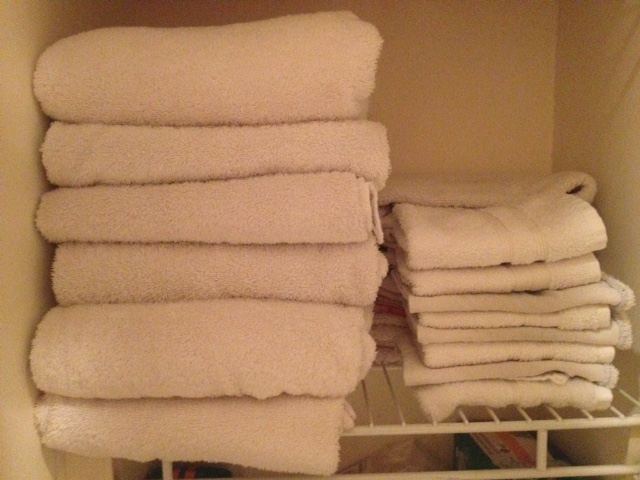
Some people think white towels look antiseptic and institutional; some people think white towels are relaxing, spa-like. I think that it’s a matter of color and quality. If you have white towels that don’t look wilted, and aren’t shredded at the edges, you will find them pleasant to use. So wash the towels frequently; use bleach when needed; use OxyClean or bluing regularly; don’t let the towels molder on the bathroom floor or use them to mop up the fluoride rinse when your husband spills it. They will remain white for a good long time. And you will not be sad when you look at them, freshly laundered and neatly hung on your towel racks. They will look handsome and comforting, folded neatly in the linen closet. Kind of like this. IMG_5628I mean, my linen closet isn’t anything to write home about — whoever designed it was clearly addicted to cocaine and not someone whose linen closet was a personal high priority — but it is orderly, and when I want a towel, there it is, clean and neatly folded.

Blog at WordPress.com.

Up ↑