On Being That Pretentious Jerk of a Parent: Suddenly, I Kind of See

In general I am as lazy a parent as I can get away with being. I ardently want my kid to entertain herself and bother me as little as possible. I don’t want to play with her most of the time; I am her mother, not her playmate, after all. But it’s difficult for her, as it is for us: she’s an only child, and one can only play alone in one’s room for so long. And right now we’re in that horrible long phase of the summer where there’s no summer camp, there’s no nothing to break up the days, and I am on my own with the kid 24/7.

Tensions are running high. We are both very deeply sick of each other. It’s been ugly. And yet, she cannot leave me alone; when we’re in the house, she insists on being in the same room I’m in. She cannot stop chattering at me; I want it to be quiet so that I can think. I can’t focus enough to even pay bills online, my daughter so consumes all the air around me. I mean, the bills are getting paid, but I don’t actually have confidence I’ve done it correctly, and I guess I’ll find out come September if we suddenly have no electricity or cooking gas.

A lot of parents in this circumstance go to great lengths to Do Things with the kids. I guess the idea is, you wear the kid out, outside the house, such that when they get back home, all they want to do is lie on the couch quietly. For various reasons, I’m not game. I’m not taking my kid to water theme parks, to the Pez factory, or even to the playground — normally I wouldn’t mind the playground, too much, but it’s 100 degrees and humid outside. Neither of us wants to be outside; we want to be indoors. The problem is that it’s just the two of us rattling around in here.

I decided last night that the smart thing to do today would be to shake up our routine. Instead of waking up and making a pot of coffee and spending a bit of time reading the papers and drinking coffee while my daughter lolled on the couch watching Mr. Bean cartoons on YouTube, I announced that I had another plan for how the morning would go. I informed my daughter of it to get her ready for the shock to her system. “Tomorrow morning,” I said, “When I get up, we’re gonna get ready to leave the house immediately and we are going to go out and get coffee at East Rock Coffee.” This was a big deal. I almost never go out for coffee, and even less often do I go to East Rock Coffee. I resent spending money at cafes, particularly when I’m with my daughter. Going to a cafe should be a relaxed luxury but instead, going with a child, it’s just stressful and annoying. I resent paying money to be stressed and annoyed; but for the change in routine, and save myself the effort of making a pot of coffee, I was willing to chance it. Predictably, my daughter reacted to this news with excitement and delight, and I thought, “There is hope.”

This morning we washed and dressed with astonishing speed and assembled our supplies to take with us to the cafe. I had three days’ worth of unread newspapers — newspapers have piled up at an appalling rate since my daughter’s stopped going to camp — and my daughter had two ancient issues of Cricket Magazine. In her tote bag was a board game, too: a moment of inspiration had led me to suggest we take my ancient travel Scrabble set with us. We got drinks (a lemonade for her, a tall iced latte for me), I paid a criminal $8 total for them, and we found a nice place to sit outside. There were many people at the tables around us: retired men with their dogs, workmen having breakfast sandwiches before heading to renovate nearby houses, and grad students complaining about the crap grad students complain about. So many grad students. This is why I don’t go to East Rock Coffee. So many grad students.

But I was not going to be brought down by the presence of so many grad students. This is my neighborhood, I feel, more than it is theirs. We imperiously arranged ourselves. My daughter read her Crickets and I read three days’ worth of Wall Street Journals. And then, around ten o’clock, I was the incredibly pretentious annoying parent sitting outside at a cafe table playing Scrabble with her daughter and demanding that she calculate the scores and add them up.

I disgusted even myself. I suppose it could have been worse. I could have been sitting there teaching her to play Bridge or Backgammon. But Scrabble is bad enough.

A woman with two children, aged maybe five and three, came over and sat down at the table next to ours. Her children looked at us and said loudly, “Are they playing Scrabble?” My daughter looked over at the five year old, a girl, and said, “Yup! It’s Scrabble!” and I think she was proud to be doing something as grown-up as playing a real, grown-up style game, not some baby game — which is fair.

The mother, having given her children pastries to eat, took out a notebook and began to write a letter to a friend. While she wrote, her children ran around loudly singing nonsense songs to each other. She didn’t pay much attention to them, and while I understood the desire to not pay much attention to them, obviously, their hubbub made it difficult for us to play our Scrabble game. “I can’t concentrate,” my daughter complained, whispering into my ear, “because those kids are making so much noise.”

“I know the feeling,” I said. I was sympathetic, to put it mildly.

Long, annoying story short: We played about half a game. When my daughter’s attention span had dwindled to the point where she would just shove her rack of tiles over to me to figure out words for her, I gave up. It was eleven o’clock. “Let’s just go home,” I said. “We’ll go home and you can scrub potatoes so that I can set up the potato salad we’ll have for dinner.” “Okay,” she said.

I now theorize that part of why we see parents pretentiously playing grownup games, or doing stretch your brain type exercises with children when out in public (“is the font on this package of Oreos sans-serif or not? Come on, you know this one, Spencer!”)  is not merely that they’re trying to make their kids better prepared for applying to Harvard; they’re trying to keep themselves from losing their minds altogether.

It’s not going to work, folks. But I’m now marginally more sympathetic toward those parents, who, till now, I’ve mostly regarded as pretentious twits. Staying home with a child can make you do weird things. It took me eight years to get this weird.

In the afternoon I posted to Facebook, wondering if anyone would be willing to babysit my daughter for a couple of hours sometime on Thursday or Friday. I explained that we really needed to get out of each other’s hair for a tiny bit. I said I couldn’t really justify the expense of paying a sitter, but that I would, because I can’t legally kick her out of the house yet, and I didn’t feel it was wise to just leave her alone. My friend Eliza, who is much more good-humored than I am, but is also spending far too much of the summer with her own only child (a nice little boy who my daughter enjoys hanging out with), said, “Have your girl come hang out with us for a couple hours. We have to go to a farm to pick up tomatoes for canning. She can come with and feed some goats.”

I said, “That would be awesome,” and told my daughter that she’d be going to this farm with Eliza and her son. “You’re not coming with us, are you?” she asked darkly.

“No, I’m not,” I said. “So you will be on your own. Please help Eliza if she needs help carrying boxes of tomatoes.”

“I will!” she said cheerfully. “Thank god I’m getting away from you.”

Eliza has sent me numerous photos and videos of my daughter horsing around with her little boy. At the farm, she fed goats and crawled around on a tractor. Back at their house: She’s got an Incredible Hulk mask on. She’s jumping on furniture. She’s having a grand old time. Soon, she’ll be returning to our house, and I’ll feed her lunch and we’ll fold some laundry. She’ll grouse about how boring it is at home. I will try to not argue with her about it. This afternoon we’ll go swimming; this evening we’ll eat sandwiches for dinner. Tomorrow will be another day. I promise I won’t make her play Scrabble. And soon it will be September.

 

Florence Foster Jenkins, Please Save Me: Wholesome Mother-Daughter Activities When the Weather Isn’t Cooperating

When the summer was mapped out, we knew that there would be a rough patch in August. We signed up the child for three weeks of summer camp, which were staggered through June and July, and we joined a swimming pool club a couple miles away so that there’d be someplace for us to go cool off now and then. But we knew that there would be long weeks of my having to come up with Things to Do with My Daughter, and that the worst patch would be in August, when there would be two solid weeks of just the two of us together, day in and day out.

What I didn’t anticipate was that there would be so much rain. There’s been incredibly fickle weather here in Southern Connecticut and it’s made it difficult for us to take advantage of the swim club. As a result, we’ve gone to the movies several times this summer, which isn’t the worst thing in the world, but it does get rather expensive after a bit. And I do feel guilty about it, because, let’s face it, going to the movies is awesome, but it’s hardly a wholesome, enlightening, get-you-into-Harvard kind of activity. But it’s all I have the strength for; I swear to God, I’m doing the best I can.

Yesterday morning, I was sitting in my comfy chair reading the New York Times online when I noticed, looking out the slider doors to the balcony, that the floor of the balcony was unusually cruddy-looking. There’s been construction going on behind our apartment, and I think between the usual crud that accumulates there (leaves, cat fur) and construction filth flying around the air, the balcony floor had come to look especially vile. The air was solid humidity and my daughter and I were both feeling fussy, obviously dreading the day ahead. There would be no swimming — we knew rain was coming — and the only thing on the calendar was a plan to go to the public library at 3 p.m. for a crafts program on how to make pop-up books. But it was seven in the morning, and we were a long, long way from three o’clock.

“Hey,” I called down to the first floor, where my daughter was sitting at the table reading a Diary of a Wimpy Kid book. “I’ve got a really stupid, crazy idea, you wanna hear it?” She answered in the affirmative.
“What if we fill a bucket with soapy water and go scrub the floor of the balcony out here?” I said. “It’s pretty gross and it doesn’t have to be.”

This was such a weird suggestion that she leapt at it. In five minutes we filled a big bucket with a mixture of dishwashing liquid, vinegar, and water; we got some scrub brushes in hand; and we laid a towel out just inside the balcony’s slider door. “Ok,” I said. “Let’s do this.” In our nightshirts, we went outside and started scrubbing. The cat sat just inside the door and watched us skeptically.

“This is fun!” my daughter crowed. She and I cleaned the short drain pipes that go from the balcony to a gutter below — which had to be done anyhow — and we got an incredible amount of schmutz loosened from the floor. About five minutes after we started, it began to rain. “This is good!” my daughter said. “The rain’s gonna help rinse the floor.” “Sure!” I said. “And it doesn’t matter if we get wet, ’cause we can just take a shower afterwards and get normal again.” Two seconds after I said that, the rain shifted from a gentle, warm rain into a cold, hard, pounding rain. It was the kind of downpour that ruins your shoes and trashes umbrellas, and there we were, scrubbing the balcony floor.

“This is awesome!” my daughter laughed. We scrubbed more and then she dumped out the bucket of soapy water to rinse off the last of the crud. Years of schmutz went swirling down through the drainpipes, and I leaned over the balcony to see it land in the gutter and funnel down to the ground. It was very satisfying.

The rain began to let up and we actually started to feel cold. “We better go clean ourselves up,” I said. We got onto the towel inside and the cat watched us peel off our disgusting soggy clothes and then I hustled us through warm showers. It was all very relaxed and enjoyable and I thought, “Maybe the day won’t be so bad. This was a weird start to the day, sure, but it wasn’t a bad start.”

Little did I know that by two o’clock we would be glowering at each other, sick to death of hearing each other’s every move, tired of the sound of our voices bickering.

Today we awakened to sunshine and ridiculous heat; unfortunately, there is also, still, the ridiculous humidity, and I suspect rain will come sufficiently soon to make going to the pool a non-option for us. It’s iffy — could go either way — but since we get to the pool by bus, and it’s a small project to get there, carrying our traditional two tote bags (one for food, one for swimsuits and towels and so on) this isn’t a chance I’m willing to take. As such, I have devised a Plan B for today, which my daughter is dreading, but which I actually have great hope for. We are going to go see the new Florence Foster Jenkins movie, which is screening downtown at 11.30.

She may or may not like it. I may be burning some bridges here. But I am optimistic. My daughter is a big fan of The Devil Wears Prada; she knows who Meryl Streep is. My thinking is, watching Meryl Streep play The World’s Worst Opera Singer might just blow her tiny mind, and she’ll remember this day fondly for the rest of her life. The other possibility — and it’s a real, likely, possibility — is that she will never forgive me for today, and hate Meryl Streep and costume movies for the rest of her life because I took her to see this movie.

It might be wise for me to soften the blow by shelling out for a tub of popcorn. Update TK.

The Book Gods, and the Cruel Jokes They Play

We have too many books in our house. I know this is the case because we still have books stored away at our old house. Like, hundreds of them. So a few months ago I decided to assemble a bag of books that I believed, earnestly, we no longer needed, and I assembled said bag with all good intentions of taking it to a used bookstore nearby where I could get some store credit for them.

It took me maybe fifteen minutes to cull a dozen titles from the shelf, and four months to get them to the used bookstore, which is less than two miles from our house.

With $20.50 in store credit, I searched the store’s shelves once more for a few things I’ve had my eye out for. One of the novels I’m always hoping to find used is a novel that came out a little more than ten years ago — it was a bestselling novel called The Book of Salt. It’s about the person who cooked for Gertrude Stein and Alice B. Toklas. You’d think it’d be easy to stumble on a cheap used copy, but apparently not. I could have bought it new, sure. But I haven’t ever been confident enough that I’d like the book; I was merely curious about it. And I didn’t want to spend $15 on curiosity. So I’ve just had it on my “find it for cheap” list for ages now. I struck out again at the store where I had $20.50 in credit, but then later on, at a second used bookstore, I found a copy for $4. This, I was willing to live with, so I picked it up. I also picked up a wonderful book called America’s Kitchens, published in 2008, which I’d never heard of. It’s quite delightful, I recommend it to anyone interested in the history of American domestic design or American cooking.

My husband was also on the hunt for a specific title, when we were out and about: he needs the next title in the Maturin/Aubrey series. At the second bookstore yesterday, he found it, and when I suggested he pick up the one that comes after the one he needed, while he was at it, he scoffed. “I won’t get around to this one for a few months anyhow,” he said. I didn’t quibble. He went and paid for our small stack of books (The Book of Salt; the kitchen book; a paperback of Colwin’s Home Cooking, which I always need spares of; a big hardcover, gorgeously illustrated book of sheet music for Gilbert & Sullivan’s greatest hits; the Aubrey/Maturin book; an a Garfield book for our daughter) and we all headed home satisfied with the day’s enterprise.

It was the next day that my husband held up his Aubrey/Maturin book and said, “I’ve already read this one.” I laughed. “I’d be really ticked off if I did that,” I said. He was sanguine about it. “I’ll find the one I need somewhere and trade this in,” he said. I said, “I’m glad to find my novel,” and explained to him how I’d been looking for it for so many years. He said, “So, the Book Gods were smiling on you.”

Later in the morning I took our daughter to the playground near our house, where there is a free book box. It’s operated by New Haven Reads, which is a wonderful program that promotes literacy — they run a book bank, which is kind of like a bookstore, except all the books are free; and they operate a massive tutoring program that serves dozens and dozens of kids across the city. While my daughter’s zooming around the playground, I poke idly through the book box, and what’s sitting there?

The Book of Salt. Price? No price: it’s from New Haven Reads, it’s free.

I cursed under my breath and picked the book up and held it in my hand, furious, for a moment; then, resigned, I put it back in the box. I missed my chance; let someone else have it.

“You realize we are never doing this again, right?”

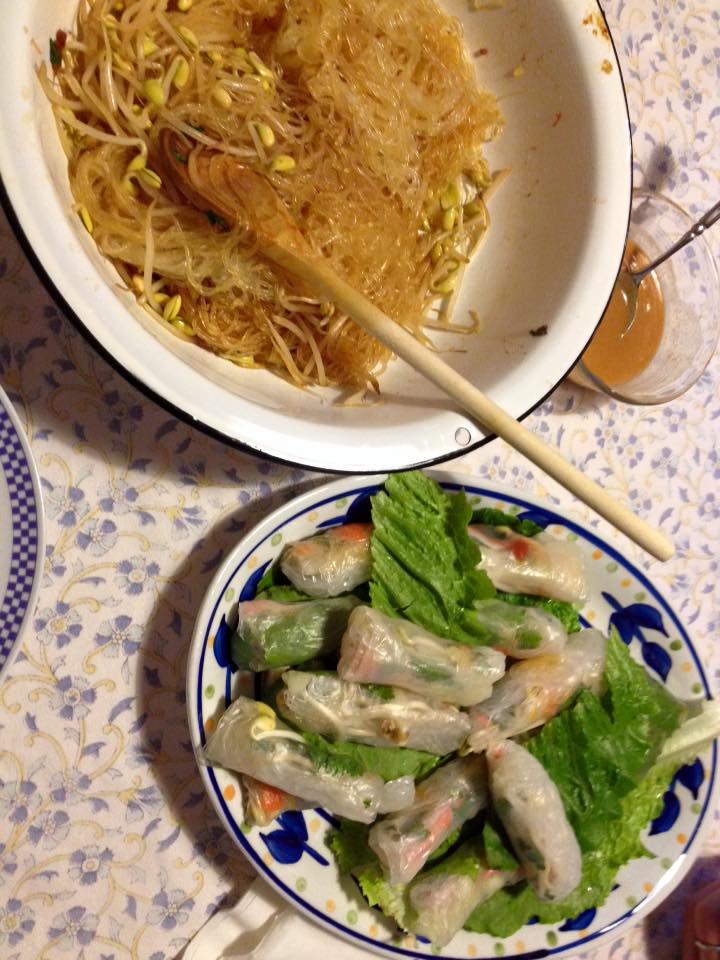
These were the words I spoke to my beloved daughter after I’d been rolling spring rolls for about fifteen minutes and realized that I could never work in a Vietnamese or Thai restaurant. Basically, any restaurant that features spring rolls on the menu is a place where the chefs have earned every ounce of my respect. Because few things in the kitchen are more infuriating than working with rice paper wrappers. It’s right up there with exotic buttercream frostings, something I will never muck with again since the last time I tried and wound up crying. Some kitchen enterprises are just not worth it.

This all started months and months ago. We had been out to lunch at a Thai restaurant with my mother. We decimated a tray of spring rolls in about three minutes and my daughter said, “We could make these, couldn’t we Mama?” I said, “Well, probably.” I meant this to mean, “I COULD, but I am not going to.” She took this as “Sure, we can ABSOLUTELY DO THAT!” and never let the subject drop. So all the rest of the school year, I’d say, “Some day over the summer, we’ll make spring rolls. It’ll be an Activity.” And she got more and more psyched about it. Which is great, to be honest. But it means the bar for success is pretty high.

Yesterday was the day we finally got around to it. We went to the Hong Kong Grocery downtown — they have pretty much everything you need to make pretty much anything except matzo ball soup — and we carried home a tote bag filled with the necessary stuff. We had a packet of rice paper wrappers — mysterious things I’d never used before — and a nice bunch of cilantro and a head of lettuce. We had surimi (imitation crab sticks), purchased because the more traditional spring roll animal flesh, shrimp, is unacceptable to my daughter. We had a fat carrot to grate, bean sprouts, a package of bean thread noodles. At home I already had a cucumber and all the condiments I’d need to pull this off.

It was early in the afternoon when we began the prep work: I explained to my daughter that making the spring rolls would be a lot of work and that it’d be easier if we got the veggie prep done well in advance. “We have to wash all this stuff before we can use it,” I said. “Let’s just get it done and then we can hang around and be lazy for a couple of hours before we really get to the hard part.”

“Why is it the hard part?” my daughter asked.

“Because I don’t know what the hell I’m doing,” I said.

We stood at the sink and spent some quality time with the salad spinner. We washed cilantro and bean sprouts and lettuce; my daughter plucked the leaves from the stems of the cilantro and filled the 1/2 cup measuring cup I’d put out for this purpose. She did a great job. I made sure that the surimi was thawed, and then we played a game of Scrabble.

At five o’clock, I filled a big enamelware bowl — I usually use it as a salad bowl — with hot water, and we lined up our mise en place, and we got to work.

Within roughly fifteen seconds I realized I was going to lose my mind. I knew that working with rice paper wrappers wouldn’t be fun, but I hadn’t fully grasped how evil those little shits would be. You have to soak the wrappers and dry them before you put them on your work surface, lay filling on them, and then roll them up. It makes hamantaschen-folding look like pouring a bowl of cereal.

I produced four spring rolls, all of them technically correct — untorn, complete — but they were messy, ugly, and I said to my daughter, “This is going to kill me.” I had no idea how many spring rolls I’d have to make in order to have spring rolls be an entire meal. In the meantime, I was tired and cranky and losing my ability to be patient with this very, very fiddly work. We had to empty out the water bowl and refill it several times: no cookbook or website I looked at mentioned this, but if the water’s not hot enough, the wrappers don’t soften correctly. And if you don’t time it JUST RIGHT, the wrapper’s not worth a damn, either. Every recipe I read said to soak the wrapper for 10 to 20 seconds, turning it once in the process. Well, no: it was more like 5 seconds on one side, three seconds on the second side. We counted aloud, that’s how I know.

You soak the wrapper and lay it on a towel, and then you fold the towel over so that you dry the top of the wrapper quickly as well. Then you have to somehow migrate the very delicate wrapper to a place where you can roll the thing up. (I suppose it could all be done on the towel, but it’s hard to see the wrapper when it’s on the towel.) A little bit of bean noodle; a little bit of carrot, of cilantro, of surimi — then you fold it like a little bitty burrito. Or, as I observed to my husband, when he got home, like a boerek. (How do I know about making boereks, those little Turkish cheese pastries? It was an annual fundraising project at my daughter’s nursery school. Don’t ask.)

Making spring rolls is one of those things where, It’s not that it’s hard; but it’s HARD. I assume it takes hours of practice to get really skilled. I had a running monologue going on the subject as I took the wrappers from my daughter and laid them on the towel and dried them and then filled them and rolled them. “The kitchens at the Thai and Vietnamese restaurants are probably all staffed by people who’ve been making these things since they were six years old,” I spat. “By the time they’re teenagers, they can do this in their sleep.” “Uh-huh,” my daughter said sympathetically. She knows when I’m on a tear. “You realize we’re never doing this again, right?” I said. “Uh-huh,” she said. At one point she refilled the bowl with hot water and carried it back to the counter saying, “I’m not gonna spill, I’m not gonna spill,” (and she didn’t) and she said, “I would give you a hug except I’d get in your way.”

I muttered my way through rolling a platter’s worth of spring rolls. A couple of them were so wretched I just fed them directly to my daughter, do not pass Go, do not collect $200. She declared them delicious. I got through my supplies of slices of surimi, cucumber, cilantro leaves, and grated carrot, and thought, “I’ve had enough of this crap.” I still had a huge bowl of bean thread noodles in front of me. And my husband and child were looking hungry.

So I cooked up a sauce out of peanut butter, garlic, ginger, soy sauce, and peanut oil, and mixed it into the noodles with my hands (this is the only way I can effectively mix sauces in with noodles like this; I don’t know how other people manage it otherwise). I sprinkled the last of the bean sprouts on top and set the bowl on the dining table. Then I whisked up a sauce for the spring rolls (peanut butter, soy sauce, Sriracha, garlic) and brought that to the table. Lastly, I brought out the spring rolls.

I had to admit, it all looked fairly impressive. Spring Rolls Cellophane NoodlesMy family certainly inhaled vast quantities of food. I think I’d rolled well more than a dozen spring rolls, when all was said and done — I could figure it out by counting how many wrappers were leftover, but that’s too depressing to contemplate, because it means I’d have to face how many I have leftover to deal with in the future. And a dozen spring rolls doesn’t sound like a lot of spring rolls, but when you’re an incompetent klutz and a novice at working with rice paper wrappers…


Well. I think, actually, that I can handle it. I think that given a little more practice, I can get good at it. And that if I do get good at it, it will be worthwhile. Just like with the hamantaschen. But in the meantime, I’m going to order spring rolls in restaurants as often as I can to try to figure out how to get mine better. Yesterday’s spring rolls were a new room in the Museum of Tsuris, but I have to believe that given practice I can demolish that room.
In the meantime, the leftover cilantro’s been turned into chimichurri sauce, which we’ll be having with a broiled steak for dinner tonight. Potato salad on the side. Very straightforward compared to last night, to which I say, Thank god.


A Plan Hatched in 1993 Comes to Fruition

Ever since I read More Home Cooking by Laurie Colwin I have thought, “I should make yogurt.”
This is a book I purchased the day it arrived at the bookstore where I then worked. I was making $5 an hour, which is to say, bupkes, but I bought it in hardcover and brought it home hours after I’d freed it from the shipping box. I carried it home, made myself a meal of spaghetti with pesto sauce (in those days I bought pre-made pesto sauce), and sat down to eat. The very first thing I did was inadvertently fling a blob of pesto onto one of the pages of the book, staining it permanently. I think I cried, I was so angry at myself, but I quickly grasped that Colwin wouldn’t mind at all, so I blotted off as much oil as I could and then kept eating and reading.

In this volume, Colwin assures her readers that any damned moron can make yogurt. I was skeptical, but thought, “Maybe she’s right. She wouldn’t lie to me.” And so I got the idea in my head that someday I would make yogurt.

Every six months or so, ever since then, I have had the thought, “I should make yogurt. See how easy it really is.” But I never did it. Whenever  the thought crossed my mind, I would be lacking one of the essential ingredients — I didn’t have enough milk on hand, or I didn’t have good, plain yogurt. There were times when I would deliberately buy fancy milk or fancy yogurt, thinking, “I will use these to start my own yogurt,” but it never worked out. This went on for decades. It’s now 2016, after all.

But yesterday I was spending an afternoon at home. My daughter had, rather uncharacteristically, decided to take a nap. I was downstairs and awake, willing to do something in the kitchen, but not willing to make a lot of noise (so anything involving the stand mixer was out). I realized that I had on hand a nearly full carton of Preferred Milk (Farmer’s Cow whole milk) and about a third of a tub of very good yogurt from Arethusa Farm Dairy.

“Here we go!” I said. And so I pulled More Home Cooking from the shelf and got to work.

Colwin says that making yogurt is ridiculously easy and that you don’t need a thermometer to do it, to which my response is, “Maybe YOU don’t need a thermometer, but I’m glad I have one.” I did exactly as she said. I took 2 1/2 cups of milk and brought it to a boil in a pot. She doesn’t tell you to have the pot boil over and make a huge mess, but I achieved this effortlessly, as well. I then simmered the milk for two minutes and took it off the heat and let it cool down. It needs to come down to a temperature between 110°-115°, which takes longer than I would have guessed if I’d just been relying on my finger to test; I was glad to have the Thermapen to let me know what was what. (Colwin says, by the way, to bring it down to 110°, but when I looked in other cookbooks to see how their recipes compared, what I found was a range — between 110° and 115°. When mine was at 114°, I moved.)

When the milk is cool enough, you whisk in your yogurt starter. I used about 1/4 cup of the Arethusa yogurt. I then made a mess on the counter pouring all of the milk and yogurt into the glass Mason jar, but most of the stuff got into the jar. I closed the jar, wrapped a tea towel around it, and set it by the stove. You want to keep it warmish while it’s fermenting or doing whatever it’s doing. I then had a lovely time cleaning up the milk from the stovetop and the countertop.

After dinner last night, when I was cleaning up the kitchen, I noticed the jar sitting by the stove and wondered if it would remain warm enough. I had just scrubbed out the biggest Dutch oven we have and it was still warm from the hot water. I decided to put the jar into the Dutch oven and balance the lid on top. I figured the residual heat couldn’t hurt the yogurt and might help it along. A lot of yogurt recipes tell you to keep the jar by the pilot light of your oven to maintain temperature, and that’s great advice, but I don’t have a pilot light of which I am aware (though there must be one, since I have a gas stove). What’s more, if I put the jar into the oven and left it overnight, I would be all but guaranteed to forget about it, which I know would lead to total disaster. So the “jar-int0-warm-Dutch-oven” plan seemed like a good compromise. I balanced the pot lid on the top of the Mason jar and turned off the kitchen lights and went up to bed, thinking, “Well….. we’ll see what we’ve got in the morning.”

Everyone writes about how when they first start making yogurt the results are soupy. That’s the word everyone uses: soupy. So I didn’t have very high expectations for my first attempt; I figured that the worst-case scenario was that I’d make soupy yogurt and then spend some time draining it with cheesecloth or use it to make a yogurt cake. I wasn’t optimistic about the process but I was curious to see what would happen.

This morning when I went downstairs to get a cup of coffee, I noticed the pot on the stove and thought, “Come on, who left a pot on the stove last night?” and remembered that it was me. Then I remembered the whole yogurt thing. I took out the Mason jar and shook it a little: would the yogurt just splosh around in there?

To my astonishment it did not splosh at all. It was a solid mass with just a little bit of whey floating at the top. In other words, it looked exactly like real yogurt. I opened the jar and took a spoonful of it: it tasted just like real yogurt.

In other words: I had successfully made yogurt. And it really was easy.

So now I feel like a jackass for not having done it before.

On the bright side: I now get to spend time thinking about how to make it even better. Must remember to add Farmer’s Cow Half-and-Half to the shopping list.

Postscript: I fully expected my husband and child to be excited about the yogurt this morning, and to want some with breakfast. My husband is in the habit of eating yogurt in the mornings, so I was particularly confident that he would want some. Instead, he complained, “What happened to my Arethusa yogurt? There’s hardly any left in the tub.” I said, astonished, “I used a quarter cup of it as a starter for the yogurt I made yesterday.” He said, “So you didn’t really make yogurt. You just took someone else’s yogurt, and added milk to it, and now you’re calling it yogurt.” “You wanna try some?” I countered. “No,” he said.
It then dawned on me that he didn’t trust the yogurt I’d made. “It’s good!” I insisted. I got the jar from the fridge. “Look! It looks just like yogurt! From the store! Except it’s homemade!” He glanced at it dismissively. I put the jar back in the fridge, saying, “I can’t believe you ingrates. I make yogurt and none of you will eat it.”
“Have you eaten any of it?” my husband asked.

“Yes!” I said. “I had a spoonful of it.”

“Well, let’s wait and see what happens,” he said.

Basically, he’s positive that I’m going to give everyone food poisoning with the yogurt. So my yogurt victory may be a total loss on the domestic front. I had not planned to put this post into the Museum of Tsuris, but after this update, I feel I have no choice. It’s not that the yogurt has given me any tsuris, mind you, but my husband sure has. Ingrate.

I Cooked a Blue Apron Meal and All I Got was…

…. well, I got a lot of things out of my Blue Apron meal. I got a lot of little packages, and I got enough food to sort of feed the family, or, at least, it might have fed the family, had the family genuinely liked the food. What I really got was, simply, the experience of using Blue Apron, and confirmation that, for someone like me, it’s a total waste of time.

I already knew I was kind of anti-Blue Apron, just on principle, but I didn’t realize how frustrating it would be to prepare a Blue Apron meal until I set out to do it. I guess part of my problem stems from the fact that I obviously misunderstood what it is that Blue Apron saves you time on. As my readers doubtless know, Blue Apron is a service that delivers to your door a box of ingredients for cooking dinner. You go to their website and look at their menu and select which meal(s) sound good to you, and the ingredients for those meal(s) are shipped to you in a refrigerated box. I knew this, but since I’d never played with the contents of such a box, I didn’t really understand how it worked, until this week.

A few months back, I noticed that my neighbors, a very busy young couple, started receiving Blue Apron packages. I figured that my neighbors’ schedules were so batshit that the service made sense to them, even though they live literally one block from a lovely Italian grocery store, three blocks from another lovely Italian grocery store, and within easy walking distance of so many other places to get food, it’s ridiculous. (I mean, there are reasons I live in this neighborhood.) The other day, the lady of the house caught me in the courtyard. She said, “Hey, I was wondering — we’re getting our Blue Apron shipment today but we’re not going to be around to cook it. I meant to cancel it but I forgot. Is there any chance you’d want it? I mean, I hate to waste the food.” I thought about it and realized this was my chance to have a crack at a Blue Apron project and said, “Sure!” So late yesterday afternoon she knocked on the door and handed over the goods.

There was a package of two catfish fillets; a little plastic bag with two Yukon Gold potatoes; a really tiny plastic packet with two sprigs of parsley in it; a small foil box of organic whole milk; a plastic bag with a weird grayish powder in it that I took to be the flour mix for breading the catfish; 1/4 of a head of Napa cabbage; and another mini-package with something in it called “knick knacks.” It took me a while to figure out the “knick knacks” because I was afraid to just open it up. It finally occurred to me to read the glossy color instruction sheet my neighbor had helpfully given me. The “knick knacks” were the things you need to make the recipe, things that, in a household like mine, you’d just have because you have them. Things like cider vinegar and butter and mayonnaise and “cajun spice blend.”

I don’t have a jar of Cajun Spice Blend around, but Blue Apron does explain to us what Cajun Spice Blend is. It is: smoked paprika, ground yellow mustard, onion powder, garlic powder, dried oregano, dried thyme, and cayenne pepper. In other words, stuff I had sitting around on my spice shelf.

My family considered this pile of ingredients. My daughter, who isn’t a big seafood person, said simply, “Yuck.” My husband said, “Catfish is good!” but seemed dubious: two potatoes does not make a whole lot of mashed potatoes. And the quarter of a head of cabbage — it was to laugh.

Well, I set to work. I read the instructions carefully and inspected the pretty color photos to make sure I understood what Blue Apron wanted me to do. It seemed to me that this was a situation where, if I winged it, I wouldn’t be giving the product the test it deserved. I resolved to follow the instructions to the letter. To this end: I took a shallow bowl and poured some of the milk and the vinegar into it, and then I stirred it around a bit, and placed the fish fillets in the bowl. This is supposed to do something to the catfish akin to soaking catfish in buttermilk. (Curdling milk with vinegar is a good way to approximate buttermilk; even I know that.) I’m not sure why we are supposed to soak catfish in buttermilk but this is Standard Operating Procedure, so, fine. I soaked the fish and turned it over in the “buttermilk” intermittently while I washed and dried the cabbage, sliced it finely the way Blue Apron wanted me to, and assembled the cole slaw (combine with mayonnaise, a little vinegar, and Cajun Spice Blend). I also set a pot of salted water to boil for the mashed potatoes. I hate making mashed potatoes; I hate cooking potatoes. But I dutifully washed and peeled and chopped the potatoes and boiled them for 12 minutes. Then I drained them (saving the potato water to use in making bread — thank you, Blue Apron, for my future loaves of potato bread) and mashed them with more of the milk and the butter Knick-Knack.

Once the potatoes were done, I put the pot in the (gently pre-heated) oven to stay warm, and I assessed the overall situation. It was abundantly clear that the cabbage might have created enough slaw to satisfy our cabbage needs (raw cabbage doesn’t shrink down the way cooked cabbage does, so I guess 1/4 a head of Napa was sufficient, and my snotty laughter was uncalled for). But there was simply not going to be enough of this meal to feed three of us. For one thing, our daughter was sure to not want to eat any catfish; and there were nowhere near enough potatoes. So I filled a stockpot with water and set it on to boil, and then I spent a few minutes mincing onion and garlic and getting a pot of pasta Natalie ready. (This meant sautéing onion, garlic, and some chopped olives in anchovies, and olive oil and then blending in tomato paste and water. It’s not hard to put together, thank god.)

Once the Natalie sauce was assembled and I didn’t have to think about it anymore, I heated some oil (not provided by Blue Apron) in a wide cast iron pan and dressed the catfish as instructed — shaking the “buttermilk” off the fish and dredging it in seasoned flour. I fried the fish and drained it on paper towels as Blue Apron advised.

“Okay everybody,” I said. “As soon as I’ve cooked the spaghetti, dinner’s ready.” I chose thin spaghetti because it takes five fewer minutes to cook than regular spaghetti, and seven minutes later, the three of us were seated around the table.

“That’s catfish?” my daughter asked, looking skeptically at the handsome platter of fried breaded fish.

“It’s yummy,” my husband said. “Well, it looks yummy,” he said. He took an entire filet and put it on his plate.

“I made spaghetti for you,” I told my daughter. “Don’t worry.” I gave her a large serving and grated cheese onto it and spooned some extra olives on top. “Here you go.” I then served myself some fish, some potatoes, and some cole slaw.

The cole slaw was fine. The potatoes were fine. The fish was entirely unappetizing. I ate a bite, trying to be optimistic. “What do you think?” I asked my husband. “It’s ok,” he said. I chewed, took another bite. “Is the problem the fish or the way I cooked it?”

“I have don’t know,” my husband said. The truth is, I almost never cook fish, so there’s no way anyone could described me as a skilled seafood cook; how could this have turned out well? My husband, the poor guy, doggedly continued to consume his fish. I got through half of mine and gave up.
He looked at my plate sadly. “Had enough?” he said.

“I’m switching to spaghetti,” I said, humiliated. “The cole slaw is good,” I said.

“The potatoes are okay,” my husband said.

“Can I have more spaghetti?” my daughter asked.

By the end of the meal, there were no leftover potatoes and the cole slaw was gone. One half of a catfish filet remained; there was enough leftover pasta to serve some to my daughter for lunch the next day and give myself some for lunch too. Had my husband and I not had catfish, cole slaw, and potatoes, there would have been no leftover pasta at all.

“What should we do with the leftover catfish?” I wondered.

“I’ll take care of it,” my husband said. I assumed this meant he would choke it down. I wiped down the kitchen counter and took the dirty kitchen linens upstairs, saying, “I might as well do a load of laundry now.”

While I was standing at the washing machine measuring in the detergent, my husband came up the stairs holding a small bowl. We don’t generally have food upstairs, so I was curious. “What’s going on?”

“Watch,” he said. He put the bowl down on the floor in the stairwell and our cat came trotting over from the towel on the bedroom floor that he regards as his bed. He sniffed. “You’re giving the cat the catfish?” I said. My husband smiled affectionately at the cat. The cat pawed at the fish and licked his paw once; then he repeated this exploratory movement. Satisfied that this was food, he then plowed through the scraps of fish in the bowl. “I only gave him a few flakes,” my husband said. “The rest of it I’m saving in the fridge as treats.”

“Okay,” I said, defeated. The truth was, if neither of us liked the fish, then the cat might as well enjoy it. The cat finished the fish in his bowl and marched away, pleased as punch. A tiny flake of fish had landed on the floor. I debated bringing it to him and decided that was insane and threw it into the toilet bowl. Then I went downstairs to help finish cleaning up the kitchen.

“I think Blue Apron’s worth it for people who really can’t stand grocery shopping,” my husband said, “or people who’re living in those extended-stay hotel type places and maybe don’t want to deal with stocking a pantry while they’re there.”

“Yeah,” I said, dolefully putting leftover pasta into a plastic tub.

“But otherwise, it’s not really worth it. They don’t take care of the prep for you, or the cooking. It’s just the shopping.”

“I spent just as much time cooking this meal — more time, really — as I would on any other normal weeknight dinner,” I said. “And it was ok, but none of us really liked it.”

The cat marched down the stairs and came into the kitchen and looked at us expectantly.

I’m wondering if I should make my neighbor an offer. For $50 a week, plus the cost of groceries, I will cook dinner for her and her husband two nights a week. It might be a better deal than Blue Apron.

Another Perfect Summer Dinner, Discovered

Recently I had a problem, which was that I had to cook dinner for the three of us and I really didn’t feel like it and, what’s more, I was determined to not go to the store to buy ingredients. In other words, whatever I came up with, it had to be done with whatever I might have in the house. Around mid-day I realized that if I was willing to put a little bit of effort into it, I did, in fact, have everything needed to make a tomato pie, which is a lovely summer meal.

So I resigned myself to the idea that, come five o’clock, I’d be assembling biscuit dough and then spending fifteen minutes assembling the pie and then I’d be baking it.

The one aspect of this that I was looking forward to was, I’d had the idea that instead of using the cheeses I usually put into tomato pie, I’d use the log of honey goat cheese that someone gave me a couple weeks ago. (It was part of a gift basket I received.) It seemed to me that if I made a pie with that cheese and thin slices of tomato and some red onion, it could be really very good.

But, while poking around online to see if anyone else had ever done something similar, I stumbled on a website that talked about a variant of what I had in mind, and it sounded so good, I thought, “Screw tomato pie.” The site I was on, Culinary Covers, listed this as a Tomato Scallion Shortcake, and apparently it’s really a Smitten Kitchen recipe. I’ve read the Smitten Kitchen cookbook and genuinely don’t remember this — though it is the lovely item shown on the cover of the book —  but it doesn’t matter. The basic idea was that you’d re-configure a shortcake so that instead of being a sweet dessert, it became a savory dish. This was so brilliant I was pissed at myself for not having thought of it (or noticed it as a good idea) years ago. I glanced at the Culinary Covers write up of the recipe. It looked to be pretty much the biscuit recipe I generally use, so once I had that taken care of, the rest of this was a snap.

This savory shortcake was so good my husband and I were actually surprised. Our first bites were a little skeptical, but by the end we were literally looking at the bowl that held the whipped “cream,” wishing there was more. The last time we had a home-cooking experience like this was the first time we made Cincinnati chili. “Weird,” we both said, at first bite. “I need MORE,” quickly followed. And Cincinnati chili has been a standard of ours ever since. I predict the same will happen with the savory shortcakes.

They’re not enough to serve on their own for dinner, sadly. So on the side, I served succotash (frozen corn, a little chopped onion, garlic, and fresh okra, cooked with a little hot sauce and some heavy cream; no one liked it but me, but that is totally okay, because I loved it), and a green salad (lettuce, pea shoots, vinaigrette, beloved by my family, primarily because it wasn’t succotash).

But let’s focus on the important thing here, which is those savory tomato biscuit things. Having done this once, I now know precisely how to do it even better the next time I do it, and there will be a next time.

The Important Part:

Biscuits with Sweet Whipped Goat Cheese, Tomato, and Red Onion

Start by doing two things:

1. Take a 4 oz. log of goat cheese out of the fridge. I used a honey goat cheese, but you could use a plain goat cheese and add your own honey to taste. The cheese needs time out of the fridge to soften. It’ll be perfect by the time you’re putting the biscuits in the oven.

2. Assemble biscuit dough. I usually like to make a very basic biscuit dough, because it’s easier than fiddling with bells and whistles. If you like bells and whistles, go for it. But the down and dirty basic biscuit means, you get a large bowl and blend in it, with a fork, about two cups of flour, 2-3 tablespoons baking powder, and about 3/4 tsp. salt. Before you get your hands dirty, and you will, pour into a measuring cup about 1 cup of milk. Clear a workspace where you can cut out biscuits; get a biscuit cutter out, and a rolling pin, and set them aside. Cut 5 tbs. of cold butter into smallish pieces and then drop them into the mixing bowl and with your fingers rub the butter into the flour mixture until it feels, as everyone always says, “like coarse meal.” You don’t want any large lumps of butter remaining. If it takes you a while to achieve this, then let the flour and butter rest in the fridge for a few minutes before proceeding. You want that stuff to be nice and cold before you proceed.

When you are assured that the flour/butter combination is not melty at all, then stir in the milk with a wooden spoon. Combine these ingredients and then when it’s pretty much a cohesive mound of dough, turn it out onto a lightly floured countertop. Give it a few kneads — not many — to make sure that there are no hidden pockets of dry flour in there, then roll out the biscuits and bake them in a 425° oven for about 13 minutes. Maybe you want your biscuit tops a little more golden, in which case, leave them in longer. I sprinkled the tops of these biscuits with parmesan cheese last night, which was great, but I now realize I should have brushed the biscuits with an egg wash first, and next time I hope to remember to do that.

The next thing you do, which is so easy it’s stupid, is you make the whipped goat cheese “topping.” You could do this by hand but I used my stand mixer because I could and because I knew I had to work on two other side dishes while the topping was coming together. Pour about 1/4 cup of heavy whipping cream into the stand mixer, put on the whisk attachment, and make whipped cream. When it’s starting to form stiff peaks, add the softened goat cheese, and let it whip. If it seems a little dense to you, you can pour in some more cream. I suppose the consistency of the finished product is a matter of taste. I really enjoyed the idea of eating something that looked like regular whipped cream but had a trick up its sleeve, so I wanted it to be really fluffy and floppy, and I added a little cream as I went along — but start with 1/4 cup, not too much. I mean, you can always add more cream, but you can’t take it away.

Once that’s taken care of, get a spatula and transfer the whipped cheese into an attractive small serving bowl.

Slice, as thinly as you can, some really nice tomatoes and some red onion. “Paper thin” wouldn’t be out of line here.

When the biscuits are cooked to how you like them — they should be nice and tall, easily split — you make little sandwiches out of them. You can do closed or open faced, as you wish. Think of it as a clotted cream and strawberries or strawberry shortcake situation. What we did was, we slathered the whipped cheese onto the biscuits and then draped the sliced vegetables on top of them and then we gobbled it all up. The honeyed cheese and the red onion were fabulous together. If you made lots and lots of these biscuits, little bitty ones, you could serve them as an hors d’oeuvre at a nice dinner or at a cocktail party. But I think we’d rather have large biscuits and just turn into total hozzers and eat vast quantities of them all by ourselves. We’ll be doing this come Shabbat this week. If I can serve nachos at Shabbat — Shabachos, we call them — then I can damned well serve savory shortcakes. Amen.

Drinking Vinegar: A Public Apology to My Mother

A few years ago we went to visit my mother, who informed us that she had gotten into the habit of drinking vinegar. We told her she was out of her mind and she insisted she was not, that she bought special cider vinegar that is meant to be used in drinks, and that we were wrong.

Well, I don’t know about “special cider vinegar,” but I want to say formally that my mother was right, I am wrong, and not only is vinegar in drinks really good, it is in fact a time-honored beverage, not exclusively the province of fermented food trend whackadoos; and I would urge anyone who is very thirsty on a hot summer day to dose their seltzer (or glass of ice water) with a little carefully selected vinegar.

It was after I had mocked my mother for a while that I remembered that back in the colonial era, people used vinegar in drinks all the time: they were called shrubs. I pulled out some of my cookbooks and started reading and thought, “Ok, I’m wrong, this isn’t merely a stupid food trend, this has been a thing for a long time. I just wasn’t thinking about it.” I decided to try drinking vinegar for myself. The thing to remember is, despite the way it sounds, it’s not that you’re going to pour yourself a tall glass of white vinegar and drink it. It’s that you will be adding a very small amount of vinegar to a large glass of water or seltzer. If you think of it as a variant on adding a spike of bitters to your Manhattan, it makes sense.

So I took a little bit of cider vinegar and added it to a glass of seltzer. And lo: it was delicious. It sharpened the drink, truly making it more refreshing. The astringent quality of the vinegar was delicious. Then I kept reading, and realized that if so inclined, one could really go to town with this. As it happened, in the freezer, I had half a bag of frozen raspberries, which had originally been purchased at my daughter’s request for making smoothies (a fad she tired of after one smoothie, thank god). I got out the bag of totally freezer-burned raspberries and set to work. It was easy to cook up the raspberries with white vinegar and let it sit around for a few days. The resulting vinegar was bright pink. I put some of it into an old jam jar plain, and to a second jar of it I added a little sugar, just for the hell of it. Both of these things were excellent additions to tall glasses of seltzer — the unsugared one was also useful in making salad dressings. “Fruit vinegar is good to have around,” was the moral of the story.

Over the past winter, we happened to be in Madison, Connecticut one awful, sleety afternoon, and I noticed that there seemed to be a twee little shop that sold only vinegar. Because I’ve been having a hard time locating bottles of Mutti tomato vinegar (about which more some other time), I said to my family, “I wanna go in there, they might have tomato vinegar.” Everyone rolled their eyes at me but we dragged ourselves into the shop. I went directly to the man behind the desk and asked, “Do you sell tomato vinegar?” He had probably fifty different vinegars for sale, but he had no idea what I was talking about. I felt bad for having stymied the guy, and so when he offered to let me sample other vinegars he did have in stock, I said, “Sure.” The three of us walked around with the shopkeeper, dipping our tongues into these tiny plastic shot glasses; he’d put maybe a teaspoon of vinegar into each one. And though I thought the place was silly…. well, it was really interesting how different the vinegars tasted. And there were a couple where I immediately thought, “This would be really, really good on [fill in the blank].” I decided I would buy two vinegars, not because I needed them really, but because I felt bad that the guy was spending so much time leading us around the store; if he didn’t make a sale, he would be pissed, and I would feel terrible. Furthermore, I genuinely thought, “This stuff will make our food better.” It was a somewhat affordable luxury. I prepared myself mentally to spend about $20 on bottles of ludicrous vinegar.

My daughter wanted me to buy the chocolate vinegar, but I selected a fig vinegar, which is very dark and thick and looks almost like chocolate syrup, and a peach vinegar, which is white and thick, very different in character from the fig. We took our bottles home and almost immediately, I began to use the fig vinegar in the kitchen, all the time. I used it in salad dressings, I used it in marinades, I used it mixed with sweet vermouth to deglaze the pot I was searing a pot roast in. It was so good in winter cooking, I (once again) conceded that I had been wrong to make fun of the stuff.

The peach vinegar, however, sat in its bottle all but untouched. I had this idea that I would use it in chicken marinades in the summer. But it was my daughter who recently insisted I pull it out and use it. I’d walked her home from school, late in the afternoon. She’d had a long day at school, and then we’d been on the playground for an hour, and the temperature had climbed to almost eighty degrees — unusually warm for May. Her face was pink from running around. “How about when we get home I’ll fix you a glass of ice water,” I said. She nodded, but asked me if I’d add some peach vinegar to the water.

I thought, “My daughter is a genius.”

We went home and I poured her a glass of ice water with maybe half a teaspoon of peach vinegar in it, and then I made myself a tall one using seltzer. “How is it?” I asked her, as she guzzled hers down; I was still adding ice to my glass. “Perfect,” she said, gasping. I took a long sip from my glass, and said, “Oh my god, that is GOOD.” “More, please,” she asked, putting her glass on the counter next to me.

Since then, with dinner every night, I have consumed a beer stein filled with seltzer and ice with a teaspoon of peach vinegar mixed in. It is, right now, almost the only thing I want to drink at all. If I were just slightly more obsessed, I would start working on making my own peach vinegar (I am not going to do this, I have to draw lines somewhere). Instead, I think we may all decide it’s worth it to go back to Madison and hit up the twee little vinegar store for another bottle of peach vinegar. And maybe this time we’ll try the chocolate vinegar, too.

The Pros and Cons of Picnics

The Hausfrau is, pretty much by definition, someone who wants to avoid the Great Outdoors. If I have to be near nature, it has to be under controlled circumstances, or there will be hell to pay: I become very unpleasant to be around, very quickly, if those needs are not met. One, there must be proper bathrooms within easy walking distance. Two, there are certain creature comforts that must be brought along for the duration. These include, but are not limited to: good food; appealing reading material; and something comfortable to sit on that separates my tush from nature. I don’t require sunscreen. I don’t require a tent (though maybe I should). I don’t see what’s so appealing about being uncomfortable, and it always seems to me that being outdoors equates to being uncomfortable. I have never gone on a hike, and I plan to keep it that way.

However, I have a child, and that child finds picnics delightful. So does her father. Over the years, as a result, we have developed a pretty solid system for picnicking. There are different versions of our picnics; we select which version we’re doing based on where we are going. And the quantity of preparation involved depends entirely on which type of picnic is anticipated, and how long we will be away from home.

The short, easy version of a picnic is what my daughter and I do when we have lunch in the courtyard of our apartment building. This is the most bare-bones picnic I do, which should alarm you. Supplies include:

Large, easily laundered blanket or tablecloth; cloth napkins; an entree; a crunchy snacky thing to have on the side (e.g. potato chips or similar); something light, juicy, and crunchy to eat, like sliced cucumbers or grape tomatoes; some cold fruit; beverages; some small sweet thing for dessert; reading material. The blanket is carried outside and spread out by my daughter while I stand holding a tray on which everything else is stacked. A picnic like this generally lasts about an hour, maybe 90 minutes if we decide to lie down on the picnic cloth and just read for a while after eating, or if my daughter decides to go look for praying mantises while I lie down and read. Cleanup is simple. Everything is stacked back onto the tray, and the blanket is rolled up, and things are carried back into the house.

A more involved version of this picnic is the setup we use when we go to the pool to spend a few hours. Depending on the time of day, we either need to bring lunch and snack with us, or snack and dinner. Either way, the above list is (minus the tray) packed into a large tote bag with some carefully arranged additions: the drinks might, for example, be packed into Ziploc bags containing ice. This keeps the beverages and everything else cold, which is important on a hot summer day, but keeps the entire enterprise still highly portable, which is also important because we take the bus. The two of us have to be able to carry all of our stuff comfortably for a distance equal to roughly two blocks. That’s not so far, but I can promise you that carrying a heavy cooler two blocks would be no fun. So: bigass tote bag, and bags of ice (which serve a dual purpose, because you can use the ice water, if you want to, to rinse hands, cool foreheads, or even drink, if it comes to that).

If my husband is joining into the picnic things will become even more elaborate, because then we usually have the luxury of being driven to the picnic location. If we are headed to a beach, then a beach umbrella is involved. Using a car means we can use the cooler and the tote bag, or even two coolers (one for food, one for drinks).  It means things are likely to get pretty elaborate.  Food that requires plates, forks, knives, food that will be cooked on-site on a grill. Ziploc bags of food will be prepped and sealed up for safe travel — marinated steak or chicken; sliced veggies on skewers; the various components for a salad to be assembled upon arrival. Salad dressing goes into an old spice jar or an old jam jar, depending on how much dressing is needed. All forks, knives, and spoons are packed into their own Ziploc bag, so they’re clean when we sit down to eat; and after we eat, when they’re dirty, they go back into the bag to be carried home for washing without getting other things all gunked up while in transit.

Often, it is necessary to have sharp knives with us when we are having this kind of picnic. Sharp knives require special packing effort. Because we are not professional chefs, we don’t have one of those snazzy rolls for safely toting knives around, but I’ve managed to come up with a fairly acceptable homemade system, which involves using dishtowels to wrap the knives up, and rubber bands to secure the little bundles. So long as only my husband and I unwrap them, it works fine (our daughter knows to not help unpack those items).

It is smart to bring a light plastic cutting board or two on a serious picnic. Something thick enough that you can safely use it on the ground, if you have to — not just one of those flexible plastic mats that seem so perfect for picnics because they’re so light and take up so little space. They’re also so light they’ll blow away in a strong breeze. Leave those at home and get something a little sturdier and pack it into the tote bag. If you’ve got a nice loaf of bread you want to slice to eat with the meal, you don’t want to cut it on the birshit-covered picnic table, do you? And after you’ve covered the birdshit covered picnic table with a cloth, you still don’t want to use the cloth as a cutting board. Bring a cutting board.

Cloth napkins are preferable to paper napkins because they’re also not so likely to blow away in the wind while you’re at table/on picnic blanket. That said, it is smart to bring along at least part of a roll of paper towels, because they can be really useful. Paper towels — which I almost never use at home — are the kind of thing that takes almost no effort to pack, and doesn’t seem like a big deal, and you think, “eh, it doesn’t matter, the napkins will be fine.” And if you leave them at home, everything is fine until you run into trouble (you need to clean up some big mess/want to drain something/want something disposable to rest a bacteria-laden object on) and don’t have anything appropriate.  And then you find yourself asking the air around you, “Does anyone have any paper towels?” So do yourself a favor and just pack some paper towels. If you don’t want to carry a whole roll, just tear off ten or so towels and pack them into something that will keep them clean, dry, and unrumpled. If you don’t use them on this jaunt, you can keep them safe for the next outing.

Stacks of paper plates are a good idea if you can’t have proper place settings. Some people have plastic dishes they use for picnics; I admire that but we don’t have any and I’ve yet to convince myself to invest in any, but am definitely not taking my proper plates to and fro for picnics. I know that it’s not environmentally friendly to use paper plates, but sometimes in life we make compromises. Mine is using the occasional small stack of paper plates. Sue me. Similarly, I don’t have a supply of plastic cups I reserve for picnics. We drink cans of seltzer or bottles of beer from the can or bottle, and call it a day. Wine drinkers; you’re on your own, I have no sage advice for you.

So you haul all this stuff to the place where you will be picnicking. If you’re going to cook, you set up your on-the-road mise en place. Someone mans the grill while someone else sets the table: tablecloth goes down first, whether it’s on the ground or on an actual table. Anchor the corners of the tablecloth with heavy-ish objects that everyone will need as the meal progresses — cans of seltzer, or bottles of condiments; the bag of cutlery can anchor one corner until the contents are pressed into use.

You set the table in such a way that it’s comfortable. You want everyone enjoying the meal to be able to enjoy the meal; no one should sit down to eat and not know where their napkin is, or where their fork is. Just because you’re eating outside, it doesn’t mean you have to live like animals. You don’t have to have dirt in your food. And you don’t need special gear, those fancy picnic basket sets (or not so fancy ones, even) that look so charming. Believe me, I think they look charming, too, but I’m convinced they’re more trouble than they’re worth. Most of us have what it takes to haul our stuff to a picnic without investing $30, let alone $150, on special picnic gear. You own serving spoons; bring a few with you so that you’ve got a way to serve your green salad and your fruit salad with different implements. You don’t want vinaigrette on your watermelon and blueberries, do you? No, you don’t. So just pack some spoons. Pack some tongs. If you’re going to do this, do it right.

Because — and this is crucial — I know it seems as though you’re preparing for Armageddon, when you’re packing up. But when you come back home, there won’t be as much stuff, because most of it will have been eaten. And then it’s just a matter of washing up. If you used paper plates, well, you threw those out already, right? It’s a matter of silverware and serving utensils, maybe a couple of trays, your cutting boards, the bowls you packed your salads in… it’s really not so bad. Now that we have a dishwasher, it’s pretty easy for me to just carry the tote bag of dirty stuff to the dishwasher and load the machine straight from the bag. Leftovers are already in bags or plastic tubs ready to go into the fridge. The tablecloth goes into the laundry with the napkins (and the beach towels and bathing suits that probably have to be laundered anyway). And if you never had to open your packet of paper towels, really, you’re ahead of the game for the next outing.

The really fun part of planning a picnic, as I learned from Laurie Colwin years ago, is the same thing that’s really fun about attending a picnic: the food. That is what I’ll talk about next: the food.

Summer Laundry: The Season has Begun

I write this at 9.15 in the morning on Wednesday. This is important information, believe it or not.

Normally, my week starts with Laundry Day. Monday is Laundry Day. There are usually two or three loads of laundry done that day, washed, dried, folded, and put away, ideally by 2.30 p.m. Some weeks, I have a second, smaller Laundry Day toward the end of the week, on Thursday or Friday, but it’s not written in stone. It depends on how vigorously active the household has been. How much of a mess have I made in the kitchen, such that we really need more towels washed? How big a mess did my daughter make of herself when she ate spaghetti and meatballs for dinner? Did my husband spill pan sauce on his shirt and pants when he offered to help out on Wednesday night?

So it pays to be flexible, when thinking about laundry.

I did laundry two days ago, on Monday. I thought we were set for the week. But somehow, between Monday and right now, Wednesday morning, the laundry basket — which is tall and capacious — became utterly filled with clothes that needed washing. So when I got home this morning, after taking my daughter to school, I took a look and started sorting. Sure enough, there’s a big load of whites and a big load of darks accumulated, and the situation isn’t going to improve any if I let things sit for a couple of days. I turned on the washing machine and threw in a load of whites. Then I went downstairs and took the leftover coffee and instead of heating it up in the microwave, I added some coffee ice cubes, milk, and sugar, and made the first iced coffee of the season. I am now sitting on our balcony, drinking iced coffee and listening to the washing machine, wondering, “How is it we already have so much laundry and it’s only Wednesday?”

It took me about two sips of iced coffee to realize: we’ve hit Summer Laundry Mode.

People with children will probably know, immediately, what I mean. Because a normal person would think that laundry rotations would stay constant throughout the year. You only wear so many socks, so many pants, so many shirts in the space of a week, unless you’re someone like Michelle Obama or Madonna, whose costume changes I imagine happen pretty much hourly. But the reality, even for non-celebrity types like us, is fluid and usually seasonal in its ebb and flow. In wintertime, one does less laundry than in the summertime, because children play outdoors less and the clothes do not require as much laundering as a result. (I suppose if you allow painting in your house, or other types of messy childish fun, this axiom will not hold; but since I am a Wholesome Play Fascist, who does not permit painting in the house, it works for me.) It’s true that wet, snowy clothes have to be laundered, especially if they get kind of muddy in the course of events — a common occurrence during New England winters — but in general, a pair of jeans can be worn numerous times by a child before it has to be washed. Shirts can be worn more than once, because they are hidden under sweaters, and so don’t get dirty on first wearing. And sweaters, unless doused in something gross, can be worn many, many times between launderings (though you do have to remember to not put wool sweaters in the dryer, which is a nuisance). In other words, the big things get numerous wears before washing, and what accumulates in the basket is little stuff: my daughter’s underwear and socks. The grownups’ under wear and socks. And those don’t take up a lot of space in the laundry basket, though they do add up.

But come fine weather, it’s another story. That’s when the child plays outside all the time. She tumbles in the grass outside; she goes digging in the sandbox at the playground; she climbs trees; she crawls through hedges looking for the praying mantis that she saw go hide in there. She eats ice cream and gets some on her shirt. All this, plus the usual paint smear from a school art project and, of course, the traditional spaghetti and meatball stains. It means that every day involves at least one shirt or dress, and sometimes two, and on a really hectic day (there might be birthday party to dress up for) maybe three different ensembles. This morning, for example, she put on a dress to wear to school and then went downstairs to eat breakfast: peanut butter on toast. When I stepped out of the shower, she was standing there telling me a complicated story about something I don’t even remember; what I do remember is I looked at her and said, “What’s that crud on your dress?” She looked down and said, “Peanut butter.” I said, “Go change your dress. You can’t wear it to school. You’ll get near some kid with a peanut allergy and they’ll have to go to the hospital because you made them sick.” So that was one dress already rendered unfit for wear before 8 a.m. today.

In fairness, come nice weather, grownups create more laundry too. We sweat through our clothes as we walk to work, as we schlep the groceries home, as we ride the bus and accidentally sit down in something, I don’t even want to know what, that was on the bus seat. Our clothes often cannot be worn twice either. Not if we want to maintain cordial relations with anyone, anyhow. My husband’s jogging clothes must be frequently laundered, or I’ll have to abandon ship entirely. And other things get added to the laundry pile more frequently in the summer, big things: the blankets and cloths we use when we go on picnics, those get laundered after use, because I’m skeeved out by the idea of not laundering them (ticks! general filth! yuck!). Organizing a summer picnic is one of the few activities that all three of us view as hugely entertaining. So it’s not like I’m going to say, “I’m sick of laundering blankets: no more picnics!” And those of you who are saying, “well, why do you need to have a picnic blanket anyhow? Who cares, can’t you sit on the grass?” — I don’t want to have a picnic with you. We like it this way; we believe in it; we think the picnic is almost an art form; and if we can’t do it right, we’re not going to do it at all. And we have to do it, because we just do. So don’t give me tsuris. Just believe me when I say: it’s more laundry.

Complicating matters further: we occasionally (ok, frequently) go to a swimming pool in the summertime and last summer I learned that it was not good enough to have two bathing suits for the child, two bathing suits for me, and one towel per person. We all have to have multiples of these things, because I cannot keep up with the laundry if we don’t have multiples. It is not fun to put on a rinsed-out-maybe-but-still-distinctly-wet bathing suit. You have to plan ahead. I now have three bathing suits, my daughter has five, and I think we need one more beach towel for me to really feel like we’ve got all the bases covered. Even so, I know I am going to spend the summer doing laundry every 36 hours or so. (My husband also needs another bathing suit, but I am not permitted to try to solve this problem for him, so he’ll just have to suffer with his wet bathing suit all summer long.)

So I’ve got a long summer ahead of me. There will be some summer camp sessions (guaranteed to produce a high laundry count), and lots of picnics, and a lot of bathing suits. There will be a lot of ice cream making, even more ice cream consuming, and somewhat less in the way of spaghetti and meatballs, but more in the way of messy tomato sandwiches. Fortunately, I am capable of planning ahead. I will buy extra laundry detergent the next time it’s on sale. I’ll be ready. Today, however, I’ll just do these two small loads of laundry. Since I got an early start on it, I’ll be done by 2.30. As my daughter says, Easy peasy lemon squeezy.

Create a free website or blog at WordPress.com.

Up ↑