On Being That Pretentious Jerk of a Parent: Suddenly, I Kind of See

In general I am as lazy a parent as I can get away with being. I ardently want my kid to entertain herself and bother me as little as possible. I don’t want to play with her most of the time; I am her mother, not her playmate, after all. But it’s difficult for her, as it is for us: she’s an only child, and one can only play alone in one’s room for so long. And right now we’re in that horrible long phase of the summer where there’s no summer camp, there’s no nothing to break up the days, and I am on my own with the kid 24/7.

Tensions are running high. We are both very deeply sick of each other. It’s been ugly. And yet, she cannot leave me alone; when we’re in the house, she insists on being in the same room I’m in. She cannot stop chattering at me; I want it to be quiet so that I can think. I can’t focus enough to even pay bills online, my daughter so consumes all the air around me. I mean, the bills are getting paid, but I don’t actually have confidence I’ve done it correctly, and I guess I’ll find out come September if we suddenly have no electricity or cooking gas.

A lot of parents in this circumstance go to great lengths to Do Things with the kids. I guess the idea is, you wear the kid out, outside the house, such that when they get back home, all they want to do is lie on the couch quietly. For various reasons, I’m not game. I’m not taking my kid to water theme parks, to the Pez factory, or even to the playground — normally I wouldn’t mind the playground, too much, but it’s 100 degrees and humid outside. Neither of us wants to be outside; we want to be indoors. The problem is that it’s just the two of us rattling around in here.

I decided last night that the smart thing to do today would be to shake up our routine. Instead of waking up and making a pot of coffee and spending a bit of time reading the papers and drinking coffee while my daughter lolled on the couch watching Mr. Bean cartoons on YouTube, I announced that I had another plan for how the morning would go. I informed my daughter of it to get her ready for the shock to her system. “Tomorrow morning,” I said, “When I get up, we’re gonna get ready to leave the house immediately and we are going to go out and get coffee at East Rock Coffee.” This was a big deal. I almost never go out for coffee, and even less often do I go to East Rock Coffee. I resent spending money at cafes, particularly when I’m with my daughter. Going to a cafe should be a relaxed luxury but instead, going with a child, it’s just stressful and annoying. I resent paying money to be stressed and annoyed; but for the change in routine, and save myself the effort of making a pot of coffee, I was willing to chance it. Predictably, my daughter reacted to this news with excitement and delight, and I thought, “There is hope.”

This morning we washed and dressed with astonishing speed and assembled our supplies to take with us to the cafe. I had three days’ worth of unread newspapers — newspapers have piled up at an appalling rate since my daughter’s stopped going to camp — and my daughter had two ancient issues of Cricket Magazine. In her tote bag was a board game, too: a moment of inspiration had led me to suggest we take my ancient travel Scrabble set with us. We got drinks (a lemonade for her, a tall iced latte for me), I paid a criminal $8 total for them, and we found a nice place to sit outside. There were many people at the tables around us: retired men with their dogs, workmen having breakfast sandwiches before heading to renovate nearby houses, and grad students complaining about the crap grad students complain about. So many grad students. This is why I don’t go to East Rock Coffee. So many grad students.

But I was not going to be brought down by the presence of so many grad students. This is my neighborhood, I feel, more than it is theirs. We imperiously arranged ourselves. My daughter read her Crickets and I read three days’ worth of Wall Street Journals. And then, around ten o’clock, I was the incredibly pretentious annoying parent sitting outside at a cafe table playing Scrabble with her daughter and demanding that she calculate the scores and add them up.

I disgusted even myself. I suppose it could have been worse. I could have been sitting there teaching her to play Bridge or Backgammon. But Scrabble is bad enough.

A woman with two children, aged maybe five and three, came over and sat down at the table next to ours. Her children looked at us and said loudly, “Are they playing Scrabble?” My daughter looked over at the five year old, a girl, and said, “Yup! It’s Scrabble!” and I think she was proud to be doing something as grown-up as playing a real, grown-up style game, not some baby game — which is fair.

The mother, having given her children pastries to eat, took out a notebook and began to write a letter to a friend. While she wrote, her children ran around loudly singing nonsense songs to each other. She didn’t pay much attention to them, and while I understood the desire to not pay much attention to them, obviously, their hubbub made it difficult for us to play our Scrabble game. “I can’t concentrate,” my daughter complained, whispering into my ear, “because those kids are making so much noise.”

“I know the feeling,” I said. I was sympathetic, to put it mildly.

Long, annoying story short: We played about half a game. When my daughter’s attention span had dwindled to the point where she would just shove her rack of tiles over to me to figure out words for her, I gave up. It was eleven o’clock. “Let’s just go home,” I said. “We’ll go home and you can scrub potatoes so that I can set up the potato salad we’ll have for dinner.” “Okay,” she said.

I now theorize that part of why we see parents pretentiously playing grownup games, or doing stretch your brain type exercises with children when out in public (“is the font on this package of Oreos sans-serif or not? Come on, you know this one, Spencer!”)  is not merely that they’re trying to make their kids better prepared for applying to Harvard; they’re trying to keep themselves from losing their minds altogether.

It’s not going to work, folks. But I’m now marginally more sympathetic toward those parents, who, till now, I’ve mostly regarded as pretentious twits. Staying home with a child can make you do weird things. It took me eight years to get this weird.

In the afternoon I posted to Facebook, wondering if anyone would be willing to babysit my daughter for a couple of hours sometime on Thursday or Friday. I explained that we really needed to get out of each other’s hair for a tiny bit. I said I couldn’t really justify the expense of paying a sitter, but that I would, because I can’t legally kick her out of the house yet, and I didn’t feel it was wise to just leave her alone. My friend Eliza, who is much more good-humored than I am, but is also spending far too much of the summer with her own only child (a nice little boy who my daughter enjoys hanging out with), said, “Have your girl come hang out with us for a couple hours. We have to go to a farm to pick up tomatoes for canning. She can come with and feed some goats.”

I said, “That would be awesome,” and told my daughter that she’d be going to this farm with Eliza and her son. “You’re not coming with us, are you?” she asked darkly.

“No, I’m not,” I said. “So you will be on your own. Please help Eliza if she needs help carrying boxes of tomatoes.”

“I will!” she said cheerfully. “Thank god I’m getting away from you.”

Eliza has sent me numerous photos and videos of my daughter horsing around with her little boy. At the farm, she fed goats and crawled around on a tractor. Back at their house: She’s got an Incredible Hulk mask on. She’s jumping on furniture. She’s having a grand old time. Soon, she’ll be returning to our house, and I’ll feed her lunch and we’ll fold some laundry. She’ll grouse about how boring it is at home. I will try to not argue with her about it. This afternoon we’ll go swimming; this evening we’ll eat sandwiches for dinner. Tomorrow will be another day. I promise I won’t make her play Scrabble. And soon it will be September.

 

The Book Gods, and the Cruel Jokes They Play

We have too many books in our house. I know this is the case because we still have books stored away at our old house. Like, hundreds of them. So a few months ago I decided to assemble a bag of books that I believed, earnestly, we no longer needed, and I assembled said bag with all good intentions of taking it to a used bookstore nearby where I could get some store credit for them.

It took me maybe fifteen minutes to cull a dozen titles from the shelf, and four months to get them to the used bookstore, which is less than two miles from our house.

With $20.50 in store credit, I searched the store’s shelves once more for a few things I’ve had my eye out for. One of the novels I’m always hoping to find used is a novel that came out a little more than ten years ago — it was a bestselling novel called The Book of Salt. It’s about the person who cooked for Gertrude Stein and Alice B. Toklas. You’d think it’d be easy to stumble on a cheap used copy, but apparently not. I could have bought it new, sure. But I haven’t ever been confident enough that I’d like the book; I was merely curious about it. And I didn’t want to spend $15 on curiosity. So I’ve just had it on my “find it for cheap” list for ages now. I struck out again at the store where I had $20.50 in credit, but then later on, at a second used bookstore, I found a copy for $4. This, I was willing to live with, so I picked it up. I also picked up a wonderful book called America’s Kitchens, published in 2008, which I’d never heard of. It’s quite delightful, I recommend it to anyone interested in the history of American domestic design or American cooking.

My husband was also on the hunt for a specific title, when we were out and about: he needs the next title in the Maturin/Aubrey series. At the second bookstore yesterday, he found it, and when I suggested he pick up the one that comes after the one he needed, while he was at it, he scoffed. “I won’t get around to this one for a few months anyhow,” he said. I didn’t quibble. He went and paid for our small stack of books (The Book of Salt; the kitchen book; a paperback of Colwin’s Home Cooking, which I always need spares of; a big hardcover, gorgeously illustrated book of sheet music for Gilbert & Sullivan’s greatest hits; the Aubrey/Maturin book; an a Garfield book for our daughter) and we all headed home satisfied with the day’s enterprise.

It was the next day that my husband held up his Aubrey/Maturin book and said, “I’ve already read this one.” I laughed. “I’d be really ticked off if I did that,” I said. He was sanguine about it. “I’ll find the one I need somewhere and trade this in,” he said. I said, “I’m glad to find my novel,” and explained to him how I’d been looking for it for so many years. He said, “So, the Book Gods were smiling on you.”

Later in the morning I took our daughter to the playground near our house, where there is a free book box. It’s operated by New Haven Reads, which is a wonderful program that promotes literacy — they run a book bank, which is kind of like a bookstore, except all the books are free; and they operate a massive tutoring program that serves dozens and dozens of kids across the city. While my daughter’s zooming around the playground, I poke idly through the book box, and what’s sitting there?

The Book of Salt. Price? No price: it’s from New Haven Reads, it’s free.

I cursed under my breath and picked the book up and held it in my hand, furious, for a moment; then, resigned, I put it back in the box. I missed my chance; let someone else have it.

“You realize we are never doing this again, right?”

These were the words I spoke to my beloved daughter after I’d been rolling spring rolls for about fifteen minutes and realized that I could never work in a Vietnamese or Thai restaurant. Basically, any restaurant that features spring rolls on the menu is a place where the chefs have earned every ounce of my respect. Because few things in the kitchen are more infuriating than working with rice paper wrappers. It’s right up there with exotic buttercream frostings, something I will never muck with again since the last time I tried and wound up crying. Some kitchen enterprises are just not worth it.

This all started months and months ago. We had been out to lunch at a Thai restaurant with my mother. We decimated a tray of spring rolls in about three minutes and my daughter said, “We could make these, couldn’t we Mama?” I said, “Well, probably.” I meant this to mean, “I COULD, but I am not going to.” She took this as “Sure, we can ABSOLUTELY DO THAT!” and never let the subject drop. So all the rest of the school year, I’d say, “Some day over the summer, we’ll make spring rolls. It’ll be an Activity.” And she got more and more psyched about it. Which is great, to be honest. But it means the bar for success is pretty high.

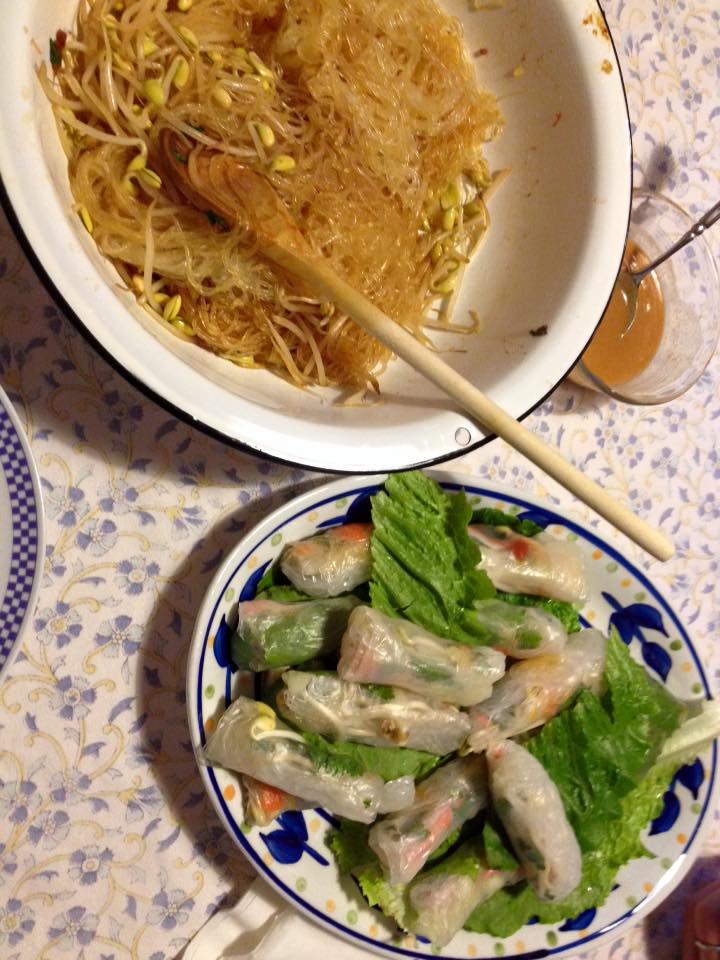
Yesterday was the day we finally got around to it. We went to the Hong Kong Grocery downtown — they have pretty much everything you need to make pretty much anything except matzo ball soup — and we carried home a tote bag filled with the necessary stuff. We had a packet of rice paper wrappers — mysterious things I’d never used before — and a nice bunch of cilantro and a head of lettuce. We had surimi (imitation crab sticks), purchased because the more traditional spring roll animal flesh, shrimp, is unacceptable to my daughter. We had a fat carrot to grate, bean sprouts, a package of bean thread noodles. At home I already had a cucumber and all the condiments I’d need to pull this off.

It was early in the afternoon when we began the prep work: I explained to my daughter that making the spring rolls would be a lot of work and that it’d be easier if we got the veggie prep done well in advance. “We have to wash all this stuff before we can use it,” I said. “Let’s just get it done and then we can hang around and be lazy for a couple of hours before we really get to the hard part.”

“Why is it the hard part?” my daughter asked.

“Because I don’t know what the hell I’m doing,” I said.

We stood at the sink and spent some quality time with the salad spinner. We washed cilantro and bean sprouts and lettuce; my daughter plucked the leaves from the stems of the cilantro and filled the 1/2 cup measuring cup I’d put out for this purpose. She did a great job. I made sure that the surimi was thawed, and then we played a game of Scrabble.

At five o’clock, I filled a big enamelware bowl — I usually use it as a salad bowl — with hot water, and we lined up our mise en place, and we got to work.

Within roughly fifteen seconds I realized I was going to lose my mind. I knew that working with rice paper wrappers wouldn’t be fun, but I hadn’t fully grasped how evil those little shits would be. You have to soak the wrappers and dry them before you put them on your work surface, lay filling on them, and then roll them up. It makes hamantaschen-folding look like pouring a bowl of cereal.

I produced four spring rolls, all of them technically correct — untorn, complete — but they were messy, ugly, and I said to my daughter, “This is going to kill me.” I had no idea how many spring rolls I’d have to make in order to have spring rolls be an entire meal. In the meantime, I was tired and cranky and losing my ability to be patient with this very, very fiddly work. We had to empty out the water bowl and refill it several times: no cookbook or website I looked at mentioned this, but if the water’s not hot enough, the wrappers don’t soften correctly. And if you don’t time it JUST RIGHT, the wrapper’s not worth a damn, either. Every recipe I read said to soak the wrapper for 10 to 20 seconds, turning it once in the process. Well, no: it was more like 5 seconds on one side, three seconds on the second side. We counted aloud, that’s how I know.

You soak the wrapper and lay it on a towel, and then you fold the towel over so that you dry the top of the wrapper quickly as well. Then you have to somehow migrate the very delicate wrapper to a place where you can roll the thing up. (I suppose it could all be done on the towel, but it’s hard to see the wrapper when it’s on the towel.) A little bit of bean noodle; a little bit of carrot, of cilantro, of surimi — then you fold it like a little bitty burrito. Or, as I observed to my husband, when he got home, like a boerek. (How do I know about making boereks, those little Turkish cheese pastries? It was an annual fundraising project at my daughter’s nursery school. Don’t ask.)

Making spring rolls is one of those things where, It’s not that it’s hard; but it’s HARD. I assume it takes hours of practice to get really skilled. I had a running monologue going on the subject as I took the wrappers from my daughter and laid them on the towel and dried them and then filled them and rolled them. “The kitchens at the Thai and Vietnamese restaurants are probably all staffed by people who’ve been making these things since they were six years old,” I spat. “By the time they’re teenagers, they can do this in their sleep.” “Uh-huh,” my daughter said sympathetically. She knows when I’m on a tear. “You realize we’re never doing this again, right?” I said. “Uh-huh,” she said. At one point she refilled the bowl with hot water and carried it back to the counter saying, “I’m not gonna spill, I’m not gonna spill,” (and she didn’t) and she said, “I would give you a hug except I’d get in your way.”

I muttered my way through rolling a platter’s worth of spring rolls. A couple of them were so wretched I just fed them directly to my daughter, do not pass Go, do not collect $200. She declared them delicious. I got through my supplies of slices of surimi, cucumber, cilantro leaves, and grated carrot, and thought, “I’ve had enough of this crap.” I still had a huge bowl of bean thread noodles in front of me. And my husband and child were looking hungry.

So I cooked up a sauce out of peanut butter, garlic, ginger, soy sauce, and peanut oil, and mixed it into the noodles with my hands (this is the only way I can effectively mix sauces in with noodles like this; I don’t know how other people manage it otherwise). I sprinkled the last of the bean sprouts on top and set the bowl on the dining table. Then I whisked up a sauce for the spring rolls (peanut butter, soy sauce, Sriracha, garlic) and brought that to the table. Lastly, I brought out the spring rolls.

I had to admit, it all looked fairly impressive. Spring Rolls Cellophane NoodlesMy family certainly inhaled vast quantities of food. I think I’d rolled well more than a dozen spring rolls, when all was said and done — I could figure it out by counting how many wrappers were leftover, but that’s too depressing to contemplate, because it means I’d have to face how many I have leftover to deal with in the future. And a dozen spring rolls doesn’t sound like a lot of spring rolls, but when you’re an incompetent klutz and a novice at working with rice paper wrappers…
 

Well. I think, actually, that I can handle it. I think that given a little more practice, I can get good at it. And that if I do get good at it, it will be worthwhile. Just like with the hamantaschen. But in the meantime, I’m going to order spring rolls in restaurants as often as I can to try to figure out how to get mine better. Yesterday’s spring rolls were a new room in the Museum of Tsuris, but I have to believe that given practice I can demolish that room.
In the meantime, the leftover cilantro’s been turned into chimichurri sauce, which we’ll be having with a broiled steak for dinner tonight. Potato salad on the side. Very straightforward compared to last night, to which I say, Thank god.


An interesting theory about Ovaltine.

I grew up drinking Ovaltine, preferably the Rich Chocolate variety. I love the stuff. However, I don’t think I’ve ever been romantically involved with anyone who liked it. I remember one old boyfriend who referred to it as “sewer water.” My husband loathes the stuff and mocks it at any available opportunity. Naturally, Christmastime is prime time for mocking Ovaltine, because we all watch A Christmas Story on TV and Ovaltine is practically a supporting actor in that flick. It was last Christmas that my daughter noticed that Ralphie was always drinking Ovaltine, and she asked what it was. I explained that it’s a kind of chocolatey powder you add to milk. The next time it seemed like a nice thing to do — after we got home from Christmas travels, and she needed a drink of milk — I offered her a chance to try some Ovaltine.

Now, my daughter was seven years old at the time, which means, yes, I had been deliberately withholding Ovaltine from her for seven long years. But my system has worked pretty well. By regarding it as a treat, and not something one consumes on a daily basis (as we might a glass of regular milk), it’s now a big deal wonderful thing when I say, casually, “hey, you want a glass of Ovaltine?” I don’t do this when my husband’s around, by the way. It something that happens after school, when it’s just me and my daughter, and Mama makes the rules. It’s like a bonding thing for us. Cold, cold glasses of Ovaltine, for me and my girl.

So this afternoon, my husband and my child and I were eating lunch. She was having a bowl of leftover tortellini salad from last night’s dinner. My husband and I were eating bologna and cheese sandwiches, which are not part of our usual repertoire here. But I bought some yellow American cheese and bologna the other day because I’d been reminiscing about how when I was in high school, I used to eat bologna and cheese sandwiches for breakfast every morning, and how good they were. I would take two slices of bread and toast the cheese onto the bread in the toaster oven, and then slap a circle of beef bologna into the middle of the slices of bread. It was a great breakfast, fast to assemble and the cleanup was a snap because there was just the plate to rinse off.

My husband, hearing this description, suggested that I should try to replicate this sandwich, and see if it was as good as I remembered it. So I did.

My husband, eating his sandwich, agreed that it would indeed be a good breakfast.

I said, “Of course, we’re not doing it right. To do it right, you wash it down with a glass of cold, cold Ovaltine.” My husband snorted, and my daughter crooned, “Ooooooovaltine. I love Ovaltine.”

“Chocolate milk with that disgusting chemical aftertaste,” my husband said.

“Our daughter’s pediatrician loves Ovaltine,” I said haughtily. I was, by this point, in the kitchen, loading my plate into the dishwasher. My husband was not within my line of vision but I could hear him rolling his eyes.

“She was a formula-fed baby,” he said. “So of course she loves Ovaltine.”

“What do you mean?” I asked, though I knew where this was headed.

“People who drank formula when they were babies will love Ovaltine,” he said, “and people who drank breast milk won’t, because they don’t like the taste of all the chemicals.”

“Hm,” I said.

“Our daughter’s doctor was a formula baby,” he said.

“How do you know?”

“She told us. When we took our daughter for her first checkup, when she was a couple days old, you told her that breast feeding wasn’t going so well, and she said, “So, formula’s fine. I had formula, and I’m ok.” I conceded that the doctor had indeed been approving of our feeding our little girl formula. “And you were formula fed,” my husband pointed out. “So it makes sense that the two of you love Ovaltine. But I was breast-fed, and I think it’s vile.”

I wanted to say, “You’re so full of shit,” but part of me thinks, “well, actually, that’s reasonable.” But is it true? Are people who were fed formula as infants predisposed to like Ovaltine? Are there any studies on this? Can anyone out there tell me?

In the meantime, my health’s been pretty good, and my daughter’s health record is sterling, and the Ovaltine doesn’t seem to be hurting us any. So as long as we both enjoy it, I’m gonna keep a jar of it on hand.

A Plan Hatched in 1993 Comes to Fruition

Ever since I read More Home Cooking by Laurie Colwin I have thought, “I should make yogurt.”
This is a book I purchased the day it arrived at the bookstore where I then worked. I was making $5 an hour, which is to say, bupkes, but I bought it in hardcover and brought it home hours after I’d freed it from the shipping box. I carried it home, made myself a meal of spaghetti with pesto sauce (in those days I bought pre-made pesto sauce), and sat down to eat. The very first thing I did was inadvertently fling a blob of pesto onto one of the pages of the book, staining it permanently. I think I cried, I was so angry at myself, but I quickly grasped that Colwin wouldn’t mind at all, so I blotted off as much oil as I could and then kept eating and reading.

In this volume, Colwin assures her readers that any damned moron can make yogurt. I was skeptical, but thought, “Maybe she’s right. She wouldn’t lie to me.” And so I got the idea in my head that someday I would make yogurt.

Every six months or so, ever since then, I have had the thought, “I should make yogurt. See how easy it really is.” But I never did it. Whenever  the thought crossed my mind, I would be lacking one of the essential ingredients — I didn’t have enough milk on hand, or I didn’t have good, plain yogurt. There were times when I would deliberately buy fancy milk or fancy yogurt, thinking, “I will use these to start my own yogurt,” but it never worked out. This went on for decades. It’s now 2016, after all.

But yesterday I was spending an afternoon at home. My daughter had, rather uncharacteristically, decided to take a nap. I was downstairs and awake, willing to do something in the kitchen, but not willing to make a lot of noise (so anything involving the stand mixer was out). I realized that I had on hand a nearly full carton of Preferred Milk (Farmer’s Cow whole milk) and about a third of a tub of very good yogurt from Arethusa Farm Dairy.

“Here we go!” I said. And so I pulled More Home Cooking from the shelf and got to work.

Colwin says that making yogurt is ridiculously easy and that you don’t need a thermometer to do it, to which my response is, “Maybe YOU don’t need a thermometer, but I’m glad I have one.” I did exactly as she said. I took 2 1/2 cups of milk and brought it to a boil in a pot. She doesn’t tell you to have the pot boil over and make a huge mess, but I achieved this effortlessly, as well. I then simmered the milk for two minutes and took it off the heat and let it cool down. It needs to come down to a temperature between 110°-115°, which takes longer than I would have guessed if I’d just been relying on my finger to test; I was glad to have the Thermapen to let me know what was what. (Colwin says, by the way, to bring it down to 110°, but when I looked in other cookbooks to see how their recipes compared, what I found was a range — between 110° and 115°. When mine was at 114°, I moved.)

When the milk is cool enough, you whisk in your yogurt starter. I used about 1/4 cup of the Arethusa yogurt. I then made a mess on the counter pouring all of the milk and yogurt into the glass Mason jar, but most of the stuff got into the jar. I closed the jar, wrapped a tea towel around it, and set it by the stove. You want to keep it warmish while it’s fermenting or doing whatever it’s doing. I then had a lovely time cleaning up the milk from the stovetop and the countertop.

After dinner last night, when I was cleaning up the kitchen, I noticed the jar sitting by the stove and wondered if it would remain warm enough. I had just scrubbed out the biggest Dutch oven we have and it was still warm from the hot water. I decided to put the jar into the Dutch oven and balance the lid on top. I figured the residual heat couldn’t hurt the yogurt and might help it along. A lot of yogurt recipes tell you to keep the jar by the pilot light of your oven to maintain temperature, and that’s great advice, but I don’t have a pilot light of which I am aware (though there must be one, since I have a gas stove). What’s more, if I put the jar into the oven and left it overnight, I would be all but guaranteed to forget about it, which I know would lead to total disaster. So the “jar-int0-warm-Dutch-oven” plan seemed like a good compromise. I balanced the pot lid on the top of the Mason jar and turned off the kitchen lights and went up to bed, thinking, “Well….. we’ll see what we’ve got in the morning.”

Everyone writes about how when they first start making yogurt the results are soupy. That’s the word everyone uses: soupy. So I didn’t have very high expectations for my first attempt; I figured that the worst-case scenario was that I’d make soupy yogurt and then spend some time draining it with cheesecloth or use it to make a yogurt cake. I wasn’t optimistic about the process but I was curious to see what would happen.

This morning when I went downstairs to get a cup of coffee, I noticed the pot on the stove and thought, “Come on, who left a pot on the stove last night?” and remembered that it was me. Then I remembered the whole yogurt thing. I took out the Mason jar and shook it a little: would the yogurt just splosh around in there?

To my astonishment it did not splosh at all. It was a solid mass with just a little bit of whey floating at the top. In other words, it looked exactly like real yogurt. I opened the jar and took a spoonful of it: it tasted just like real yogurt.

In other words: I had successfully made yogurt. And it really was easy.

So now I feel like a jackass for not having done it before.

On the bright side: I now get to spend time thinking about how to make it even better. Must remember to add Farmer’s Cow Half-and-Half to the shopping list.

Postscript: I fully expected my husband and child to be excited about the yogurt this morning, and to want some with breakfast. My husband is in the habit of eating yogurt in the mornings, so I was particularly confident that he would want some. Instead, he complained, “What happened to my Arethusa yogurt? There’s hardly any left in the tub.” I said, astonished, “I used a quarter cup of it as a starter for the yogurt I made yesterday.” He said, “So you didn’t really make yogurt. You just took someone else’s yogurt, and added milk to it, and now you’re calling it yogurt.” “You wanna try some?” I countered. “No,” he said.
It then dawned on me that he didn’t trust the yogurt I’d made. “It’s good!” I insisted. I got the jar from the fridge. “Look! It looks just like yogurt! From the store! Except it’s homemade!” He glanced at it dismissively. I put the jar back in the fridge, saying, “I can’t believe you ingrates. I make yogurt and none of you will eat it.”
“Have you eaten any of it?” my husband asked.

“Yes!” I said. “I had a spoonful of it.”

“Well, let’s wait and see what happens,” he said.

Basically, he’s positive that I’m going to give everyone food poisoning with the yogurt. So my yogurt victory may be a total loss on the domestic front. I had not planned to put this post into the Museum of Tsuris, but after this update, I feel I have no choice. It’s not that the yogurt has given me any tsuris, mind you, but my husband sure has. Ingrate.

I Cooked a Blue Apron Meal and All I Got was…

…. well, I got a lot of things out of my Blue Apron meal. I got a lot of little packages, and I got enough food to sort of feed the family, or, at least, it might have fed the family, had the family genuinely liked the food. What I really got was, simply, the experience of using Blue Apron, and confirmation that, for someone like me, it’s a total waste of time.

I already knew I was kind of anti-Blue Apron, just on principle, but I didn’t realize how frustrating it would be to prepare a Blue Apron meal until I set out to do it. I guess part of my problem stems from the fact that I obviously misunderstood what it is that Blue Apron saves you time on. As my readers doubtless know, Blue Apron is a service that delivers to your door a box of ingredients for cooking dinner. You go to their website and look at their menu and select which meal(s) sound good to you, and the ingredients for those meal(s) are shipped to you in a refrigerated box. I knew this, but since I’d never played with the contents of such a box, I didn’t really understand how it worked, until this week.

A few months back, I noticed that my neighbors, a very busy young couple, started receiving Blue Apron packages. I figured that my neighbors’ schedules were so batshit that the service made sense to them, even though they live literally one block from a lovely Italian grocery store, three blocks from another lovely Italian grocery store, and within easy walking distance of so many other places to get food, it’s ridiculous. (I mean, there are reasons I live in this neighborhood.) The other day, the lady of the house caught me in the courtyard. She said, “Hey, I was wondering — we’re getting our Blue Apron shipment today but we’re not going to be around to cook it. I meant to cancel it but I forgot. Is there any chance you’d want it? I mean, I hate to waste the food.” I thought about it and realized this was my chance to have a crack at a Blue Apron project and said, “Sure!” So late yesterday afternoon she knocked on the door and handed over the goods.

There was a package of two catfish fillets; a little plastic bag with two Yukon Gold potatoes; a really tiny plastic packet with two sprigs of parsley in it; a small foil box of organic whole milk; a plastic bag with a weird grayish powder in it that I took to be the flour mix for breading the catfish; 1/4 of a head of Napa cabbage; and another mini-package with something in it called “knick knacks.” It took me a while to figure out the “knick knacks” because I was afraid to just open it up. It finally occurred to me to read the glossy color instruction sheet my neighbor had helpfully given me. The “knick knacks” were the things you need to make the recipe, things that, in a household like mine, you’d just have because you have them. Things like cider vinegar and butter and mayonnaise and “cajun spice blend.”

I don’t have a jar of Cajun Spice Blend around, but Blue Apron does explain to us what Cajun Spice Blend is. It is: smoked paprika, ground yellow mustard, onion powder, garlic powder, dried oregano, dried thyme, and cayenne pepper. In other words, stuff I had sitting around on my spice shelf.

My family considered this pile of ingredients. My daughter, who isn’t a big seafood person, said simply, “Yuck.” My husband said, “Catfish is good!” but seemed dubious: two potatoes does not make a whole lot of mashed potatoes. And the quarter of a head of cabbage — it was to laugh.

Well, I set to work. I read the instructions carefully and inspected the pretty color photos to make sure I understood what Blue Apron wanted me to do. It seemed to me that this was a situation where, if I winged it, I wouldn’t be giving the product the test it deserved. I resolved to follow the instructions to the letter. To this end: I took a shallow bowl and poured some of the milk and the vinegar into it, and then I stirred it around a bit, and placed the fish fillets in the bowl. This is supposed to do something to the catfish akin to soaking catfish in buttermilk. (Curdling milk with vinegar is a good way to approximate buttermilk; even I know that.) I’m not sure why we are supposed to soak catfish in buttermilk but this is Standard Operating Procedure, so, fine. I soaked the fish and turned it over in the “buttermilk” intermittently while I washed and dried the cabbage, sliced it finely the way Blue Apron wanted me to, and assembled the cole slaw (combine with mayonnaise, a little vinegar, and Cajun Spice Blend). I also set a pot of salted water to boil for the mashed potatoes. I hate making mashed potatoes; I hate cooking potatoes. But I dutifully washed and peeled and chopped the potatoes and boiled them for 12 minutes. Then I drained them (saving the potato water to use in making bread — thank you, Blue Apron, for my future loaves of potato bread) and mashed them with more of the milk and the butter Knick-Knack.

Once the potatoes were done, I put the pot in the (gently pre-heated) oven to stay warm, and I assessed the overall situation. It was abundantly clear that the cabbage might have created enough slaw to satisfy our cabbage needs (raw cabbage doesn’t shrink down the way cooked cabbage does, so I guess 1/4 a head of Napa was sufficient, and my snotty laughter was uncalled for). But there was simply not going to be enough of this meal to feed three of us. For one thing, our daughter was sure to not want to eat any catfish; and there were nowhere near enough potatoes. So I filled a stockpot with water and set it on to boil, and then I spent a few minutes mincing onion and garlic and getting a pot of pasta Natalie ready. (This meant sautéing onion, garlic, and some chopped olives in anchovies, and olive oil and then blending in tomato paste and water. It’s not hard to put together, thank god.)

Once the Natalie sauce was assembled and I didn’t have to think about it anymore, I heated some oil (not provided by Blue Apron) in a wide cast iron pan and dressed the catfish as instructed — shaking the “buttermilk” off the fish and dredging it in seasoned flour. I fried the fish and drained it on paper towels as Blue Apron advised.

“Okay everybody,” I said. “As soon as I’ve cooked the spaghetti, dinner’s ready.” I chose thin spaghetti because it takes five fewer minutes to cook than regular spaghetti, and seven minutes later, the three of us were seated around the table.

“That’s catfish?” my daughter asked, looking skeptically at the handsome platter of fried breaded fish.

“It’s yummy,” my husband said. “Well, it looks yummy,” he said. He took an entire filet and put it on his plate.

“I made spaghetti for you,” I told my daughter. “Don’t worry.” I gave her a large serving and grated cheese onto it and spooned some extra olives on top. “Here you go.” I then served myself some fish, some potatoes, and some cole slaw.

The cole slaw was fine. The potatoes were fine. The fish was entirely unappetizing. I ate a bite, trying to be optimistic. “What do you think?” I asked my husband. “It’s ok,” he said. I chewed, took another bite. “Is the problem the fish or the way I cooked it?”

“I have don’t know,” my husband said. The truth is, I almost never cook fish, so there’s no way anyone could described me as a skilled seafood cook; how could this have turned out well? My husband, the poor guy, doggedly continued to consume his fish. I got through half of mine and gave up.
He looked at my plate sadly. “Had enough?” he said.

“I’m switching to spaghetti,” I said, humiliated. “The cole slaw is good,” I said.

“The potatoes are okay,” my husband said.

“Can I have more spaghetti?” my daughter asked.

By the end of the meal, there were no leftover potatoes and the cole slaw was gone. One half of a catfish filet remained; there was enough leftover pasta to serve some to my daughter for lunch the next day and give myself some for lunch too. Had my husband and I not had catfish, cole slaw, and potatoes, there would have been no leftover pasta at all.

“What should we do with the leftover catfish?” I wondered.

“I’ll take care of it,” my husband said. I assumed this meant he would choke it down. I wiped down the kitchen counter and took the dirty kitchen linens upstairs, saying, “I might as well do a load of laundry now.”

While I was standing at the washing machine measuring in the detergent, my husband came up the stairs holding a small bowl. We don’t generally have food upstairs, so I was curious. “What’s going on?”

“Watch,” he said. He put the bowl down on the floor in the stairwell and our cat came trotting over from the towel on the bedroom floor that he regards as his bed. He sniffed. “You’re giving the cat the catfish?” I said. My husband smiled affectionately at the cat. The cat pawed at the fish and licked his paw once; then he repeated this exploratory movement. Satisfied that this was food, he then plowed through the scraps of fish in the bowl. “I only gave him a few flakes,” my husband said. “The rest of it I’m saving in the fridge as treats.”

“Okay,” I said, defeated. The truth was, if neither of us liked the fish, then the cat might as well enjoy it. The cat finished the fish in his bowl and marched away, pleased as punch. A tiny flake of fish had landed on the floor. I debated bringing it to him and decided that was insane and threw it into the toilet bowl. Then I went downstairs to help finish cleaning up the kitchen.

“I think Blue Apron’s worth it for people who really can’t stand grocery shopping,” my husband said, “or people who’re living in those extended-stay hotel type places and maybe don’t want to deal with stocking a pantry while they’re there.”

“Yeah,” I said, dolefully putting leftover pasta into a plastic tub.

“But otherwise, it’s not really worth it. They don’t take care of the prep for you, or the cooking. It’s just the shopping.”

“I spent just as much time cooking this meal — more time, really — as I would on any other normal weeknight dinner,” I said. “And it was ok, but none of us really liked it.”

The cat marched down the stairs and came into the kitchen and looked at us expectantly.

I’m wondering if I should make my neighbor an offer. For $50 a week, plus the cost of groceries, I will cook dinner for her and her husband two nights a week. It might be a better deal than Blue Apron.

The Pros and Cons of Picnics

The Hausfrau is, pretty much by definition, someone who wants to avoid the Great Outdoors. If I have to be near nature, it has to be under controlled circumstances, or there will be hell to pay: I become very unpleasant to be around, very quickly, if those needs are not met. One, there must be proper bathrooms within easy walking distance. Two, there are certain creature comforts that must be brought along for the duration. These include, but are not limited to: good food; appealing reading material; and something comfortable to sit on that separates my tush from nature. I don’t require sunscreen. I don’t require a tent (though maybe I should). I don’t see what’s so appealing about being uncomfortable, and it always seems to me that being outdoors equates to being uncomfortable. I have never gone on a hike, and I plan to keep it that way.

However, I have a child, and that child finds picnics delightful. So does her father. Over the years, as a result, we have developed a pretty solid system for picnicking. There are different versions of our picnics; we select which version we’re doing based on where we are going. And the quantity of preparation involved depends entirely on which type of picnic is anticipated, and how long we will be away from home.

The short, easy version of a picnic is what my daughter and I do when we have lunch in the courtyard of our apartment building. This is the most bare-bones picnic I do, which should alarm you. Supplies include:

Large, easily laundered blanket or tablecloth; cloth napkins; an entree; a crunchy snacky thing to have on the side (e.g. potato chips or similar); something light, juicy, and crunchy to eat, like sliced cucumbers or grape tomatoes; some cold fruit; beverages; some small sweet thing for dessert; reading material. The blanket is carried outside and spread out by my daughter while I stand holding a tray on which everything else is stacked. A picnic like this generally lasts about an hour, maybe 90 minutes if we decide to lie down on the picnic cloth and just read for a while after eating, or if my daughter decides to go look for praying mantises while I lie down and read. Cleanup is simple. Everything is stacked back onto the tray, and the blanket is rolled up, and things are carried back into the house.

A more involved version of this picnic is the setup we use when we go to the pool to spend a few hours. Depending on the time of day, we either need to bring lunch and snack with us, or snack and dinner. Either way, the above list is (minus the tray) packed into a large tote bag with some carefully arranged additions: the drinks might, for example, be packed into Ziploc bags containing ice. This keeps the beverages and everything else cold, which is important on a hot summer day, but keeps the entire enterprise still highly portable, which is also important because we take the bus. The two of us have to be able to carry all of our stuff comfortably for a distance equal to roughly two blocks. That’s not so far, but I can promise you that carrying a heavy cooler two blocks would be no fun. So: bigass tote bag, and bags of ice (which serve a dual purpose, because you can use the ice water, if you want to, to rinse hands, cool foreheads, or even drink, if it comes to that).

If my husband is joining into the picnic things will become even more elaborate, because then we usually have the luxury of being driven to the picnic location. If we are headed to a beach, then a beach umbrella is involved. Using a car means we can use the cooler and the tote bag, or even two coolers (one for food, one for drinks).  It means things are likely to get pretty elaborate.  Food that requires plates, forks, knives, food that will be cooked on-site on a grill. Ziploc bags of food will be prepped and sealed up for safe travel — marinated steak or chicken; sliced veggies on skewers; the various components for a salad to be assembled upon arrival. Salad dressing goes into an old spice jar or an old jam jar, depending on how much dressing is needed. All forks, knives, and spoons are packed into their own Ziploc bag, so they’re clean when we sit down to eat; and after we eat, when they’re dirty, they go back into the bag to be carried home for washing without getting other things all gunked up while in transit.

Often, it is necessary to have sharp knives with us when we are having this kind of picnic. Sharp knives require special packing effort. Because we are not professional chefs, we don’t have one of those snazzy rolls for safely toting knives around, but I’ve managed to come up with a fairly acceptable homemade system, which involves using dishtowels to wrap the knives up, and rubber bands to secure the little bundles. So long as only my husband and I unwrap them, it works fine (our daughter knows to not help unpack those items).

It is smart to bring a light plastic cutting board or two on a serious picnic. Something thick enough that you can safely use it on the ground, if you have to — not just one of those flexible plastic mats that seem so perfect for picnics because they’re so light and take up so little space. They’re also so light they’ll blow away in a strong breeze. Leave those at home and get something a little sturdier and pack it into the tote bag. If you’ve got a nice loaf of bread you want to slice to eat with the meal, you don’t want to cut it on the birshit-covered picnic table, do you? And after you’ve covered the birdshit covered picnic table with a cloth, you still don’t want to use the cloth as a cutting board. Bring a cutting board.

Cloth napkins are preferable to paper napkins because they’re also not so likely to blow away in the wind while you’re at table/on picnic blanket. That said, it is smart to bring along at least part of a roll of paper towels, because they can be really useful. Paper towels — which I almost never use at home — are the kind of thing that takes almost no effort to pack, and doesn’t seem like a big deal, and you think, “eh, it doesn’t matter, the napkins will be fine.” And if you leave them at home, everything is fine until you run into trouble (you need to clean up some big mess/want to drain something/want something disposable to rest a bacteria-laden object on) and don’t have anything appropriate.  And then you find yourself asking the air around you, “Does anyone have any paper towels?” So do yourself a favor and just pack some paper towels. If you don’t want to carry a whole roll, just tear off ten or so towels and pack them into something that will keep them clean, dry, and unrumpled. If you don’t use them on this jaunt, you can keep them safe for the next outing.

Stacks of paper plates are a good idea if you can’t have proper place settings. Some people have plastic dishes they use for picnics; I admire that but we don’t have any and I’ve yet to convince myself to invest in any, but am definitely not taking my proper plates to and fro for picnics. I know that it’s not environmentally friendly to use paper plates, but sometimes in life we make compromises. Mine is using the occasional small stack of paper plates. Sue me. Similarly, I don’t have a supply of plastic cups I reserve for picnics. We drink cans of seltzer or bottles of beer from the can or bottle, and call it a day. Wine drinkers; you’re on your own, I have no sage advice for you.

So you haul all this stuff to the place where you will be picnicking. If you’re going to cook, you set up your on-the-road mise en place. Someone mans the grill while someone else sets the table: tablecloth goes down first, whether it’s on the ground or on an actual table. Anchor the corners of the tablecloth with heavy-ish objects that everyone will need as the meal progresses — cans of seltzer, or bottles of condiments; the bag of cutlery can anchor one corner until the contents are pressed into use.

You set the table in such a way that it’s comfortable. You want everyone enjoying the meal to be able to enjoy the meal; no one should sit down to eat and not know where their napkin is, or where their fork is. Just because you’re eating outside, it doesn’t mean you have to live like animals. You don’t have to have dirt in your food. And you don’t need special gear, those fancy picnic basket sets (or not so fancy ones, even) that look so charming. Believe me, I think they look charming, too, but I’m convinced they’re more trouble than they’re worth. Most of us have what it takes to haul our stuff to a picnic without investing $30, let alone $150, on special picnic gear. You own serving spoons; bring a few with you so that you’ve got a way to serve your green salad and your fruit salad with different implements. You don’t want vinaigrette on your watermelon and blueberries, do you? No, you don’t. So just pack some spoons. Pack some tongs. If you’re going to do this, do it right.

Because — and this is crucial — I know it seems as though you’re preparing for Armageddon, when you’re packing up. But when you come back home, there won’t be as much stuff, because most of it will have been eaten. And then it’s just a matter of washing up. If you used paper plates, well, you threw those out already, right? It’s a matter of silverware and serving utensils, maybe a couple of trays, your cutting boards, the bowls you packed your salads in… it’s really not so bad. Now that we have a dishwasher, it’s pretty easy for me to just carry the tote bag of dirty stuff to the dishwasher and load the machine straight from the bag. Leftovers are already in bags or plastic tubs ready to go into the fridge. The tablecloth goes into the laundry with the napkins (and the beach towels and bathing suits that probably have to be laundered anyway). And if you never had to open your packet of paper towels, really, you’re ahead of the game for the next outing.

The really fun part of planning a picnic, as I learned from Laurie Colwin years ago, is the same thing that’s really fun about attending a picnic: the food. That is what I’ll talk about next: the food.

Summer Laundry: The Season has Begun

I write this at 9.15 in the morning on Wednesday. This is important information, believe it or not.

Normally, my week starts with Laundry Day. Monday is Laundry Day. There are usually two or three loads of laundry done that day, washed, dried, folded, and put away, ideally by 2.30 p.m. Some weeks, I have a second, smaller Laundry Day toward the end of the week, on Thursday or Friday, but it’s not written in stone. It depends on how vigorously active the household has been. How much of a mess have I made in the kitchen, such that we really need more towels washed? How big a mess did my daughter make of herself when she ate spaghetti and meatballs for dinner? Did my husband spill pan sauce on his shirt and pants when he offered to help out on Wednesday night?

So it pays to be flexible, when thinking about laundry.

I did laundry two days ago, on Monday. I thought we were set for the week. But somehow, between Monday and right now, Wednesday morning, the laundry basket — which is tall and capacious — became utterly filled with clothes that needed washing. So when I got home this morning, after taking my daughter to school, I took a look and started sorting. Sure enough, there’s a big load of whites and a big load of darks accumulated, and the situation isn’t going to improve any if I let things sit for a couple of days. I turned on the washing machine and threw in a load of whites. Then I went downstairs and took the leftover coffee and instead of heating it up in the microwave, I added some coffee ice cubes, milk, and sugar, and made the first iced coffee of the season. I am now sitting on our balcony, drinking iced coffee and listening to the washing machine, wondering, “How is it we already have so much laundry and it’s only Wednesday?”

It took me about two sips of iced coffee to realize: we’ve hit Summer Laundry Mode.

People with children will probably know, immediately, what I mean. Because a normal person would think that laundry rotations would stay constant throughout the year. You only wear so many socks, so many pants, so many shirts in the space of a week, unless you’re someone like Michelle Obama or Madonna, whose costume changes I imagine happen pretty much hourly. But the reality, even for non-celebrity types like us, is fluid and usually seasonal in its ebb and flow. In wintertime, one does less laundry than in the summertime, because children play outdoors less and the clothes do not require as much laundering as a result. (I suppose if you allow painting in your house, or other types of messy childish fun, this axiom will not hold; but since I am a Wholesome Play Fascist, who does not permit painting in the house, it works for me.) It’s true that wet, snowy clothes have to be laundered, especially if they get kind of muddy in the course of events — a common occurrence during New England winters — but in general, a pair of jeans can be worn numerous times by a child before it has to be washed. Shirts can be worn more than once, because they are hidden under sweaters, and so don’t get dirty on first wearing. And sweaters, unless doused in something gross, can be worn many, many times between launderings (though you do have to remember to not put wool sweaters in the dryer, which is a nuisance). In other words, the big things get numerous wears before washing, and what accumulates in the basket is little stuff: my daughter’s underwear and socks. The grownups’ under wear and socks. And those don’t take up a lot of space in the laundry basket, though they do add up.

But come fine weather, it’s another story. That’s when the child plays outside all the time. She tumbles in the grass outside; she goes digging in the sandbox at the playground; she climbs trees; she crawls through hedges looking for the praying mantis that she saw go hide in there. She eats ice cream and gets some on her shirt. All this, plus the usual paint smear from a school art project and, of course, the traditional spaghetti and meatball stains. It means that every day involves at least one shirt or dress, and sometimes two, and on a really hectic day (there might be birthday party to dress up for) maybe three different ensembles. This morning, for example, she put on a dress to wear to school and then went downstairs to eat breakfast: peanut butter on toast. When I stepped out of the shower, she was standing there telling me a complicated story about something I don’t even remember; what I do remember is I looked at her and said, “What’s that crud on your dress?” She looked down and said, “Peanut butter.” I said, “Go change your dress. You can’t wear it to school. You’ll get near some kid with a peanut allergy and they’ll have to go to the hospital because you made them sick.” So that was one dress already rendered unfit for wear before 8 a.m. today.

In fairness, come nice weather, grownups create more laundry too. We sweat through our clothes as we walk to work, as we schlep the groceries home, as we ride the bus and accidentally sit down in something, I don’t even want to know what, that was on the bus seat. Our clothes often cannot be worn twice either. Not if we want to maintain cordial relations with anyone, anyhow. My husband’s jogging clothes must be frequently laundered, or I’ll have to abandon ship entirely. And other things get added to the laundry pile more frequently in the summer, big things: the blankets and cloths we use when we go on picnics, those get laundered after use, because I’m skeeved out by the idea of not laundering them (ticks! general filth! yuck!). Organizing a summer picnic is one of the few activities that all three of us view as hugely entertaining. So it’s not like I’m going to say, “I’m sick of laundering blankets: no more picnics!” And those of you who are saying, “well, why do you need to have a picnic blanket anyhow? Who cares, can’t you sit on the grass?” — I don’t want to have a picnic with you. We like it this way; we believe in it; we think the picnic is almost an art form; and if we can’t do it right, we’re not going to do it at all. And we have to do it, because we just do. So don’t give me tsuris. Just believe me when I say: it’s more laundry.

Complicating matters further: we occasionally (ok, frequently) go to a swimming pool in the summertime and last summer I learned that it was not good enough to have two bathing suits for the child, two bathing suits for me, and one towel per person. We all have to have multiples of these things, because I cannot keep up with the laundry if we don’t have multiples. It is not fun to put on a rinsed-out-maybe-but-still-distinctly-wet bathing suit. You have to plan ahead. I now have three bathing suits, my daughter has five, and I think we need one more beach towel for me to really feel like we’ve got all the bases covered. Even so, I know I am going to spend the summer doing laundry every 36 hours or so. (My husband also needs another bathing suit, but I am not permitted to try to solve this problem for him, so he’ll just have to suffer with his wet bathing suit all summer long.)

So I’ve got a long summer ahead of me. There will be some summer camp sessions (guaranteed to produce a high laundry count), and lots of picnics, and a lot of bathing suits. There will be a lot of ice cream making, even more ice cream consuming, and somewhat less in the way of spaghetti and meatballs, but more in the way of messy tomato sandwiches. Fortunately, I am capable of planning ahead. I will buy extra laundry detergent the next time it’s on sale. I’ll be ready. Today, however, I’ll just do these two small loads of laundry. Since I got an early start on it, I’ll be done by 2.30. As my daughter says, Easy peasy lemon squeezy.

Some New Terminology in the Field of Domestic Life: The Hausfrau, by Another Name…

Bear in mind, this is all off the (freshly ironed) cuff:

I recently had occasion to hear a woman describing the less-than-delightful first time she met her husband’s ex-girlfriend. The woman (wife) had instinctively made the move to take the high road and not let fear or jealousy of her husband’s past color meeting this person. The ex-girlfriend obviously had no such instincts: When the wife extended her hand and said, “Hi, it’s nice to meet you after hearing so much about you!” the ex responded by not shaking hands and saying, “Oh, what a nice little housebitch you’ll be!”

Which is not an auspicious beginning for much of anything. Except for this:

I’d never heard the term “housebitch” before and on hearing it, I thought, “Wow, that is not a nice thing to say,” and then immediately afterward, “But why does it have to be that way?”

Concerned that I was not grasping the most accurate meaning of the term, knowing I’m not exactly up on current (or even decade-old) slang, I Googled “housebitch” to see what was out there. Naturally, Urban Dictionary rose to the occasion. “Housebitch” is not a term that has any positive connotations, in current/recentish usage. It’s been understood to mean Someone who’s been whipped by life such that all that they’re good for is housework. I gather that the term is particularly insulting when applied to men. But I think that should change. Much as the gay community reclaimed “queer,” and as other groups have taken back pejorative terms to use as statements of group and identity pride, I will say that strong willed women who are housewives should feel free to declare themselves housebitches. I realize that many will be uncomfortable with this. They will be angered by this, because “bitch” is not always perceived as, like, a positive term.

To which I say: If sounding slightly unpleasant is what it takes to convey that, even if you’re a stay at home parent, you’re not a doormat, then so be it. The housebitch, as I see her, is a housewife who is actually pretty good at coming up with dinner for five on a night when you thought it would be dinner for three. The housebitch is a skilled problem-solver. The housebitch is annoyed when the kid spills paint water on the kitchen floor, but has a pile of towels nearby to be used precisely for mopping up this kind of mess. The housebitch has systems for the household that work. The housebitch is someone who knows that it’s smart to own a pair of scissors that can be taken apart for washing, that you always keep a Sharpie in the kitchen drawer, and isn’t afraid of taking apart the vacuum cleaner when it starts making a weird noise. Ten years ago, the kids might have called this having mad housewifery skillz.

A lot of women are reluctant housewives who defensively take pride in being crappy at it because they’re rebelling against the Donna Reedism that they think is part and parcel of being a housewife. They are women who had children and found themselves at home all the time and feel daunted by it and so they do the best they can. That’s fine. The reluctant housewife isn’t likely to embrace housebitchery as I’m envisioning it here, though bitching about housework may be a primary activity. But this may be a mistake: the reluctant housewife who’s pulling it off even half-way well should embrace the moniker housebitch and claim it with pride. Because if she’s still getting shit done, that counts.  If she’s doing it while still wearing her old Fluevogs? Hell yes.

But what about the people who find themselves unexpectedly at home with children and who turn out to be good at it? And whose brains do not, in fact, melt into applesauce as the result of being a housewife? And who say to themselves, “Ok, this has some bad moments, but overall, I can do this shit?” You can be a competent housewife and a sentient being. You can be a housewife and a not-vapid person at the same time. You can be a housewife without being someone who identifies with the current stereotype of the woman who’s holding a microfiber cloth in one hand and a glass of wine in the other hand. You can be a housewife — and be good at it, even — without giving up your own fractious identity.  This has been said before a thousand times, but I don’t think it’s ever been said while connecting this idea to housebitchery. And this is a real linguistic opportunity, which I am grabbing, the way my husband will reflexively grab another brownie before bedtime, just because they are there.

To me, the word housebitch conveys: Someone who’s taking care of the household (making sure that daily life isn’t a total shitstorm; that the kid/s is/are alive and reasonably content at the end of the day; taking care of laundry in reasonable fashion, and making dinner most if not all nights of the week; you know how this list could go on and on) while retaining her former personality. The housebitch is not defaulting to an artificially sweet and light mode because she feels like she has to turn into Donna Reed when she wakes up in the morning. The housebitch hasn’t forgotten who she was before. She’s recognizing that she’s using parts of herself that perhaps didn’t have an application until this time, and making the most of that application. You, Housebitch, can be someone who does a good job of keeping house without sacrificing the things that make you who you are (unless, I suppose, your inner you is just a massive slob, in which case you might have to reconsider). You can be a housewife, and maintain the title respectably, without going off an emotional deep end and winding up as someone who cleans the baseboards with Q-Tips. And yes, I’ve met someone who did this. (She also refinished all the woodwork in an early 20th century house, bit by bit, over a ten year period, and did a job so good that no one would ever guess that all that woodwork had once been slathered with white paint: so we have to admit that the compulsive types have their virtues, in the context of housewifery: when they tackle a job, they tackle a job.)

The housebitch is an intensely domestic person who is frankly ok with that; and who combines that sensibility and skill set without losing her essential sense of self. It may or may not have always been part of her essential self, but it is part of her now,  and she does it on her own terms and often with considerable élan. You can be a housewife without letting a lowest-common-denominator version of housewife take over your personality, your sense of who you are, or, importantly, losing your sense of humor about your day to day life.

It probably helps, to be honest, if in your life Before Housewifery, you were already aware of being something of a difficult character. You have to be self-aware. So I will come clean here (no housekeeping pun intended):

Yes: more than once, people have told me that I was not a fun, easy-to-be-around person. Yes, a boyfriend dumped me once for someone who was “more fun” than I was. I can’t say I was surprised to be described as “not fun.”  Likewise, the word “bitch” has definitely been applied to me. It’s ok. I’m not afraid of it. I have my priorities. I have better things to be afraid of.

Since becoming a parent? I’m definitely even less “fun” than I used to be. I’m the kind of person who will lie on the couch and read a book until 9 o’clock on Saturday night and then go to bed. Going out would mean having to deal with other people, and other people usually suck. (There are exceptions, but those exceptions are almost never in bars or out carousing on Saturday night.) Even wholesome activities, like taking my child on wonderful hikes up the local mountains so that she can experience… dirt, or something? That isn’t going to happen. I didn’t give a crap about nature when I was 25, and I don’t give a crap now that I’m 45. I won’t pretend to give a crap because it’s the trendily virtuous thing to do. I’d really rather stay home and take care of the laundry and listen to music.

But all my life, I’ve also been someone who liked being at home and making “home” a nicer place. My mother remembers my endlessly making “nests” under coffee tables, when I was small; I’d set up a pillow and a blanket and a stack of books and crawl under the table and spend hours under the table, reading, napping, or, probably, just staring at the underside of the table. And I think back on that and go, “Well, that’s a fine afternoon, isn’t it!” The nesting instinct, which supposedly only hits women hard when they’re very pregnant, is clearly essential to my nature, and I suspect that most housebitches would read that sentence and nod.

Not everyone with that instinct is a housebitch full time: there are also part-time housebitches. People have jobs, and they can curtail your ability to get too wrapped up in the minutiae of every last detail. I get that. Housebitchery does involve picking one’s battles. You could be working out of financial necessity or out of emotional necessity. I have a friend who embodies many fine housebitch qualities — she will make dinner for ten out of a can of tuna, a can of beans, and a box of ziti, I swear to God — but she really believes she’d lose her mind if she didn’t go to work somewhere every day. Maybe I’m wrong, but I think she feels she benefits from having her time organized in that way, and she feels it makes her more productive on both home and work fronts, because she knows that the hours at each are finite. She loves home and she loves her family but she doesn’t really get much satisfaction out of doing housework and so for her, she splits her time up in a way that works for her and her family. When she is at home, she is at home with a vengeance, and displays domestic competence that leaves me awed. But I think she feels that if she became a housewife, she would sink into a morass of emotional oatmeal and lose her sense of who she is.
I suspect she finds me mystifying in this regard. She and I had spent years discussing the minutiae of running a household but neither of us ever expected me to become a housewife. When I became one, and turned out to not mind it so much, she seemed kind of awed, and said she could never do it. The way time expands and contracts when you are at home with a baby all day, every day, is very difficult for a lot of people, and I can’t say I thought it was fun, but it didn’t throw me the way I thought it might. It turned out I was good at figuring out how to keep things going under those circumstances. I cooked dinner, I took a shower every morning, the baby grew big and got her first pair of shoes.
I complained when things annoyed me, and lost my shit a few times, but overall, I was temperamentally well-suited to staying home with a baby, and I was good at running the household: making sure we didn’t run out of milk, making sure of a thousand little things. I can’t say I felt called to it, the way people feel they’re called to the priesthood, but it was not the stretch I’d thought it would be. Kind of the opposite, in fact.  

There were foremothers, I am sure. Perhaps the fact that I spent my youth reading Peg Bracken and Shirley Jackson’s Life Among the Savages over and over again prepared me for this life. Bracken and Jackson were women who, in today’s terms, we wouldn’t describe as housewives, but they definitely knew the drill. Most of the great housebitches, I suspect, are women you’ve never heard of — and neither have I — because they toil in anonymity. Maybe they don’t accomplish things that make them famous in the big world. They’re just grousing through their days with as much good humor as they can shake together. The washing machine still emits that funny smell. The dog has to go to the vet. But it’ll be okay, because the housebitch isn’t going to let it bring her down. The washing machine will either gets its shit together (by virtue of the housebitch attacking it with vinegar and Borax) or get replaced. The dog will get to the vet one of these days. In the meantime, dinner will be pretty good, and when everyone goes to bed, they will climb into beds that were nicely made that morning…. The housebitch will prevail, without shame, with pride in her abilities to take care of this shit. She may have to crack her copy of Home Comforts to look up how to deal with getting Gorilla Glue off the countertop, but she will prevail.

And, here, ye shall read her words, and ye shall find succor. And maybe a brownie.

The Problem of the Pencil Sharpener

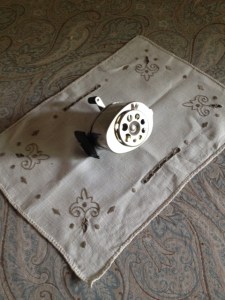
In 2002 my boyfriend and I bought a house together and shortly after that we got married. Sometime soon after that, he bought a pencil sharpener. He bought, in fact, this very pencil sharpener. It is the kind of pencil sharpener that many of us had in our households when we were little kids. Our responsible parents installedPencil Sharpener them in sensible locations: in the doorway near the kitchen closet, in the basement near the workbench, and so on. They installed pencil sharpeners so that everyone in the household would know what to do when a pencil got dull and needed to be sharpened. You would go to the pencil sharpener — which was not too high up on the wall, but placed in such a way that both adults and school-age children could use it — and sharpen your pencil. It wasn’t a big deal, really, but it was definitely fun. Everyone knows that pencil sharpeners are fun. And then there’s the pleasure of using a freshly sharpened pencil.

My husband and I are both fans of pencils, freshly-sharpened pencils in particular, and we have strong feelings about what types of pencils are best. We’re kind of snobs about it, in my opinion — perhaps my husband would protest and say, “I’m not a snob about pencils!” but let me tell you: anyone who mail orders boxes of pencils so that they only have the kind of pencil they like best is definitely a snob about pencils — and part of that is caring about how the pencil is sharpened. We agree that for on-the-go sharpening, the small metal jobs you get at art supply stores are necessary (and I keep one in my wallet). We agree that the plastic ones you find at drug stores and the like are inevitably mediocre; supermarket ones with the little plastic enclosures that catch the shavings are useless. You’re better off just having the naked metal sharpener and holding it over the wastebasket when you’re using it.

So we were both very pleased with ourselves when we got this pencil sharpener. The problem was, we could never figure out where to install it. So we lived in that house for a decade — ten years, folks — and never installed it anywhere. It lived on a shelf in the pantry for that whole time, unused. Much loved, mind you, but unused.

When we moved house in 2011, I carefully packed everything on those pantry shelves. Tiny glass bottles that got dug out of the backyard during the misguided attempts at gardening; strange salt and pepper shakers that were given to us as wedding gifts; a jar of silver polish; a can of Nevr-Dull, which is terrifying stuff but really, really effective for cleaning metal; the iron that my husband acquired at the Hadassah in Boston; the pencil sharpener. These items, and more, were packed into a large Rubbermaid bin and hauled over to the new apartment, and because we no longer had a pantry, and we no longer had shelves on which to store these items, they’ve stayed in the Rubbermaid bin for five years now. I’ve had occasion to take out the can of Nevr-Dull (we got a copper coffee table and decided to polish it, which is a whole other story), but the rest of the stuff’s just been sitting there all this time.

But a few days ago, readers will recall, I had occasion to pull out the iron, which now, by the way, lives in a bucket near the washing machine. And in pulling out the iron, I stumbled on the pencil sharpener, which is a thing we’ve all been thinking about a lot because our daughter is now at an age where she does a lot of homework and can sharpen her own pencils. For three years she’s been doing homework and in all those years we’ve been relying on the pencil sharpener I carry in my wallet. It’s fine; my wallet is usually handy. But frankly, it’s also annoying that every time my daughter does homework, I have to reach for my wallet. “We should really install that pencil sharpener,” I’ve said to my husband probably once a month for the last two years. “Yeah,” he’s said. “I’d install if if I knew where it was.” “It’s in a box in the basement,” I’d always say helpfully. There the conversation would end, because, of course, while he could go to the basement and look for the pencil sharpener in the Rubbermaid bin, this is really my domain, and he doesn’t encroach on my Personal Space that way.

However, when I saw the sharpener sitting there next to the iron, I seized the moment and cannily took both useful items upstairs, out of the basement. That evening I said to my husband, “I found the pencil sharpener, we should figure out a place to install it.”
“Cool,” he said. “Yeah, we should think of a place.”

The pencil sharpener, in all its well-built glory, has been sitting on the kitchen table uselessly for about a week now. I’m taking bets on how long it will sit there. And I’m trying to think of a good place to install it. We have no kitchen closet. There is no workbench in the basement. So far, it’s looking like the only practical option is rather unappealing aesthetically: on the kitchen wall above the garbage can. Which is also next to the toaster, and the countertop where we do most of our kitchen prep work. It’s not a great location for a pencil sharpener, but it’s the one place that makes sense.

Probably when the sharpener gets installed we should do two things: one, pour ourselves a couple of drinks to recover from the shock, and two, have a giant party to celebrate. Anything that’s taken that long to achieve — we’re talking 15 years now — is worth celebrating.

Create a free website or blog at WordPress.com.

Up ↑