The Myers-Briggs Test for Housewives

IMG_5430The I Hate to Housekeep Book opens with Peg Bracken’s concise layout of Who We Are, we hausfrauen, personality types that are infinitely clearer and probably have more scientific validity than the Myers-Briggs tests everyone takes online when they’re bored.

“There are three kinds of housekeepers,” she writes at the start of Chapter 1. “There is the spotless housekeeper, who won’t stop, and there is the spotful housekeeper, who won’t start. Then there is the occasional or random housekeeper, whose book this is.”

(An amusing aside: when I was typing out the above, WordPress autocorrected “spotful” to “spiteful,” which is damned accurate, for an autocorrect.)

I have friends who think I am the first type, but they don’t know the truth. I am definitely the third type, the occasional or random housekeeper. How do I know this? Because our bathrooms can get quite grungy looking before I’ll think, “gee, I should probably do something about that.” Because I know for a fact that I haven’t dusted the bookcases in the guest room since we moved here, which was in 2011. (I’m writing this on September 3, 2015.) The spotless housekeeper has these things under control because she keeps a weekly schedule from which she will not deviate, ever. Bracken sketches a sample schedule on page 4, and it’s definitely on the grim side. Bracken pokes fun at the spotless housekeeper’s tendency to clean the kitchen while she cooks (something I do — because I have to, my kitchen being a rather finite space). And, I admit, I am someone who will say, “Monday is Laundry Day,” in earnest, because otherwise the laundry will pile up to a scary degree and we’ll all run out of clean undies. But even I totally see that the Spotless Housekeeper has to be, at some level, insane.

The piece of advice I grabbed onto immediately upon reading this book for the first time in the 1990s was this — No. 5 : “Act immediately upon whatever housewifely impulses come your way.” It is this sort of thing that explains why I only ever wash the kitchen floor at nine o’clock at night, when I ought to be lying on the couch watching TV or thumbing through the pile of magazines that have piled up over the last six weeks (thus creating even more clutter than we might have to begin with). The fact is, it’s while I’m washing the dinner dishes that I tend to become most disgusted with the state of the kitchen floor. We have a wooden floor which we paid good money to have installed a couple of years ago. I do not enjoy it when it feels sticky underfoot. The good news is that because we have a small, one-wall, galley-type kitchen, the span of actual kitchen floor is quite minimal. So it takes me about ten minutes to wash it, rinse it, and dry it. But trust me, I never do this at a normal time of day, like when the kid is at school and the husband’s at work. No, I do it at night, when the light is poor and I probably miss a ton of schmutz because I can’t see properly anyhow.
But the important thing is that I take advantage of the housewifely impulse when I have it.  Some cleaning is preferable to none, which is what we’d have otherwise. Bracken advises us that the cliche “anything worth doing is worth doing well” is not true — I disagree a little, she’s probably right. What I really think is,  it’s a matter of taste and personal preference. There are some things that I  think are worth doing properly, as often as possible, if only because the results make one’s life measurably more comfortable or safe. For example: it’s not necessary to make beds nicely every day. No one gets hurt because the bed is messy at bedtime. But we are a family who appreciate getting into nicely made beds at night. It’s comforting, it’s pleasant. So it’s worth it, to us, to have the beds made in the morning (after being aired out). That’s just us. Maybe you don’t care. Fine. But if you’re a guest at my house, spending the night, your bed will be nicely made, with sheets that smell and feel clean. The bookcases will be very dusty, because dust on bookshelves doesn’t happen to be one of my own bugaboos (and my husband seems to not believe in dust at all). But the bed will be comfortable and neat, with an extra blanket folded for you at down by your feet.

One idea that Bracken emphasizes in this chapter happens to be very trendy right now, which is that you do not, no matter what the marketing people tell you, need to own thirty-six specialized cleaners for the ten different types of surfaces in your house that need occasional cleaning. Peg Bracken was probably the person who first alerted me to the cleaning value of things like baking soda and vinegar — I remember keeping cans and jars of these things under my sink in the apartment I lived in in 1995. No Fantastik or Method Special Granite Cleaner for me (not that I ever had granite counters, but that’s beside the point). The items on the Bracken List were cheap, I knew, and I figured if it was good enough for Peg Bracken it was good enough for me. Reading the book again, I find it amusing that the Bracken lists seems so contemporary, so…. well, hip, even, as housecleaning supplies go. I remember that when I first read the book I was mystified by all these references to “sal soda.” What the hell was sal soda? I’d never seen it anywhere. Well, I know what it is, now: it’s sodium carbonate, and you can buy it in boxes in the laundry aisle of the supermarket, and it’s worth buying. I have even learned, thanks to Google, that if I don’t feel like using it to help scrub the bathtub or brighten the laundry, I can also use it to help me with my taxidermy projects — making me a very hip hausfrau indeed.

Bracken closes this chapter with a sage nugget: “never think unkindly about someone else’s housekeeping, nor speak unkindly either.” This is a real challenge sometimes, at least for me. (My mother is reading this and laughing. Hi, Mom.) But it’s true. And in this era of Sanctimommies, it’s definitely worth keeping in mind. She points out that you, we, the visitor to the friend’s house that we regard as crazypsychoneat or crazypsychoCollyerBrothers, don’t know what the friend is really dealing with on the home front. In other words, there can be good and valid explanations for behavior that may strike us as completely unacceptable in any given direction. So don’t criticize peoples’ dirty bathrooms or their manically clean bathrooms either.

Bracken opens her book gently and encouragingly. She is not lecturing us. She’s inviting us to sit down and put our feet up with this book for a while, saying, “ok, so, this might get a little ugly, but really, it doesn’t have to be as ugly as you fear.” And you can figure it all out while you’re sitting at the table drinking a nice iced coffee. Don’t worry about leaving a ring on the table. It’s fine. Not a big deal. We can deal with it later (probably much later).

Cleaning out the fridge: Tamar Adler would be proud.

This past Friday and Saturday nights, we hosted very small dinner parties and in each case, the evenings ended with small amounts of leftover food. Most notably, Saturday night found us putting into the fridge small tubs of leftover caprese salad and shrimp scampi on angel hair pasta.

I realized that I could use the salad as a dressing for pasta during the week, but I admit I was somewhat stymied as to what I’d do with the two tablespoons of leftover angel hair and the dozen small shrimp. I figured I’d work something out, though: a dozen shrimp would be enough to gloss a salad or chop up and add to some kind of sour cream chip dip, something snacky, right? It would; but it was the Gourmensch who said, on Sunday morning, as he was getting breakfast ready, that our fridge was filled with things that would be excellent on pizza.

So last night, we made a caprese salad pizza, and a shrimp scampi on angel hair pasta pizza — this second one, we used no mozzarella on the pie, but thin slices of provolone cheese (which we also had just sitting around in the fridge). It was very, very good indeed. “In fact,” I said, as we tucked into it, “it might be worth it to make the shrimp again, but make a little extra, so we have enough to put on pizza the next day.” “I totally agree,” my husband said. What would Tamar Adler think?

My Tamar Adler Problem.

A couple weeks ago, the friend who turned me on to Laurie Colwin back in the 1990s — who’s now a professional caterer — sent me a Facebook message thanking me for a tip regarding compound butter and asked me, as a side note, if I’d ever read Tamar Adler. I said I sort of recognized the name, but, no, I hadn’t read her. “Oh, you should,” she told me. I did not think twice, and special ordered a copy from the local bookstore. My friend advised, Adler’s “more precious than LC in tone, but ultimately a valuable read.” And so I rushed to pick up the book when it arrived downtown, and carried it home excitedly.

Tragically, my problem with Tamar Adler began the moment I opened the book and saw that the introduction was written by Alice Waters. Alice Waters is a flashing red light to me, a sign that I need to hold back and be careful. She writes, among other things, “[Adler’s] prose is exquisitely crafted, beautiful and clear-eyed and open, in the thoughtful spirit of M.F.K. Fisher.”

Well, ok. Does she have the wry sense of humor that Fisher displayed so well in her Alphabet for Gourmets and How to Cook a Wolf? Because a great writer, to me, isn’t just one who knows how to make a nice sentence, but one who knows how to use tone to good effect; who won’t earnestly hector me into doing something good or well but who will nudge good-humoredly, assuring me that yes, this might seem crazy, that some detail or other would appear to be inconsequential, but, trust me, it’s worthwhile.

Tamar Adler is of the earnest, hectoring type of food writers. I would write her off entirely but for one thing: a lot of what she says makes good sense, and I know this because a lot of her technique is identical to my own kitchen system, and I know empirically that it WORKS.

Here’s what I like about her so far: she states what’s always been obvious to me, which is that boiling food, not steaming it, is the way to go, when cooking food in water. She says, “Boiling has a bad name, and steaming a good one, but I categorically prefer boiling.” Me, too, lady. Because anyone with any sense would. People who insist on steaming their vegetables, and as a result serve broccoli that wants to pick a fight with you or Brussels sprouts that have identity problems and think they’re in cole slaw, are insisting on eating food that hasn’t been cooked properly.

So we’re in agreement about boiling food.

But then she gets on about eggs. (This is chapter two, folks.) It is here that I really begin to part ways with Ms. Adler. “Eggs should be laid by chickens that have as much of a say in it as any of us about our egg  laying does.” Huh? You mean, I should only consume eggs laid by chickens who decided that they were going to go off the Pill and start letting those eggs do their thing naturally? This is insane. It’s obviously preferable to eat eggs that aren’t chockablock with weird chemical additives from whatever the birds eat, but really, most people are just going to eat the best eggs they can afford, period. Let them be happy with that. Because some eggs, from whatever grey cardboard box you see at the store, are better than no eggs at all. (And, incidentally, has anyone ever talked about why it is that the fancy-schmancy organic free range eggs are inevitably packed in clear, plastic boxes, surely less environmentally correct than the paper boxes less expensive eggs come in?)

Adler wants us to make our own mayonnaise, all the time, end of story. “The degrading of mayonnaise from a wonderful condiment for cooked vegetable or sandwiches to an indistinguishable layer of fat has been radical and violent.” My god! And then: “Mayonnaise is a food best made at home and almost never made at home. This has robbed us of something that is both healthy and an absolute joy to eat with gusto.” Well, look. Homemade mayonnaise is good, but it’s just not THAT good. And it spoils so quickly, it’s just not practical for most households to make it. (I’m going to let go her use of “healthy” when she should have said “healthful” — this is a bugaboo of mine that I realize shows me at my pedantic worst, but really, I’d’ve expected better from a writer like Adler. Similarly, I’m going to let it go that her book misspells “Seussian,” even though, really, some editor ought to’ve caught that.) Not only Adler want everyone to make their own mayonnaise, she wants everyone to make it by hand, because using metal blades of a food processor to do it makes the mandatory “good olive oil” bitter.

There are things Adler says about mayonnaise that make sense to me. For example, a few weeks ago, I made mayonnaise (using the evil metal-bladed food processor), in a moment of real desperation, and I did think to use some of the leftovers as a pasta sauce — as Adler suggests we do, even with mayonnaises that don’t quite work. What this says to me is that she shares with me a basic reluctance to throw food away, a desire to use things up as much as is humanly possible.

Let me see how my reaction to Adler evolves as I meander through the book.

Here is a strange fact about Russian dressing

You know how if you go to make Russian dressing at home, and you look in your cookbook or on the internet, it tells you to start with mayonnaise and ketchup? Like this? http://www.marthastewart.com/263013/russian-dressing

Well, it turns out that if you do what I did last night, you wind up with something equally good, if not better. The weird part is, there’s no mayonnaise or ketchup involved.

Take about 3-4 oz. roasted red pepper; 3-4 oz. cream cheese; 4 tbs. olive oil; 2 tbs. bottled mustard: whizz in food processor. Add water to thin. Process until very smooth. Fold in 1 tb. sweet pickle relish, 1 tb. prepared horseradish, and 1 tsp. capers.

This is excellent with leftover flank steak and can be used to dress a pasta salad very effectively. It might even have nutritional value, I’m not sure. I should ask around.

Seltzer Makes the News in Boston and New York, and This New Haven Native Laughs.

An article made me laugh aloud yesterday. It was this: http://www.bostonmagazine.com/health/blog/2015/06/22/polar-seltzer-flavors-ranked/

In which some intrepid magazine editor polled a bunch of people around the office and ranked all the flavors of Polar brand seltzer. It seems clear to me that some people do not understand what seltzer is about.

I grew up in a family where we knew from seltzer. For years it was delivered to us in glass bottles, in a wooden case. When I lived in Baltimore for one very, very hot summer, I bought two bottles of Vintage seltzer every single day at Eddie’s and drank it from glasses loaded to the top with ice. In my adult life, I’ve not been able to get glass bottles delivered, and they don’t sell Vintage seltzer in our area, but our household has come to be pretty savvy about buying bottles of Polar seltzer, and cans — they each have their place in our beverage repertoire.  We also have a Sodastream (which only I use these days). We’ve learned that bottles of seltzer are a better deal than cans, but that if you’re making egg creams, you have to use a fresh can for each serving to get maximum fizz into the finished product. Similarly, because I’m the only member of the household who is happy drinking slightly flat (or even completely flat) seltzer, the Sodastream is useful pretty much only to me. (But in the summertime, I drink so much seltzer, it’s worth having around, and not a wasted appliance at all.) We are pros at making our own combinations for drinks. I made raspberry vinegar and mix it with seltzer and lots of ice: this is the most refreshing drink at the end of a hot summer day, and if you want to make it grownup you can add vodka or gin or rum or Pimm’s or whatever floats your boat. The key has always been to start with plain seltzer, though, and build from there.

Flavored seltzers are something we have come to accept with great reluctance and conservatism.  However, we have come to accept a small number of the Polar flavored drinks. The first one we tried, years ago, was lemon, because it seemed to make perfect sense. Why wouldn’t you want lemon-flavored seltzer? Well, I’ll tell you why: because the stuff tastes like Lemon Pledge. We bought it once and vowed never again. Lime was much, much preferred. So for about ten years, if you opened our fridge, you’d see a case of lime-flavored seltzer and one plain. In the last few years, though, we’ve tried other flavors, and deemed some acceptable in a pinch, some completely awful, and one a must-have.

Vanilla: it’s ok, I think, but I’m the only one who liked it at all. Nothing orange flavored enters our household, so the Mandarin is out. Blueberry? Strawberry? Any berry? Why would anyone want these things? It’s a mystery to me. Green apple seltzer? Why?

We accept: raspberry-lime; it’s nice with some mint added and a little gin.

But the one we make a point of getting these days, because it really is so good, is the pink grapefruit. It’s like drinking an unsweet Fresca (and I love Fresca). The silvery pink on the cans is so pretty! And it tastes so good! And it mixes well with other things!

But it’s clear that not everyone understands about seltzer. It’s really not supposed to taste like anything: true seltzer tastes like nothing but cold fizzy water. It’s not supposed to have the salty taste that you get with Pellegrino water or club soda. Really, I judge people on this stuff: if you think plain seltzer tastes weird, it’s a fault in you. I once watched a woman try seltzer for the first time — a woman in her 40s — and the look on her face: totally wretched. She clearly was expecting the kind of sweet blast you get when you drink a Sprite; she must have thought that seltzer was just some kind of colorless special-flavor carbonated drink. She nearly spat it out. She said, horrified, “It’s just WATER!” and I said, “well, yeah — it’s just carbonated water.” She was obviously disgusted, and couldn’t understand why anyone would drink the stuff.

Fine: she can avoid seltzer. It leaves more carbonation in the world for us, those of us who aren’t afraid to say ‘seltzer,’ who don’t pussyfoot around and call it “sparkling water,” those of us who understand that there is no egg in an egg cream.
Which reminds me, actually. I should go make sure we’ve got a bottle of Fox’s U-Bet in the house. Egg cream season is upon us.

The Boston magazine article made me laugh: it was clear to me these folks were amateurs. For a more serious seltzer article, I would recommend this, from the Wall Street Journal a couple of weeks ago: http://www.wsj.com/articles/buy-into-these-bubbles-seltzers-fizz-is-back-1434489861

Then again, the Wall Street Journal is based in New York.

Ann Hodgman, revised. And totally worth revisiting.

The other day I was at the home of Prof. P so that our kids could have a playdate. We were cautiously ignoring our kids, and making sure his young toddler, in the room with us, didn’t eat rubber bands, when we got to talking about making biscuits — real biscuits, not the kind of “making biscuits” that cats do on your lap. He asked me if I knew how to make them. “Sure!” I said, and rattled off a recipe. This led to a discussion of cookbooks, during which we perused the shelves in his dining room (lovely built-ins, by the way) that hold his family’s cookbook collection. I noticed there a shiny new paperback copy of Ann Hodgman’s Beat This! and said, “That’s a good one, I have that.” I pulled it out to admire it; I hadn’t realized it had been reprinted. It turned out that it is a new edition, heavily revised, that was done in 2011. “I bought that after I heard them talking about it on NPR,” said Prof. P., and I said, “wow, I’ll have to read this.” “You can borrow it,” he said, and I did, gratefully.

I started reading it that night. I would have finished it last night, except my husband was reading it.

The differences between this version and the original (which I read in 2007, some long years after original publication) are significant. Some recipes have gone away, new ones have been added. Because of the little rush of publicity that came with this book’s release, I assume, if you go to Amazon there are a lot of reviews of this edition, many of which are properly admiring, many of which take note of the subtle differences between editions.

And then there are the reviews by people who clearly did not grasp what this book is for, like this one:
“First off, all copies of this book, which were sent to Amazon’s Vine review program, were “Advance Reading Copies” and “UNCORRECTED proofs. This is not the final book. The pages are not numbered – and neither are references made in the text to other pages.) This was the copy I received.
Apparently Ann Hodgman is a well-known cookbook author but I was unfamiliar with her before reading through this book. Personally, I was not impressed and actually turned off by her “attitude” to concerns about even “moderately” healthy food. No, I’m not a “natural foods” addict – far from it! But here are some excerpts that you should be aware of:
On the page (of course not numbers in my copy) with the Introduction to the Introduction, she stares in HUGE print: “Anyone who’s BOTHERED by BUTTER and cream can put this BOOK down and LEAVE the store RIGHT NOW.” (Note that the CAPS are hers, not mine.)
In the recipe for Carol’s Perfect Poached Chicken-salad Chicken she states (really!): I must mention. However, that it (the recipe) doesn’t get the chicken hot enough to kill the Salmonella bacteria. So, if you happen to be a worrywart….” (A worrywart? This is UNHEALTHY!)
In her salad dressing recipes she uses RAW EGGS. (Hmm. Salmonella again!)
I love pulled pork and make it all the time in a slow cooker. I was looking forward to hers. Well you need a gas grill to make it.
There’s a nice recipe for fresh tomato sauce. Easy? Well sure, but it takes FIVE hours in the oven and you need to check every 30 minutes. So don’t leave home.
Oh yes, there is a great Roast chicken recipe. What is it? Take a chicken, stuff with three lemons; make a garlic salt paste to spread on the outside. Roast in an oven. That’s it. See, you don’t need the book now.
While this country gets fatter due to overindulging in high cholesterol, the author promotes Crisco and bacon in LOTS of recipes. So I have yet to find a reason I would buy this book. You decide but be prepared to call a doctor – especially with the Chicken salad and salad dressing recipes.”

This review was written by a guy who a) didn’t read the book closely enough and b) is really worried about everyone’s health, assuming that Hodgman is suggesting we should eat exclusively food prepared from these recipes, and that we’re all going to heart attack hell as a result. He has a) missed the point and b) needs to chill, like long-rising dough.

Look. It’s true that the organization of these cookbooks is a little odd. On the other hand, there’s an index, which is, actually, the first place I go when I’m hunting down a recipe in a cookbook, so — it doesn’t MATTER how weird  the organization of the book is. If there’s an index, we’re fine.
It’s also true that Hodgman recommends use of Crisco — but only in rare and limited situations. She’s hardly shilling for the Crisco people. In fact, at the end of the book she writes a lovely little series of pieces about specific ingredients or tools, and talks specifically about Crisco, which she uses as sparingly as possible. She clearly finds the stuff vile.

Here’s what Hodgman does really well. She takes recipes that are for normal, mundane things (like cookies) and doesn’t waste your time with crappy versions of it. She doesn’t waste time on photographs of food you don’t need. This is a book for someone who’s fundamentally comfortable in the kitchen, and wants to make things that are reliable and — for the most part — not too time consuming or difficult. (There are huge exceptions to this: the recipe for croissants? JESUS. I won’t be making croissants any time soon, and I think of myself as someone who could probably do it, if I decided to.)

Interestingly to me, her bread recipe — the World’s Best Bread — is different from the bread I make on a near-weekly basis, but the logic behind it is really similar. While my ingredients list varies from hers, and I don’t do a separate sponge (though I suppose I could) the principle of both loaves is this: use a tiny amount of yeast, and let it rise for 24 hours. In my case, I do three rises, one of them cold. This, she does not say to do. But I think we’re on the same basic wavelength. With Hodgman’s cookbook, the point is not necessarily speed, it is results. (Incidentally, this is where another Amazon reviewer is wrong. She posits that Hodgman is just a highbrow Peg Bracken. I see what she means — they both have the light, comic tone in their writing — but Bracken was all about the shortcut, the “why bother,” the canned soup. The results didn’t have to be stunningly good; they just had to be good enough. Whereas Hodgman isn’t satisfied with that: she is after superlatives, the superb loaf, the Platonic vanilla ice cream. This is not Bracken-y at all. If Bracken read this book, she’d appreciate the humor and say, “yeah, I’d like to eat that, but damned if I’m going to cook it.” And that’s ok.

Here’s what else is so awesomely cool about the new edition of Beat This!:
It’s the only cookbook I personally know of that refers casually to Nicholson Baker.

They Claim You Can Make a Pizza on the Stove in 20 Minutes.

Someone I know posted a link to Facebook which had a video clip showing how to make a pizza on your stovetop in 20 minutes. I don’t normally watch clips like these but I just couldn’t for the life of me figure out how this was possible — that is, how it was possible to make a good pizza in that time. I can easily imagine making a real piece of crap in that time.

So I watched. https://recipes.thechefstoolbox.net/component/yoorecipe/recipe/4-stove-top-pizza/83-vegetarian.html

Chef’s Toolbox is a company that sells cooking equipment, it turns out, and this recipe is basically a way for them to show off one of their pans.

The idea is, “YOU TOO can take these ingredients, MIX THEM IN THE PAN, and just COOK ON YOUR STOVETOP to produce a delicious pizza in 20 minutes with NO MUSS AND NO FUSS.”

You are to take the following ingredients:

  • 1 cup(s) self-raising flour
  • 1 cup(s) Plain flour
  • 1 pinch(es) good pinch of Salt
  • 1 teaspoon(s) rounded teaspoon of dried yeast
  • 1 teaspoon(s) honey
  • 1 cup(s) luke warm water
  • 1 cup(s) pasta sauce of your choice
  • 1 handful(s) bocconcini cheese
  • 1 cup(s) Roasted capsicum – sliced
  • 1 handful(s) basil leaves, torn
  • 1 cup(s) Semi-dried tomatoes

to make your pizza. You take the flours, the honey, the yeast, the salt, and the water, and you stir them up to make your dough, which you pat nicely to cover the bottom of the sauté pan. Then you add your toppings. Then you turn on your stove burner and cook the pizza with the lid tightly placed on the lid for a few minutes; after a while you turn the lid so that steam can vent through these little spouts that appear if the lid is turned just so, and finish cooking the pizza.
Now, I haven’t made this thing, but I have a few questions. Why on earth would you want to use a whole teaspoon of yeast to make one pizza? I use less than that to make dough that rises and is enough to make four proper pizzas. My concerns are many and varied: 1. Wouldn’t the finished product taste utterly, disgustingly, yeast-y, if there’s that much yeast in there that hasn’t had time to develop at all? 2. Wouldn’t the sudden burst of heat just kill the yeast, leaving it worthless but still present to impart an unpleasant taste to the dough? 3. If you’re using self-rising flour, why do you need yeast in there anyhow? 4. Wouldn’t it be a better bet, if you’re insisting on making pizza this way, to use a baking powder/baking soda system instead of yeast? 5. What the hell is wrong with people, anyhow?

I’m not too interested in buying self-rising flour, but I am perfectly capable of making a batch of it myself (KAF’s directions: 1 cup King Arthur flour + 1 ½ teaspoons baking powder + ¼ teaspoon salt, whisked together) and one of these days I am going to take a sauté pan and have a bash at this recipe. I will bet our old pizza stone, which we never use, that this recipe results in crap.

The Sinister Knife

In our household, the sinister knife is the one designed for the right-handed user.

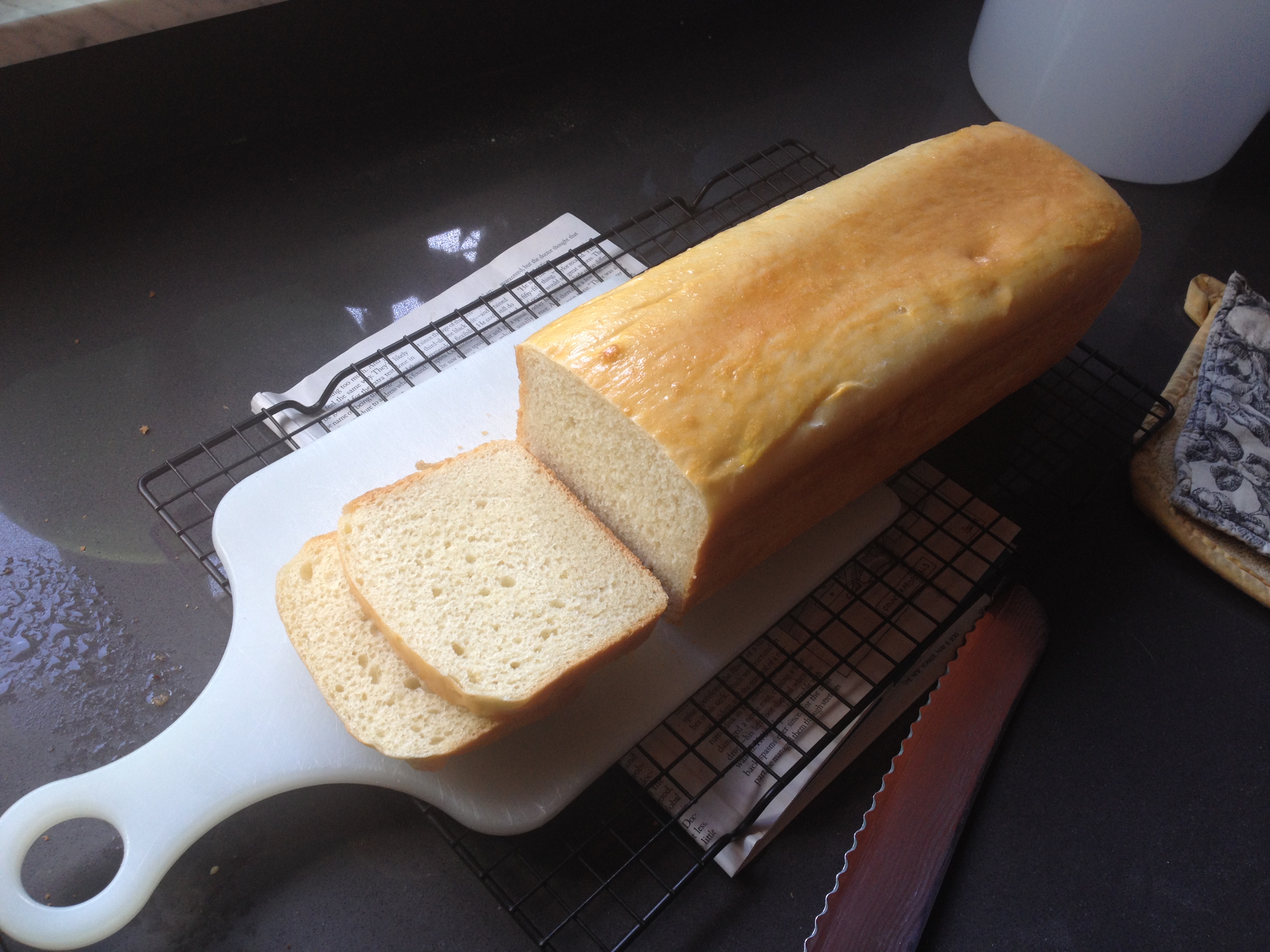
Since 1999, the Gourmensch mocked me for not being able to cut a straight line in a loaf of bread. I would pull out the long, serrated bread knife that we always used, when I was a kid, for slicing loaves of challah, and I would then very carefully slice these weirdly angled pieces of bread. And he’d go nuts. “WHY can’t you cut a STRAIGHT SLICE?” he’d ask. And he would take the knife and cut one corrective slice from the loaf, and then do the rest: nice, evenly sided slices of bread.

It dawned on me after a while that the problem wasn’t me, it was the knife, that the blade was handed. Specifically, right-handed. I said as much to my husband, who mocked me. He said it was a dumb idea, and that I just didn’t know how to cut bread. “Knives aren’t handed,” he said — but he’s right handed, so of course he’s never given it a moment’s thought. It’s a “history is written by the victors” moment. Right handed people never grasp (ahem) the issues that left-handed people have to deal with literally every day — big or small. The left-handed person working in the kitchen, in particular, learns to adjust or accept a thousand small nuisances because kitchen implements aren’t always really neutral, when it comes to handedness. It’s not just knives. It’s the handles on measuring cups, the way the can opener works, even the layouts of kitchens. But this is a larger subject I’m not going to tackle now. Now, we’re talking about serrated bread knives.

The matter began to come up more frequently, as years went by and our household changed. We had a child, and began to do Shabbat dinner most Friday nights. This led to a lot of badly sliced challahs. Then I started to bake most of our bread again: even more badly sliced bread. Our daughter would watch, wide-eyed, as the Gourmensch and I bickered over slicing bread. I finally said, “YOU can slice ALL THE BREAD.”

And then last year, at Christmas, he presented me with a special gift: a left-handed serrated bread knife. He said, “I went online and read about it and it turns out you were right, that the knives are handed. So I bought you a special bread knife.” And when I slice bread with it, I get nice even slices…. and the Gourmensch gets weirdly angled slices. I could have lived my whole life without this knife, and it really would have been okay with me — the funny slices weren’t making me miserable — but I have to say it’s really nice, now that I make perfect pains de mie, that I can make perfect, gorgeous slices.

A perfect loaf of bread, sliced by me with the left-handed serrated knife.

Using Things Up, Again.

Yesterday I received an email from a woman I don’t know very well wanting my advice on how to use up five pounds of carrots. She said she was planning to make carrot cake but realized that that would not require five pounds of carrots: did I have any other ideas? Since I don’t spend a lot of time thinking about carrots, and I definitely avoid thinking about carrot cake, I didn’t have much to offer her. So I posted her query to Facebook and within a few hours a slew of people had posted a number of unusual and reasonable suggestions, all of which I dutifully forwarded to her. Only she and her family will know what comes of this, I assume; I haven’t heard back from her yet, at any rate.

In the meantime, though, this morning I found myself looking at little jars of things I had lying around and thinking, “Man, this is stupid, I should use this stuff up.” I thought about this while I made myself breakfast, a bowl of oatmeal, which resulted in even more leftovers. Contemplating the few cups of white whole wheat flour I had (which is taking up far too much space) and the half-jar of chopped walnuts leftover from Passover and the half-jar of chocolate chips which aren’t enough to do anything with on their own, I decided the solution was to make an oatmeal walnut chocolate chip cake.

So I did this. And it came out great. I’m very pleased. A problem remains, however, which is, What am I going to make for dinner tonight? I have about a pound of leftover flank steak, three celery stalks, a cucumber, a half-jar of roasted red peppers, and no ideas whatsoever. I suspect this will mean that dinner tonight is some kind of salad involving steak, chopped celery, cucumber, and roasted red peppers. Actually, even as I type this is comes to me: put the peppers and some goat cheese (which I also have on hand) in the food processor to make salad dressing; cook up some rotini… you see where I’m going with this? Good. Dinner is solved.

Pound cakes.

The days right before Passover I began to want pound cake more than anything in the world, and I swore that as soon as Passover was over I was going to start making pound cakes. It took me about a month to bake anything, after Passover was through — I’ve been really busy — but I did finally bake two pound cakes. One of them was a real pain to make (it involved separating eggs and whipping the whites to soft peaks, in addition to everything else) and one of them was pretty easy. One of them was sublime, and one of them was, despite my best efforts, entirely mediocre.

I want to say, “The lesson learned is, good pound cakes require effort like whipping egg whites,” but I know this isn’t the case. The Gourmensch remembers as well as I do that about ten years ago I occasionally made a really excellent chocolate chip poundcake; the recipe was in a cookbook I cooked out of all the time. I used to make this cake every couple of months, a big cake it was, baked in a tube pan, and it would disappear within about three days. This means, by the way, that he and I were eating truly revolting quantities of cake every day. But it was so good, we didn’t care.

Problem is, I can’t remember which of my books had that recipe.

So I’m thrown back to hunting for good pound cake recipes. We will eat up the last of the bad one I made — because my husband and child declared it perfectly good and we have no intention of throwing it out; it has chocolate chips in it, after all (which sank! and they weren’t supposed to sink! I coated them in flour before mixing them in, why’d they sink?), so it isn’t just trash. And when it is gone, I will start working again. I will figure out if there is a way to make a truly excellent poundcake without having to whip egg whites.

There is probably a book somewhere which is nothing but poundcake recipes. If there isn’t, perhaps I should start assembling one.

Create a free website or blog at WordPress.com.

Up ↑