The Snickerdoodle: The Most Goyische Cooky Ever?

I have an associate who is an American living in England, in Norfolk. She’s been there a long time and seems very happy there. The basis of our friendship is comparing notes on food and cookery, and one of our running dialogues is about how Jewish cooking gets bastardized by mainstream media outlets. We spent a long time discussing how the Great British Bake-Off treated babka, for example. And then she recently posted to Facebook a link to a recipe in Better Homes & Gardens, a magazine I only see when I’m at a doctor’s office. It was for something they called “Snickerdoodle Croissant Cookies.”

E. took one look at this and wrote on Facebook, “No, they are rugelach. I know it’s hard to pronounce, but at least give credit.” She is, of course, absolutely correct. These are rugelach. Not the kind I’d make, mind you — all my rugelach work is in the chocolate format — but they are undeniably rugelach. The cream cheese dough. The rolling out and twirling into little triangles. Etc. etc. These are rugelach.

I was as disgusted as E. was and commented in support of her post. When E expressed surprise at how many snickerdoodle recipes BH&G has on their website, I observed, “Well, a lot of people like snickerdoodles.” I added, “I think of them as a WASP cooky. Like, “We’ll make cookies, okay, but we’ll make sure they don’t taste TOO good.” “ This comment garnered an amusing number of “likes” and it got me thinking, “Maybe they really ARE a WASP cooky.” So I Googled “snickerdoodle” and one of the first sites I landed on opened with this paragraph of text:
“To me, Snickerdoodles are the quintessential Christmas cookie. [“Aha. There you go,” I thought.] Nope, they are altogether the quintessential cookie. Not chocolate chip cookies. Not oatmeal. And for heaven’s sake, not fussy decorated cookies. It seems there are a lot of people with this sort of reverent endearment for snickerdoodles. So what exactly is it that makes them so special?”
This is someone named Sommer, by the way, writing at The Pioneer Woman’s website. We all know that The Pioneer Woman is very popular; this post wouldn’t be up there unless it was felt that this snickerdoodle thing would resonate with a large audience.

So I read Sommer’s paean to the snicker doodle and then I read the list of ingredients for the cookies. It goes like this: Flour; sugar; butter; cream of Tartar; baking soda; salt; eggs; cinnamon. Assembly is the usual system — you cream the butter and sugar together, you add the eggs, you blend them in. Then you take the dry ingredients, holding back some of the sugar and the cinnamon, and you add those to the mixing bowl. You make little balls of dough with your hands, roll them in the cinnamon and sugar, and bake.

And what you wind up with is the Official State Cooky of Connecticut, I am sorry to say — the most abstemious cooky recipe I can think of, off the top of my head. An almost ascetic cooky.

“But shortbread!” you’re saying. “Shortbread has an even shorter list of ingredients.”

It does. It’s true. But the sheer quantity of sugar and butter involved in shortbread makes it so much more decadent than the snickerdoodle. E., over in Norfolk, and I were in agreement about this.

The snickerdoodle, we agreed, is among the most goyische cookies ever. Possibly the holder of the First Place Prize for Most Goyische Cooky. (There’s probably some orange-flavored spice cooky that would technically win first place except that no American bakes them at home, and they’re either imported from Germany or baked exclusively by a handful of small bakeries in Minnesota.) I admit that my notions regarding snicker doodles are colored by my primary association with them: my husband likes snicker doodles and has fond memories of his mother making them. So I associate them with Gentile mothers who now and then feel pressed to bake something vaguely sweet.

I posted on Facebook. “Who of you love snickerdoodle cookies? Like, if someone asks you what your favorite cooky is — it’s your BIRTHDAY and you can have ANY COOKY YOU WANT — do you want snickerdoodles?” Out of a fairly long run of comments, with (as of this writing) 23 people responding, only three people said they were their favorite cooky; one person said, “yes, they’re my favorite if my mom makes them”; and the overwhelming majority of commenters — an extreme minority of which were Jewish, by the way — said, basically, “meh.” Like, “I’ll eat them if they’re in front of me and there’s no other cookie option, but whatever.” One woman remarked, “They’re such a Mom cookie.” That rang some bells with me: they ARE a mom cooky. To me the snickerdoodle does convey that sense of “I have to do SOMEthing, here, I’ll do THIS” — that tired, harried woman who has to bake something for the PTA bake sale and knows she can’t get away with just chucking a bag of Chips Ahoy cookies onto a tray. It does not convey, to me, any kind of familial or holiday warmth. Between the “plain” vibe and the “spice cooky” vibe, it is so stern, to me. There’s no luxury in a snickerdoodle, there’s no treat in it at all. It’s a “doing the best I can” kind of cooky. And worst of all, it calls for Cream of Tartar, a substance that almost no one keeps around the house*, so it’s actually a pain in the ass to make. That’s the kind of cooky that doesn’t speak to me at all.

Rugelach, by contrast: rugelach is rich; it is warm; it is homey (even if it’s not made at home: the hands-on attention required to make rugelach makes serving even bakery rugelach an act of love: no one pretends that it’s a snap to make rugelach). Rugelach are, in a way, the exact opposite of snickerdoodles. It’s obvious that a plate of rugelach is gemutlich. I suppose there are people for whom the snickerdoodle also conveys that feeling, but I am 100% sure: those are people who grew up without rugelach.

And I am sad for those people.

If readers want to provide me with a list of cookies even less treat-like than the snickerdoodle, please feel free to post a comment.

*Yes, I keep Cream of Tartar around the house, but I’m not a normal person.

In which we solve the problem of honey cakes being Jewish fruitcakes

This past weekend, aware that Rosh Hashanah was coming up, I was moved to think about making a honey cake. The problem is, of course, 99% of honey cakes are stupid, vile, tasteless, dry slabs of brown crumbly crud. There are not enough glasses of milk to help me gag down most things called honey cake. It’s like the Jewish baking community was trying to make gingerbread but went hideously wrong and wound up with honey cake. Furthermore, I don’t even know anyone who likes honey cake. Yet year after year, countless Jewish women — it’s not just me! — feel obligated to serve honey cake to their families. It is the Jewish version of Christmas fruitcake. I am not the first person to make this observation; but you can be damned sure I won’t be the last.

Deb Perelman has a nice discussion of the sadness of bad honey cake and provides for us Marcy Goldman’s honey cake recipe. I’m sure that for those who want orange juice and booze in their honey cakes, this is just the ticket; but I am not one of those people. I personally solve the dismal honey cake problem by adopting the Mollie Katzen solution: add chocolate. There’s an old Moosewood cookbook that has a fairly ok chocolate honey cake recipe. I made this cake for years, and it was definitely a step up from the old Jenny Grossinger routine, but it still wasn’t really what I had in mind. This year, I decided to investigate: had anyone managed to come up with a better version of a chocolate honey cake?

Some idle Googling on Friday night led me to remember that Nigella Lawson’s Feast has a recipe for a chocolate honey cake, and, very good sign indeed, her recipe calls for boiling water. (This is, as we know, something I like to see in a chocolate cake recipe.)

The year it was published, I received Nigella Lawson’s Feast as a Christmas gift from my mother in law. I remember that I sat down and read it on Boxing Day, and thought it looked marvelous, and then never cooked out of it. Over the last few years, though, I have found it to be a wonderful resource, in spite of my initial apathy. When I am trying to plan a holiday meal, or any meal that needs to have a little more oomph than my normal evening fare, Feast often has something in it I can do without too much agony that comes out really, really well. At the very least, it will jog my memory in the direction of some perfect thing I already know how to make but had somehow forgotten about.

It was clear to me that the thing to do was pluck Feast off the shelf, put it on the kitchen counter, and get to work on Saturday.

The recipe is fairly easy: https://www.nigella.com/recipes/honey-chocolate-cake. You cream butter and light brown sugar together, and then add honey, eggs, chocolate, flour, baking soda, and boiling water to create an extremely thin batter that takes a ridiculous amount of time to bake. You think, “This cannot possibly end well,” because the cakes take so long. Have no fear: it ends very well.

The ingredients list, for those of you who won’t click on the link:

4 oz. bittersweet chocolate

1 1/3 cups light brown sugar

2 sticks sweet butter, softened

1/2 cup honey

2 large eggs (I used jumbo eggs)

1 1/2 cups flour

1 tsp baking soda

1 tablespoon unsweetened cocoa powder

1 cup boiling water

Clever readers will notice the recipe calls for four ounces of bittersweet chocolate. For reasons I cannot fathom, I had none on hand when I got to making this on Saturday night. I did have rather a lot of cocoa powder, so I looked up online substitution calculations. (This not having bittersweet chocolate is a chronic problem of mine. I never seem to have bittersweet chocolate around. I should really work on that. And, yes, you’d think I’d have these substitution measurements memorized by now. I’m almost there, but not quite.) Were I following the recipe strictly, I’d’ve used something like 12 tablespoons of cocoa powder, 4 tablespoons of sugar, and 4 tablespoons of butter to pull this off. But as I measured, I thought, “This is a LOT of cocoa.” It seemed excessive, even to me. So I decided to hold off a bit, and I used 10 tablespoons of cocoa, of which one tablespoon was Hershey’s Extra Dark cocoa; and I put in three tablespoons of sugar; and one tablespoon of butter on top of the two sticks already called for in the recipe. I was leery of using the technically recommended amount of butter, lest the cake turn greasy.

I creamed all the butter and sugars together, and then added all of the cocoa powder. It took some scraping down the bowl to get everything incorporated nicely. The cocoa powder had a way of settling in and caking at the bottom of the Kitchen Aid bowl. Adding liquid (in the form of the eggs) helped but to be honest the batter didn’t loosen and mix properly until the boiling water was added — but it was easy to manage, as long as I was diligent about scraping the bowl with a spatula very thoroughly. At the end, the batter was exactly the kind of dark and very thin goop I’ve learned is a Good Sign when making chocolate cakes.

Nigella advises us to use a 9” springform pan. I do own a springform pan (though I think it’s 10”) but I wanted to make three loaf cakes. I have this idea that honey cakes should be loaf cakes. So I buttered two little tiny stoneware loaf pans and one larger stoneware pan and then lined the bottoms with parchment (with cakes, I always worry about turning them out, and feel parchment is maybe unnecessary but a good safety net); the paper was cut long so that I would have a parchment sling to help me get the cakes out when they were done.

Pouring the batter between three pans was easier than I anticipated; I’m getting good at eyeballing this kind of thing. A better person would use a scale to determine that the batter was evenly distributed between the mini-pans and went mostly into the big pan. Even my sloppy, measuring-by-eye system worked well.

This is a cake that rises but not very much — it sort of bakes like a pound cake. It gets puffy and then develops a little sad streak on top, when you take it out of the oven. Nigella says to bake the cake for up to an hour and a half, which seems ridiculous, until you remember that pound cakes can bake for incredibly long times. The two baby cakes I did took about 45 minutes, and the larger loaf took a bit over an hour. If you were doing it as one large cake, I can easily see this taking an hour and a half of baking time.

You do not rush to tip these cakes out of the pans. Set the pans to cool on a rack; after maybe half an hour, you can safely lift them out using the sling of parchment paper and peel back the parchment and let them continue cooling. These are very very tender cakes; be gentle with them.

Here we get to the part in which we see how cosmically lazy I am.

Nigella’s recipe calls for making a sticky honey glaze, which doesn’t look at all difficult. But I was too lazy to assemble it and pour it on any of these cakes. I left the plain, on the racks, overnight. Sunday morning, I awoke and was cheered by the sight of these three dark cakes. When my husband and child saw them, they said “Ooooo!” and looked at me expectantly. “Uh-uh-uh!” I said: “These are for Rosh Hashanah.” My plan was to have one baby cake be a snack cake for me and my daughter; to have the large cake be dessert for our nice Rosh Hashanah dinner; and to have the last baby cake to give to a friend as a gift.

I could have wrapped them; I could have at least draped them in Saran Wrap. But I didn’t. I just let them sit on the counter for days. Treated this way, a normal cake would dry out and be rather unappealing. But when my daughter and I finally cut into one of the baby cakes, at about noon on Monday, it was perfect. I mean, perfect. It was a dense, almost fudgey cake, and it tasted like dark chocolate with a honey aftertaste. It didn’t need any glaze (but I admit, the next time I make these, I’m going to make the glaze, just to see how it improves the cake). It utterly lacks the Medieval quality that so many honey cakes have: that grim, wholesome, heavily spiced thickness. This is, by contrast, a genuinely lush cake. It is just the thing to start off a New Year. It is divine. Shanah tovah, folks.

Mimi Thorisson, We Meet Again

I hadn’t given Mimi Thorisson much thought at all since I last made one of the pear cakes I make that improve on Thorisson’s original.  But a recent copy of the Wall Street Journal brought her to mind because there was a lovely article about Ms. Thorisson’s kitchen at her house in France. I looked at the article quickly while I was sitting on a bus, and while I wanted to recycle the newspaper once I reached my destination, I actually saved this section of the paper so that I could really absorb the lunacy here at my leisure.

What actually happened was that a bottle of water leaked in my bag, and the newspaper got soaked, and in the end I had to go online and dig up the article in order to more fully absorb Ms. Thorisson’s beautiful house in Bordeaux. Which has fifteen bedrooms. I can’t figure out how many toilets have to get cleaned; I’m trying to remember how many children Ms. Thorisson has. It’s some mind-boggling number. Ditto with the dogs.

But it’s clearly ok. Ms. Thorisson and her husband are not worried much about money or housecleaning. They doubtless have people to worry about that stuff for them. I’m ok with that. (I mean, I’m jealous as fuck, but whatever.)

What bugs the hell out of me, with this article, is the layout of Ms. Thorisson’s kitchen. It’s a really good example of the kind of kitchen that I think about all the time — I have, in fact, been working on a long essay on the subject that keeps slipping away from me — which is, The Kitchen that is Really Beautiful and Really Big and Really Hard to Imagine Working in. They spent $45,000 working on this kitchen, and I can’t figure out where they set the dishes down when it’s time to bring them near the sink for washing; I can’t figure out where they set down the spoon when they’re done stirring the pot at the stove.

I decided to spend some time really looking at the pictures in the online version of the article to absorb what it would actually be like to work in this space. Photo 3/21 gave me some hope, for a moment. I considered the practical, real-life move of keeping the newborn in a pram near the stove. As long as Baby’s not blocking my path to anything, I find this a sensible solution to the “where should Baby go while I’m cooking?” problem. I looked to the marble-topped table, where one of the older daughters is working. “Ah,” I thought, “It’s on wheels! So, that’s smart, actually, because you can do your prep work and roll it further from or close to the stove as needed.” But then I looked more closely. The Kitchen Aid and the Cuisinart are both on that table — both plugged in. So you can’t just blithely wheel the table around. It’s got to be pretty stationery, or else there will be hell to pay (and possibly small children wounded). It was only after a few minutes of staring at this photo that my eye landed on the photo’s caption, which advised me that the young woman at the marble topped table wasn’t one of the older daughters, but was, rather, Ms. Thorisson’s assistant, Allegra.

My apologies, Allegra.

I get that Ms. Thorisson can do whatever she wants, and that she’s cooking for a mob at most times. And I get that these rooms are beautiful. I’d like a giant, curved, corner-fitting china cabinet too, folks. (Not that I have anywhere to put such a thing, but that doesn’t matter, does it?) I really like the purple sofa, though it seems a bit… well, I like to lie down on the sofa when I watch a movie, and it doesn’t seem to me quite that kind of sofa.

What I don’t get is, How can anyone view this household’s kitchen decor and design as actually aspirational, when the fact is, it must be really annoying to cook in such a kitchen? In fact, Ms. Thorisson has two such kitchens in her house. The second kitchen does seem to have some countertop near the sink, but there’s no dish drainer visible. I’m still left scratching my head. It’s all very lovely, but I keep looking at the pictures and thinking, “I couldn’t deal with that. It’s too big. Nothing is convenient to anything else.” If the stove and the sink were close enough to each other, and had a long countertop spanning between them, I’d feel a lot better. (Nowhere do we see the fridge, which also troubles me. )

There’s some other mindset at work, clearly, when people look at kitchens like Ms. Thorisson’s and say, “oooooo, I wish I had that.” I can’t relate. It’s not that I want to go back to the days when I had a kitchen that was (no exaggeration) smaller than the closet on the third floor of our row house — that closet, I turned into a “Fortress of Solitude” for my daughter’s last birthday party, and five young children (aged 8 and under, mostly 5-6) could sit comfortably on the floor in there and color pages from a coloring book. The Fortress of Solitude would make a perfectly workable kitchen, actually, if I had to install one there. There would not be a lot of floor space, but it would be enough. So long as I never had to cook for more than four people, it would be enough.

I think this is the real issue. Our sense of “enoughness” has evaporated. Mimi Thorisson’s kitchen is lovely, but it is far, far more than enough of some things, yet not enough of others. Then again, I guess it should have been obvious to me from the get-go that “enough” isn’t really a Thorisson family mantra. Eight children, ten dogs. Two kitchens. Fifteen bedrooms.

Whereas I live in a three bedroom, 2 1/2 bathroom apartment that my husband believes is more than we need. Perspectives vary widely on what is enough. I realize that, in practical terms, my husband is right. This is quite enough. But I would love to have two more rooms: a study for my husband, a study for me. But it’s a fantasy. I don’t actually believe we will ever live in such a grand space. Some people get to live in grand spaces with endless rooms, and maids to clean them: we are not those kind of people.

After thinking about all of this, and deciding on a whim to see what was out there online about Ms. Thorisson’s kitchen layout, I discovered that a while back, Ms. Thorisson engaged in a large-scale online feud with a cookbook reviewer who didn’t like her cookbook quite as much as she might have liked. She was actually quite gracious about it, though obviously she would have preferred a glowing review. Readers of the review accused the reviewer of sexism, of this, of that, and mostly of viewing Ms. Thorisson as nothing more than a mere lifestyle writer, not a real cook. Well: I have to say, I think there’s something to that; on the other hand, I take the position (that I think Ms. Thorisson would agree with) that the cooking that happens in peoples’ homes is as legitimate a thing to write about as professional cooking. Since Ms. Thorisson has to cook on a scale much larger than I do, I actually respect her cooking: she’s feeding this large family, right? That counts for something. I do think she can be a little tone-deaf in her writing, but on the other hand, who isn’t? Seriously: who isn’t? One of the most conscientious food bloggers I know — and I know her personally, I feel, after years of written correspondence, though I admit I’ve never met her in real life — has gone back, in recent months, to look at things she wrote a decade ago, and cringed. Assumptions about what is possible, and about who has access to what — and coming from the keyboard of someone who’s about as socially aware as a person can be — are rife. But we all suffer from this. We’re all writing from a certain moment’s mood, perspective, position. Who is to say that Ms. Thorisson won’t look back on her work of 2015 in ten years and think, “My god, what was I thinking?”

Ms. Thorisson responded to all of this with a surprisingly even temper, I thought. A lot of gorgeous women in her shoes would have stamped their perfect little feet and said, “Oh my god, you’re such an asshole, Mr. Cookbook Reviewer!” But she was calm and almost good-humored about the whole thing (not that humor is really Ms. Thorisson’s strong point, from what I see). Her responses online to this debate about her work made me somewhat sympathetic to her. Not because I don’t think her life is a bit ludicrous — I do — but I don’t think she’s trying to put over on anyone. The accusation is that her work is not really about food, but about “my life is better than yours.” There’s something to that. But I think she feels she is simply presenting herself as an example of one kind of thing. (An exceptionally attractive, well-dressed, clearly unAmerican version of her kind of thing.) She lives the way she lives, and she presents her life and her recipes in the way she right now wants to present them. She had an interesting aside about working on a TV show which really made me see her in a different light.

Her aside was more telling to me than anything else she’d written. It was reasonable, and made me sympathetic to her. She’s got a cooking show somewhere — I’ve never seen it — and apparently people saw her kitchen tables and complained about them.  She wrote, “….every now and then someone, somewhere, questions my choice of working tables. It seems they are just too low. But here’s the thing. They are my tables, that I actually use. And I’m tall. We filmed two seasons for Canal+ and a number of people commented on the tables. My tables. So they brought in a new table for the third season. It was higher, more comfortable perhaps. But it wasn’t real. When I cook at home, when we make blog posts, we use the things that are already there. Strange as it is sometimes reality looks weird or fake and sometimes when things are faked to look real, they feel all wrong. So I say, let’s keep it real – always, even when reality looks strange.”

I guess this is where I have to agree with her. Her reality is strange to me. It is entirely foreign. My reality would be strange to her. We’ll all have to accept that our realities are strange to one another. On one point, I will differ: it is a competition, Ms. Thorisson, and my pear cake is better than yours. (If you’re ever in town, I’d be happy to serve you a piece. Assuming I have some pears sitting around….)

Tomato Pie Variant: A Technical Success, an Actual Failure

Yesterday it came to me that the thing to do with the last summer tomatoes that are sitting on my counter was to make a kind of Last Hurrah tomato pie, to do something really special with them. Remembering how spectacular tomato pie with Liuzzi ricotta is, I acquired some ricotta. I also had fresh figs on hand, which isn’t par for the course at all, and when I was riding the bus home I thought, “Ok, obviously, what you want to do is take these things and put them together. There is no reason to not take that ricotta, whip it with some honey, and make a gorgeous single-crust fig and tomato pie.”

So though I was utterly wiped come five p.m. yesterday,  I did this. I actually made a lattice crust pie, because I had just enough dough to do so, but never you mind that. I assembled this pie with love and patience, skinning the tomatoes, slicing the figs perfectly, whipping the cheese with locally-made honey, the whole nine yards. I baked the bottom crust first — beautiful — and I layered on the tomatoes and figs — gorgeous — and then I assembled the lattice crust (not as awful to do as I’d feared). I baked the pie and drizzled a little more honey on the top to jazz up the presentation a little. It looked quite nice — not beautiful, but impressive, for an average home cook. And you know what?

No one liked it.

Half of the pie is leftover. The plain, cooked-in-salted-water broccoli I made was a bigger hit than the pie. It was a lackluster meal, to be generous about it. And I am sad about it. I wasted 3/4 of a pound of perfect ricotta, four perfect figs, and  two perfect tomatoes on this product. I will be the only one eating the leftovers. I just know the last slice of it will wind up in the trash because even I won’t be able to eat it all myself.

I don’t know what went wrong. I had thought it would be a pie version of the spectacular goat-cheese-and-honey-on-biscuits thing we all ate so happily over the summer. But it wasn’t.  Maybe it needed some red onion to sharpen it a little (it was kind of bland). Maybe I should have whipped some goat cheese into the ricotta and honey.  Maybe it’s just that no one else in the family likes figs. It wasn’t that it was bad, mind you; it just was not interesting to eat, at all. Unfortunately, it’s not something I’m going to be able to work on improving, at least not right now, because the ingredients necessary are coming to the end of their season.

I think I’d better throw myself in the direction of autumn cooking. I’ve clearly had it with summer cooking.


Burning Up the Vegetables: or, Thinking Again about Strategically Burned Vegetables, also known as Carbonized Food

When Talking Heads recorded “Burning Down the House” they probably weren’t thinking about housebitches who would be making dinner at 1.30 in the afternoon so it’d be easy to heat up at 7.30 on Tuesday evening after attending their child’s school open house, messing up the process so badly that email was sent to a housebitch’s spouse reading, “I may have ruined all the vegetables for dinner, sorry about that.”

There was probably something more rock and roll in mind.

However, this actually happened to me, and once again, we’re mulling over the fact that burning vegetables can be a good thing. Burning things is something we shouldn’t really aim to do, in our day to day life — we don’t want to cause house fires, after all — but it really does seem to be true that a certain amount of godawful overcooking results in some really good food.

I’m not referring to steak here; we all know some people like their steak burnt to hell. Ditto with French fries and grilled cheese sandwiches (“the burnt parts are the best part!”).

In a world where there are people who believe vegetables should be gently steamed, never overcooked, or just served exclusively raw (god help these folks), I am going to fight the good fight and say this:

Burning your vegetables can be the best thing to happen to your dinner plate.

It was many years ago that I first burned the hell out of a big pot of Brussels sprouts because I got distracted from the stove and discovered that this resulted in fabulous sprouts. We came to call this “strategic burning” and never looked back. I’ve since done it with great success to many types of vegetables — broccoli, cabbage — basically, your strong, hearty veggies — and green beans.

This week, I knew Tuesday was going to be hell, and I began to prepare for it on Monday. At noon on Monday I was starting Tuesday’s dinner. I had frozen buffalo short ribs pulled from the freezer on Sunday; once thawed, I started braising them Monday afternoon, and then I put them in the fridge feeling smug. Tuesday, I bought a bag of carrots, and thought, “I will cut these into coins, and cut those fancy-pants farmer’s market radishes (that have been sitting in the fridge for more than a week) into coins, and I will braise them together, and I will reheat the short ribs, and we can have it with egg noodles. That will be a fine dinner.” I had to be out of the house most of Tuesday, and would be at my daughter’s school’s open house from six till 7.30; but I had faith that if I had the meat ready, and the veggies cooked and just in need of re-heating, I could task my husband with cooking egg noodles such that when my daughter and I got home at 7.30, all three of us could sit down to eat in style.

It was a noble plan. The problem was that in the 90 minutes I was home on Tuesday, I got the carrots and radishes cooking, and went upstairs, and forgot to set a timer. The phone rang, and I forgot that I was cooking anything, and the next thing I knew, I walked into the hallway and thought, “I smell burning food.”

I flew down the stairs and found that I had really burnt the shit out of my fancy pants radishes and the plain jane carrots. The bottom of the pot was black, thickly crusted with black. It wasn’t a good situation. I had to leave the house soon — it was time for me to go get my daughter — and after saying, “Crap, crap, crap” a few times, I sighed, resigned. There was nothing for it but to turn off the flame, cover the pot, and deal with the mess when I got home at 7.30.

I fetched my daughter (“You’re LATE!” she scolded me) and once we were on the bus headed downtown, I texted my husband: “I burned the shit out of the veggies for dinner.” He wrote back and said to not worry about it. I expressed dismay over the fact that I’d ruined $5 worth of vegetables (those fancy radishes had cost me $3.00). “I think we can recover from this financial disaster,” he wrote back.

I took my daughter to her piano lesson; I gave her a healthy snack (yogurt and jam and a Scottie-shaped shortbread cookie; ok, so it wasn’t a SUPER healthy snack, but screw it, the yogurt was organic, the jam French, and the cookie imported from Great Britain, a leftover Christmas stocking item we need to use up). I sat dutifully through the piano lesson. On finally leaving the music school, I advised her, “We’re gonna have to stop at Romeo’s on the way home, really fast; we’ll drop off the food and then go back to school for the Open House, ok?” It had been a long day, but we knew we just had to soldier on. My daughter was exhausted, but she nodded. “Can we at least take a bus home?” she asked. I conceded we didnt have to walk. We came back to our neighborhood, we bought some broccoli, we went home.

When we walked in the door, my daughter said, “It smells like food in here.”

“I burned the vegetables,” I said. I went straight to the stove and lifted the lid off the pot still on the stove. To my surprise, the contents of the pot smelled wonderful. I pulled out a charred radish and popped it into my mouth, and it was…. really good. These radishes, raw, were so peppery that eating one raw brought tears to my eyes — it was like eating wasabi at a good Japanese restaurant — but cooked like this, they were just buttery and slightly sweet. The carrots were somehow almost candied. I had added to the pot only butter and water and salt; there had been no tricks to this dish. There had been no sprinklings of sugar or splashes of balsamic vinegar. The extreme cooking session with only butter and salt had caused this complete evolution: they were now the exact opposite of the hard, raw, aggressive vegetables they’d been at one in the afternoon.

My daughter saw me eating and trotted over. “Me too?” I popped a radish into her mouth. “Mmmmmm,” she said peering into the pot.

“No,” I said. “For dinner, not snack.” I filled a stock pot with water for the egg noodles, set it on the stove, and got us out the door and to the school open house.

I was settling into the school auditorium, about twenty minutes later, when my cell phone buzzed: my husband writing: “Jesus. What is that SMELL?”

“Burnt carrots and radishes,” I wrote back.

At 7.30 on the nose, we got home. The open house was nice if not super-informative, but then, I don’t know what I need to know anyway. My husband was sitting on the couch, relaxing with the cat. The house smelled of short ribs, reheating gently in the oven. The vegetables were in their pot, also gently reheating; the egg noodles were boiling on the stove. In a few minutes, we all sat down to eat what was, truly, one of the most delicious dinners we’d had in a long time. There was much discussion of how good the radishes were, in particular.

The challenge now: deciding what to do with the leftover short ribs. I’m seriously thinking chili. And wondering what other vegetables I’d like to burn. Maybe I should turn to Talking Heads for ideas. “More Songs About Buildings and Food.”

Tomato Pie, revisited: 2016 Brings Perfection

As I write this, I want you to bear in mind that none of the following is likely to be useful to you until next summer. But I’m writing it now for future reference. In July 2017, 2018, and so on — assuming the world hasn’t come to an end — when you are seeking information about tomato pie, this is where you go.

I recently had a sad realization, which was that an entire summer had gone by and I hadn’t made a single tomato pie.

When I happened, during the week, to walk past a farmer’s market where one of the stands had baskets of big, beautiful tomatoes for $4 per basket, I decided it was a sign, and I bought a lot of tomatoes and carried them home.

Last night I set to making tomato pie. I was feeling tired and unenthusiastic about the whole enterprise, but I was determined to do it, not only because a year without tomato pie is an unacceptable proposition, but because if I didn’t use up several of these tomatoes, there’d be no hope of eating them all before they began to rot, which would mean my good intentions and money would all be just down the (bleached and Boraxed) toilet.

I pulled myself together and decided to try a couple new steps in my tomato pie recipe this year, to see if I could substantially improve the finished product. The fact is: While we love tomato pie, some pies are better than others, and there’s always one problem, which is that the bottom crust becomes mush, and the dining experience is sadder for it.

I am happy to report that this pie was a huge success. The two extra steps I added to the system made a world of difference. My husband reported this pie was “teashop-worthy,” and possibly the best tomato pie I’d ever made. I think the best one I’d yet made, prior to now, involved using Liuzzi’s ricotta cheese, which this one did not; I have a plan to make another pie soon using that cheese, to see if I can nail this recipe down and declare it perfected.

Readers who are looking for a fast, easy meal should go look elsewhere. This tomato pie requires a lot of steps. There’s no getting around it. Sometimes, you have to invest heavily in a project to get it right, and I’m afraid there’s no faking it with tomato pie.

You will need many things:

  1. the makings for biscuits sufficient to make a double-crusted pie;
  2. Tomatoes (probably about two lbs., fresh and good — not hard spring or winter tomatoes; canned will not do; this is a summer recipe)
  3. some green thing in the basil/scallion/parsley range
  4. mayonnaise
  5. cheese. More than one kind. Last night I had feta and Parmesan.

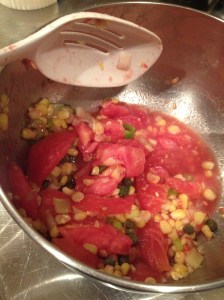
The first step is to peel your tomatoes. I never used to do this but have decided it improves the pie dramatically if you do it. Bring a pot of water to a boil. Cut little Xs into the bottom of the tomatoes; fling them into boiling water for 30 seconds, maximum (15 seconds may well do the trick). The skin will begin to peel back. Don’t boil them for very long, because you will ruin the tomatoes and have to start over. Fill a bowl with ice and water, and use a big spoon to put the tomatoes in the ice bath. When they are cool enough to handle, peel the tomatoes. The tomatoes must then be sliced and seeded and drained: you want as little liquid as possible to remain. (You can, if you wish, save the tomato liquid for cooking something else, or just drink it. I drank mine mixed with seltzer, which put some pep in my step, enough to se me through finishing making dinner.) Put the sliced tomato flesh into a mixing bowl and set aside.

By this point you have decided what your green element is going to be, and if you’re going to get creative with any other elements in your pie. I like scallions in my tomato pies, and on a whim decided to add some frozen corn. img_7196Wash a scallion, and slice it thinly, using the white and green parts. A cup of frozen corn, thawed, should be roughly chopped (you can do this down and dirty on your cutting board with a chef’s knife, though I suppose some folks would do it in a food processor). Add them to the mixing bowl with the tomatoes. Add any seasoning you want.
I might have done some ground pepper, though I didn’t; I did add a heaping tablespoon of capers. The truth is, I keep things pretty simple. NB: I do not add salt to this mixture, because my feeling is that the cheeses and mayonnaise in tomato pie are quite salty enough.

Now it is time to assemble your biscuit crust. Get the oven heating to 400° while you do this.

I find that the usual biscuit recipes, which start with two cups of flour, make a perfect amount of dough to make this pie; if you’re using a smaller or larger pie plate (mine is 9”) you may find you need less or more dough. But the basic recipe goes like this:

Combine in a large mixing bowl: 2 cups all purpose flour; one heaping tablespoon baking powder; a teaspoon of salt. Combine with a fork. Using your fingers, cut in six tablespoons of very cold butter and blend until you have coated the flour with fat. Food writers always say this mixture should resemble a coarse meal, and that’s basically true. Stir in a scant cup of milk and stir. When the dough begins to cohere into a ball, stop using a utensil to work it, and use your hands to fold it together until you have a smooth dough. If the dough is too dry and crumbly, add milk, teaspoon by teaspoon. Set it in its mixing bowl and put the bowl in the fridge so you can wash your hands and get the next step together.

The next step involves two things: getting ready to roll out a bottom crust, and getting some stuff ready to put on that bottom crust.

To roll out the crust, I highly recommend using what the pros call a pastry cloth, and what I would describe as a flat-weave towel (something that doesn’t produce lint), and some flour. Spread the towel flat on your countertop and sprinkle maybe 1/4 cup of flour over the middle of it. This will be the surface you use to roll out the crust. If you did it on the countertop, you’d need to use more flour, and that works, but too much flour and you’ll toughen the dough. This way, you’ll have a bare minimum of extra flour on the biscuit crust.

In a smallish mixing bowl (could be a cereal bowl, I don’t care) combine about 1/2 cup mayonnaise (Hellman’s works for me; anyone who makes homemade mayonnaise to make tomato pie is a git, as far as I’m concerned) with cheese. Last night I used some feta, because I had half a cup of crumbled feta sitting around, but you could use shredded cheddar or Muenster or crumbled goat cheese (goat cheese is really good) or whatever floats your boat. Ideally it’s a cheese that will melt fairly well — I don’t like to use all cheddar, because cheddars don’t actually melt the way I’d like. But cheddar plus something else is dandy. Whatever cheeses you choose, have a cup of it ready to incorporate into this mixture. Be aware that if you use the stuff that comes pre-shredded in a bag, the cheese is coated with cornstarch or something, which will produce a slightly different end result from what you’d have if you grated a block of cheese on your own. Have that mayonnaise-cheese mixture near at hand; say, put it next to the tomato/scallion/corn bowl.

IF you are using life-changing ricotta, such as the unbelievably smooth, whipped-cream-like stuff made by the Liuzzi people in North Haven, Connecticut, you will not need mayonnaise at all. I can’t honestly recommend using supermarket ricotta for a tomato pie: it’s too grainy. But if you live in a place where you can get this sort of ricotta — it looks as smooth as cream cheese — I urge you to put some in a tomato pie. A 1 lb. tub of cheese is too much for one tomato pie, but if you use about half of it in a pie, you’ll have enough cheese leftover to put in a nice pasta dish the next day, or to spread on a pizza, or whatever floats your boat.

By this time, your oven is hot. Roll out your first crust. Take 1/3 of your biscuit dough from the fridge, roll it out nicely so that you have a circle that will fill the bottom of your pie pan and come up the sides. This will be a thin, delicate round to move into the pan. I’m sure that there are clever ways to roll it out and fold it for safer moving (Deb Perelman talks about how to do this, in fact, at Smitten Kitchen) but I didn’t find it so hard to just pick it up and move it six inches to the pan. So do it. img_7193Sprinkle a couple tablespoons of your hard cheese (some of your cheddar or Parmesan, say) onto the crust. What you’re doing preparing the bottom crust so that it won’t turn into a sodden mess by the end of final baking. Bake the bottom crust for about ten minutes.

This is important: don’t let it get particularly brown. It has to be cooked through, and risen a bit; but you don’t need to bake it too long because it’s going to be put back into the oven for another 30 minutes. In these ten minutes, you can wash prep dishes and drain any juices you can from the bowl of tomatoes and corn and scallions (or, tomato and minced red pepper and parsley and basil, or whatever combination you’ve got in there). If you’re very enterprising you can save the liquids from all this tomato draining to use in stock or something.img_7194

Remove the crust from the oven once it’s done, and get to work assembling the rest of the pie. With a spoon or a spatula spread a thin layer of the mayo-cheese goop (or your ricotta) on top of the crust. Then begin to layer on your veggies. You put down one thin layer of tomato-corn-whatever, and then sprinkle on some cheese, and then spread some of the mayonnaise (or ricotta) on top of that. Then you start again with the tomato-corn-whatever. It’s usually my experience that you get two layers of veggies out of this; there needs to be a layer of mayo-cheese on top when you’re done.

img_7198Then you take the rest of your biscuit dough out of the fridge and roll out another circle, and lay it on top of the whole shebang. Cut in some steam vents with a knife, press the edges together (if you’re someone who cares about aesthetics you could do some fancy fluting; I personally don’t give a crap), brush the top with a little melted butter, and put the whole thing in the oven again for 30 minutes.

When you pull this beast out of the oven, it is hot as hell: far too hot to eat immediately. I advise letting it sit on the counter for fifteen or twenty minutes before cutting into it. When you do cut inimg_7199to it, assuming you haven’t used a lot of a really runny cheese, the contents of the pie will be messy but nowhere near as messy as it is if you don’t bake the bottom crust first, because the bottom crust will not have dissolved into mush. Ricotta will probably be runnier than mayonnaise, but regardless: having baked the bottom crust first, you should be able to serve this with a pie server, and not have to just reach for your big serving spoon.
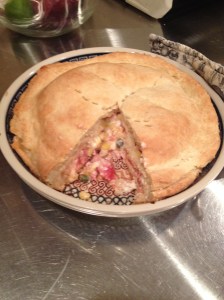
img_7201This pie is extremely filling. I always feel I should serve it with a side dish — a green salad, or some kind of green vegetable — and
that’s all well and good. But the fact is, my family of three — and we all eat like pigs — can only consume about half of a tomato pie in one meal. You could serve this with more elegant sides at a summer dinner party. (For example: A platter of asparagus could be roasted while you’re making this, and then served at room temperature: done and done.)

We have always enjoyed tomato pie, but it has also been responsible for several closet-sized rooms in the Museum of Tsuris. But today we are deaccessioning tomato pie from the Museum. In other words, tomato pie has been perfected, and we’re evicting it so we can make room for more kitchen disasters. Onward.

Setting Up for the School Year

I suppose there are people out there who didn’t thrill to buying new school supplies at the end of the summer, when they were kids, and teenagers, but those people were never friends of mine.

I have vivid memories of my mother taking me to the Dartmouth Bookstore in Hanover, NH, where I would carefully, carefully, select the notebooks and pens and pencils and erasers and the pencil case that I would use for the next nine months. Some parents would have probably just taken the kid to the local five and dime and said, “Come on, let’s get this crap and get out of here,” but my mother is the sort of person who understands the importance of notebooks, and so is my father, for that matter: basically, everyone in the household grasped the importance of having the right tools for the tasks facing us. I remember that my father even had opinions about which protractors were good and which ones were mere mediocrities. It was difficult when we couldn’t find the right color Trapper Keeper notebook, but I survived; and some of the discoveries of that era (Le Pens, for example) are gifts that keep on giving, all these years later. I still go to Hull’s Art Shop on Chapel Street to stock up on my preferred colors of Le Pens (and I get ticked off when my daughter nicks them to draw with — because they are a pleasure to use — and ruins the pen tips). When my daughter needs school supplies, I do the right thing: I insist we take an inventory of what she already has that’s good, and then I make a list of what gaps need to be filled.

This year, I’m told, she needs to have two highlighter pens. I don’t think I had a highlighter of my own until I was in high school, but whatever. We did inventory and then wrote up a list of what gaps needed to be filled in, and we went downtown.

The pleasure of stocking up on new erasers, new notebooks (two composition notebooks required, in addition to the looseleaf binder with five labeled, tabbed, sections of fresh looseleaf paper), new pencil case (to supplement the old pencil case, which is to hold colored pencils exclusively), new pencil sharpener! What colors should the composition notebooks be? (Because these days, you don’t have to settle for just black and white. My daughter opted for teal blue and a shade of purple I think of as Chiclet Purple.)

The joy of laying everything out on the dining table when you get home to examine it all and assemble it and decide which things will be embellished with zebra striped duct tape and which will have leopard print duct tape! We didn’t acquire any Trapper-Keeper folders, but there was joy in the house nonetheless.

My daughter is very pleased with herself to have everything all set up. I made her pack it all away into a brown paper bag with handles so that her special new school supplies wouldn’t wind up scattering around the living room and dining room — the temptation to have it merge with the chaos of the papers that are piled high on the kitchen table is vast — but last night she unpacked it all to show her father. “Look, Papa,” she said. “Look at my new green pencil case!” He admired it dutifully. “Looks good,” he said. “Should hold a lot of pencils.” He then glanced at me. “When does school start?”

“September first,” I said. “And we are all ready.”

We are ready….. if you don’t count the fact that I’ll have to sharpen all those pencils before we head off for the first day of third grade. This reminds me: I should really ask my husband, “Can you install that pencil sharpener that’s been sitting on the kitchen table for a few months now?”

On Being That Pretentious Jerk of a Parent: Suddenly, I Kind of See

In general I am as lazy a parent as I can get away with being. I ardently want my kid to entertain herself and bother me as little as possible. I don’t want to play with her most of the time; I am her mother, not her playmate, after all. But it’s difficult for her, as it is for us: she’s an only child, and one can only play alone in one’s room for so long. And right now we’re in that horrible long phase of the summer where there’s no summer camp, there’s no nothing to break up the days, and I am on my own with the kid 24/7.

Tensions are running high. We are both very deeply sick of each other. It’s been ugly. And yet, she cannot leave me alone; when we’re in the house, she insists on being in the same room I’m in. She cannot stop chattering at me; I want it to be quiet so that I can think. I can’t focus enough to even pay bills online, my daughter so consumes all the air around me. I mean, the bills are getting paid, but I don’t actually have confidence I’ve done it correctly, and I guess I’ll find out come September if we suddenly have no electricity or cooking gas.

A lot of parents in this circumstance go to great lengths to Do Things with the kids. I guess the idea is, you wear the kid out, outside the house, such that when they get back home, all they want to do is lie on the couch quietly. For various reasons, I’m not game. I’m not taking my kid to water theme parks, to the Pez factory, or even to the playground — normally I wouldn’t mind the playground, too much, but it’s 100 degrees and humid outside. Neither of us wants to be outside; we want to be indoors. The problem is that it’s just the two of us rattling around in here.

I decided last night that the smart thing to do today would be to shake up our routine. Instead of waking up and making a pot of coffee and spending a bit of time reading the papers and drinking coffee while my daughter lolled on the couch watching Mr. Bean cartoons on YouTube, I announced that I had another plan for how the morning would go. I informed my daughter of it to get her ready for the shock to her system. “Tomorrow morning,” I said, “When I get up, we’re gonna get ready to leave the house immediately and we are going to go out and get coffee at East Rock Coffee.” This was a big deal. I almost never go out for coffee, and even less often do I go to East Rock Coffee. I resent spending money at cafes, particularly when I’m with my daughter. Going to a cafe should be a relaxed luxury but instead, going with a child, it’s just stressful and annoying. I resent paying money to be stressed and annoyed; but for the change in routine, and save myself the effort of making a pot of coffee, I was willing to chance it. Predictably, my daughter reacted to this news with excitement and delight, and I thought, “There is hope.”

This morning we washed and dressed with astonishing speed and assembled our supplies to take with us to the cafe. I had three days’ worth of unread newspapers — newspapers have piled up at an appalling rate since my daughter’s stopped going to camp — and my daughter had two ancient issues of Cricket Magazine. In her tote bag was a board game, too: a moment of inspiration had led me to suggest we take my ancient travel Scrabble set with us. We got drinks (a lemonade for her, a tall iced latte for me), I paid a criminal $8 total for them, and we found a nice place to sit outside. There were many people at the tables around us: retired men with their dogs, workmen having breakfast sandwiches before heading to renovate nearby houses, and grad students complaining about the crap grad students complain about. So many grad students. This is why I don’t go to East Rock Coffee. So many grad students.

But I was not going to be brought down by the presence of so many grad students. This is my neighborhood, I feel, more than it is theirs. We imperiously arranged ourselves. My daughter read her Crickets and I read three days’ worth of Wall Street Journals. And then, around ten o’clock, I was the incredibly pretentious annoying parent sitting outside at a cafe table playing Scrabble with her daughter and demanding that she calculate the scores and add them up.

I disgusted even myself. I suppose it could have been worse. I could have been sitting there teaching her to play Bridge or Backgammon. But Scrabble is bad enough.

A woman with two children, aged maybe five and three, came over and sat down at the table next to ours. Her children looked at us and said loudly, “Are they playing Scrabble?” My daughter looked over at the five year old, a girl, and said, “Yup! It’s Scrabble!” and I think she was proud to be doing something as grown-up as playing a real, grown-up style game, not some baby game — which is fair.

The mother, having given her children pastries to eat, took out a notebook and began to write a letter to a friend. While she wrote, her children ran around loudly singing nonsense songs to each other. She didn’t pay much attention to them, and while I understood the desire to not pay much attention to them, obviously, their hubbub made it difficult for us to play our Scrabble game. “I can’t concentrate,” my daughter complained, whispering into my ear, “because those kids are making so much noise.”

“I know the feeling,” I said. I was sympathetic, to put it mildly.

Long, annoying story short: We played about half a game. When my daughter’s attention span had dwindled to the point where she would just shove her rack of tiles over to me to figure out words for her, I gave up. It was eleven o’clock. “Let’s just go home,” I said. “We’ll go home and you can scrub potatoes so that I can set up the potato salad we’ll have for dinner.” “Okay,” she said.

I now theorize that part of why we see parents pretentiously playing grownup games, or doing stretch your brain type exercises with children when out in public (“is the font on this package of Oreos sans-serif or not? Come on, you know this one, Spencer!”)  is not merely that they’re trying to make their kids better prepared for applying to Harvard; they’re trying to keep themselves from losing their minds altogether.

It’s not going to work, folks. But I’m now marginally more sympathetic toward those parents, who, till now, I’ve mostly regarded as pretentious twits. Staying home with a child can make you do weird things. It took me eight years to get this weird.

In the afternoon I posted to Facebook, wondering if anyone would be willing to babysit my daughter for a couple of hours sometime on Thursday or Friday. I explained that we really needed to get out of each other’s hair for a tiny bit. I said I couldn’t really justify the expense of paying a sitter, but that I would, because I can’t legally kick her out of the house yet, and I didn’t feel it was wise to just leave her alone. My friend Eliza, who is much more good-humored than I am, but is also spending far too much of the summer with her own only child (a nice little boy who my daughter enjoys hanging out with), said, “Have your girl come hang out with us for a couple hours. We have to go to a farm to pick up tomatoes for canning. She can come with and feed some goats.”

I said, “That would be awesome,” and told my daughter that she’d be going to this farm with Eliza and her son. “You’re not coming with us, are you?” she asked darkly.

“No, I’m not,” I said. “So you will be on your own. Please help Eliza if she needs help carrying boxes of tomatoes.”

“I will!” she said cheerfully. “Thank god I’m getting away from you.”

Eliza has sent me numerous photos and videos of my daughter horsing around with her little boy. At the farm, she fed goats and crawled around on a tractor. Back at their house: She’s got an Incredible Hulk mask on. She’s jumping on furniture. She’s having a grand old time. Soon, she’ll be returning to our house, and I’ll feed her lunch and we’ll fold some laundry. She’ll grouse about how boring it is at home. I will try to not argue with her about it. This afternoon we’ll go swimming; this evening we’ll eat sandwiches for dinner. Tomorrow will be another day. I promise I won’t make her play Scrabble. And soon it will be September.


Florence Foster Jenkins, Please Save Me: Wholesome Mother-Daughter Activities When the Weather Isn’t Cooperating

When the summer was mapped out, we knew that there would be a rough patch in August. We signed up the child for three weeks of summer camp, which were staggered through June and July, and we joined a swimming pool club a couple miles away so that there’d be someplace for us to go cool off now and then. But we knew that there would be long weeks of my having to come up with Things to Do with My Daughter, and that the worst patch would be in August, when there would be two solid weeks of just the two of us together, day in and day out.

What I didn’t anticipate was that there would be so much rain. There’s been incredibly fickle weather here in Southern Connecticut and it’s made it difficult for us to take advantage of the swim club. As a result, we’ve gone to the movies several times this summer, which isn’t the worst thing in the world, but it does get rather expensive after a bit. And I do feel guilty about it, because, let’s face it, going to the movies is awesome, but it’s hardly a wholesome, enlightening, get-you-into-Harvard kind of activity. But it’s all I have the strength for; I swear to God, I’m doing the best I can.

Yesterday morning, I was sitting in my comfy chair reading the New York Times online when I noticed, looking out the slider doors to the balcony, that the floor of the balcony was unusually cruddy-looking. There’s been construction going on behind our apartment, and I think between the usual crud that accumulates there (leaves, cat fur) and construction filth flying around the air, the balcony floor had come to look especially vile. The air was solid humidity and my daughter and I were both feeling fussy, obviously dreading the day ahead. There would be no swimming — we knew rain was coming — and the only thing on the calendar was a plan to go to the public library at 3 p.m. for a crafts program on how to make pop-up books. But it was seven in the morning, and we were a long, long way from three o’clock.

“Hey,” I called down to the first floor, where my daughter was sitting at the table reading a Diary of a Wimpy Kid book. “I’ve got a really stupid, crazy idea, you wanna hear it?” She answered in the affirmative.
“What if we fill a bucket with soapy water and go scrub the floor of the balcony out here?” I said. “It’s pretty gross and it doesn’t have to be.”

This was such a weird suggestion that she leapt at it. In five minutes we filled a big bucket with a mixture of dishwashing liquid, vinegar, and water; we got some scrub brushes in hand; and we laid a towel out just inside the balcony’s slider door. “Ok,” I said. “Let’s do this.” In our nightshirts, we went outside and started scrubbing. The cat sat just inside the door and watched us skeptically.

“This is fun!” my daughter crowed. She and I cleaned the short drain pipes that go from the balcony to a gutter below — which had to be done anyhow — and we got an incredible amount of schmutz loosened from the floor. About five minutes after we started, it began to rain. “This is good!” my daughter said. “The rain’s gonna help rinse the floor.” “Sure!” I said. “And it doesn’t matter if we get wet, ’cause we can just take a shower afterwards and get normal again.” Two seconds after I said that, the rain shifted from a gentle, warm rain into a cold, hard, pounding rain. It was the kind of downpour that ruins your shoes and trashes umbrellas, and there we were, scrubbing the balcony floor.

“This is awesome!” my daughter laughed. We scrubbed more and then she dumped out the bucket of soapy water to rinse off the last of the crud. Years of schmutz went swirling down through the drainpipes, and I leaned over the balcony to see it land in the gutter and funnel down to the ground. It was very satisfying.

The rain began to let up and we actually started to feel cold. “We better go clean ourselves up,” I said. We got onto the towel inside and the cat watched us peel off our disgusting soggy clothes and then I hustled us through warm showers. It was all very relaxed and enjoyable and I thought, “Maybe the day won’t be so bad. This was a weird start to the day, sure, but it wasn’t a bad start.”

Little did I know that by two o’clock we would be glowering at each other, sick to death of hearing each other’s every move, tired of the sound of our voices bickering.

Today we awakened to sunshine and ridiculous heat; unfortunately, there is also, still, the ridiculous humidity, and I suspect rain will come sufficiently soon to make going to the pool a non-option for us. It’s iffy — could go either way — but since we get to the pool by bus, and it’s a small project to get there, carrying our traditional two tote bags (one for food, one for swimsuits and towels and so on) this isn’t a chance I’m willing to take. As such, I have devised a Plan B for today, which my daughter is dreading, but which I actually have great hope for. We are going to go see the new Florence Foster Jenkins movie, which is screening downtown at 11.30.

She may or may not like it. I may be burning some bridges here. But I am optimistic. My daughter is a big fan of The Devil Wears Prada; she knows who Meryl Streep is. My thinking is, watching Meryl Streep play The World’s Worst Opera Singer might just blow her tiny mind, and she’ll remember this day fondly for the rest of her life. The other possibility — and it’s a real, likely, possibility — is that she will never forgive me for today, and hate Meryl Streep and costume movies for the rest of her life because I took her to see this movie.

It might be wise for me to soften the blow by shelling out for a tub of popcorn. Update TK.

Timing is Everything, or, Why We Need Another Thermometer

It’s a long story but usually once a summer my family goes to Cape Cod for several days. Most people would regard this as ‘vacation’ but I don’t, exactly, and it’s hard to explain but you just have to take my word for it. It’s vacation for my husband and my child but not for me. And even my child: after four days, she’s had her fill of Cape Cod and needs to get back into a place where she can be walked to a playground and find other kids to play with. She needs to not be in isolation. I need to be prepared for dealing with living in a kind of isolation that does not come naturally to me, to put it gently. We stay at my father in law’s house, and while he lives in the middle of a village, it’s the kind of place that WalkScore would describe as “car dependent.” In other words, if there’s something I think I’m going to need while there, I’d damned well better bring it with me from Connecticut, or be prepared to shell out for a duplicate of it at an overpriced Cape Cod shop, under duress. I pack accordingly, very carefully; this time around, I remembered to pack our thermometer. There’s been a summer cold going around, and I thought I’d be wise to pack the thermometer. Just in case. Just in case.

So, a few days ago, my daughter and I went to the Cape. My husband was already up there. We spent four days doing the sorts of things we do. It’s a challenge to fill the days, now that we have a child who requires activities. We can’t just loaf the way we did in the days before we had a child. Playing is my daughter’s default position,  not reading; and neither my husband or I are big on playing. As a result, when she’s the only person her age around, we have to come up with big plans to fill the day. It’s true there’s a certain amount of sitting around the house, but there’s also lot of driving around. We are not really beach people, so it means coming up with Plans B, C, D, E., F, and on through Z. It kind of wears thin, but we all do the best we can. This can mean Driving to a Children’s Museum, or Driving to a Playground Where There MIGHT Be Children, or Driving to a Movie Theater, If It’s Raining. There’s a lot of Going to Used Bookstores, if I’m lucky. There’s a lot of discussion about what to eat. We do a jaunt to Martha’s Vineyard with a friend from college, who comes to the Cape from Providence, Rhode Island, specifically to go to Martha’s Vineyard with us: this is actually the highlight of the whole trip for me and my daughter.

For my husband, the point of going to Martha’s Vineyard is being on the ferry; for me, my daughter, and our friend Susan, the point of going to Martha’s Vineyard is eating apple fritters the size of our heads, and I highly recommend those apple fritters, by the way. You get them at Back Door Donuts, which you can walk to from the Oak Bluffs ferry landing, easy. You’re only allowed to buy six at a time unless you call in an order ahead of time. Buy one more than you think you want, because you will want more than however many you bought, and if you need more than six, call ahead.

Once those big activities are done, there’s not much for us for us to do. We ate lots of scallops and clams and oysters and some of us ate plates of pasta because we don’t like seafood.

Thursday morning we went to the beach for an hour: this was our first visit to a beach, en famille, since we’d all met up on the Cape. Out of four days, we allotted a maximum of 90 minutes for beach-going. The beach adventure was cut short by my realization that my daughter would require serious bathing in order to prepare her for our trip back to Connecticut. Ninety minutes became sixty minutes plus a shower. Susan, who had to go home, too, drove us back to Providence, and dropped us off at the train station.

My daughter and I are fairly good traveling companions by now. I know what makes her nervous, she knows that I am not to be messed with while we’re on the road, as long as we both have stuff to read or doodle with, we’re in good shape. (I attribute this to our habitual getting around town on buses.) We got a sandwich at the train station (veggie pesto panini) and a lemonade and boarded our train. It was almost 2.30 in the afternoon when we left Providence; we arrived in our hometown at ten minutes after 4, and my daughter rejoiced. “We’re gonna go see our CAT!” she told me. “And be HOME!” “I know,” I said. I was pretty happy, too.

We caught a bus downtown, and transferred to another bus that would take us to our neighborhood. We stopped by the apartment of the friend who’d been housesitting for us — she had my house keys — and while there I helped her move a mattress onto a new bed and got instructions on watering her plants, something I’ll be doing this coming week. Then we went to Romeo’s, a block away, and picked up milk, a tomato, a cucumber, and a head of garlic. These were the things I knew we’d need to feed us for the next couple of days: I don’t need anything more elaborate than that, if my husband’s not in the house.

By the time we were really home, it was five o’clock. There was much cat-petting, much putting milk away in the fridge, much flinging of selves onto the couch heaving sighs of relief. I thought of all the laundry that would arrive home on Sunday, when my husband came back from the Cape, and realized that there was no point in being stressed out about the inevitable mess of unpacking all that stuff, because there was truly nothing I could do about it until Sunday night. “We’ve got two full days ahead of us with nothing to do, except I am going out Friday night, tra la; the sitter is lined up, tra la,” I thought to myself. Feeling cheerful, if tired, I began to make dinner.

My daughter had requested an old favorite: noodles with Parmesan cheese, egg, and peas. Just before I drained the pasta, a bit before seven o’clock, she came over to me, and said, “Mama, I feel funny.”

“What’s wrong,” I said, all  mental tra-la-ing coming to an abrupt halt.

“My nose is runny,” she said. “My throat hurts.”

I pressed my hand to my daughter’s head. It felt warm. I began to say, “Where’s the –” and stopped. The thermometer was in my toiletry bag, which I’d left on Cape Cod, because there was (I’d assumed) nothing in it I’d need once we got home. I don’t need travel size shampoo when I’m at home, or the little travel-size packet of Q-Tips, or the extra nail clippers.

But I only own one thermometer. And my daughter was sick, but the thermometer was on Cape Cod.

I had a moment of optimism: maybe, just maybe, I’d slipped the thermometer into my tote bag, which has many pockets, and not into the toiletry bag. I searched my tote bag: no thermometer. In the meantime, my daughter sagged on the couch. I texted my husband: “Is the thermometer in the toiletry bag?” He wrote back with uncharacteristic speed. “Yes,” he wrote, “Who’s sick?”

I explained that our daughter appeared to be ill. “Excellent timing,” I observed. “If she has to get sick, it’s better to get sick at home.” My husband agreed. There’s a lesson for me here, which is this: no matter where you are, the thermometer is not in the place where you are when you need it. Peg Bracken had a plan, longtime readers will recall, in which every room of the house has a box that contains a few things you always need at random moments: a pair of scissors, some safety pins, a pencil and some paper, etc. To this list, I should probably add: a thermometer. Keep one on each floor of the house — one in the kitchen drawer (perhaps next to the Thermapen, which I suppose you could use to take someone’s temperature if you had to, but boy would that be an uncomfortable experience), one in the second floor bathroom, and one in the third floor bathroom.

I made dinner. We ate. At 7.30 on the nose, my daughter set down her bowl and looked at me with tears in her eyes. “I want to go to bed now,” she said. I put her to bed. The next day was a wash. She was sad, feverish, not herself. We spent most of the day curled up on the couch watching the entire “Back to the Future” collection, streaming on Netflix. I cancelled all the plans I’d made for Friday night and sighed: I had scheduled our early return precisely so that I could go do these things on Friday night, and it was all down the toilet. Tra-fucking-la. “At least she got sick after we got home,” I said to myself.

All was well come Saturday morning. My husband returned home on Sunday and I opened the toiletry bag he unloaded from the car and looked at the thermometer. “I should really get at least one more thermometer,” I said dolefully. My husband, who finds my tendency to buy things in duplicate inexplicable, said, “yeah, maybe you’re right.” And then I commenced doing laundry.


Create a free website or blog at WordPress.com.

Up ↑