The incomplete history of some cobalt blue mixing bowls: Yvette, and the Hausfrau’s Set

In the early days of my life as an adult my brother gave me a set of blue nested mixing bowls: bright, clear, blue glass. Cobalt, people call it. I have lugged them from apartment to apartment and used them as mixing bowls, as bowls for dough to rise in, as bowls to eat dinner out of, to serve salads from at potluck suppers, as serving bowls for more dishes more elegant than noodle salad, and, last but not least, as punch bowls. I’ve had them for almost thirty years now and they show almost no wear despite nearly constant use and a lot of being packed up and relocated. They are miracle bowls.

This weekend, I went to an estate sale in a house where my brother lived, as a housesitter, for a few months, circa 1989. This was a very well-appointed house that, once upon a time, was the home of a good friend of my mother’s. He was a professor, and he lived there with his wife. The professor died two decades ago, and his widow has decided to downsize, finally, and she organized an estate sale. I saw a sign for it (“Estate sale: Friday, Sat., Sun., 9-1”) and thought, “I should go to that.”

I couldn’t convince my daughter to go with me late Friday morning — she was too hot, too cranky, too in need of lunch — but I did manage to convince her to come with me on Saturday morning. I went to the estate sale expecting to see good housewares and a lot of books. I was not wrong. While I could not justify taking home all the pieces I wanted — the well-designed white plates and pasta bowls; the little Fiestaware plates; the darling Pyrex refrigerator boxes — I kept my eyes peeled for things that I knew I could use and things that deserved to find a new home either with me or because of me.

I noticed, on a kitchen counter, a set of cobalt blue mixing bowls identical to the set my brother gave me. The moment I saw them, I realized that my brother had seen them, back in the day, and thought, “This is what I’ll get my little sister for her birthday.” So in that sense, they had a kind of sentimental value to me. And I had a strong sense that I should take this set home, even though I obviously don’t need them, because, duh, I have a set. I couldn’t justify buying them. It wasn’t the money — they were well priced. I just knew that my husband would think I’d lost my mind if I brought them home and put them on the shelf next to our other set.

At the same time, I really wanted them to go to a good home — to the right person. Instead of buying them, I did what seemed like the responsible thing. I went home. When I got home, I unpacked my haul (two flat linen sheets, one nicely printed 1950s cotton tablecloth acquired for a friend who likes these sorts of things, and two men’s handkerchiefs, one of which appears to have been picked up while traveling on SAS (airlines no longer print their own promotional handkerchiefs: a shame)).

As I was saying: I unpacked my haul. And then I did the right thing: I got onto Facebook.

“Nice estate sale at [location redacted]. Anyone who’s ever ogled my blue cobalt mixing bowls should head over there posthaste and snag a set for themselves.”

Within about six minutes a long thread had grown. A friend who grew up in Pittsburgh and now lives in the Bay Area bemoaned hysterically the fact that she’d moved to the West Coast: apparently, out there, estate sales are a different thing entirely and tend to lack lovely things like cobalt blue mixing bowls. Another friend, a dearest pal from college, who lives in Virginia, asked more calmly, “How much?” I honestly couldn’t recall what the price tag said. It wasn’t more than $20, I remembered. I tagged a few locals who might have been at the sale after I left. I thought, “Someone will notice those bowls and let us know if they’re available.” One woman said she was there half an hour ago,  and didn’t notice the bowls. But another woman reported that she was just there, and she’d bought the little Pyrex refrigerator boxes, and the blue bowls were there when she left. $10.

It was about four in the afternoon on Saturday and I had no way to ask for a definitive answer to the question “Did the blue bowls sell?” All I could do was hope that the bowls hadn’t sold, and go back on Sunday morning, as early as possible. The last day of the sale was Sunday, and it would close at 1 p.m.

I awoke at 6.30 Sunday morning thinking, “Estate sale.” I showered and dressed and announced to my family, “I’m going back to that estate sale so I can see if I can get those blue bowls.” My husband and child looked up at me, not too interested, and said, “Okay.” I walked down to the house — not quite a mile away — and as I turned the corner I could see a woman leaving the house carrying the blue bowls. My stomach lurched. Some random person had the bowls??? And then I realized that I knew the woman carrying the bowls. She is a neighbor of mine, she lives about five blocks away, her name is Jo, and she is a peach. I thought, “Well, if someone else is going to score those bowls, it’s good that it’s Jo.” I called out, “Jo! You got the bowls!” She laughed and asked, “Did you come for them?” I said, “I did!” I caught up with her on the sidewalk. “I don’t know if you saw,” I told her, “But I had a whole Facebook thread going on about those bowls.” She said, “I did see the thread! And I was coming to work this morning and I thought, “I should stop in and see if the bowls are still there.” It turned out that she had bought them intending to get them to me so that I could get them to my friend G.

I was, you might say, bowled over.

I reimbursed Jo for the bowls, then and there on the sidewalk, and thanked her about a million times. She said, “It’s funny, I have a set just like these, except red.” I thought, “She gets it,” and told her that her small action would make my friend in Virginia very happy. Jo went off to work, and I put the bowls into the big tote bag I’d brought with me, and all was right with the world, at least when it came to blue glass bowls.

On coming home, I unpacked the second set of bowls onto our kitchen counter, and we dashed off to do the things we had planned for the afternoon. IMG_6933In the evening, when I moved the bowls aside so I could start making dinner, my husband ambled over. “They really are handsome, aren’t they?” he asked. “They are,” I agreed. I told him how I’d actually done a little research about these blue bowls, and how they were apparently manufactured by a French company called Arcoroc. There was a time when you could get these blue bowls easily — they seemed to be ubiquitous in housewares shops, high and low-end, but now they were a little hard to find. “EBay?” he suggested. “Etsy?” I said, “Even there! I only found one set for sale, and they wanted sixty bucks for them, which is pretty much what they cost if you bought them new, I think.”
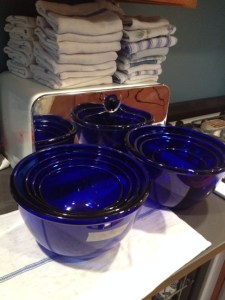
I look at the two sets now, side by side, and remember something else. The set my brother gave me came with three bowls. I acquired the fourth bowl years later. The fourth one in my set, which is significantly smaller than the “small” bowl in the original gift, is smaller than the “small” bowl in the Estate Sale set, which I will name Yvette. What we have are two slightly different sets of four. In other words, I suspect that to have a “complete” set of these Arcoroc bowls, you’d have to have five bowls. But I’ve never seen a set of five for sale anywhere. I don’t know where Yvette came from. Was Yvette originally made up of five pieces, but the smallest Yvette broke? I will never know. My fourth bowl, I remember, I found in a housewares shop in the Hartford area ca. 2001, and I got it not because I needed it but because it was so obvious that I should have it and give it a home with its siblings. (My mom was with me at the time and she immediately saw that this was the right thing to do; I think she paid for the bowl, actually. It was the same shopping trip where we acquired two beer steins, for my then-boyfriend, now-husband, and we were also gifted with a basket for our newly-acquired cat to sleep in. The cat loved that basket. He wasn’t much of a beer drinker, though.)

If I were a perfect person, I would find another one of the really small blue bowls, and add it to the set, and then present it all to G. I would also find a bowl like the smallest Yvette I have in my possession now, and add it to the Hausfrau set. But this is a little crazy, and I think I should just be content with what I’ve acquired through chance and happy gifts.

I’m worried about shipping these bowls: their scarcity means that, if I ship them, and something bad happens, they’ll be difficult to replace. As luck would have it, I am going to be seeing my friend G. in about a month. So I’m going to wash these bowls, and pack them up carefully, and bring them to her in person. Don’t thank the Hausfrau, either, G. — thank Jo.

You Don’t Need a Tattoo, but You Should Really Get a Paleta.

 
About a year and a half ago, I was made aware of the existence of something called a paleta, which is a Mexican popsicle. I was on a food tour of a neighborhood in town that’s the residential and cultural base of the Central and South American communities here, and we had stopped into a restaurant where, I was told, there was a freezer case of paletas. “They’re wonderful,” the guide advised us. I didn’t have time to sample one just then, but I made a mental note to go back and try one later. As luck would have it, I’ve not gotten back to that particular restaurant, but I’ve spent a lot of time wondering about paletas.

I spend a lot of time downtown at a place called The Institute Library, which is located on a somewhat rag-tag block of Chapel Street. Chapel Street is, like so many city streets, variable, block by block. Some sections are quite high-end, with shops catering to the Yale community, and some are, as the phrase goes, low-rent. The Institute Library, which has been in its unassuming building since the 1870s, is in what is currently a low-rent district (but rents are definitely going up). This distinguished and strange Library has been, for decades, surrounded by retail storefronts selling inexpensive goods to New Haveners who are decidedly not part of the Yale community. You can find beauty supplies, wigs, flashy jewelry, dollar store stuff. You can get a pair of Nikes, a pair of Chuck Taylors, bars of black soap. And right next door to the Library is a tattoo parlor. As the Hausfrau is not a big fan of tattoos, I’ve never been inside the tattoo parlor (though I’ve logged many hours in the beauty supply shops and the dollar stores). As I was walking to the Institute Library, I noticed suddenly that the tattoo parlor next door, of all places, had a sign in their window announcing that they had paletas for sale. “Well, isn’t that interesting,” I said to myself.

Then I found myself engaged in a long Facebook conversation with a friend who had also seen the sign and wanted to try one. She, like me, found it hilarious that the tattoo parlor was hawking popsicles.  What got me was that there were so many flavors. I wrote, “I want to try — I think the sign said there’s a caramel one. Also coconut. It’s like a Crayola crayon 64 pack list of flavors.” We had this conversation in February, when, frankly, eating popsicles was no one’s highest priority. But we stowed the information away for future reference.

Well, last week, the future came. L. and I made plans to meet downtown and scoop up a paleta or two. First we met at the English Building Market, a delightful shop selling various vintage items, mostly housewares, and I picked up an Ice-O-Matic there (more on that later). Then we went to the tattoo parlor.
The paletas are kept in a freezer case by the front window. Depending on the time of day, the way the light hits, you might not be able to see into the freezer case while standing on the street — glare can be a bitch. But you can read the sign in the window that lists all the flavors. L and I strode into the tattoo parlor with, really, no idea what we might be iIMG_6382n for. Neither of us had ever been inside the tattoo parlor before. What we found was a very clean, orderly shop, with rows of chairs for people to wait in, like at a doctor’s office, and signs advising clients to please keep their children under control. Along the left wall was a long glass case displaying jewelry for sale, and we perused the selections while the woman working the desk (the owner, it turns out) helped a client. The jewelry was a surprise — I’d never known they had jewelry in there, and to be quite a honest, I rather liked a lot of it, and none that I saw at first glance had hideously high prices. I mean, I’m in the market for a new ring, and it may well come from there.
Once the clerk had finished her transaction, she turned to us and I said, “Hi, we’d like to buy a couple popsicles.” She came down from behind the desk and walked over to the case with us. She unlocked the case, and we scanned the case: What would be seriously good? What would just be a novelty item, worth a couple of bites but possibly not worth finishing? This was a MAJOR DECISION we were making. “I’m kind of leaning toward the rice pudding,” I said to L. She said, “That’s what I was thinking about, too,” she admitted. I said, “We should really get two different flavors. You get the rice pudding, I’ll get something else.”

Not all flavors are available at any given moment, it appears; of the ones I could see quickly — I didn’t want to waste too much of the clerk’s time — there were two contenders I could take seriously, one of them coconut, one of them an old favorite of mine, lime. Lime isn’t a very unusual popsicle flavor, but on the other hand, I find that I don’t see it around much these days. And I had a suspicion that if I got one of these lime popsicles, it would be exponentially more lime-y than whatever crap I’d be likely to get from an ice cream truck or in the ice cream novelties section at Stop and Shop.

We paid for the paletas and unwrapped them quickly. The clerk very sweetly handed us each a paper towel — she didn’t have to do that, it was very motherly and kind of her — and we thanked her and took our soon-to-be-messy paletas out in the street. We walked over to Pitkin Plaza, sat down at a cafe table, and talked and ate our popsicles.

L. declared hers weird but delicious. “The rice has a kind of chewy quality,” she said. I reported that the lime was sharp and sweet and just the right thing for a hot summer day. Sitting at the table, we ate the popsicles quickly — we had to — and discussed the oddity of going to a tattoo parlor downtown to buy popsicles. “Did you see you can get a rum raisin one?” L. asked me. I said, “Rum raisin is very mysterious.” “I don’t think they make rum raisin ice cream anymore,” L. said. “I never see it anywhere.” I told her that there’s a shop in my neighborhood that carries it, and explained my theory that they stock it for one elderly customer who lives nearby. “I think they keep just enough of it around to keep her happy, and then when it runs out, they order more. But it’s only for her.” “That sounds entirely plausible,” she said, nodding.

“This is just so New Haven, though,” L. observed. And she’s right. New Haven has all kinds of places that are, ostensibly, one thing, but then are beloved for some other thing entirely, or are known to have some specific product that you just can’t get anywhere else in town. Sure, there are pizza places that are pizza places and movie theaters that are movie theaters. But there have also been bars that were really places we went because the jukebox was so great. It wasn’t that the drinks were so great; it was that the jukebox was great, and the drinks were at least cheap enough that you didn’t mind if they were sort of badly mixed, because the jukebox was awesome. There are bars where you go because they have really good French fries. There is a felafel store where you can buy cheap pomegranate molasses and this brand of tea that is, otherwise somewhat hard to find, I am told. (This is Ahmad tea. I’m not a tea drinker, but my husband is; he got turned onto the stuff by a co-worker who gave him a tin of it as a gift. Hooked, he started ordering it online because he couldn’t find it in shops. Then it turned out that the felafel store around the corner sells it very affordably.) There’s the little Asian grocery store where, sure, you can pick up your sushi rice and your sweet soy sauce and your Pocky sticks, if that’s what floats your boat, but the real gold there is the bi bim bop, a big bowl of wonderful food for about five bucks. This is why it pays to keep your eyes open all the time. Jewels everywhere, if you’re willing to find them.

We left Pitkin Plaza and headed for Church Street: I had to catch a bus, and L. was going to head home. “I think I’m going to go make some rice pudding,” she said thoughtfully.

I like to wander around town with my daughter and take her into places like the grocery store with the secret bi bim bap and the felafel store with the hidden stash of pomegranate molasses and pickled turnips. I would never have guessed that it would be on my agenda to take my daughter to a tattoo parlor, but with popsicles as good as these for sale — $2.50 a pop — I see no reason why I shouldn’t take her there for a treat. We actually went by and peered into the freezer case through the window yesterday as we were walking to the Institute Library. “I’m gonna take you here soon, we’ll get a popsicle — think about what flavor you’ll want.” She said, very firmly, “I think blackberry.” We’ll see how many time she changes her mind once we’re in the store. But we’re definitely going. Maybe tomorrow. We had ice cream sundaes for lunch on Monday; ice cream sodas on Wednesday; today I taught her how to make an egg cream; next up, tattoo parlor paletas.


Deviled Beef: or, The Nameless, Delicious Thing Peg Bracken Told Me to Make

When I bought a sirloin steak last Friday, I thought I was buying one nice, big, fat steak. I admit I wasn’t paying close attention to the details of the object, standing at the butcher counter. The meat weighed a little more than two pounds, which was what I was concerned about: I wanted leftovers.

What I didn’t realize, until rather late in the game — I had already broiled the entire slab of meat — was that what I really had was three separate steaks that happened to be attached to each other with these big webs of fat. I’m not complaining. The steak was delicious. But it did mean that when I went to slice the steak last Friday night, I had a small technical problem as one mini-steak separated itself from the rest of the meat and I came close to making a big mess on the counter with the dripping meat juices. It all turned out fine, don’t worry: I managed to flip everything onto the carving board and all the juices landed in the board’s channels, just the way they were supposed to. Nothing landed on, say, the filthy kitchen floor. And as it happened, the piece that had seceded from the United Pieces of Steak was just enough to serve the three of us comfortably on Friday night, and the two remaining pieces turned out to be just right for two other projects. I was vindicated, regarding my plans for leftovers, and the meat itself had done the portioning for me.

One leftover mini-steak was turned into nachos the other evening, as longtime readers may recall. And you longtime readers are now probably wondering, “What did you do with the last of the meat?”

At this juncture in the narrative, let us now remember Peg Bracken’s writings on the subject of leftover meat, in The I Hate to Cook Book.

Peg Bracken was, of course, a genius on the subject of what to do with leftover food, and the world owes her thanks on this matter. But the fact is, one of her suggestions regarding leftover beef is something that I’ve read a thousand times or more and never tried. It is this:

“And have you ground up a chunk of it with pickles and onion and celery and added some mayonnaise, as a spread for after-school sandwiches?”

To this, until recently, all I could ever say was, “No, why would I want to do that?” Not when I could do things like make chili or nachos or beef stroganoff out of my leftover beef! It wasn’t until recent years that I began to think, “That might be pretty good.” The younger Hausfrau — the pre-Hausfrau Hausfrau — always read this and thought, “I’m supposed to grind up meat with pickles? Are you insane?”

Well, I have been wrong.

Last night I took my last few ounces of sirloin steak and threw it into the food processor with a hefty hunk of red onion, a tablespoon of powdered garlic, and some mayonnaise, and I made a tan mush that looked disgusting. I scraped it into a mixing bowl and folded in a couple tablespoons of pickle relish. It looked vile. But I was undaunted. Appearances can be deceiving. Much as cakes that are works of sugar art can taste like chocolate-scented cardboard, many things that look revolting often taste very good.

My husband came home and peered into the bowl and said, “Tuna salad sandwiches for dinner?”

“No, it’s… beef spread,” I said, a little dubiously, I confess. “I don’t know what you call it, really.”

“I bet it’s really good,” he remarked. My husband has never met a thing involving beef that didn’t brighten his day. My daughter, a more skeptical meat-eater, came into the kitchen and peered into the bowl with great hopefulness and then got a sad look on her face. This stuff does not look appetizing at all. Have I mentioned this before? Because it’s true. But I took a dab of it and offered it to her to taste. “Here,”I said. She opened her mouth and I stuck my finger in and she looked happy.

“Dinner won’t be ready for about twenty minutes,” I said. “Get out of the kitchen.” My family went and sat on the couch to watch stupid cat videos and I thought, “I’ll make them a little appetizer.” I made two small sandwiches with the beef glop and brought them to the couch. Then I turned and went back to working on dinner.

“How is it?” I called from the kitchen.

“It’s really good,” my husband said.

“Does our daughter like it?” I asked.

My husband said, “I don’t know, she’s too busy cramming the rest of it into her mouth.”

I ambled back out to the living room. “Is it good?” I asked my daughter.

“Can I have another one?” she asked.

Let’s call it Deviled Beef. You could call it Beef Salad, you could call it Beef Spread, you could call it That Stuff That Looks Like Something the Cat Gakked Up. Deviled Beef sounds the most appealing to me.

There are a lot of articles online that talk about this substance, which is simultaneously ubiquitous, it seems, in certain low-brow food circles, and entirely undiscussed in others. The Pioneer Woman, Ree Drummond, who has a vast following, wrote a piece about this delicious stuff almost exactly six years ago. But I’ve not seen the articles I expected to see. I expected to see swooning from someone at Epicurious.com about how this old-timey sandwich spread deserves to be served on crackers or Melba toasts at your next cocktail party. I expected to see some hipster-y piece somewhere, maybe from Serious Eats, about how beef spread can be a solution to your picnic sandwich woes this summer. I expected some food blogger to have a thousand words on Peg Bracken’s beef spread and how it’s an unappreciated work of genius. If nothing else, I really thought the Peg Bracken angle would have led some Bracken fangirl to write about beef spread, or salad, or whatever you call it.

What I found was a fair number of very middle-America websites suggesting we grind up our beef with mayonnaise and pickle relish and things (hard-boiled eggs often came into play, as with Ree Drummond), and a lot of comments from people saying, either, “Oh my god, that looks like baby vomit” or “My grandmother used to make this and it was delicious.” I found a website that talked about Southern food and gave a recipe for Roast Beef Spread which looked pretty much like what I’d made, but there are no comments on it (not that kind of site, I guess). But Saveur hasn’t talked about it, though they’ve discussed pimiento cheese at great length. I don’t recall anything about beef spread in Cook’s Illustrated. And Tamar Adler and Sam Sifton haven’t written about it, to the best of my knowledge.

In other words, this substance has not yet made it into the elite (or elitist) food world yet, the way deviled eggs and pimiento cheese cycled back in a few years ago. (I still haven’t recovered from the time I went for drinks at a fancy bar that specializes in serving bourbon, and they charged me $7 for three deviled eggs. I don’t mean three whole eggs. I mean, three half-eggs. Seven bucks. For seven bucks, I could make about 48 deviled eggs.) It may be that deviled beef is just too disgusting-looking for it to have a cultural and culinary renewal, but that would be a mistake. This stuff is good. And it’s economical. Not that that is the point. The point is, it’s good. But if I ran a restaurant and had a lot of leftover beef around — not hamburger meat, but leftover steaks or something — I would totally make a killing selling this stuff to my customers.

I’ll tell you how good it is. After I denied my daughter a second deviled beef sandwich last night — because we were soon to sit down to eat huge bowls of Pasta Natalie — she asked me, “You’re gonna make me a sandwich of that for lunch at camp tomorrow, right?”

Deviled Beef Sandwich


The answer is Yes. And furthermore, I intend to spend some serious time fiddling with this stuff. Deviled Beef is going to be awesome with horseradish, with capers, with chimmichurri blended in….

The Effort Required to Get to Monday Evening

We were out of town over the weekend, visiting friends in Vermont, and while it is always delightful to visit these friends, inevitably it is always a pleasure to come home. The three of us love hanging out in their kitchen and tramping through the woods surrounding their house (well, my husband and child enjoy that last part; my grouchy presence there is merely tolerated). It’s like the bit in one of the Madeline books, I think it’s Madeline and the Gypsies: The best part of a voyage, by ship or train, is when the trip is over, and you are home again.

One challenge, however, is getting everything taken care of The Day After. We came home late Sunday night, exhausted, and I knew Monday would be a bear. It was. I faced many loads of laundry (see: tramping through woods, summer use of towels). And it also came to my attention that I had to run the full dishwasher that had been sitting for three days, a neatly stacked cabinet of festering filth. I never once considered that I might not have something I could make for dinner on hand, because I am someone who Has Faith in the Pantry, but come afternoon, I had to think hard about it. What was I going to make for dinner?

I picked my child up at camp and as we walked home, she asked, as she always does, “What’s for dinner?” and I said, “I’m not really sure. I just know it’ll involve leftover steak.”

This led me to think even harder about what was waiting for us at home. There was a tomato; a few tablespoons of chimichurri sauce; sour cream; the steak.

“Nachos,” I said. “We’re having nachos.”

“Mmmmmmmnachos,” my daughter said enthusiastically.

In the end, these were nachos that deserve honor in the Nacho Pantheon. These were heroic nachos; they were so good, they did not require sour cream or salsa.

I had about seven ounces of broiled sirloin I could use up, but I opted to use only a third of it. I minced it finely and threw it into a mixing bowl. To this I added:

an ear of corn, kernels shaved off the cob; about 1/2 cup of minced black olives; two scallions, thinly sliced; one finely diced tomato and its juices; three tablespoons of chimichurri sauce. I mixed this all together with a fork and let it sit for a few minutes while I got the rest of my act together. This involved taking a bag of tortilla chips down from the cabinet above the fridge and pulling a brick of cheddar from the cheese drawer in the fridge. I got a baking sheet out and covered it with a layer of chips. Then I tossed forkfuls of the meat-and-veggie mixture here and there over the chips. I grated cheese all over that, and repeated the process until I had used up all the m-&-Vs and all the cheese.  I dotted some pickled jalapeños over the top — so that they’d be easy for my daughter to remove them from her serving — and I put it into a 400° oven and let it bake for about ten minutes.
Usually when I make nachos, there are some leftovers. Not a lot, but enough for me to heat up and eat as a mid-day snack the next day. In this case, there were no leftovers. At all. These nachos were so ridiculously good, unembellished by salsa or sour cream, it was just shocking. With sour cream and salsa, they were criminal.
The tragedy, of course, is that there’s almost no way I will be able to pull this off again. But we will always have the memory of those perfect nachos.
I imagine some readers are wondering why I didn’t make them again with the rest of the leftover sirloin steak. AH: therein lies a tale.

“You realize we are never doing this again, right?”

These were the words I spoke to my beloved daughter after I’d been rolling spring rolls for about fifteen minutes and realized that I could never work in a Vietnamese or Thai restaurant. Basically, any restaurant that features spring rolls on the menu is a place where the chefs have earned every ounce of my respect. Because few things in the kitchen are more infuriating than working with rice paper wrappers. It’s right up there with exotic buttercream frostings, something I will never muck with again since the last time I tried and wound up crying. Some kitchen enterprises are just not worth it.

This all started months and months ago. We had been out to lunch at a Thai restaurant with my mother. We decimated a tray of spring rolls in about three minutes and my daughter said, “We could make these, couldn’t we Mama?” I said, “Well, probably.” I meant this to mean, “I COULD, but I am not going to.” She took this as “Sure, we can ABSOLUTELY DO THAT!” and never let the subject drop. So all the rest of the school year, I’d say, “Some day over the summer, we’ll make spring rolls. It’ll be an Activity.” And she got more and more psyched about it. Which is great, to be honest. But it means the bar for success is pretty high.

Yesterday was the day we finally got around to it. We went to the Hong Kong Grocery downtown — they have pretty much everything you need to make pretty much anything except matzo ball soup — and we carried home a tote bag filled with the necessary stuff. We had a packet of rice paper wrappers — mysterious things I’d never used before — and a nice bunch of cilantro and a head of lettuce. We had surimi (imitation crab sticks), purchased because the more traditional spring roll animal flesh, shrimp, is unacceptable to my daughter. We had a fat carrot to grate, bean sprouts, a package of bean thread noodles. At home I already had a cucumber and all the condiments I’d need to pull this off.

It was early in the afternoon when we began the prep work: I explained to my daughter that making the spring rolls would be a lot of work and that it’d be easier if we got the veggie prep done well in advance. “We have to wash all this stuff before we can use it,” I said. “Let’s just get it done and then we can hang around and be lazy for a couple of hours before we really get to the hard part.”

“Why is it the hard part?” my daughter asked.

“Because I don’t know what the hell I’m doing,” I said.

We stood at the sink and spent some quality time with the salad spinner. We washed cilantro and bean sprouts and lettuce; my daughter plucked the leaves from the stems of the cilantro and filled the 1/2 cup measuring cup I’d put out for this purpose. She did a great job. I made sure that the surimi was thawed, and then we played a game of Scrabble.

At five o’clock, I filled a big enamelware bowl — I usually use it as a salad bowl — with hot water, and we lined up our mise en place, and we got to work.

Within roughly fifteen seconds I realized I was going to lose my mind. I knew that working with rice paper wrappers wouldn’t be fun, but I hadn’t fully grasped how evil those little shits would be. You have to soak the wrappers and dry them before you put them on your work surface, lay filling on them, and then roll them up. It makes hamantaschen-folding look like pouring a bowl of cereal.

I produced four spring rolls, all of them technically correct — untorn, complete — but they were messy, ugly, and I said to my daughter, “This is going to kill me.” I had no idea how many spring rolls I’d have to make in order to have spring rolls be an entire meal. In the meantime, I was tired and cranky and losing my ability to be patient with this very, very fiddly work. We had to empty out the water bowl and refill it several times: no cookbook or website I looked at mentioned this, but if the water’s not hot enough, the wrappers don’t soften correctly. And if you don’t time it JUST RIGHT, the wrapper’s not worth a damn, either. Every recipe I read said to soak the wrapper for 10 to 20 seconds, turning it once in the process. Well, no: it was more like 5 seconds on one side, three seconds on the second side. We counted aloud, that’s how I know.

You soak the wrapper and lay it on a towel, and then you fold the towel over so that you dry the top of the wrapper quickly as well. Then you have to somehow migrate the very delicate wrapper to a place where you can roll the thing up. (I suppose it could all be done on the towel, but it’s hard to see the wrapper when it’s on the towel.) A little bit of bean noodle; a little bit of carrot, of cilantro, of surimi — then you fold it like a little bitty burrito. Or, as I observed to my husband, when he got home, like a boerek. (How do I know about making boereks, those little Turkish cheese pastries? It was an annual fundraising project at my daughter’s nursery school. Don’t ask.)

Making spring rolls is one of those things where, It’s not that it’s hard; but it’s HARD. I assume it takes hours of practice to get really skilled. I had a running monologue going on the subject as I took the wrappers from my daughter and laid them on the towel and dried them and then filled them and rolled them. “The kitchens at the Thai and Vietnamese restaurants are probably all staffed by people who’ve been making these things since they were six years old,” I spat. “By the time they’re teenagers, they can do this in their sleep.” “Uh-huh,” my daughter said sympathetically. She knows when I’m on a tear. “You realize we’re never doing this again, right?” I said. “Uh-huh,” she said. At one point she refilled the bowl with hot water and carried it back to the counter saying, “I’m not gonna spill, I’m not gonna spill,” (and she didn’t) and she said, “I would give you a hug except I’d get in your way.”

I muttered my way through rolling a platter’s worth of spring rolls. A couple of them were so wretched I just fed them directly to my daughter, do not pass Go, do not collect $200. She declared them delicious. I got through my supplies of slices of surimi, cucumber, cilantro leaves, and grated carrot, and thought, “I’ve had enough of this crap.” I still had a huge bowl of bean thread noodles in front of me. And my husband and child were looking hungry.

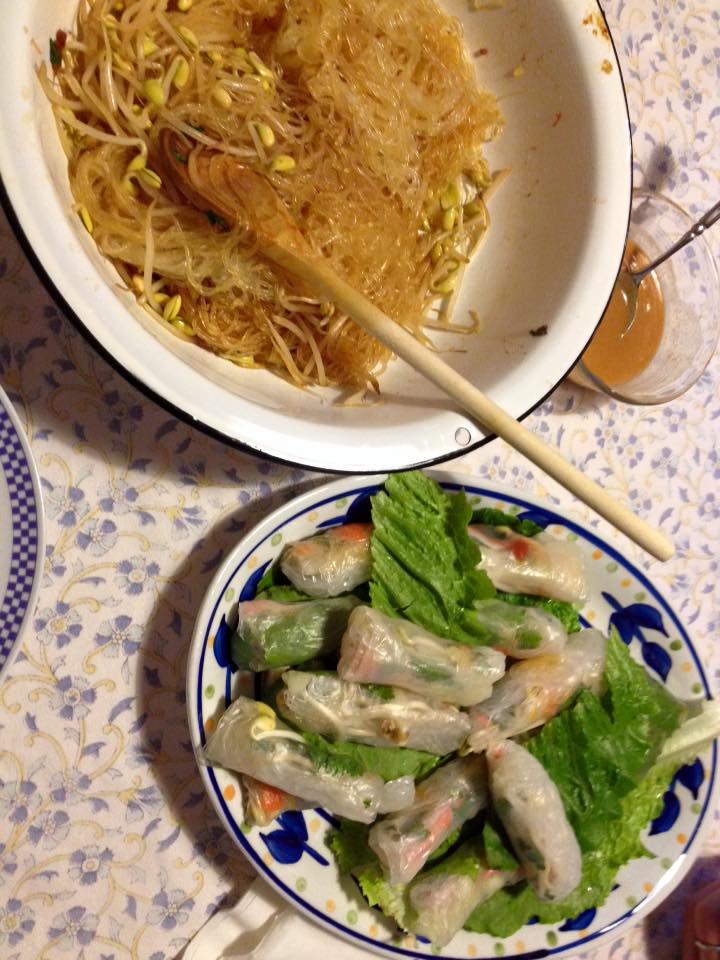
So I cooked up a sauce out of peanut butter, garlic, ginger, soy sauce, and peanut oil, and mixed it into the noodles with my hands (this is the only way I can effectively mix sauces in with noodles like this; I don’t know how other people manage it otherwise). I sprinkled the last of the bean sprouts on top and set the bowl on the dining table. Then I whisked up a sauce for the spring rolls (peanut butter, soy sauce, Sriracha, garlic) and brought that to the table. Lastly, I brought out the spring rolls.

I had to admit, it all looked fairly impressive. Spring Rolls Cellophane NoodlesMy family certainly inhaled vast quantities of food. I think I’d rolled well more than a dozen spring rolls, when all was said and done — I could figure it out by counting how many wrappers were leftover, but that’s too depressing to contemplate, because it means I’d have to face how many I have leftover to deal with in the future. And a dozen spring rolls doesn’t sound like a lot of spring rolls, but when you’re an incompetent klutz and a novice at working with rice paper wrappers…


Well. I think, actually, that I can handle it. I think that given a little more practice, I can get good at it. And that if I do get good at it, it will be worthwhile. Just like with the hamantaschen. But in the meantime, I’m going to order spring rolls in restaurants as often as I can to try to figure out how to get mine better. Yesterday’s spring rolls were a new room in the Museum of Tsuris, but I have to believe that given practice I can demolish that room.
In the meantime, the leftover cilantro’s been turned into chimichurri sauce, which we’ll be having with a broiled steak for dinner tonight. Potato salad on the side. Very straightforward compared to last night, to which I say, Thank god.


The Master List: Why You Need More Towels Than You Think You Need

This master list is not universal, but it’s about as close to universal as I can get. Let us assume you are a household with the following:

someone who cooks a lot; a child or two; an occasional need to bathe; an occasional need to clean house; an occasional tendency to go to a beach or a swimming pool or the local Ol’ Swimmin’ Hole; one or two total klutzes; pets

There are different categories of towels you want to have on hand at all times. Some of them can be, more or less, rags, but they shouldn’t all start out that way, ’cause that’d be a major bummer.

  1. You need bath towels. Nice, big, regularly laundered bath towels.
  2. You need hand towels: two for each bathroom. Keep one on the rack and a spare stowed away nearby, clean, because sometimes you have a guest and realize at the worst possible moment that the hand towel is vile and you want to be able to put a fresh one out immediately. If you have a spare hidden away, you can do that very easily.
  3. You need a metric fuckton of kitchen towels. I have written elsewhere about this. If you want details, go find that piece here.
  4. When kitchen towels start to look shabby, that’s when you demote them to the cleaning/spills pile. Rags made of old clothes work fine here, except in my experience a lot of the time old clothes are dark or too thick or somehow the wrong kind of fabric for this purpose. It just depends on what your own personal supply is like. So if you’re me, you hang onto old dishrags and dishtowels until they are literally fraying to the point of dust, and you use them for dusting and mopping up and catching drips and all kinds of things until they just cannot be laundered any more. The grungiest of the grungy are what you use for cleaning up animal messes, in the event paper towels are not available. (Pet messes are almost the only reason I use paper towels. Pet messes, and absorbing cooking grease, like when you have to drain fried food on something. This is why we use a roll of paper towels only once a year or so, if that.)
  5. Beach/Pool/Summer Activities towels. THESE are a whole different breed of thing, and I don’t exactly approve of them but I have come to accept that they are necessary. What seems to work for us is this: every member of the household has two towels that are “their” beach towels. They are brightly colored/patterned/illustrated, large towels that are instantly identifiable whether they’re spread out on the sand, thrown over the back of a chair, or wadded up on the floor someplace. I used to think everyone needed only one each, but two summers of constant laundry have caused me to decide that this is incorrect, and really everyone has to have two. My husband has two; my child has two. I have one, but I don’t count. Yes, that’s a joke. Kind of. Sort of.
    The each person has “x” themed/colored towels is a system that I know has been adopted by other families after years of domestic strain caused by squabbling over beach towels. Avoid the squabbling and plan ahead, please.

You will, in the summertime, be laundering these things constantly, in a way you don’t at any other time of year. Summer is the season for going swimming, for eating popsicles, for  spilling nail polish on the bathroom floor, for opening bottles of beer and having the head burst up and make a mess on the kitchen counter and the floor. It’s the season for biting into fruit that is so juicy it pours itself down your chin (good peaches) and the season for making messes with bubble blowing supplies (every child ever). Be prepared for summer. Invest in towels. Signed, the mother who has done laundry every 36 hours this week because it is summer.

An interesting theory about Ovaltine.

I grew up drinking Ovaltine, preferably the Rich Chocolate variety. I love the stuff. However, I don’t think I’ve ever been romantically involved with anyone who liked it. I remember one old boyfriend who referred to it as “sewer water.” My husband loathes the stuff and mocks it at any available opportunity. Naturally, Christmastime is prime time for mocking Ovaltine, because we all watch A Christmas Story on TV and Ovaltine is practically a supporting actor in that flick. It was last Christmas that my daughter noticed that Ralphie was always drinking Ovaltine, and she asked what it was. I explained that it’s a kind of chocolatey powder you add to milk. The next time it seemed like a nice thing to do — after we got home from Christmas travels, and she needed a drink of milk — I offered her a chance to try some Ovaltine.

Now, my daughter was seven years old at the time, which means, yes, I had been deliberately withholding Ovaltine from her for seven long years. But my system has worked pretty well. By regarding it as a treat, and not something one consumes on a daily basis (as we might a glass of regular milk), it’s now a big deal wonderful thing when I say, casually, “hey, you want a glass of Ovaltine?” I don’t do this when my husband’s around, by the way. It something that happens after school, when it’s just me and my daughter, and Mama makes the rules. It’s like a bonding thing for us. Cold, cold glasses of Ovaltine, for me and my girl.

So this afternoon, my husband and my child and I were eating lunch. She was having a bowl of leftover tortellini salad from last night’s dinner. My husband and I were eating bologna and cheese sandwiches, which are not part of our usual repertoire here. But I bought some yellow American cheese and bologna the other day because I’d been reminiscing about how when I was in high school, I used to eat bologna and cheese sandwiches for breakfast every morning, and how good they were. I would take two slices of bread and toast the cheese onto the bread in the toaster oven, and then slap a circle of beef bologna into the middle of the slices of bread. It was a great breakfast, fast to assemble and the cleanup was a snap because there was just the plate to rinse off.

My husband, hearing this description, suggested that I should try to replicate this sandwich, and see if it was as good as I remembered it. So I did.

My husband, eating his sandwich, agreed that it would indeed be a good breakfast.

I said, “Of course, we’re not doing it right. To do it right, you wash it down with a glass of cold, cold Ovaltine.” My husband snorted, and my daughter crooned, “Ooooooovaltine. I love Ovaltine.”

“Chocolate milk with that disgusting chemical aftertaste,” my husband said.

“Our daughter’s pediatrician loves Ovaltine,” I said haughtily. I was, by this point, in the kitchen, loading my plate into the dishwasher. My husband was not within my line of vision but I could hear him rolling his eyes.

“She was a formula-fed baby,” he said. “So of course she loves Ovaltine.”

“What do you mean?” I asked, though I knew where this was headed.

“People who drank formula when they were babies will love Ovaltine,” he said, “and people who drank breast milk won’t, because they don’t like the taste of all the chemicals.”

“Hm,” I said.

“Our daughter’s doctor was a formula baby,” he said.

“How do you know?”

“She told us. When we took our daughter for her first checkup, when she was a couple days old, you told her that breast feeding wasn’t going so well, and she said, “So, formula’s fine. I had formula, and I’m ok.” I conceded that the doctor had indeed been approving of our feeding our little girl formula. “And you were formula fed,” my husband pointed out. “So it makes sense that the two of you love Ovaltine. But I was breast-fed, and I think it’s vile.”

I wanted to say, “You’re so full of shit,” but part of me thinks, “well, actually, that’s reasonable.” But is it true? Are people who were fed formula as infants predisposed to like Ovaltine? Are there any studies on this? Can anyone out there tell me?

In the meantime, my health’s been pretty good, and my daughter’s health record is sterling, and the Ovaltine doesn’t seem to be hurting us any. So as long as we both enjoy it, I’m gonna keep a jar of it on hand.

A Plan Hatched in 1993 Comes to Fruition

Ever since I read More Home Cooking by Laurie Colwin I have thought, “I should make yogurt.”
This is a book I purchased the day it arrived at the bookstore where I then worked. I was making $5 an hour, which is to say, bupkes, but I bought it in hardcover and brought it home hours after I’d freed it from the shipping box. I carried it home, made myself a meal of spaghetti with pesto sauce (in those days I bought pre-made pesto sauce), and sat down to eat. The very first thing I did was inadvertently fling a blob of pesto onto one of the pages of the book, staining it permanently. I think I cried, I was so angry at myself, but I quickly grasped that Colwin wouldn’t mind at all, so I blotted off as much oil as I could and then kept eating and reading.

In this volume, Colwin assures her readers that any damned moron can make yogurt. I was skeptical, but thought, “Maybe she’s right. She wouldn’t lie to me.” And so I got the idea in my head that someday I would make yogurt.

Every six months or so, ever since then, I have had the thought, “I should make yogurt. See how easy it really is.” But I never did it. Whenever  the thought crossed my mind, I would be lacking one of the essential ingredients — I didn’t have enough milk on hand, or I didn’t have good, plain yogurt. There were times when I would deliberately buy fancy milk or fancy yogurt, thinking, “I will use these to start my own yogurt,” but it never worked out. This went on for decades. It’s now 2016, after all.

But yesterday I was spending an afternoon at home. My daughter had, rather uncharacteristically, decided to take a nap. I was downstairs and awake, willing to do something in the kitchen, but not willing to make a lot of noise (so anything involving the stand mixer was out). I realized that I had on hand a nearly full carton of Preferred Milk (Farmer’s Cow whole milk) and about a third of a tub of very good yogurt from Arethusa Farm Dairy.

“Here we go!” I said. And so I pulled More Home Cooking from the shelf and got to work.

Colwin says that making yogurt is ridiculously easy and that you don’t need a thermometer to do it, to which my response is, “Maybe YOU don’t need a thermometer, but I’m glad I have one.” I did exactly as she said. I took 2 1/2 cups of milk and brought it to a boil in a pot. She doesn’t tell you to have the pot boil over and make a huge mess, but I achieved this effortlessly, as well. I then simmered the milk for two minutes and took it off the heat and let it cool down. It needs to come down to a temperature between 110°-115°, which takes longer than I would have guessed if I’d just been relying on my finger to test; I was glad to have the Thermapen to let me know what was what. (Colwin says, by the way, to bring it down to 110°, but when I looked in other cookbooks to see how their recipes compared, what I found was a range — between 110° and 115°. When mine was at 114°, I moved.)

When the milk is cool enough, you whisk in your yogurt starter. I used about 1/4 cup of the Arethusa yogurt. I then made a mess on the counter pouring all of the milk and yogurt into the glass Mason jar, but most of the stuff got into the jar. I closed the jar, wrapped a tea towel around it, and set it by the stove. You want to keep it warmish while it’s fermenting or doing whatever it’s doing. I then had a lovely time cleaning up the milk from the stovetop and the countertop.

After dinner last night, when I was cleaning up the kitchen, I noticed the jar sitting by the stove and wondered if it would remain warm enough. I had just scrubbed out the biggest Dutch oven we have and it was still warm from the hot water. I decided to put the jar into the Dutch oven and balance the lid on top. I figured the residual heat couldn’t hurt the yogurt and might help it along. A lot of yogurt recipes tell you to keep the jar by the pilot light of your oven to maintain temperature, and that’s great advice, but I don’t have a pilot light of which I am aware (though there must be one, since I have a gas stove). What’s more, if I put the jar into the oven and left it overnight, I would be all but guaranteed to forget about it, which I know would lead to total disaster. So the “jar-int0-warm-Dutch-oven” plan seemed like a good compromise. I balanced the pot lid on the top of the Mason jar and turned off the kitchen lights and went up to bed, thinking, “Well….. we’ll see what we’ve got in the morning.”

Everyone writes about how when they first start making yogurt the results are soupy. That’s the word everyone uses: soupy. So I didn’t have very high expectations for my first attempt; I figured that the worst-case scenario was that I’d make soupy yogurt and then spend some time draining it with cheesecloth or use it to make a yogurt cake. I wasn’t optimistic about the process but I was curious to see what would happen.

This morning when I went downstairs to get a cup of coffee, I noticed the pot on the stove and thought, “Come on, who left a pot on the stove last night?” and remembered that it was me. Then I remembered the whole yogurt thing. I took out the Mason jar and shook it a little: would the yogurt just splosh around in there?

To my astonishment it did not splosh at all. It was a solid mass with just a little bit of whey floating at the top. In other words, it looked exactly like real yogurt. I opened the jar and took a spoonful of it: it tasted just like real yogurt.

In other words: I had successfully made yogurt. And it really was easy.

So now I feel like a jackass for not having done it before.

On the bright side: I now get to spend time thinking about how to make it even better. Must remember to add Farmer’s Cow Half-and-Half to the shopping list.

Postscript: I fully expected my husband and child to be excited about the yogurt this morning, and to want some with breakfast. My husband is in the habit of eating yogurt in the mornings, so I was particularly confident that he would want some. Instead, he complained, “What happened to my Arethusa yogurt? There’s hardly any left in the tub.” I said, astonished, “I used a quarter cup of it as a starter for the yogurt I made yesterday.” He said, “So you didn’t really make yogurt. You just took someone else’s yogurt, and added milk to it, and now you’re calling it yogurt.” “You wanna try some?” I countered. “No,” he said.
It then dawned on me that he didn’t trust the yogurt I’d made. “It’s good!” I insisted. I got the jar from the fridge. “Look! It looks just like yogurt! From the store! Except it’s homemade!” He glanced at it dismissively. I put the jar back in the fridge, saying, “I can’t believe you ingrates. I make yogurt and none of you will eat it.”
“Have you eaten any of it?” my husband asked.

“Yes!” I said. “I had a spoonful of it.”

“Well, let’s wait and see what happens,” he said.

Basically, he’s positive that I’m going to give everyone food poisoning with the yogurt. So my yogurt victory may be a total loss on the domestic front. I had not planned to put this post into the Museum of Tsuris, but after this update, I feel I have no choice. It’s not that the yogurt has given me any tsuris, mind you, but my husband sure has. Ingrate.

Summer Vacation. See: Fuck This, but I’ll Do the Best I Can

A couple of weeks ago, my delightful daughter’s school year ended and the summer began. Because I am a hausfrau full time, this did not involve quite the same type of angst and drama that engulfs the lives of all my friends and associates who are working mothers; but the stay at home mother who is not utterly delighted by engaging in wholesome family activities also finds summer vacations stressful. I personally am not someone who wants to spend my time coming up with fun educational activities for the kid. I don’t have the disposable income or the inclination to take her on Big Trips. What I have is a small budget for summer entertainment, and a lot of time on my hands, and the simultaneous need to keep the house operating the way it’s supposed to the other nine months of the year. In other words: Kid, sure, you’re on summer vacation, but I still have to vacuum and make dinner every night.

And, in fact, since the kid’s not being fed lunch at school five days a week, I have to produce more food than usual, come summer vacation, because I have to scrape together two mid-day meals every day, instead of just scrounging something together for myself.

The first week that school was out, my daughter attended a lovely day camp that’s about a mile from our house. Actually, it’s precisely one mile from our house. I mapped it online: one mile from door to door. She loves the program, which is awesome; I was a child who dreaded all summer camps and it makes me happy that we landed on something that is, by happy circumstance, nearby and a place she loves. They build things, they make things, they do real stuff that teaches them real skills. My daughter can now sew better than I can, and has no fear of pliers. God Bless the Eli Whitney Museum.
But this week, she is not in camp. Nor will she be there next week. So we’ve got two solid weeks ahead of us where the days will be…. long.

With this in mind, last Friday afternoon, we began to compile a list of Things We Could Do that would be entertaining, useful, educational, not too toxic, not too demanding of my energy, and not too expensive. (In other words, her proposal that she and I go on a girl’s trip to Montreal was really appreciated, but I had to veto it.)

One thing I realized was that these would be good days during which to cook things that she’s asked me to make that I never get around to making. Can we make fresh spring rolls? Sure! Can we make ice cream? Sure! These are things we’ll be happy to eat, and in the case of the spring rolls, shopping for ingredients will be half the entertainment. I also expect we’ll spend some time rolling vegetable sushi. (We love sushi, but we’re not stupid: no way am I going to muck around with raw fish at home.)

There will be Beauty Makeovers: I have agreed to let my daughter start to play with my makeup. It’s a shame I no longer have the kind of supplies I had between the ages of 14-25 — she’d have a BLAST with that stuff — but I think we can make do. I will also show her the wonders of Pond’s Cold Cream, while we’re at it.

I told her that we could try to frost glass windows of our apartment using a mixture made of water, dishwashing liquid, and epsom salts. We’ve done the dirty work, and now we’re waiting for it to dry. “Jesus,” I said, watching her make a mess painting. “I hate coming up with activities for you.” “Well, you’re sure good at it though,” she said cheerfully.

We’re on Day 2, people. Day 2. Thursday, the big activity will be going to a radio station in Bridgeport, CT, where I will be a special guest on my associate Duo Dickinson’s radio show. He wants me to talk about being a housewife, and how I make a happy home. (He has this idea that we have a happy home, which I guess I can’t really dispute, even though I am not feeling particularly happy right now.) I think that there’s a lot of towels involved. Really, that’s what it’s all about, it seems to me, on days like this. The key to a happy home is having enough clean towels, to use for all those things you need clean towels for.
And now we’re back to laundry.

I Cooked a Blue Apron Meal and All I Got was…

…. well, I got a lot of things out of my Blue Apron meal. I got a lot of little packages, and I got enough food to sort of feed the family, or, at least, it might have fed the family, had the family genuinely liked the food. What I really got was, simply, the experience of using Blue Apron, and confirmation that, for someone like me, it’s a total waste of time.

I already knew I was kind of anti-Blue Apron, just on principle, but I didn’t realize how frustrating it would be to prepare a Blue Apron meal until I set out to do it. I guess part of my problem stems from the fact that I obviously misunderstood what it is that Blue Apron saves you time on. As my readers doubtless know, Blue Apron is a service that delivers to your door a box of ingredients for cooking dinner. You go to their website and look at their menu and select which meal(s) sound good to you, and the ingredients for those meal(s) are shipped to you in a refrigerated box. I knew this, but since I’d never played with the contents of such a box, I didn’t really understand how it worked, until this week.

A few months back, I noticed that my neighbors, a very busy young couple, started receiving Blue Apron packages. I figured that my neighbors’ schedules were so batshit that the service made sense to them, even though they live literally one block from a lovely Italian grocery store, three blocks from another lovely Italian grocery store, and within easy walking distance of so many other places to get food, it’s ridiculous. (I mean, there are reasons I live in this neighborhood.) The other day, the lady of the house caught me in the courtyard. She said, “Hey, I was wondering — we’re getting our Blue Apron shipment today but we’re not going to be around to cook it. I meant to cancel it but I forgot. Is there any chance you’d want it? I mean, I hate to waste the food.” I thought about it and realized this was my chance to have a crack at a Blue Apron project and said, “Sure!” So late yesterday afternoon she knocked on the door and handed over the goods.

There was a package of two catfish fillets; a little plastic bag with two Yukon Gold potatoes; a really tiny plastic packet with two sprigs of parsley in it; a small foil box of organic whole milk; a plastic bag with a weird grayish powder in it that I took to be the flour mix for breading the catfish; 1/4 of a head of Napa cabbage; and another mini-package with something in it called “knick knacks.” It took me a while to figure out the “knick knacks” because I was afraid to just open it up. It finally occurred to me to read the glossy color instruction sheet my neighbor had helpfully given me. The “knick knacks” were the things you need to make the recipe, things that, in a household like mine, you’d just have because you have them. Things like cider vinegar and butter and mayonnaise and “cajun spice blend.”

I don’t have a jar of Cajun Spice Blend around, but Blue Apron does explain to us what Cajun Spice Blend is. It is: smoked paprika, ground yellow mustard, onion powder, garlic powder, dried oregano, dried thyme, and cayenne pepper. In other words, stuff I had sitting around on my spice shelf.

My family considered this pile of ingredients. My daughter, who isn’t a big seafood person, said simply, “Yuck.” My husband said, “Catfish is good!” but seemed dubious: two potatoes does not make a whole lot of mashed potatoes. And the quarter of a head of cabbage — it was to laugh.

Well, I set to work. I read the instructions carefully and inspected the pretty color photos to make sure I understood what Blue Apron wanted me to do. It seemed to me that this was a situation where, if I winged it, I wouldn’t be giving the product the test it deserved. I resolved to follow the instructions to the letter. To this end: I took a shallow bowl and poured some of the milk and the vinegar into it, and then I stirred it around a bit, and placed the fish fillets in the bowl. This is supposed to do something to the catfish akin to soaking catfish in buttermilk. (Curdling milk with vinegar is a good way to approximate buttermilk; even I know that.) I’m not sure why we are supposed to soak catfish in buttermilk but this is Standard Operating Procedure, so, fine. I soaked the fish and turned it over in the “buttermilk” intermittently while I washed and dried the cabbage, sliced it finely the way Blue Apron wanted me to, and assembled the cole slaw (combine with mayonnaise, a little vinegar, and Cajun Spice Blend). I also set a pot of salted water to boil for the mashed potatoes. I hate making mashed potatoes; I hate cooking potatoes. But I dutifully washed and peeled and chopped the potatoes and boiled them for 12 minutes. Then I drained them (saving the potato water to use in making bread — thank you, Blue Apron, for my future loaves of potato bread) and mashed them with more of the milk and the butter Knick-Knack.

Once the potatoes were done, I put the pot in the (gently pre-heated) oven to stay warm, and I assessed the overall situation. It was abundantly clear that the cabbage might have created enough slaw to satisfy our cabbage needs (raw cabbage doesn’t shrink down the way cooked cabbage does, so I guess 1/4 a head of Napa was sufficient, and my snotty laughter was uncalled for). But there was simply not going to be enough of this meal to feed three of us. For one thing, our daughter was sure to not want to eat any catfish; and there were nowhere near enough potatoes. So I filled a stockpot with water and set it on to boil, and then I spent a few minutes mincing onion and garlic and getting a pot of pasta Natalie ready. (This meant sautéing onion, garlic, and some chopped olives in anchovies, and olive oil and then blending in tomato paste and water. It’s not hard to put together, thank god.)

Once the Natalie sauce was assembled and I didn’t have to think about it anymore, I heated some oil (not provided by Blue Apron) in a wide cast iron pan and dressed the catfish as instructed — shaking the “buttermilk” off the fish and dredging it in seasoned flour. I fried the fish and drained it on paper towels as Blue Apron advised.

“Okay everybody,” I said. “As soon as I’ve cooked the spaghetti, dinner’s ready.” I chose thin spaghetti because it takes five fewer minutes to cook than regular spaghetti, and seven minutes later, the three of us were seated around the table.

“That’s catfish?” my daughter asked, looking skeptically at the handsome platter of fried breaded fish.

“It’s yummy,” my husband said. “Well, it looks yummy,” he said. He took an entire filet and put it on his plate.

“I made spaghetti for you,” I told my daughter. “Don’t worry.” I gave her a large serving and grated cheese onto it and spooned some extra olives on top. “Here you go.” I then served myself some fish, some potatoes, and some cole slaw.

The cole slaw was fine. The potatoes were fine. The fish was entirely unappetizing. I ate a bite, trying to be optimistic. “What do you think?” I asked my husband. “It’s ok,” he said. I chewed, took another bite. “Is the problem the fish or the way I cooked it?”

“I have don’t know,” my husband said. The truth is, I almost never cook fish, so there’s no way anyone could described me as a skilled seafood cook; how could this have turned out well? My husband, the poor guy, doggedly continued to consume his fish. I got through half of mine and gave up.
He looked at my plate sadly. “Had enough?” he said.

“I’m switching to spaghetti,” I said, humiliated. “The cole slaw is good,” I said.

“The potatoes are okay,” my husband said.

“Can I have more spaghetti?” my daughter asked.

By the end of the meal, there were no leftover potatoes and the cole slaw was gone. One half of a catfish filet remained; there was enough leftover pasta to serve some to my daughter for lunch the next day and give myself some for lunch too. Had my husband and I not had catfish, cole slaw, and potatoes, there would have been no leftover pasta at all.

“What should we do with the leftover catfish?” I wondered.

“I’ll take care of it,” my husband said. I assumed this meant he would choke it down. I wiped down the kitchen counter and took the dirty kitchen linens upstairs, saying, “I might as well do a load of laundry now.”

While I was standing at the washing machine measuring in the detergent, my husband came up the stairs holding a small bowl. We don’t generally have food upstairs, so I was curious. “What’s going on?”

“Watch,” he said. He put the bowl down on the floor in the stairwell and our cat came trotting over from the towel on the bedroom floor that he regards as his bed. He sniffed. “You’re giving the cat the catfish?” I said. My husband smiled affectionately at the cat. The cat pawed at the fish and licked his paw once; then he repeated this exploratory movement. Satisfied that this was food, he then plowed through the scraps of fish in the bowl. “I only gave him a few flakes,” my husband said. “The rest of it I’m saving in the fridge as treats.”

“Okay,” I said, defeated. The truth was, if neither of us liked the fish, then the cat might as well enjoy it. The cat finished the fish in his bowl and marched away, pleased as punch. A tiny flake of fish had landed on the floor. I debated bringing it to him and decided that was insane and threw it into the toilet bowl. Then I went downstairs to help finish cleaning up the kitchen.

“I think Blue Apron’s worth it for people who really can’t stand grocery shopping,” my husband said, “or people who’re living in those extended-stay hotel type places and maybe don’t want to deal with stocking a pantry while they’re there.”

“Yeah,” I said, dolefully putting leftover pasta into a plastic tub.

“But otherwise, it’s not really worth it. They don’t take care of the prep for you, or the cooking. It’s just the shopping.”

“I spent just as much time cooking this meal — more time, really — as I would on any other normal weeknight dinner,” I said. “And it was ok, but none of us really liked it.”

The cat marched down the stairs and came into the kitchen and looked at us expectantly.

I’m wondering if I should make my neighbor an offer. For $50 a week, plus the cost of groceries, I will cook dinner for her and her husband two nights a week. It might be a better deal than Blue Apron.

Create a free website or blog at WordPress.com.

Up ↑