The Overwritten Recipe: Another Book Edward Gorey Forgot to Write and Illustrate

If you are reading a recipe, and the instructions seem over-written to you, the novice recipe reader, you should bear in mind that the person who wrote the recipe is probably trying to save you some angst by being so precise. Don’t sign angrily and insist that the writer is an asshole or just trying to get your goat. He or she is trying to explain to you why you should take step A before step B, lest you veer in the wrong direction and wind up in the Museum of Tsuris. It is true that longwindedness in recipes can be due to mere literary preciousness, or culinary pretention, but in my own case? It’s really just that I’m trying to convey to my reader, in entertaining manner, the good reasons why something is done a certain way. In other words, I’m not trying to piss you off, I’m trying to be helpful, dammit.

Conversely, an underwritten recipe can be nearly useless. We’ve all seen old index cards tucked into books or found in boxes of random stuff in our grandmother’s junk drawer. The recipe is titled, “Angela’s Spice Cookies — very good!” and it’s a list of ingredients but then there’s no instruction for how to combine them. The card’s text ends, “Bake in hot oven for 12 minutes.” Thanks, Angela.

I’ve also met another sneaky bastard, the Secretly Underwritten Recipe, that you really have to watch out for, because it’s a sneaky bastard that can ruin your day. This is the recipe that comes from a normally reliable source, but that turns out to have some crucial ingredient or step left out. Like, it tells you that you need four eggs to make the recipe, but then doesn’t tell you what to do with them. Ever. Or it neglects to advise you that not only should you grease the pan, but that you should put some parchment paper down before you pour in the batter, otherwise you will never get the cake out of the pan.

I am thinking about all of this because the other day I was doing some online research about madeleines. Specifically, I was wondering, “Can you make madeleines without a madeleine pan? I mean, of course you CAN, but is there any reason to seriously feel bad about not using a special pan?” I arrived at the conclusion that if what you want is little puffy lemon cookies, you should absolutely not feel bad about not using a madeleine pan. But in the process, I stumbled on a website maintained by a young woman who clearly has it in for food writers who use more than one sentence to describe a process.

At http://goutaste.com/a-modified-madeleines-recipe/ we read the madeleine recipe of Deb Perelman (Smitten Kitchen — an exceptionally fine blog, known to everyone who’s reading this, I am sure, except my mother, and, Mom, even you might even like reading Smitten Kitchen, if you were in the right mood, because Deb Perelman’s pretty flippant and sassy about cooking). Goutaste Lady (E. Grossman) feels that Deb Perelman uses too many words to write her recipes, which makes me think of the Emperor who moans that Mozart used too many notes. Grossman pouts, “I finally found one that looked just about right, except that this chef clearly has way too much time on her hands! Who has time to read – let alone WRITE – paragraphs of instruction??”
It makes me think of the Emperor who moaned that Mozart used too many notes.

The reason why Perelman uses those words is to get you to create a thing that is Correct, that is not a Disappointment. There are reasons why she wants you to combine ingredients in a certain order. Like, science reasons.

anigif_enhanced-buzz-17498-1400688809-8

I can’t always explain them, but I know for a fact that there are reasons why we combine certain ingredients together at certain times. It isn’t just that recipe writers are persnickety for the fun of it.

There are really good reasons why Smitten Kitchen has been such a success: Perelman’s writing is clear and precise and works to make intimidating enterprises less intimidating. She’s following in the footsteps of people like Irma Rombauer and Marion Rombauer and Ethan Becker (Joy of Cooking), and Julia Child — someone who Ms. Grossman should have heard of, what with being such a Francophile and all. Where would any food writer today be without these people, who used a lot of words in their recipes, as role models? It is nearly unthinkable.

Deb Perelman doesn’t talk down to her readers and she doesn’t dumb recipes down needlessly or pointlessly. She assumes that someone wants to make something and then says, basically, “Ok, is this easy? Is it hard? Can it be done in a tiny kitchen, possibly an ill-equipped kitchen?” Then she goes about and explains how the thing can be made, whether it’s churros (which she had assumed were a pain to make, but assures us are totally easy, but even so, I’m not gonna bother, well, maybe someday) or babka (which is a pain to make, no matter how you do it, but it is worth doing, and the SK recipes are a good way to go). It seems clear to me that she assumes a certain level of competence in the kitchen, but it’s also clear from the comments that if a novice baker has a question, she’ll answer it, no matter how obvious the answer may seem to her or her more experienced-cook fellow-commenters. Many, many of the comments on Smitten Kitchen are written by people who would never have tried to bake or cook at all, if not for her website. Even I — I’m pretty comfortable in the kitchen, but when I am daunted by the prospect of baking a particular thing, I will turn to Smitten Kitchen for reassurance that I can do this.

Ms. Grossman’s recipe for madeleines may work; I don’t know, and I never will, because I don’t want to make madeleines. I know that her attitude is amusing. But I also know that there are recipes where if you get too flip about method, the product will fail. The end result will not be what you want. There is, for example, a real difference between “folding in” an ingredient and “mixing in” an ingredient. God help Ms. Grossman if she ever decides to make something involving whipped egg whites. If she decides to just mix them into her flourless chocolate gateau, instead of carefully folding them in, she is going to wind up with a very, very fallen cake. And there will not be enough whipped cream in the world to make up for the fact that she didn’t respect the ingredients and how they have to be handled.

So, missy, don’t get all high and mighty about those overwritten recipes. Because, come the day when you really, really fuck something up in the kitchen, and you’re crying and screaming, “Why did this happen to me? Why does God hate me?” you will seek out that overwritten recipe, and it will calmly explain to you, “If you are not careful with this step, your cake will fall/your butter will taste burned and you will have to start all over/your beef will be tough and stringy and you will want to just throw it to the dog rather than serve it to your loved one on your anniversary.” Ms. Grossman, be flip. But respect the people who’re doing the heavy lifting, to whom you will run crying like a baby in times of trouble and sadness.

In the meantime, I will keep a light on for Ms. Grossman in a small room in the northern part of the guest wing (where visiting scholars may rest their weary heads) of the Museum of Tsuris.

You Don’t Need Mise en Place Bowls: or, There isn’t Much Virtue in the Prep Process Being Beautiful

Don’t get me wrong. It is all well and good to have mise en place bowls — which are the little cute bitsy-size bowls made of glass or metal, usually, that cooks use to organize the stuff they’re going to use in small amounts while they are cooking. Online recipes, especially those little video ones you see on Facebook all the time, always show all the ingredients for something lined up in mise en place bowls. Here is one bowl with your teaspoon of cinnamon, another with your teaspoon of cumin, another with your tablespoon of coriander, another one with your half teaspoon of salt. Sometimes you see these presentations of mise en place bowls and it’s so pretty you just have to hold a scented hanky to your eyes, it’s so affecting, it’s like a painting, it’s so lovely. But it is also  true that using mise en place bowls makes for a hell of a lot of little bitty bowls to wash.
Look at this, for an example. This is a link to a Blue Apron recipe. https://www.blueapron.com/recipes/chicken-cacciatore-with-fettuccine-pasta-mushrooms

Blue Apron is a service that charges you a bunch of money so  that you can have delivered to your door a box of ingredients, pre-measured and ready to go, as I understand it, so that you can cook a nice homemade meal without having to go grocery shopping. I know a woman who is a subscriber to this service but observes, “It’s still a pain. And I don’t have all those little bowls.” I screech, “You don’t need the little bowls to cook the meal!” but she doesn’t care. Somehow, in her mind, she has to have the little bowls to have things Work Right. Because that’s how Blue Apron shows you how to use their product. I pointed out that she could buy mise en place bowls, and that they are, indisputably, cute and would be fun to buy; or that, alternatively, she could just use whatever little bowls she has around, and it would still work fine. “But then you have to wash all those bowls!” she moaned. Well, it’s true: if you dirty a bowl, you have to wash it. But the thing is: most home cooks aren’t doing anything that really requires the use of mise en place bowls. It is useful to have them in a photo essay describing how a recipe is put together, so that the visually-minded novice home cook has a mental image of what they need (“oh, so that’s what a tablespoon of cinnamon looks like”) but it’s not like you get arrested if you don’t use mise en place bowls.

The fact is, there’s a learning curve to cooking that doesn’t perhaps get discussed as much as it should. The novice cook doesn’t have to start with a book or recipe labeled “E-Z Italian Recipes” and assume that he or she is doomed if they look at Marcella Hazan; at the  same time, expecting the novice cook to, as Laurie Colwin says, waltz into the kitchen with a copy of Edwardian Glamour Cooking Without Tears and expect a decent meal to result is sure to result in at least an emotional disaster. Cookbooks and online recipes are, whether or not they expressly say so, targeted toward different skill and interest levels, and these should be assessed and respected.

I remember clearly when, in 1988, as someone who had zero interest in cooking, someone who had a deep love of cooking and entertaining told me that I must buy The Silver Palate Cookbook. I was just missing out if I didn’t make Chicken Marbella. And I remember sitting down in the bookstore and looking through it and going, “Are you kidding me?” I saw all these references to creme fraiche, an ingredient I knew I would never buy, and demands for the use of pieces of kitchen equipment I didn’t own, many of which I don’t own to this day, mind you. It was all so ludicrous. The idea that this was someone’s idea of a 101-level cookbook was madness — and yet, thousands and thousands of well-intentioned people gave this book as a gift to young people setting up their first apartment, as a wedding gift…. and I imagine that thousands and thousands of people attempted Chicken Marbella, made some tough chicken with weird mushy prunes, and said, “Fuck this,” which is why in the 1990s, working in a used bookstore, we were always being offered barely used copies of The Silver Palate Cookbook. It’s a useful book if you are already comfortable in the kitchen. For the novice? It’s just painful and intimidating and annoying. A much more reasonable gift would have been a copy of The Joy of Cooking, which is a book that contains recipes both insanely complicated and ridiculously simple. There is, literally, something in it for everyone. And they never make you feel bad for not having mise en place bowls.

These days, because so many people rely on the internet for their recipe searches (i.e., they’re getting their recipes from photo-heavy blogs, not like this one), and so many cookbooks have elaborately staged color photographs of the recipes being laid out, prepared, and served, we have an over-ambitious, unrealistic sense of what our cooking should look like, in terms of process and result. The people who maintain beautiful, inspiring food blogs (I don’t mean me; I mean, people like Mimi Thorisson or whoever is out there that has a nice supply of mise en place bowls) are in the business of making sure that the images of their cooking process are perfect. That’s part of the point. It’s not just about “This would make a good meal.” It’s that all of these are, at some level, lifestyle magazines. And I guess it’s nice to look at, sure, but it can have a dampening effect on the reader/viewer who innocently went online to figure out how to make chicken cacciatore or salade Nicoise, things that aren’t in fact hard to make, at all, but are easily presented in such a way that a novice cook might be scared right into calling for some Indian takeout.

You don’t need mise en place bowls. You can cook very good meals without laying out your spices and herbs in seventeen perfect little bowls around your big mixing bowl. Your mixing bowl could, in fact, not be a bowl at all, but be the stock pot you also use when you cook your 89 cent box of totally un-chic spaghetti. How do I know this? Because — while it’s true I own a lot of mixing bowls, all given to me as gifts — the “bowl” I use to bake bread (where I mix the dough initially, and then let it sit and rise) is also the 7 quart pot I use for making spaghetti. It’s just a big metal pot with a lid. It’s not fancy. It’s just there, and it works. My mise en place bowls, when I feel called to use something like that, are the same bowls I serve ice cream out of on lazy weekend afternoons when we all need a treat. They’re just little bowls I have around. And in the days before I had no dishwasher, I swear on all that is holy, it wasn’t a big deal to wash them; now that I have a dishwasher, it’s even less of a big deal.

Saint Colwin wrote about kitchen equipment, and how people get all worked up over having just the right gear, but that most of the time, there’s really no need for such agonies. It’s really true. There are certain pieces of equipment you have to have to achieve a few specific goals; it is, undeniably, hard to make true madeleines without a madeleine pan. But if you just want a madeleine-flavored cooky, you could make them in muffin tins, or as drop cookies, if you wanted to. No one is stopping you. You don’t need mise en place bowls to make Cincinnati chili, the recipe I make most often that calls for more than three spices. And you know how I handle organizing the spices, which do have to be added to the pot in a fairly organized manner, to be sure that they cook properly and don’t burn?

I do this.


I look at the list of ingredients, which is long:

1 Tbsp canola oil
2 cups diced onions
1 clove garlic, minced
2 Tbsp tomato paste
2 Tbsp chili powder
1 Tbsp dried oregano
1 1/2 tsp ground cinnamon
1 tsp salt
3/4 tsp black pepper
1/4 tsp allspice
2 cups low-sodium chicken broth
2 cups tomato sauce
2 Tbsp cider vinegar
2 tsp dark brown sugar
1 1/2 lbs lean ground beef

And then I do this: I cut up the onions and I put them into the pot. While they sauté, I prep the garlic, and add it to the pot.

Then I get one of my ice cream bowls and in it I put the chili powder, the oregano, the cinnamon, the salt, the black pepper, and the allspice.

I squeeze the tomato paste straight from the tube into the pot. I dump the entire bowl of spices into the pot. I pour the vinegar straight from the bottle into the pot. The brown sugar is spooned directly into the pot from the plastic box where I keep the brown sugar, usually with a soup spoon, not a measuring spoon, because it really doesn’t matter. Then I add the tomato sauce (i.e., open a can of crushed tomatoes and dump it into the pot) and the ground beef (i.e., unwrap the package of meat and put it into the pot) and the chicken broth (or water, as the case may be), which is probably poured from a measuring cup, but who knows, I may just pour it from the teakettle or the tub where I’ve been storing the chicken broth in the fridge for the last week. I can eyeball two cups of liquid. It’s not that big a deal.

This means that the prep equipment to be washed, after setting up the Cincinnati chili, is this: a knife; a cutting board; a soup spoon; an ice cream bowl. Four objects. The only one of them that can’t go in the dishwasher is the knife (you don’t put knives in the dishwasher, period. Got it?). If I used a measuring cup for water, I just set it in a rack to dry. Painless.
If I used mise en place bowls and showed you how to do this a la Blue Apron: there would be a knife, a cutting board, several measuring spoons, and possibly as many as 14 mise en place bowls. Which is a lot of little bowls. I’d be annoyed if I had to clean up 14 little bowls (ok, the meat would admittedly require a larger bowl). But it’s just not necessary! What is necessary, to cook efficiently, is to read the recipe and really absorb what steps you have to take with which ingredients, and when. Cooking is a flow chart, and a well-written recipe will be clear and explain in concise terms which actions you take at which junctures in the cooking process. No cookbook is going to seriously insist that you have mise en place bowls. And no one should be intimidated out of the kitchen because they don’t have such things.

Forget the mise en place bowls. Just read the recipe carefully, put a pot on the stove, and start cooking. Don’t worry about pretty, don’t worry about not having a mandoline. Just put the pot on the stove and start cooking. Then you’ll get to be all smug about not paying for takeout, and about how you cleaned up the kitchen in ten minutes. As someone with a fancy website or two has said, “And that’s a good thing.”

Acquired Tastes: or, On Acquiring Tastes

This Old Hausfrau grew up in the Northeast, specifically, in southern Connecticut, and this means many things in many ways, but probably not what the average American who might get lost and land here might think.

I did not grow up eating WASP home cooking, as it had evolved to be by the 1970s; there were no tuna noodle casseroles or Jell-O salads or desserts in my upbringing, unless they were served to me at school. I am the child of New Yorkers, who came to Connecticut in the 1960s, and I grew up in a college town. Hence, as my brother once observed, we were weaned on won ton soup (there were at least three decent and two excellent Chinese restaurants within a five block radius of our apartment building). I thought bagels and bialys and knishes were normal; I never once regarded Italian food as “ethnic” food —  I really don’t understand it when people have a hard time twirling spaghetti; and while I knew there were people who ate lobsters and clams and oysters, I grew up eating none of these things, because my parents, while perhaps not particularly observant of the laws of Kashrut, never served these things at home or urged us to consider eating them when out in the world. I cannot prove it but I believe that the only way I ever ate clams, until I was in my 20s, was by having them on white clam pizzas from Sally’s or Pepe’s in Wooster Square. (And if you don’t know about white clam pizza, I urge you to do a Google search, and that’s all I’m saying about that right now.)

One other thing that was entirely foreign to me was okra. To say I grew up in an okra-free household is a vast understatement. I imagine if you’d asked my mother, “Can we have okra for dinner tonight?” she’d have responded by asking, “What’s okra?” and then pressing her hand to your forehead and asking if you felt okay. It was not served in any restaurant I can remember going to in my youth, it was not served in the homes of any of my friends. As I grew up and began to read cookbooks I grasped that many people regarded okra as a normal thing, but it wasn’t until I was in my 20s and a place called Jaylyn’s Fried Chicken opened on Park Street in New Haven that I understood what this was all about.

Jaylyn’s had two booths you could sit at; it was really a takeout place. They had excellent fried chicken, but the reason I went there (and I went there often) was that they had the best sides in town. It was kind of embarrassing to order food there because I didn’t really want the chicken. What I wanted was biscuits and macaroni and cheese (which was not Kraft, but some seriously good stuff of the béchamel school) and greens and FRIED OKRA. They would sell you a Chinese takeout box of fried okra; you could get a small carton for two dollars and a big carton for $3.50 and believe me I always got the big carton, after realizing that the small carton was simply not sufficient.

Jaylyn’s closed, and I’ve never found another place nearby where I could get fried okra. I can now occasionally find good okra dishes on the menus in Indian restaurants, but it hasn’t yet reached the tables of the fancier joints in town. No pizza place has decided to put okra on their pies (which is understandable) and the gastropub type places haven’t decided to add fried okra to their lists of appetizers, on the theory that if people will eat fried pickles, by God, they’ll surely eat fried okra.

And frozen okra, I learned the hard way, is pretty vile.

So I have been leading a largely okra-free existence for the last fifteen years or so. The occasional treat, when I can get it. But not much okra. The Gourmensch doesn’t like it, so I don’t cook it at home. But a few months ago, on a shelf of jarred specialty items at the local Italian grocery store, among the jars of giardiniera and pickled onions and pickled eggplant, I noticed a fat, obviously not-from-Italy, jar of pickled okra. I automatically reached for it and brought it home. I had this idea: wouldn’t it be great to use these as a garnish in mixed drinks?

But not everyone agreed with me. And so the jar languished in the cabinet, until the inevitable day when I finally decided, “Damnit, I’m just going to eat these things on their own, for the sheer pleasure of it.” And I offered one to my daughter, who takes after her father, and loves most pickled things.

“Yuck,” she said, turning her head.

“Dude, you can’t be serious,” I said. “These things are great.”

“No!” she said. “Can I have some crackers?”

Months went by. Once in a while, when I was really hungry but didn’t want to eat something substantial because it was too close to dinner, I would take the jar out of the fridge and eat maybe two or three pieces of pickled okra, thinking of Julia Child. Apparently, when she was starved between meals, she would eat a dill pickle or two to stave off the hunger pangs. It does seem to work — you don’t eat a lot of pickle, but just a little will keep you going.

The jar’s contents dwindled. I was down to the last six okra pods a few days ago when I pulled out the jar; I was cooking dinner and needed to eat something lest I start eating large hunks of cheese intended for the macaroni and cheese I was preparing. My daughter was sitting nearby and saw me pull out a pickle and bite into it. She heard the crunch. “What’re you eating?” she asked.

“Okra,” I said. “Pickled okra.” I took another bite. “These are so good, it’s ridiculous.”

“Yuck,” she said.

“No way. You do NOT know what you’re talking about,” I said, biting into another piece. “Plus,” I added, “they’re cute. Look!” I showed her how when you bite into it, it looks like a little bitty wagon wheel inside.

“What is it like?” she asked me.

“It’s sharp and a little bit crunchy, but not crispy like a potato chip; and then the seeds kind of crunch in your teeth,” I said. “Do you want to try a little bite?”

She nodded, but slowly. I held out a pod and she took a tiny bite. She looked unconvinced. But then she asked for a second bite. I let her have one, and then I popped the rest of the pod into my mouth. I saw her look longingly at the jar.

“Do you want a whole one for yourself?” I asked. She nodded. I pulled one out and gave it to her, and then I noticed at the bottom of the jar was one very small, baby okra pod that had somehow fallen to lay flat across the bottom, instead of standing upright like the rest of the okra.

“And I tell you what,” I said. “You can have the last one, that little baby at the bottom.” She smiled at that. I fished it out for her and she gobbled up the okra pods.

The jar was finished. She looked at it and asked, “Will you buy more?”

I said I would. “In the meantime,” I said, “what if we sliced up a cucumber and put it in the jar to soak in the okra pickle brine?”

She thought this was an excellent idea, and we’ve been eating those cucumber slices up. Now the cucumber slices are gone, and today she announced to me, as I sliced another cucumber, that at Thanksgiving, we ARE, ABSOLUTELY, going to have pickled okra and pickled cucumber slices on the table.

Fair warning. Now, if only we can get the Gourmensch on board.


Relatively fast, relatively painless, definitely delicious: One Evening Meal for Three

A few days ago I was riding in a car with two people who are far-better travelled than I, which is not a hard thing to be, because I am one of the least well-traveled people I know. These associates of mine were discussing Italy, specifically the food in Italy, and I realized, as I listened to them, that while it is certainly true I have never been to Italy, I am, for an ugly American, remarkably conversant on the subject of Italian food. It’s not just because I grew up in New Haven, which is a very Italian place, for a New England city. I chalk it down to two things: 1. my owning rather a lot of Italian cookbooks, considering my lack of real interest in Italian food and 2. my having worked, for many years, for a guy whose wife was from Sicily. He, unlike me, was very interested in Italian food, and had considerable access to it. Between his wife and their spending much of their year in Sicily, visiting her family, he knew quite a bit about Italian food — and even regional variations, because he was a traveling man. From him, I picked up a lot of data without trying to. I remember the time he bought some boxes of old issues of Gourmet magazine, even though they were pretty much without resale value. (I was, I should explain, working in a used/rare/out of print bookstore.) He just thought we’d find them fun, and we did. I spent hours paging through them. One issue caught my eye because the photograph on the cover featured a salad I could not imagine eating: it was oranges sliced thinly, scattered on a platter with red onions, also sliced thinly. What a bizarre combination. “My god,” I said, “who would eat that?” He said, “We eat it all the time in Italy,” he said, “It’s really delicious.” So I was the philistine. And, quite frankly, because I don’t like oranges, so when it comes to orange and red onion salad, I still am a philistine.

But other dishes I wouldn’t have imagined preparing, back then, are now second nature to me. One such dish is one I described while sitting in that car with those two well-traveled Americans discussing Italian cookery. “Oh, the anchovies!” one of them cried. “I love anchovies,” said the other. “I make a dish with anchovies all the time,” I said meekly. “My daughter really loves it.”

The other passenger in the car besides me, the mother of a toddler, perked up. “Really!” she said. “What is it?” I explained that it was just a pasta thing, with anchovies and garlic and olives and capers, no big deal really. “Could you send me a recipe?” she asked. I thought for a second, and she said, “It’s probably one of those things you don’t have a recipe for,” a bit glumly. I said, “No, no, I’m sure there are a thousand recipes for this, it’s just, I tend to just throw it together.”

Tonight was one of those nights when I threw it together. It was a night when I didn’t want to make a big production out of cooking. Frankly, I’d had a rather craptastic day, and I was tired, and I wanted something hot and savory that I could do without paying close attention. A lot of recipes for this are called Midnight Pasta, or Pasta Mezzanotte, or some variant thereof, but I’ll call it Natalie’s Pasta here. The technique, such as it is, is simple. It’s a simpler and less spicy version of pasta Puttanesca. The time spent in preparation is about 15, 20 minutes. A pot of this feeds my family of three. Tonight, I served it with sautéed zucchini on the side, because I felt a green side dish would be nice. But some nights, there is no side at all.

Set to boil a stockpot of water; you will be cooking a pound of pasta. I personally prefer a long, thin pasta, like spaghetti; the rest of my family seems to like a chunkier noodle, like cavatappi. It doesn’t really matter.

In a 2 1/2 quart pot (I use a small Dutch oven), put one half a tin of anchovies and some of the oil from it and put the heat on to medium. You want to heat the oil and let the anchovies begin to melt into the oil. Add a couple of tablespoons of olive oil that actually tastes good — not extra virgin, though. Once the oil is hot, add one medium onion, sliced thinly; cook the onion with the anchovies and oil. When the onion is translucent, add two fat cloves of garlic, also thinly sliced. (I think that’s the last “thinly sliced” of this blog post.) When the garlic has also reached a translucent state — this takes some stirring — add a tablespoon or two of tomato paste and maybe 1/2 cup of water. Stir to create a thin, pinkish sauce. By this point, the anchovy will be invisible in the sauce, but the pot will emanate a distinctly strong, almost meaty, salty, scent. You then add a tablespoon or two of capers — this is a matter of personal preference — and maybe 1/2 cup of good olives (even canned crappy ones are okay if that’s all you’ve got, but some nice Kalamatas are better), sliced up however you want them. Stir and let simmer on very low heat until your noodles are cooked. You could even just turn off the burner and put the pot aside, keeping it warm by covering the pot. Cook the noodles; dump on the sauce. You’re done. Unless you want to add some minced parsley, which, if you’ve got parsley around, is really really good on this. If you are totally on your game, the best topping for this is bread crumbs you’ve made yourself in a food processor with parsley added to the bowl. This makes for slightly flavored bread crumbs, which are somehow really good on top of these noodles. Because we are heathens and philistines, we’ve been known to add Parmesan to this as well, but it’s really unnecessary. It’s just that it seems like an extra topping is nice.

I have been known to make a batch of parsleyed bread crumbs in the food processor and just stow a jar of it in the fridge for a few days to use on top of whatever pasta things I make during the week. You’d think it would grow mold within 24 hours, but it never seems to; I’ve had a jar of these crumbs last very nicely for almost a month, tightly closed. But usually, to be honest, they get used up pretty quickly because they are so good on so many things.

The glory of Natalie’s Pasta is that you can make it with stuff you would keep around the kitchen. Except for the parsley — which is optional — everything here is something that can live in your pantry in a tin or a jar. Anchovies, capers, and olives. If you don’t have anchovies (heaven forfend) you could use some canned tuna instead (ideally the fancy stuff from a jar, packed in Italy, but seriously, even Bumble Bee in olive oil is fine, and I’ve  done it, when truly pinched, with the really crappy store brand tuna packed in water, and it got gobbled up). If you wanted to add more stuff, for the sake of adding more stuff, you could crack a can of chickpeas or a can of cannellini beans and add those to the pot as well. But that’s more effort. My goal here is, Cheap dinner, reasonably fast. I suppose if you were the kind of person who didn’t keep onions or garlic around all the time, this wouldn’t be a great meal for you; nor will it work if you’re phobic when it comes to anchovies, capers, or olives. But I don’t know how someone who likes savory dishes could possibly dislike those things, which are basically the definition of savory.

The funny thing about Natalie’s Pasta is  that it’s not fancy at all, really, though it uses, in small amounts, ingredients that we ugly American types think of as “fancy.” They’re just not run-of-the-mill items in American cooking. But they are, in European cooking, and since they store so well, there’s no reason to not keep them on hand. Even the tin of anchovies, once you’ve opened it: you’re only using half the tin, so you think, “What the hell will I do with the other half?” Well, I’ll tell you. You dump it into an empty jam jar you’ve washed clean, put it in the fridge, and keep it there until ten days go by, and you don’t know what the hell to make for dinner. Yank that jar from the fridge, and… you’ve already got dinner started. And how cool is that?


You’d Think It Wouldn’t be Hard: Peanut Butter Brownies

IMG_6211
The first one. Not so great.

I suppose that out of my couple thousand cookbooks I probably have at least thirty different reliable recipes for peanut butter brownies, but the other day when I decided on a whim that I had to bake peanut butter brownies, I did not turn to any of my utterly reliable cookbooks, but instead went to the internet. I found a recipe that seemed plausible and, after making sure that I in fact had all the ingredients on hand, I set to work. I had this idea that I would make peanut butter brownies and put some chocolate chips in them.

But when I stopped to think for a moment, I realized that I had in the refrigerator a little tub with leftover chocolate babka filling, and that, instead of using chocolate chips,  I should swirl the babka filling into the brownie batter. So I melted the chocolate filling in the microwave (because that stuff hardens to rock in the fridge) and poured it atop the brownie batter. My daughter watched me. “Mmmmmmmmm,” she said approvingly. “Yeah,” I said. “But you know what, this was dumb of me, I should have put half the batter in the pan, then put the chocolate, and then put the rest of the batter on top of the chocolate.” “Well who cares,” said the wise one. “I do,” I said, “but never mind, I can do it next time.”

I baked the pan of brownies and they came out…. fine, but not at all brownie-like. They were more like peanut butter cake, and rather dry peanut butter cake at that. We ate them, but none of us loved them. I was disappointed, but immediately grasped the problem. Too much flour, by 50%. “I will fix this,” I said to everyone, and everyone paid no attention at all.

The other day, having baked a lovely loaf of chocolate bread, I then returned to the peanut butter brownie problem, which sounds like it would be a really good episode of Peg + Cat, except probably peanuts aren’t allowed on PBS shows. This time, I revised the recipe, cutting the flour dramatically. So now it went like this:

1/2 cup peanut butter

1/3 cup butter (original recipe called for margarine, but get real)

2/3 cup white sugar

1/2 cup brown sugar

2 eggs

1/2 tsp vanilla extract

1/2 cup flour

1 tsp baking powder

1/4 tsp salt

You cream the peanut butter and butter together in a mixer and when it’s smooth you add the sugars. Then you add the eggs and vanilla. Whip it all up so it looks fluffy. In a separate little bowl, whisk together the dry ingredients and add them to the butter/sugar/eggs.

Prepare an 8×8″ baking pan by taking the wrapper from a stick of butter and lightly rubbing it on the bottom of the pan. Then make a sling of parchment paper and lightly coat the paper with butter, too. The grease on the wrapper will be enough to achieve this, you don’t need to slice any actual butter or get your hands messy to do this; you just need a microscopic film of butter on the pan and paper.

Put half the batter in the pan, then put most of your chocolate filling (or chocolate chips) over the batter. Cover the layer of chocolate with the rest of the peanut butter batter, then add the rest of the chocolate to form the top layer. Swirl with a knife until it looks however you think it looks best, then bake at 350° for about 30 minutes. I kept thinking 20 minutes would do the trick, but it didn’t, and I kept adding time, six minutes at a time, and I think I wound up at 30 minutes. Let cool a while in the pan (about 20 minutes) on a rack; then remove from pan using edges of parchment, and place the brownie, still on the paper, on the rack. It needs to cool all the way before removing the paper and slicing.

This peanut butter brownie is far superior to the one I made the first time around. “Much more chewy, peanut-buttery,” said one reviewer. “Mmmm, really good,” said another reviewer. It was felt that chocolate chips would be preferable chocolate element over the leftover babka filling, so when I work on this again, I’ll be doing it with chocolate chips.
However, there is an argument to be made for making babka again, and, again, making too much chocolate filling, and starting this vicious cycle all over again, because some of us like the chewy, rich, chocolate sludge…

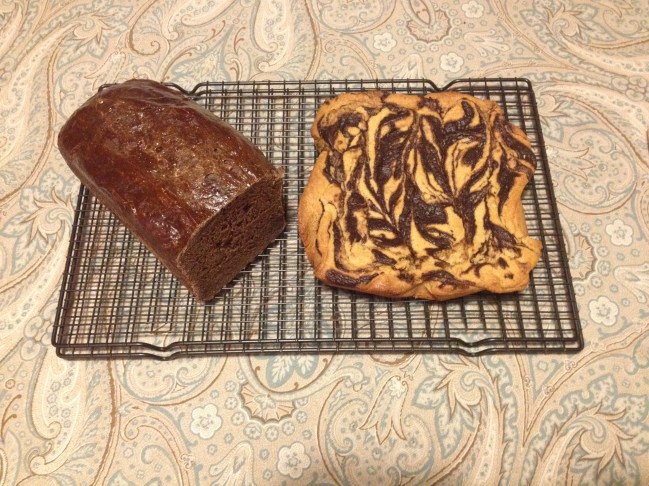
IMG_6223
Much better. Peanut butter swirl brownies, and half a loaf of chocolate bread for good measure.


When My Lunacy Pays Off: Beef Soup for a Sick Child

I occasionally wonder why I do things like hoard beef bones in the freezer for months and then spend a few hours slowly simmering them with parsley and celery and carrot and onion peels. It would be really easy to just throw a cube of beef bouillon into whatever I’m cooking, right?

Except that I find those bouillon cubes so aggressively salty, it hurts me to eat them. I’m not being hyperbolic; it literally hurts my mouth to eat that stuff. (Though I admit, when I was little, I loved those little cubes, and they are sooooooo cuuuuute  that I still kind of like them in principle.)

A couple of weeks ago I spent some time making this beef stock, and it came out beautifully, and I got all organized and froze it into ice cube trays and then cracked all the beef cubes into plastic bags which I then stored in the freezer and I felt all smug but wondered, “What am I gonna do with all of this?” The last two cups of stock that I didn’t freeze, I used in a really good risotto. Would all of this just go into another risotto? It wouldn’t be the worst use, but would it really the best use of this kind of specialty food item?

Fortunately, my daughter came to my rescue. She came down with some kind of creeping crud over the weekend. Fever, sore throat. General malaise. And I thought, “What this child needs is beef broth with little bitty alphabet noodles in it.” I always have alphabet noodles around, but reserve them for very special uses — I only serve them when she’s feeling sick. When the child didn’t want to eat anything for lunch on Sunday, I said, “hey, what if I make you some beef soup with alphabets?” she croaked, “yes, please,” and it took me almost no effort. I put about eight icy beef cubes into a pot, put it on the stove, and melted them down in about two minutes; it quickly came to a boil. I added to it maybe a quarter of a teaspoon of Chinese mustard powder, an equal amount of salt, and three teaspoons of alphabet noodles. Then I walked away, letting it simmer, and took the child’s temperature and told her to wash up for lunch. In five minutes, the soup was ready.

Monday she stayed home from school. Walking home from the doctor’s office — she doesn’t have strep, we’re pleased to report — she asked, “Can I have beef soup for lunch again? With alphabets? and with the mustard?” Because God forbid I leave out the mustard…

Akbar & Jeff’s Crunchy Corn Gobbles: or, Just buy a bag of Fritos and call it a day.

The previous post on Fritos and Cheez-Its caused me to ponder homemade junk food as a category. I know it exists. I know there are a billion websites that perkily tell you that YOU CAN MAKE YOUR OWN FRITOS and that even the New York Times has provided its earnest readers with a recipe. I decided that in the name of being an honest writer, I owed it to my readers, all six of you, to report fully on what that would involve, and whether or not it is worth it.

I want to start by saying that I have made cheese crackers many, many times, using many different types of cheeses, and that while they never are quite like Cheez-Its, they are all good and they are all easy to make and they are all worth doing, once in a while, when you want to have something really snappy to serve at a dinner party or to give as a gift in a little glass jar. So that’s a subject for another time, perhaps. Here, I want to focus on Fritos, because, frankly, I just spent three hours working on Fritos. The kitchen is cleaned up, mostly, and the results are in.

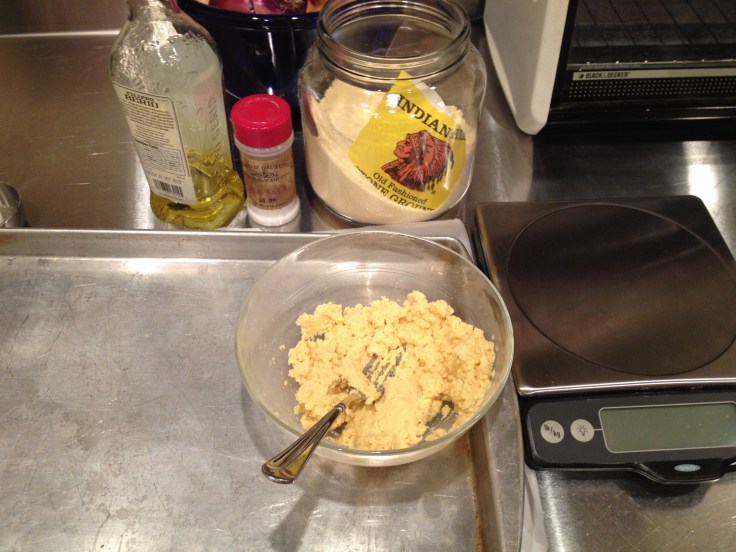
http://cooking.nytimes.com/recipes/12326-homemade-fritos is the recipe I worked with. I  followed the recipe, mixing up the ingredients precisely — I even took out the kitchen scale. IMG_6295

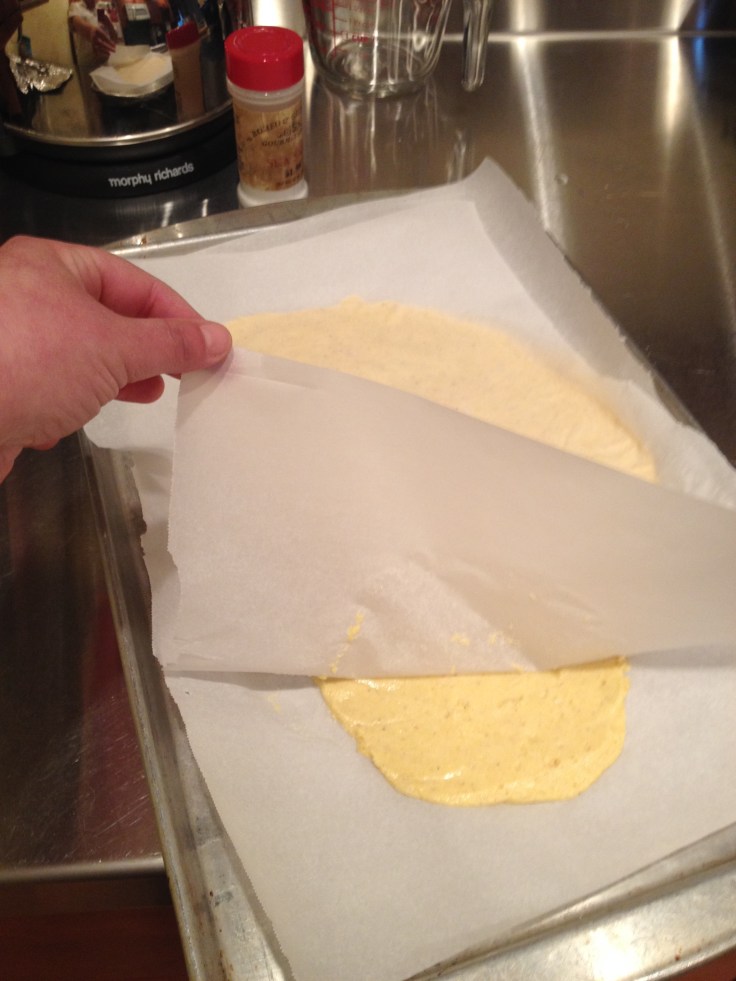
It takes very few ingredients. You’re looking at what it takes. Corn meal, salt, oil. Takes about 30 seconds to put that together. I didn’t include the boiling water in the picture because that’s stupid. But there was water mixed in with the corn meal, salt, and oil. Then I rolled out the dough, as instructed, between two sheets of parchment paper.

IMG_6297

I don’t usually post a lot of photos, but I was specifically asked to document this process, so I’m doing the best I can, here.
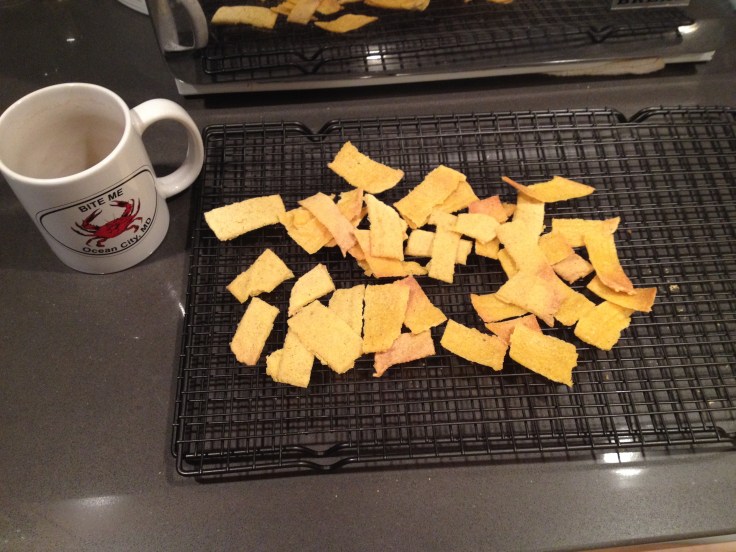
I scored the corn dough with a bench scraper and put the pan in the oven as instructed: 375° for 12-15 minutes. At 15 minutes, these things were nowhere near done. They looked flabby. I added another five minutes to the timer. Same. I finally set my stopwatch and left the kitchen and went about my business for a while and came back about 15 minutes later. Still looking kind of pathetic. The recipe says to bake until golden brown. The chips were starting to curl up a little at the scored edges, but… nowhere near golden brown. They finally began to get golden brown around the 35 minute mark. I took them out of the oven and this is what I had:
IMG_6303
I’m using a photograph with an Ocean City mug to try to convey to you how goddamned few corn chips resulted from all this work. That’s supposed to be TWO to FOUR snack size servings, people. I don’t know who they think is snacking, but that’s just delusional. This wouldn’t have made a sufficient snack for my daughter when she was two; and now? Forget it.
And they don’t even taste very good.

So then I thought, “Ok. The recipe gives you an option for baking and an option for frying. I should try to fry another batch.” So I embarked on a Plan B and Subset B-2, which was this: I’d mix up another batch of the corn batter, and fry half of it in hot oil (something I hate doing, frying things in oil), and bake the other half but in a hotter oven, at 425°.

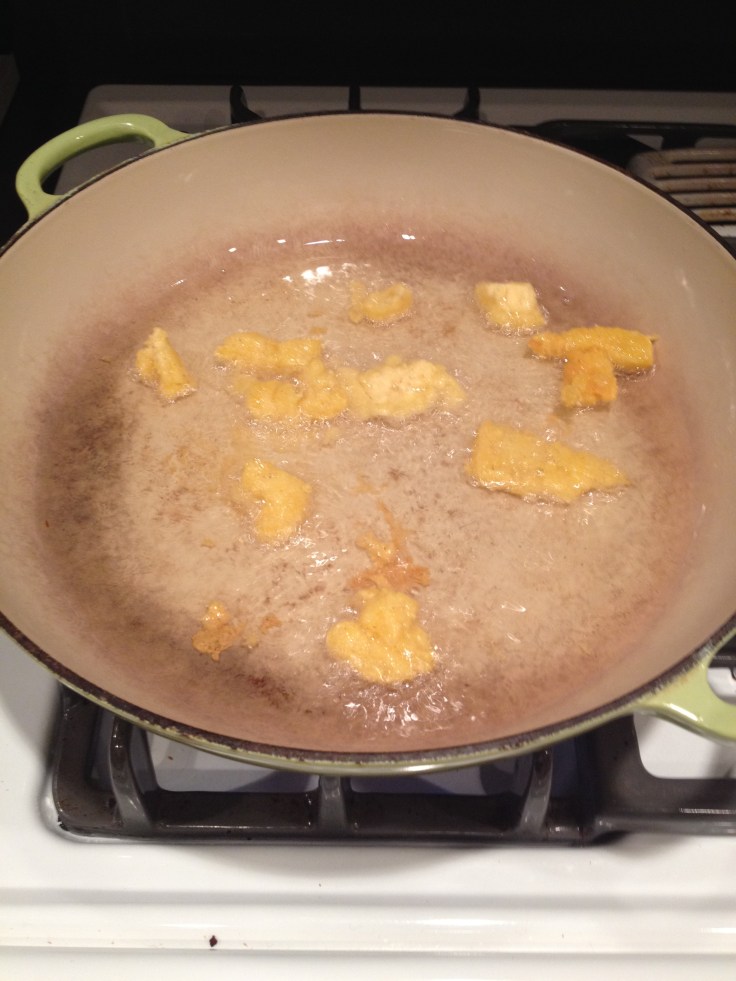
The second round of baked “Fritos” came out pretty much the way the first batch had — quite unimpressive, with a slightly shorter baking time — and the fried Fritos were a whole other thing entirely. Because it turned out that I had no ability whatsoever to get a nice, neat, rectangular mini-slab of corn batter into the pot of hot oil. I gather that proper Fritos are extruded somehow, from some kind of big pipe into vats of hot oil, and I suppose that if I were more dedicated to this project I could have taken a pastry bag and a flat-tip nozzle and figured out a way to extrude my own Fritos, but seriously. Even I don’t have time for this. So I did the best I could, and what I had in the pot was this:

IMG_6304

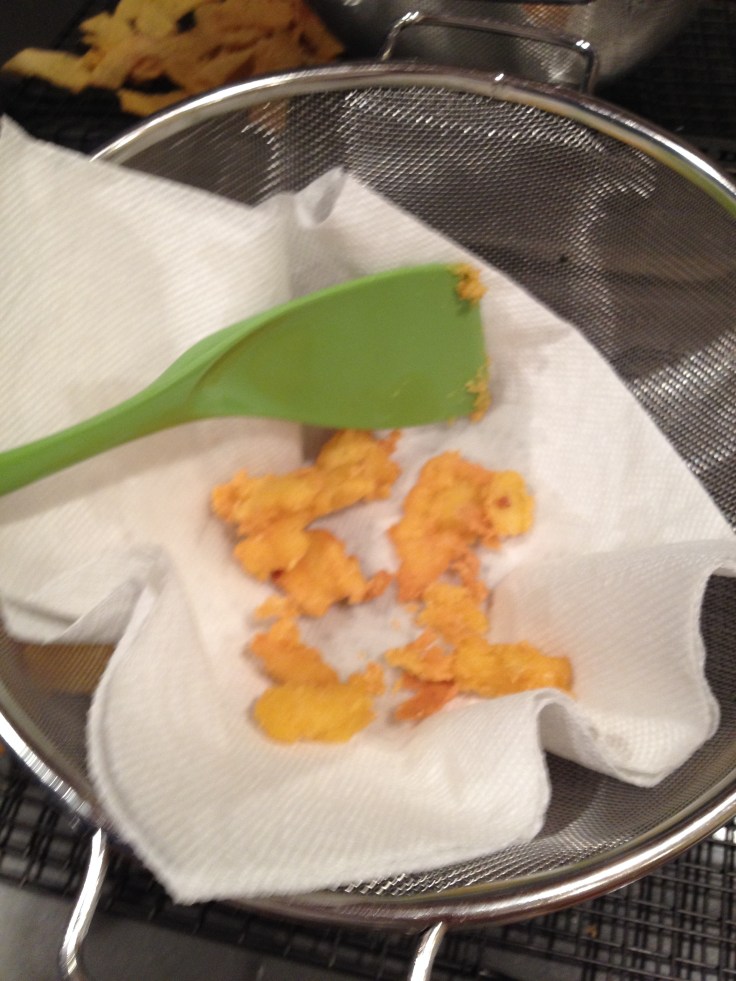
This looks like…. well, it looks like scrambled eggs, but what it ACTUALLY is, is a small batch of Crunchy Corn Gobbles.

IMG_6305

Sorry for the fuzzy photo, but trust me, it’s not any more attractive when in focus.
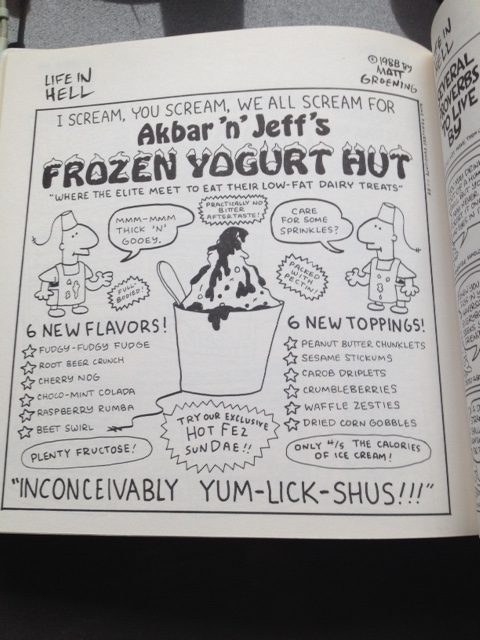
This would be a variant form of Dried Corn Gobbles, available as one of the Six Tempting Toppings at Akbar’n’Jeff’s Frozen Yogurt Hut:

IMG_6308

Now, Crunchy Corn Gobbles don’t taste bad, certainly not compared to my baked homemade Fritos, but they aren’t exactly good, either. God knows they’re not worth making an effort to produce. I’d rather eat a Peanut Butter Chunklet.

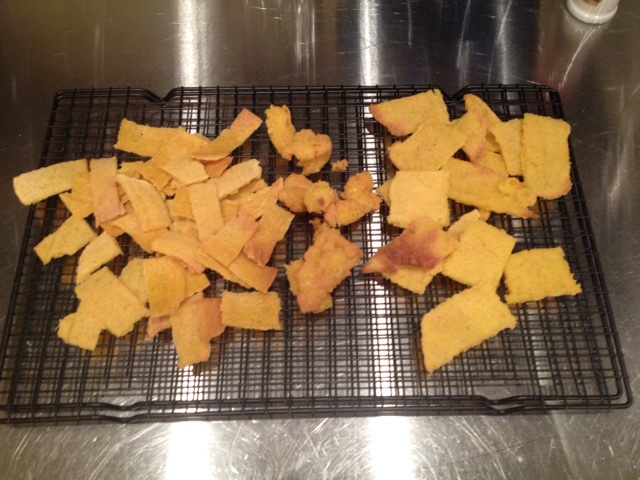
I spent most of my morning working on this. I still have to wash the greasy frying pan (and I’ve thrown out all that oil, because I just don’t think I’ll want to reuse it for anything), but this experiment is over and done with — finit0 — and the results are these pathetic things.IMG_6309

On the left, the first batch; in the middle, the Crunchy Corn Gobbles; and on the right, the second baked batch, which are sort of leathery and awful. Two batches of homemade Frito batter, and, even if these things tasted good, which they don’t, it still wouldn’t be enough to make for a satisfying snack for two or three people.
The moral of the story is, my instincts were correct. Fritos are like Grape-Nuts. Don’t try this at home. Pay the corporate people their money, and just buy the thing that tastes the way it should.
I think I’ll buy myself a Snickers bar on my way to pick up my daughter at school. After all this work, and so little payback, I could use some junk food that works.

IMG_6108


On Great American Snak Klassiks: The Cheez-It, and the Hideously Underrated Frito

In general, the Hausfrau does not keep a lot of junk food in the house, not because no one likes it, but because I view it as a waste of money. If I don’t spend money on crap food that has no expiration date, then it means I can have a budget to do things like go to Ashley’s Ice Cream and get some really, really, really good ice cream. This is sound logic. Once in a while I will buy some potato chips (to go with sandwiches, a summertime phenomenon mostly); at Thanksgiving, we’ve come to view Bugles as a traditional part of the hors d’oeuvres platters (they go well with pimiento cheese). But these are treats; they are not standard everyday fare.

I’ve worked hard to get my kid to grasp that things like potato chips (and Ashley’s Ice Cream) are treats, and she’s cool with it. That said, when you have a toddler, it’s almost inevitable that you’re going to have Goldfish crackers around. To me, Goldfish are a waste of time: they are unsatisfying as either food or junk food. But toddlers love them. Our Goldfish phase lasted about two years. We bought giant cartons of them. They got eaten, but hardly ever by me, and as soon as I could get away with not having Goldfish crackers in the house all the time, I stopped buying them.

But the fact remains that some members of our household often require a snack and they want it to be salty and crunchy. As a result, in the last several years I’ve become someone who clips coupons for certain brands of crackers (yes, I clip coupons to save money on purchases I view as frivolous; if I have to buy these things, I shouldn’t spend too much money on them. Though I also clip coupons for things I use all the time, like our brand of coffee or toothpaste or whathaveyou, because why the hell not). I try to not read the lists of ingredients for these crackers, because the purist in me would probably faint if I absorbed the data.

The preferred brands of crackers, as of this writing, are: Cheez-Its (not Cheese Nips, which I’ve been informed are distinctly inferior). I had thought there’d be a list to put there, but the truth is, there isn’t. I do also keep Ritz crackers around, because they are just nice enough to serve to company, should we have any; but if there are Cheez-Its in the house, the Ritz crackers go uneaten. If I buy Wheat Thins or Triscuits, those will get consumed, but not with the same vim or vigor. Maybe they’ll get eaten quickly if there’s some delicious cheese around, like Beemster, or if I have pimiento cheese in the fridge, or tapenade. But no one wants to eat those crackers just on their own, for their own sake. Come the end of the day, when the husband and child need something to see them through to dinner, the preferred cracker is the Cheez-It, often served in a bowl with a tablespoon or two of peanut butter, because it turns out that dipping Cheez-Its in peanut butter is really good.

There is another junk food that I purchase with a certain level of calm acceptance: the Frito. My mature appreciation of Fritos began when I bought a bag of them on a whim, to have with a deli sandwich. I ate them and thought, “Man, Fritos are good. I’d forgotten how good they are.” They tasted clean and uncomplicated compared to the fancy potato chips we inevitably got when we decided to make cold cut sandwiches for dinner (something that happens in the summer, when it’s too hot for me to want to cook). Horseradish and cheddar potato chips are all well and good, but Fritos seemed honest and unpretentious in comparison. Furthermore, they’re good with pimiento cheese, good with chili, good with just about everything I can think of to dip them in. My husband also likes Fritos, because who doesn’t, so I resolved that it wouldn’t be the worst thing in the world to buy a bag of them once in a while. They occasionally go on sale for something like $1.50 for a large bag; if you happen to have a coupon that gets you some money off, that’s a very affordable treat.

It was when I bothered to look at the list of ingredients that I realized the Frito-Lay people were missing out on a golden opportunity. I posted to Facebook, on October 17, 2011: “wonders again why uptight overeducated parents who spend a fortune on “healthy” snacks for their kids don’t embrace Fritos. You know what the ingredients are in Fritos? Corn; corn oil; salt. I don’t think I have ever seen such a short list of ingredients on an item we think of as “junk” food.” The thread that followed was long, passionate, and had far more people commenting on it than I would have expected. Everyone loves Fritos, but they do it silently, in private, ashamed, like it’s something you’d have to confess to a priest about. As if Fritos are as fundamentally disgusting as, say, Funyuns. But it shouldn’t be that way. We should eat our Fritos with pride, knowing that there’s no polymonodextrosorbaglycophol in them. Assuming the Fritos people haven’t been lying to us all these years, we can eat our Fritos with pride, impunity, and pleasure.

But: the people at Frito-Lay are missing out on a golden opportunity. If they were smart, they would focus on re-branding and get the demographic that shops at Whole Foods and Trader Joe’s to accept Fritos as the ultimate and perfect junk food, a junk food that is almost of such high quality that it is no longer junk food. Because it almost already is. The difference between polenta — a foodstuff no one dares insult — and Fritos is, when you get down to it, merely a matter of cooking technique, and marketing. If someone made Fritos but called them  Polenta Crackers? They’d be selling them at Dean and DeLuca, or, in my town, at Romeo’s and P&M and Edge of the Woods and the Elm City Market. Selling them for $3.25 for a 2 ounce bag. They make organic Ruffles, for pity’s sake — why not have a similar option for Fritos?

Because the ingredients in Fritos are things we might even have in our own kitchen at home, it was inevitable that I should pause to wonder if they could be made at home. I definitely have corn(meal), salt, and oil. Could I make, like, artisanal Fritos? Would the average person, with average ingredients at his or her disposal, and a perhaps slightly above-average tolerance for kitchen mishegas, be able to pull this off? And the answer, I’m going to tell you right now, is “Yes, you can make artisanal Fritos, but seriously, don’t bother, it’s like the homemade Grape Nuts. Don’t do it.” The New York Times helpfully provides a recipe for those of us who are just nutty enough to want to give this a roll, at http://cooking.nytimes.com/recipes/12326-homemade-fritos. I leave this for you to contemplate at your leisure.

Back to reality, in which you don’t make your own Fritos: As long as you’re buying the basic, original flavor Frito chips, not some kind of honey-barbecue style, then you’re on solid moral ground, as far as I’m concerned. Because I’m not someone who actually cares much about GMO food, and I don’t eat enough Fritos to feel that anything in them is real likely to affect my well-being anyhow. But I think Frito-Lay would do well — expand their their hold on the market — to revisit their production system and start making Fritos with organic, free-range, non-GMO corn and organic, free range, non-GMO oil and sea salt harvested from someplace fancy-sounding. What’s holding them back? It’s a real mystery to me. Think what the Pirate Booty people did with Cheetos. What Smartfood and Annie’s did in the 1980s with snack-pack bags of crappy cheese popcorn, the kind that you got out of vending machines in the 1970s. Some of which are probably still there, dangling from a curved hook….
I won’t go so far as to say Fritos are actually healthful, but for god’s sake, in the context of American snack foods today? They are comparatively healthful; they are straightforward; they appear to have no tricks up their sleeves. And they are very, very good with chili, which is a healthful dish, properly made. So as far as I’m concerned — and, please remember, I’m a hausfrau, not a doctor or nutritionist — you can have your Frito pie and sleep the sleep of the right and just.


So Efficient, I’m My Own Worst Enemy

Some Monday evenings, I produce better-than-usual dinners because I’m on top of things: I’ve made it through the day, the kid’s in one piece, and I’m feeling relatively cheerful. It helps if I’ve gone shopping in the morning, and have nice fresh vegetables and maybe some meat in the house.

Other Monday evenings arrive, and I’m not so lucky. I’ve been doing Good Works in the morning instead of grocery shopping, and I have to be at a meeting at seven o’clock in the evening. Mid-afternoon arrives — as it is, this very moment — and I still don’t know what we’re having for dinner. This is a less-than-ideal situation, but it’s only two p.m. In other words, there’s still time for me to turn it around.

But I’ve looked into the fridge, and basically, what I’ve got in there is this:

a lot of condiments; a pint and a half or so of really good beef broth I made a few days ago; and rather a lot of cheese.
Can I ask my family to drink beef broth and have cheese on bread for dinner? No, I cannot. This is one of those moments when I wish I hadn’t so efficiently used Friday night’s leftovers during the weekend. If I still had some of that chicken sitting around — it was wonderful, by the way — I could make some chili out of it. (That’s what I did Saturday, though.)

Can I make a risotto? I could, if I had arborio rice, and some nice vegetables; however, I have neither. I could fake the risotto with regular white rice, no one would complain, but the lack of vegetables remains a sore point.

Can my family overlook the lack of fresh vegetables with dinner, if I simply serve them a pot of macaroni and cheese? If I served them macaroni and cheese and succotash, made from handy-dandy frozen lima beans and frozen corn, they’d be happy. I wouldn’t be — I’ve never eaten a succotash I actually enjoyed — but I’m not the primary audience, here. Last week I made succotash, and while I ate my serving dolefully, my husband and child cooed over it and my daughter asked me petulantly why I don’t make succotash more often. “Because I don’t like it that much,” I said.

“But WE like it!” she said. “Who doesn’t like lima beans?”

“Well, a LOT of people, as a matter of fact,” I said.

My daughter was unimpressed. “What do they know,” she said. “Lima beans are one of my favorite vegetables.”

Let’s move away from pondering the way in which my child is demented, because I just had a sinking thought, which was, “What if I’ve used up all the lima beans?” This could happen. I’m not someone who buys lima beans in bulk. There must be someone who does, but I have no idea who. Anyway, I just dragged myself to the freezer in the basement, where I keep the frozen vegetables, and discovered that while, yes, I do have two bags of frozen lima beans there, and lots of frozen corn, I also have something that means that I don’t have to make succotash for dinner if I don’t want to. Forsooth: I have frozen peas. One lonely bag of frozen peas.

What this means is that I can make a fake risotto — put in a slice of duck bacon, the beef broth, and frozen peas — and serve that as a one-pot meal, and leave for my meeting with a fairly clear conscience at 6.45; and the succotash can wait another day. Thank god, too, because I really don’t want to come home from a meeting at nine o’clock and face eating succotash for dinner. Meetings are hard enough without coming home to something grim for dinner. Risotto: that’s something I can look forward to.


Two Chicken Breasts, Some Idle Thought, and Goal Achieved

It is, every week, a bit of a challenge to devise a nice Shabbat dinner. “Nice” doesn’t have to be particularly elaborate, and often, here, it is not. I have been known to make a giant tray of nachos for Shabbat dinner; in fact, Shabachos are regarded as a big treat.

But the truth is, I feel it’s not quite cricket of me to do things like this. I much prefer to come up with a plan that has some element of the traditional Friday night dinner about it. Chicken. Rice. A vegetable.

This morning I awoke and wondered what I would make; I really had no idea. However, determined that I could come up with something if I just wandered to the store and bought some chicken, I went to the store, and purchased two boneless, skinless chicken breasts, a very large cucumber, and some fresh broccoli. I took all these things home and set them on the counter and then I stared at them. It was a quarter to three.

At three p.m., I was standing at the stove sautéing onions in olive oil and searing the chicken breasts. I had at my side an opened can of whole-cranberry cranberry sauce I’d purchased by accident last month, and a small jar of Colman’s mustard also purchased by accident (I had thought it was dry mustard, but it turned out to be the pre-mixed stuff, not what I wanted). At 3.15, the Dutch oven was in the oven, and it’s now 3.45, and the house smells wonderful. In the fridge, furthermore, is a little bowl filled with cucumber slices that are soaking in a pepper vinegar-brown sugar marinade. These two things will be served alongside plain sides: boiled broccoli and white rice. But it will be a sterling meal, I am absolutely positive. (Yes, there will also be challah; I bought a loaf of the best challah in Connecticut, as far as I’m aware, which is made by Bread and Chocolate in Hamden. Infinitely better than Judie’s, and really worth whatever they charge for it.)

CHICKEN in CRANBERRY MUSTARD SAUCE

Preheat oven to 275°.

Slice one small onion into slices about 1/2″ thick. Saute in a couple of tablespoons of olive oil heated in a Dutch oven. Pat chicken breasts dry with a paper towel, add to pot, sear both sides of chicken pieces. Remove chicken from pot, and lay on the inside of the lid of the pot (saves some dishwashing effort later). Set lid aside (it will balance on the knob nicely if it’s a Le Creuset pot). Add four fat cloves of garlic, peeled and sliced so that there is a flat side to caramelize in the pot. Continue to stir onions and garlic for a couple of minutes until the bottom of the pot begins to show browning and deglaze pot with some rum (light or dark, it doesn’t matter; about 1/2 cup). After pot is deglazed, add to pot the contents of one can of whole cranberry cranberry sauce and about two tablespoons of very sharp prepared mustard (I used Colman’s but you could use whatever you wanted). Stir to melt the cranberry sauce, adding about 1/2 cup of water. Add a teaspoon of salt and one bay leaf; stir; then carefully move the chicken breasts back into the pot. Bring contents of pot to a boil, then stir once, turn heat off, cover pot, and place in oven.

Slow-cook in the oven for three and a half to four hours, stirring occasionally, turning over the chicken so that all sides of it soak in the sauce.

Serve with plain side dishes, as this is highly flavored and will not need much embellishment. Any chicken leftover will make for really fabulous chicken sandwiches for lunch on Saturday, too…

Create a free website or blog at WordPress.com.

Up ↑