The Book Gods, and the Cruel Jokes They Play

We have too many books in our house. I know this is the case because we still have books stored away at our old house. Like, hundreds of them. So a few months ago I decided to assemble a bag of books that I believed, earnestly, we no longer needed, and I assembled said bag with all good intentions of taking it to a used bookstore nearby where I could get some store credit for them.

It took me maybe fifteen minutes to cull a dozen titles from the shelf, and four months to get them to the used bookstore, which is less than two miles from our house.

With $20.50 in store credit, I searched the store’s shelves once more for a few things I’ve had my eye out for. One of the novels I’m always hoping to find used is a novel that came out a little more than ten years ago — it was a bestselling novel called The Book of Salt. It’s about the person who cooked for Gertrude Stein and Alice B. Toklas. You’d think it’d be easy to stumble on a cheap used copy, but apparently not. I could have bought it new, sure. But I haven’t ever been confident enough that I’d like the book; I was merely curious about it. And I didn’t want to spend $15 on curiosity. So I’ve just had it on my “find it for cheap” list for ages now. I struck out again at the store where I had $20.50 in credit, but then later on, at a second used bookstore, I found a copy for $4. This, I was willing to live with, so I picked it up. I also picked up a wonderful book called America’s Kitchens, published in 2008, which I’d never heard of. It’s quite delightful, I recommend it to anyone interested in the history of American domestic design or American cooking.

My husband was also on the hunt for a specific title, when we were out and about: he needs the next title in the Maturin/Aubrey series. At the second bookstore yesterday, he found it, and when I suggested he pick up the one that comes after the one he needed, while he was at it, he scoffed. “I won’t get around to this one for a few months anyhow,” he said. I didn’t quibble. He went and paid for our small stack of books (The Book of Salt; the kitchen book; a paperback of Colwin’s Home Cooking, which I always need spares of; a big hardcover, gorgeously illustrated book of sheet music for Gilbert & Sullivan’s greatest hits; the Aubrey/Maturin book; an a Garfield book for our daughter) and we all headed home satisfied with the day’s enterprise.

It was the next day that my husband held up his Aubrey/Maturin book and said, “I’ve already read this one.” I laughed. “I’d be really ticked off if I did that,” I said. He was sanguine about it. “I’ll find the one I need somewhere and trade this in,” he said. I said, “I’m glad to find my novel,” and explained to him how I’d been looking for it for so many years. He said, “So, the Book Gods were smiling on you.”

Later in the morning I took our daughter to the playground near our house, where there is a free book box. It’s operated by New Haven Reads, which is a wonderful program that promotes literacy — they run a book bank, which is kind of like a bookstore, except all the books are free; and they operate a massive tutoring program that serves dozens and dozens of kids across the city. While my daughter’s zooming around the playground, I poke idly through the book box, and what’s sitting there?

The Book of Salt. Price? No price: it’s from New Haven Reads, it’s free.

I cursed under my breath and picked the book up and held it in my hand, furious, for a moment; then, resigned, I put it back in the box. I missed my chance; let someone else have it.

The incomplete history of some cobalt blue mixing bowls: Yvette, and the Hausfrau’s Set

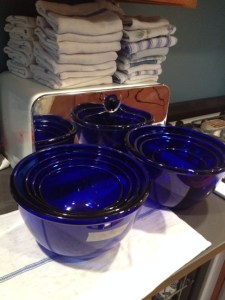
In the early days of my life as an adult my brother gave me a set of blue nested mixing bowls: bright, clear, blue glass. Cobalt, people call it. I have lugged them from apartment to apartment and used them as mixing bowls, as bowls for dough to rise in, as bowls to eat dinner out of, to serve salads from at potluck suppers, as serving bowls for more dishes more elegant than noodle salad, and, last but not least, as punch bowls. I’ve had them for almost thirty years now and they show almost no wear despite nearly constant use and a lot of being packed up and relocated. They are miracle bowls.

This weekend, I went to an estate sale in a house where my brother lived, as a housesitter, for a few months, circa 1989. This was a very well-appointed house that, once upon a time, was the home of a good friend of my mother’s. He was a professor, and he lived there with his wife. The professor died two decades ago, and his widow has decided to downsize, finally, and she organized an estate sale. I saw a sign for it (“Estate sale: Friday, Sat., Sun., 9-1”) and thought, “I should go to that.”

I couldn’t convince my daughter to go with me late Friday morning — she was too hot, too cranky, too in need of lunch — but I did manage to convince her to come with me on Saturday morning. I went to the estate sale expecting to see good housewares and a lot of books. I was not wrong. While I could not justify taking home all the pieces I wanted — the well-designed white plates and pasta bowls; the little Fiestaware plates; the darling Pyrex refrigerator boxes — I kept my eyes peeled for things that I knew I could use and things that deserved to find a new home either with me or because of me.

I noticed, on a kitchen counter, a set of cobalt blue mixing bowls identical to the set my brother gave me. The moment I saw them, I realized that my brother had seen them, back in the day, and thought, “This is what I’ll get my little sister for her birthday.” So in that sense, they had a kind of sentimental value to me. And I had a strong sense that I should take this set home, even though I obviously don’t need them, because, duh, I have a set. I couldn’t justify buying them. It wasn’t the money — they were well priced. I just knew that my husband would think I’d lost my mind if I brought them home and put them on the shelf next to our other set.

At the same time, I really wanted them to go to a good home — to the right person. Instead of buying them, I did what seemed like the responsible thing. I went home. When I got home, I unpacked my haul (two flat linen sheets, one nicely printed 1950s cotton tablecloth acquired for a friend who likes these sorts of things, and two men’s handkerchiefs, one of which appears to have been picked up while traveling on SAS (airlines no longer print their own promotional handkerchiefs: a shame)).

As I was saying: I unpacked my haul. And then I did the right thing: I got onto Facebook.

“Nice estate sale at [location redacted]. Anyone who’s ever ogled my blue cobalt mixing bowls should head over there posthaste and snag a set for themselves.”

Within about six minutes a long thread had grown. A friend who grew up in Pittsburgh and now lives in the Bay Area bemoaned hysterically the fact that she’d moved to the West Coast: apparently, out there, estate sales are a different thing entirely and tend to lack lovely things like cobalt blue mixing bowls. Another friend, a dearest pal from college, who lives in Virginia, asked more calmly, “How much?” I honestly couldn’t recall what the price tag said. It wasn’t more than $20, I remembered. I tagged a few locals who might have been at the sale after I left. I thought, “Someone will notice those bowls and let us know if they’re available.” One woman said she was there half an hour ago,  and didn’t notice the bowls. But another woman reported that she was just there, and she’d bought the little Pyrex refrigerator boxes, and the blue bowls were there when she left. $10.

It was about four in the afternoon on Saturday and I had no way to ask for a definitive answer to the question “Did the blue bowls sell?” All I could do was hope that the bowls hadn’t sold, and go back on Sunday morning, as early as possible. The last day of the sale was Sunday, and it would close at 1 p.m.

I awoke at 6.30 Sunday morning thinking, “Estate sale.” I showered and dressed and announced to my family, “I’m going back to that estate sale so I can see if I can get those blue bowls.” My husband and child looked up at me, not too interested, and said, “Okay.” I walked down to the house — not quite a mile away — and as I turned the corner I could see a woman leaving the house carrying the blue bowls. My stomach lurched. Some random person had the bowls??? And then I realized that I knew the woman carrying the bowls. She is a neighbor of mine, she lives about five blocks away, her name is Jo, and she is a peach. I thought, “Well, if someone else is going to score those bowls, it’s good that it’s Jo.” I called out, “Jo! You got the bowls!” She laughed and asked, “Did you come for them?” I said, “I did!” I caught up with her on the sidewalk. “I don’t know if you saw,” I told her, “But I had a whole Facebook thread going on about those bowls.” She said, “I did see the thread! And I was coming to work this morning and I thought, “I should stop in and see if the bowls are still there.” It turned out that she had bought them intending to get them to me so that I could get them to my friend G.

I was, you might say, bowled over.

I reimbursed Jo for the bowls, then and there on the sidewalk, and thanked her about a million times. She said, “It’s funny, I have a set just like these, except red.” I thought, “She gets it,” and told her that her small action would make my friend in Virginia very happy. Jo went off to work, and I put the bowls into the big tote bag I’d brought with me, and all was right with the world, at least when it came to blue glass bowls.

On coming home, I unpacked the second set of bowls onto our kitchen counter, and we dashed off to do the things we had planned for the afternoon. IMG_6933In the evening, when I moved the bowls aside so I could start making dinner, my husband ambled over. “They really are handsome, aren’t they?” he asked. “They are,” I agreed. I told him how I’d actually done a little research about these blue bowls, and how they were apparently manufactured by a French company called Arcoroc. There was a time when you could get these blue bowls easily — they seemed to be ubiquitous in housewares shops, high and low-end, but now they were a little hard to find. “EBay?” he suggested. “Etsy?” I said, “Even there! I only found one set for sale, and they wanted sixty bucks for them, which is pretty much what they cost if you bought them new, I think.”

I look at the two sets now, side by side, and remember something else. The set my brother gave me came with three bowls. I acquired the fourth bowl years later. The fourth one in my set, which is significantly smaller than the “small” bowl in the original gift, is smaller than the “small” bowl in the Estate Sale set, which I will name Yvette. What we have are two slightly different sets of four. In other words, I suspect that to have a “complete” set of these Arcoroc bowls, you’d have to have five bowls. But I’ve never seen a set of five for sale anywhere. I don’t know where Yvette came from. Was Yvette originally made up of five pieces, but the smallest Yvette broke? I will never know. My fourth bowl, I remember, I found in a housewares shop in the Hartford area ca. 2001, and I got it not because I needed it but because it was so obvious that I should have it and give it a home with its siblings. (My mom was with me at the time and she immediately saw that this was the right thing to do; I think she paid for the bowl, actually. It was the same shopping trip where we acquired two beer steins, for my then-boyfriend, now-husband, and we were also gifted with a basket for our newly-acquired cat to sleep in. The cat loved that basket. He wasn’t much of a beer drinker, though.)

If I were a perfect person, I would find another one of the really small blue bowls, and add it to the set, and then present it all to G. I would also find a bowl like the smallest Yvette I have in my possession now, and add it to the Hausfrau set. But this is a little crazy, and I think I should just be content with what I’ve acquired through chance and happy gifts.

I’m worried about shipping these bowls: their scarcity means that, if I ship them, and something bad happens, they’ll be difficult to replace. As luck would have it, I am going to be seeing my friend G. in about a month. So I’m going to wash these bowls, and pack them up carefully, and bring them to her in person. Don’t thank the Hausfrau, either, G. — thank Jo.

You Don’t Need a Tattoo, but You Should Really Get a Paleta.

 
About a year and a half ago, I was made aware of the existence of something called a paleta, which is a Mexican popsicle. I was on a food tour of a neighborhood in town that’s the residential and cultural base of the Central and South American communities here, and we had stopped into a restaurant where, I was told, there was a freezer case of paletas. “They’re wonderful,” the guide advised us. I didn’t have time to sample one just then, but I made a mental note to go back and try one later. As luck would have it, I’ve not gotten back to that particular restaurant, but I’ve spent a lot of time wondering about paletas.

I spend a lot of time downtown at a place called The Institute Library, which is located on a somewhat rag-tag block of Chapel Street. Chapel Street is, like so many city streets, variable, block by block. Some sections are quite high-end, with shops catering to the Yale community, and some are, as the phrase goes, low-rent. The Institute Library, which has been in its unassuming building since the 1870s, is in what is currently a low-rent district (but rents are definitely going up). This distinguished and strange Library has been, for decades, surrounded by retail storefronts selling inexpensive goods to New Haveners who are decidedly not part of the Yale community. You can find beauty supplies, wigs, flashy jewelry, dollar store stuff. You can get a pair of Nikes, a pair of Chuck Taylors, bars of black soap. And right next door to the Library is a tattoo parlor. As the Hausfrau is not a big fan of tattoos, I’ve never been inside the tattoo parlor (though I’ve logged many hours in the beauty supply shops and the dollar stores). As I was walking to the Institute Library, I noticed suddenly that the tattoo parlor next door, of all places, had a sign in their window announcing that they had paletas for sale. “Well, isn’t that interesting,” I said to myself.

Then I found myself engaged in a long Facebook conversation with a friend who had also seen the sign and wanted to try one. She, like me, found it hilarious that the tattoo parlor was hawking popsicles.  What got me was that there were so many flavors. I wrote, “I want to try — I think the sign said there’s a caramel one. Also coconut. It’s like a Crayola crayon 64 pack list of flavors.” We had this conversation in February, when, frankly, eating popsicles was no one’s highest priority. But we stowed the information away for future reference.

Well, last week, the future came. L. and I made plans to meet downtown and scoop up a paleta or two. First we met at the English Building Market, a delightful shop selling various vintage items, mostly housewares, and I picked up an Ice-O-Matic there (more on that later). Then we went to the tattoo parlor.
The paletas are kept in a freezer case by the front window. Depending on the time of day, the way the light hits, you might not be able to see into the freezer case while standing on the street — glare can be a bitch. But you can read the sign in the window that lists all the flavors. L and I strode into the tattoo parlor with, really, no idea what we might be iIMG_6382n for. Neither of us had ever been inside the tattoo parlor before. What we found was a very clean, orderly shop, with rows of chairs for people to wait in, like at a doctor’s office, and signs advising clients to please keep their children under control. Along the left wall was a long glass case displaying jewelry for sale, and we perused the selections while the woman working the desk (the owner, it turns out) helped a client. The jewelry was a surprise — I’d never known they had jewelry in there, and to be quite a honest, I rather liked a lot of it, and none that I saw at first glance had hideously high prices. I mean, I’m in the market for a new ring, and it may well come from there.
Once the clerk had finished her transaction, she turned to us and I said, “Hi, we’d like to buy a couple popsicles.” She came down from behind the desk and walked over to the case with us. She unlocked the case, and we scanned the case: What would be seriously good? What would just be a novelty item, worth a couple of bites but possibly not worth finishing? This was a MAJOR DECISION we were making. “I’m kind of leaning toward the rice pudding,” I said to L. She said, “That’s what I was thinking about, too,” she admitted. I said, “We should really get two different flavors. You get the rice pudding, I’ll get something else.”

Not all flavors are available at any given moment, it appears; of the ones I could see quickly — I didn’t want to waste too much of the clerk’s time — there were two contenders I could take seriously, one of them coconut, one of them an old favorite of mine, lime. Lime isn’t a very unusual popsicle flavor, but on the other hand, I find that I don’t see it around much these days. And I had a suspicion that if I got one of these lime popsicles, it would be exponentially more lime-y than whatever crap I’d be likely to get from an ice cream truck or in the ice cream novelties section at Stop and Shop.

We paid for the paletas and unwrapped them quickly. The clerk very sweetly handed us each a paper towel — she didn’t have to do that, it was very motherly and kind of her — and we thanked her and took our soon-to-be-messy paletas out in the street. We walked over to Pitkin Plaza, sat down at a cafe table, and talked and ate our popsicles.

L. declared hers weird but delicious. “The rice has a kind of chewy quality,” she said. I reported that the lime was sharp and sweet and just the right thing for a hot summer day. Sitting at the table, we ate the popsicles quickly — we had to — and discussed the oddity of going to a tattoo parlor downtown to buy popsicles. “Did you see you can get a rum raisin one?” L. asked me. I said, “Rum raisin is very mysterious.” “I don’t think they make rum raisin ice cream anymore,” L. said. “I never see it anywhere.” I told her that there’s a shop in my neighborhood that carries it, and explained my theory that they stock it for one elderly customer who lives nearby. “I think they keep just enough of it around to keep her happy, and then when it runs out, they order more. But it’s only for her.” “That sounds entirely plausible,” she said, nodding.

“This is just so New Haven, though,” L. observed. And she’s right. New Haven has all kinds of places that are, ostensibly, one thing, but then are beloved for some other thing entirely, or are known to have some specific product that you just can’t get anywhere else in town. Sure, there are pizza places that are pizza places and movie theaters that are movie theaters. But there have also been bars that were really places we went because the jukebox was so great. It wasn’t that the drinks were so great; it was that the jukebox was great, and the drinks were at least cheap enough that you didn’t mind if they were sort of badly mixed, because the jukebox was awesome. There are bars where you go because they have really good French fries. There is a felafel store where you can buy cheap pomegranate molasses and this brand of tea that is, otherwise somewhat hard to find, I am told. (This is Ahmad tea. I’m not a tea drinker, but my husband is; he got turned onto the stuff by a co-worker who gave him a tin of it as a gift. Hooked, he started ordering it online because he couldn’t find it in shops. Then it turned out that the felafel store around the corner sells it very affordably.) There’s the little Asian grocery store where, sure, you can pick up your sushi rice and your sweet soy sauce and your Pocky sticks, if that’s what floats your boat, but the real gold there is the bi bim bop, a big bowl of wonderful food for about five bucks. This is why it pays to keep your eyes open all the time. Jewels everywhere, if you’re willing to find them.

We left Pitkin Plaza and headed for Church Street: I had to catch a bus, and L. was going to head home. “I think I’m going to go make some rice pudding,” she said thoughtfully.

I like to wander around town with my daughter and take her into places like the grocery store with the secret bi bim bap and the felafel store with the hidden stash of pomegranate molasses and pickled turnips. I would never have guessed that it would be on my agenda to take my daughter to a tattoo parlor, but with popsicles as good as these for sale — $2.50 a pop — I see no reason why I shouldn’t take her there for a treat. We actually went by and peered into the freezer case through the window yesterday as we were walking to the Institute Library. “I’m gonna take you here soon, we’ll get a popsicle — think about what flavor you’ll want.” She said, very firmly, “I think blackberry.” We’ll see how many time she changes her mind once we’re in the store. But we’re definitely going. Maybe tomorrow. We had ice cream sundaes for lunch on Monday; ice cream sodas on Wednesday; today I taught her how to make an egg cream; next up, tattoo parlor paletas.


The Master List: Why You Need More Towels Than You Think You Need

This master list is not universal, but it’s about as close to universal as I can get. Let us assume you are a household with the following:

someone who cooks a lot; a child or two; an occasional need to bathe; an occasional need to clean house; an occasional tendency to go to a beach or a swimming pool or the local Ol’ Swimmin’ Hole; one or two total klutzes; pets

There are different categories of towels you want to have on hand at all times. Some of them can be, more or less, rags, but they shouldn’t all start out that way, ’cause that’d be a major bummer.

  1. You need bath towels. Nice, big, regularly laundered bath towels.
  2. You need hand towels: two for each bathroom. Keep one on the rack and a spare stowed away nearby, clean, because sometimes you have a guest and realize at the worst possible moment that the hand towel is vile and you want to be able to put a fresh one out immediately. If you have a spare hidden away, you can do that very easily.
  3. You need a metric fuckton of kitchen towels. I have written elsewhere about this. If you want details, go find that piece here.
  4. When kitchen towels start to look shabby, that’s when you demote them to the cleaning/spills pile. Rags made of old clothes work fine here, except in my experience a lot of the time old clothes are dark or too thick or somehow the wrong kind of fabric for this purpose. It just depends on what your own personal supply is like. So if you’re me, you hang onto old dishrags and dishtowels until they are literally fraying to the point of dust, and you use them for dusting and mopping up and catching drips and all kinds of things until they just cannot be laundered any more. The grungiest of the grungy are what you use for cleaning up animal messes, in the event paper towels are not available. (Pet messes are almost the only reason I use paper towels. Pet messes, and absorbing cooking grease, like when you have to drain fried food on something. This is why we use a roll of paper towels only once a year or so, if that.)
  5. Beach/Pool/Summer Activities towels. THESE are a whole different breed of thing, and I don’t exactly approve of them but I have come to accept that they are necessary. What seems to work for us is this: every member of the household has two towels that are “their” beach towels. They are brightly colored/patterned/illustrated, large towels that are instantly identifiable whether they’re spread out on the sand, thrown over the back of a chair, or wadded up on the floor someplace. I used to think everyone needed only one each, but two summers of constant laundry have caused me to decide that this is incorrect, and really everyone has to have two. My husband has two; my child has two. I have one, but I don’t count. Yes, that’s a joke. Kind of. Sort of.
    The each person has “x” themed/colored towels is a system that I know has been adopted by other families after years of domestic strain caused by squabbling over beach towels. Avoid the squabbling and plan ahead, please.

You will, in the summertime, be laundering these things constantly, in a way you don’t at any other time of year. Summer is the season for going swimming, for eating popsicles, for  spilling nail polish on the bathroom floor, for opening bottles of beer and having the head burst up and make a mess on the kitchen counter and the floor. It’s the season for biting into fruit that is so juicy it pours itself down your chin (good peaches) and the season for making messes with bubble blowing supplies (every child ever). Be prepared for summer. Invest in towels. Signed, the mother who has done laundry every 36 hours this week because it is summer.

Summer Vacation. See: Fuck This, but I’ll Do the Best I Can

A couple of weeks ago, my delightful daughter’s school year ended and the summer began. Because I am a hausfrau full time, this did not involve quite the same type of angst and drama that engulfs the lives of all my friends and associates who are working mothers; but the stay at home mother who is not utterly delighted by engaging in wholesome family activities also finds summer vacations stressful. I personally am not someone who wants to spend my time coming up with fun educational activities for the kid. I don’t have the disposable income or the inclination to take her on Big Trips. What I have is a small budget for summer entertainment, and a lot of time on my hands, and the simultaneous need to keep the house operating the way it’s supposed to the other nine months of the year. In other words: Kid, sure, you’re on summer vacation, but I still have to vacuum and make dinner every night.

And, in fact, since the kid’s not being fed lunch at school five days a week, I have to produce more food than usual, come summer vacation, because I have to scrape together two mid-day meals every day, instead of just scrounging something together for myself.

The first week that school was out, my daughter attended a lovely day camp that’s about a mile from our house. Actually, it’s precisely one mile from our house. I mapped it online: one mile from door to door. She loves the program, which is awesome; I was a child who dreaded all summer camps and it makes me happy that we landed on something that is, by happy circumstance, nearby and a place she loves. They build things, they make things, they do real stuff that teaches them real skills. My daughter can now sew better than I can, and has no fear of pliers. God Bless the Eli Whitney Museum.
But this week, she is not in camp. Nor will she be there next week. So we’ve got two solid weeks ahead of us where the days will be…. long.

With this in mind, last Friday afternoon, we began to compile a list of Things We Could Do that would be entertaining, useful, educational, not too toxic, not too demanding of my energy, and not too expensive. (In other words, her proposal that she and I go on a girl’s trip to Montreal was really appreciated, but I had to veto it.)

One thing I realized was that these would be good days during which to cook things that she’s asked me to make that I never get around to making. Can we make fresh spring rolls? Sure! Can we make ice cream? Sure! These are things we’ll be happy to eat, and in the case of the spring rolls, shopping for ingredients will be half the entertainment. I also expect we’ll spend some time rolling vegetable sushi. (We love sushi, but we’re not stupid: no way am I going to muck around with raw fish at home.)

There will be Beauty Makeovers: I have agreed to let my daughter start to play with my makeup. It’s a shame I no longer have the kind of supplies I had between the ages of 14-25 — she’d have a BLAST with that stuff — but I think we can make do. I will also show her the wonders of Pond’s Cold Cream, while we’re at it.

I told her that we could try to frost glass windows of our apartment using a mixture made of water, dishwashing liquid, and epsom salts. We’ve done the dirty work, and now we’re waiting for it to dry. “Jesus,” I said, watching her make a mess painting. “I hate coming up with activities for you.” “Well, you’re sure good at it though,” she said cheerfully.

We’re on Day 2, people. Day 2. Thursday, the big activity will be going to a radio station in Bridgeport, CT, where I will be a special guest on my associate Duo Dickinson’s radio show. He wants me to talk about being a housewife, and how I make a happy home. (He has this idea that we have a happy home, which I guess I can’t really dispute, even though I am not feeling particularly happy right now.) I think that there’s a lot of towels involved. Really, that’s what it’s all about, it seems to me, on days like this. The key to a happy home is having enough clean towels, to use for all those things you need clean towels for.
And now we’re back to laundry.

I Cooked a Blue Apron Meal and All I Got was…

…. well, I got a lot of things out of my Blue Apron meal. I got a lot of little packages, and I got enough food to sort of feed the family, or, at least, it might have fed the family, had the family genuinely liked the food. What I really got was, simply, the experience of using Blue Apron, and confirmation that, for someone like me, it’s a total waste of time.

I already knew I was kind of anti-Blue Apron, just on principle, but I didn’t realize how frustrating it would be to prepare a Blue Apron meal until I set out to do it. I guess part of my problem stems from the fact that I obviously misunderstood what it is that Blue Apron saves you time on. As my readers doubtless know, Blue Apron is a service that delivers to your door a box of ingredients for cooking dinner. You go to their website and look at their menu and select which meal(s) sound good to you, and the ingredients for those meal(s) are shipped to you in a refrigerated box. I knew this, but since I’d never played with the contents of such a box, I didn’t really understand how it worked, until this week.

A few months back, I noticed that my neighbors, a very busy young couple, started receiving Blue Apron packages. I figured that my neighbors’ schedules were so batshit that the service made sense to them, even though they live literally one block from a lovely Italian grocery store, three blocks from another lovely Italian grocery store, and within easy walking distance of so many other places to get food, it’s ridiculous. (I mean, there are reasons I live in this neighborhood.) The other day, the lady of the house caught me in the courtyard. She said, “Hey, I was wondering — we’re getting our Blue Apron shipment today but we’re not going to be around to cook it. I meant to cancel it but I forgot. Is there any chance you’d want it? I mean, I hate to waste the food.” I thought about it and realized this was my chance to have a crack at a Blue Apron project and said, “Sure!” So late yesterday afternoon she knocked on the door and handed over the goods.

There was a package of two catfish fillets; a little plastic bag with two Yukon Gold potatoes; a really tiny plastic packet with two sprigs of parsley in it; a small foil box of organic whole milk; a plastic bag with a weird grayish powder in it that I took to be the flour mix for breading the catfish; 1/4 of a head of Napa cabbage; and another mini-package with something in it called “knick knacks.” It took me a while to figure out the “knick knacks” because I was afraid to just open it up. It finally occurred to me to read the glossy color instruction sheet my neighbor had helpfully given me. The “knick knacks” were the things you need to make the recipe, things that, in a household like mine, you’d just have because you have them. Things like cider vinegar and butter and mayonnaise and “cajun spice blend.”

I don’t have a jar of Cajun Spice Blend around, but Blue Apron does explain to us what Cajun Spice Blend is. It is: smoked paprika, ground yellow mustard, onion powder, garlic powder, dried oregano, dried thyme, and cayenne pepper. In other words, stuff I had sitting around on my spice shelf.

My family considered this pile of ingredients. My daughter, who isn’t a big seafood person, said simply, “Yuck.” My husband said, “Catfish is good!” but seemed dubious: two potatoes does not make a whole lot of mashed potatoes. And the quarter of a head of cabbage — it was to laugh.

Well, I set to work. I read the instructions carefully and inspected the pretty color photos to make sure I understood what Blue Apron wanted me to do. It seemed to me that this was a situation where, if I winged it, I wouldn’t be giving the product the test it deserved. I resolved to follow the instructions to the letter. To this end: I took a shallow bowl and poured some of the milk and the vinegar into it, and then I stirred it around a bit, and placed the fish fillets in the bowl. This is supposed to do something to the catfish akin to soaking catfish in buttermilk. (Curdling milk with vinegar is a good way to approximate buttermilk; even I know that.) I’m not sure why we are supposed to soak catfish in buttermilk but this is Standard Operating Procedure, so, fine. I soaked the fish and turned it over in the “buttermilk” intermittently while I washed and dried the cabbage, sliced it finely the way Blue Apron wanted me to, and assembled the cole slaw (combine with mayonnaise, a little vinegar, and Cajun Spice Blend). I also set a pot of salted water to boil for the mashed potatoes. I hate making mashed potatoes; I hate cooking potatoes. But I dutifully washed and peeled and chopped the potatoes and boiled them for 12 minutes. Then I drained them (saving the potato water to use in making bread — thank you, Blue Apron, for my future loaves of potato bread) and mashed them with more of the milk and the butter Knick-Knack.

Once the potatoes were done, I put the pot in the (gently pre-heated) oven to stay warm, and I assessed the overall situation. It was abundantly clear that the cabbage might have created enough slaw to satisfy our cabbage needs (raw cabbage doesn’t shrink down the way cooked cabbage does, so I guess 1/4 a head of Napa was sufficient, and my snotty laughter was uncalled for). But there was simply not going to be enough of this meal to feed three of us. For one thing, our daughter was sure to not want to eat any catfish; and there were nowhere near enough potatoes. So I filled a stockpot with water and set it on to boil, and then I spent a few minutes mincing onion and garlic and getting a pot of pasta Natalie ready. (This meant sautéing onion, garlic, and some chopped olives in anchovies, and olive oil and then blending in tomato paste and water. It’s not hard to put together, thank god.)

Once the Natalie sauce was assembled and I didn’t have to think about it anymore, I heated some oil (not provided by Blue Apron) in a wide cast iron pan and dressed the catfish as instructed — shaking the “buttermilk” off the fish and dredging it in seasoned flour. I fried the fish and drained it on paper towels as Blue Apron advised.

“Okay everybody,” I said. “As soon as I’ve cooked the spaghetti, dinner’s ready.” I chose thin spaghetti because it takes five fewer minutes to cook than regular spaghetti, and seven minutes later, the three of us were seated around the table.

“That’s catfish?” my daughter asked, looking skeptically at the handsome platter of fried breaded fish.

“It’s yummy,” my husband said. “Well, it looks yummy,” he said. He took an entire filet and put it on his plate.

“I made spaghetti for you,” I told my daughter. “Don’t worry.” I gave her a large serving and grated cheese onto it and spooned some extra olives on top. “Here you go.” I then served myself some fish, some potatoes, and some cole slaw.

The cole slaw was fine. The potatoes were fine. The fish was entirely unappetizing. I ate a bite, trying to be optimistic. “What do you think?” I asked my husband. “It’s ok,” he said. I chewed, took another bite. “Is the problem the fish or the way I cooked it?”

“I have don’t know,” my husband said. The truth is, I almost never cook fish, so there’s no way anyone could described me as a skilled seafood cook; how could this have turned out well? My husband, the poor guy, doggedly continued to consume his fish. I got through half of mine and gave up.
He looked at my plate sadly. “Had enough?” he said.

“I’m switching to spaghetti,” I said, humiliated. “The cole slaw is good,” I said.

“The potatoes are okay,” my husband said.

“Can I have more spaghetti?” my daughter asked.

By the end of the meal, there were no leftover potatoes and the cole slaw was gone. One half of a catfish filet remained; there was enough leftover pasta to serve some to my daughter for lunch the next day and give myself some for lunch too. Had my husband and I not had catfish, cole slaw, and potatoes, there would have been no leftover pasta at all.

“What should we do with the leftover catfish?” I wondered.

“I’ll take care of it,” my husband said. I assumed this meant he would choke it down. I wiped down the kitchen counter and took the dirty kitchen linens upstairs, saying, “I might as well do a load of laundry now.”

While I was standing at the washing machine measuring in the detergent, my husband came up the stairs holding a small bowl. We don’t generally have food upstairs, so I was curious. “What’s going on?”

“Watch,” he said. He put the bowl down on the floor in the stairwell and our cat came trotting over from the towel on the bedroom floor that he regards as his bed. He sniffed. “You’re giving the cat the catfish?” I said. My husband smiled affectionately at the cat. The cat pawed at the fish and licked his paw once; then he repeated this exploratory movement. Satisfied that this was food, he then plowed through the scraps of fish in the bowl. “I only gave him a few flakes,” my husband said. “The rest of it I’m saving in the fridge as treats.”

“Okay,” I said, defeated. The truth was, if neither of us liked the fish, then the cat might as well enjoy it. The cat finished the fish in his bowl and marched away, pleased as punch. A tiny flake of fish had landed on the floor. I debated bringing it to him and decided that was insane and threw it into the toilet bowl. Then I went downstairs to help finish cleaning up the kitchen.

“I think Blue Apron’s worth it for people who really can’t stand grocery shopping,” my husband said, “or people who’re living in those extended-stay hotel type places and maybe don’t want to deal with stocking a pantry while they’re there.”

“Yeah,” I said, dolefully putting leftover pasta into a plastic tub.

“But otherwise, it’s not really worth it. They don’t take care of the prep for you, or the cooking. It’s just the shopping.”

“I spent just as much time cooking this meal — more time, really — as I would on any other normal weeknight dinner,” I said. “And it was ok, but none of us really liked it.”

The cat marched down the stairs and came into the kitchen and looked at us expectantly.

I’m wondering if I should make my neighbor an offer. For $50 a week, plus the cost of groceries, I will cook dinner for her and her husband two nights a week. It might be a better deal than Blue Apron.

Heavy cream is useful.

Of course I did not grow up in a household where heavy cream was a kitchen staple, because no one cooked seriously in our household, and on the rare occasions we needed whipped cream, we purchased a can of the totally awesome Reddi-Wip, which was not only good to eat but crazy fun to dispense. Now that I am who I am, however, there are often occasions when I need heavy cream for cooking, and so I’d say 50% of the time, if you open our fridge, you’ll find a carton of heavy cream around.

I have very strong feelings about what brands of heavy cream are acceptable. I am very loyal to Farmer’s Cow heavy cream, which I feel is both high quality and affordable. Anything with weird gums added to it is not acceptable, but I admit that we wind up with it in the house a fair amount because that’s what’s easiest to find. Stuff from Smyth’s Trinity Farm or Arethusa Dairy Farm is also wonderful, but it’s a lot more expensive. Basically, I raise or lower my standards depending on what I’m planning to use the cream in, and I can live with that. Right now we’ve got a carton of the medium-undistinguished-but-okay Guida heavy cream. I bought it to make something very specific a few days ago, and I made it, but now I can’t recall what it was. Oh: whipped cream, to go with strawberry shortcake.

I only whipped up about 3/4 of a cup of the cream that night, so right now we’ve got a fair amount of it in the fridge waiting to be used up. If I haven’t used it in a day or so, I will pour it into an ice cube tray and freeze it, because I’ve learned that adding a cube or two of cream to a number of things is a very good idea (more on that later, some day), but in the meantime, last night I had a small heavy cream epiphany.

I had had a very complicated day. Usually when this happens I try very hard to ensure that even if the day is very busy, by four o’clock or five o’clock — 6 p.m. at the latest — I am at home and organizing dinner. That did not happen yesterday. What did happen was that in the one hour and fifteen minutes when I was home, mid-day, I had the presence of mind to assemble and bake a meatloaf and wash a lot of Romaine lettuce and arugula, so that when my daughter and husband and I all got home between 6.30 and 7 o’clock, it wouldn’t be too difficult to assemble dinner. All we’d have to do is reheat the meatloaf — if we felt like it — and assemble a salad. (Yes, I forgot about the starch aspect of the meal. More on that momentarily.)

So at 6.30 my daughter and I were on a bus headed home after a long afternoon downtown and I was texting my husband saying “we’re on the bus, we’ll be home soon” and he wrote back to ask if he should heat up the meatloaf; he’d just gotten home. I said Sure, and added, “I just realized I forgot to prep a starch. You could put on a pot of rice maybe.” When we got home, fifteen minutes later, the meatloaf was heating gently in the oven and a pot of instant mashed potatoes was being assembled on the stovetop: all was well. Except I’d also forgotten about making salad dressing.

We’ve been eating a lot of salads lately, which is most unlike me. I generally take a hard stance against salads: I think they’re a waste of time. Rabbit food. I don’t care. But because my daughter turns out to love lettuces of all types, so long as they’re not too bitter, I’ve gotten in the habit of serving them. Usually I just throw on some oil and vinegar and call it a day, but sometimes I get a little more ambitious. Last night, my interest was not in being ambitious, but avoiding the same old oil and vinegar thing again. I opened the fridge to see what I might have that would make a nice salad dressing and I saw the heavy cream and I thought, “Well, I could make some kind of creamy salad dressing for a change?”

I took a bowl and poured in maybe a quarter cup of cream, and then I began to whip it. When it started to thicken, I put in a teaspoon of garlic powder, a little cayenne, some salt, and a splash of tomato vinegar, and I kept whipping. In about 30 seconds we had a thick but pourable salad dressing that was really, really delicious, strong enough to stand up to the arugula I’d snuck into the salad bowl (my daughter carefully picked it out and gave it to her father). It was so delicious that after the salad was gone, my husband folded some of the dressing into his mashed potatoes. It took almost no effort to make this salad dressing and it tasted like it required planning and real expertise: in other words, this was a very good trick to have figured out. I don’t know what took me so long. It’s obviously totally 101, but I guess sometimes it’s the really obvious stuff that slips by us.

The Reluctant KonMari: Or, how to be crazy without actually being certifiable, and why being a little crazy can be useful

The Life-Changing Magic of Tidying Up by Marie Kondo came out in the U.S. a couple years ago and there was a phase when it seemed as though all of my friends were talking about it, with derision and not a small quantity of defensiveness. I spoke of it, too, remarking that surely the woman who wrote it was a nut job, but also suspecting that my friends took me to be not that far removed from Marie Kondo. In my circle, I’m regarded as The Crazy Cleaning Lady, which is not much better than being a Crazy Cat Lady.

But I didn’t read the book; I wasn’t willing to buy it to find out just how unreasonable the KonMaris were. (By the way: I think it should be Konmaristes, to lend it a little flair, but I guess that extra flair goes against the spirit of KonMari, in which there are no frivolities, no extras. But Konmaristes sparks joy in me, so there.)

However, I was recently at the public library, which is a wonderful place for KonMaristes, because you can borrow books and then return them, so you needn’t clutter your home with so many books. I was standing there at the New Non-Fiction section when I noticed The Life-Changing Magic of Tidying Up and I thought, “Well, look. Here’s my chance.” So I took the book and started reading it on the bus ride home. By page 38 I had jotted down a number of thoughts. That evening my husband accused me of having bought the book as a way of, I don’t know, casting aspersions on his sterling character. I refuted this by asserting that I had borrowed the book from the library; that I had no plans to buy it; and that I was by no means commenting on his character (when we first crossed paths with this book a couple years ago in a bookstore, I held it up to show him, and he stuck his nose in the air and said, “I could have written that”). I was merely trying to keep up with this cultural movement. In the middle of reading, I suddenly glanced at the coffee table on which I was resting my feet, and began to speedily  re-stack all the crap on it so that it was, yes, tidier. It still had the same amount of crap on it, but the crap was Knolled, which even I know is better than just having crap all over the place.

Reading Marie Kondo does something to you: you become instantly aware of all of your shortcomings. I guess that could be construed as life-changing, except that most of us are already aware of our shortcomings. So I’m not sure how beneficial this really is.

Moreover: It was quickly clear to me that Marie Kondo is indeed a nut case. But she is a very impressive nut case: she’s the rare bird who’s taken her neuroses and channelled them into a highly profitable enterprise. All of her character flaws — and they are many, if I can judge from her text — are turned, by her book, in her book, into virtues.

From the time she was very young, she was a compulsive tidier. She didn’t want to go play outside, as a schoolchild; she wanted to stay in and tidy the classroom. When at home, she’d tidy her family’s house. As a youth she threw away bags of things that didn’t belong to her, but to her siblings and parents, because she felt they were unnecessary. (It didn’t matter what they thought. If I’d pulled this kind of stunt, as a child, I am positive my parents would have either permanently lost their voices from screaming at me, or had me committed.) In my circle, here in America, a girl like this would probably be analyzed and medicated and turned into something else. In Japan, she grew up just as she was, and found work that took advantage of her compulsions. In her late 20s, her book was published in Japan; now she’s 31 and has a six or seven month old baby, and I imagine her life is…. less tidy than it was. But I assume she’s made a lot of money.

The book is both laughable and valuable. I’ll be brave and admit that. I wanted to be able to just dismiss Marie Kondo entirely, but the fact is, there are some sensible observations in there. I gritted my teeth when I got to bits that suggested little ways of organizing stuff that are, in fact, methods or systems I use on a daily basis. It irked me that I was doing anything that Marie Kondo would describe as “correct.” She is not an easy writer to love, Marie Kondo: she’s written a book that, I feel, were it a book on tape, the narrator would be whoever the young Japanese lady version of Mr. Rogers is. A lot of people love Mr. Rogers, I know; but I don’t, and I never did. He bored me. He annoyed me. And that’s the voice I hear in Marie Kondo: this slow, soft-spoken, very reassuring voice, telling you that you really can get rid of all the things you don’t need. Except with Marie Kondo, there’s something I read as smugness. I’m sure there are people who find it calming or encouraging; they don’t feel that they’re being scolded. They feel they’re being moved to become better people. But I’m pretty much okay with being who I am already. I don’t want to be soothed into having only thirty books in my house. (That’s what she finds acceptable, in her home: thirty books.) I am confident that she would say I should get rid of my LPs and the few CDs I own (I have maybe 100 CDs). And my visceral reaction to this is twofold:

  1. I need to tidy the coffee table; and
  2. I want to play Ramones albums really loudly. Messy house, messy music.

But here she is, blithely insisting that you can do it. That I can do it. That women, even more than men, should be tidy, because to be sloppy is unfeminine. Women own far, far too much clothing. A hundred pairs of shoes is too many.  And that, furthermore, if you KonMari your house, the odds are actually good that you will lose weight!

This is the kind of thing that makes me lose my mind. We don’t just have to be tidy, we have to be skinny and tidy. Really, the only way for some of us to achieve that would be to become addicted to amphetamines, but wouldn’t that be a bad thing? (Don’t argue with me.)

Many of the women I know who’ve discussed KonMari have mentioned that the technique is basically an impossible proposition for anyone with small children, and this is, if you ask me, a cold, hard fact. Having a child means giving up, at many levels, on calm and order in one’s household. One of my friends told me that Marie Kondo had a baby a few months ago and that she gave an interview on NPR more or less recanting, saying, “Mothers, fathers, you’re right, this is all bullshit.” But I am unsatisfied. Partly because I haven’t heard this interview, myself, and partly because what I really think is that Kondo is either going to simply have a nervous breakdown after some months of motherhood, or her child is going to grow up to be a lunatic as the result of living with a woman who cannot tolerate the slightest bit of untidiness in her home.

This is a woman who wants us to thank our handbags and briefcases, when we empty them out at the end of the work day. She thinks we have time to do these things, in addition to the inclination. I can tell you: when my daughter was very small, and leaving the house took 20 solid minutes of preparation, it also took 20 minutes to unload. I had to put down the groceries I was carrying in addition to the diaper bag and then I had to undo the Ergo baby carrier and put the baby someplace safe. Then I had to get the groceries into the fridge as fast as I could, before the baby began to scream because she was pissed off. Remembering to get the yucky diapers stored in the diaper bag into the trash was another essential activity. If I myself needed to pee, that was another matter that needed attention, and since I didn’t wear diapers, I gave it higher priority than my daughter’s need for a new diaper. At no time did I find it feasible to unpack bags entirely and thank them for their loyal service. If I could get through a day without discovering a spilled bottle of formula lying somewhere, and do a load of laundry, and cook dinner and serve it to us by 7.30 p.m., and get the baby bathed and fed and into clean clothes, and keep the house reasonably clean (as opposed to tidy: a distinction I feel is vitally important, and which is not fully explored in Kondo’s book), then I was doing great. 

At the same time, I want to give credit where credit is due. Some of Kondo’s suggestions for tidying are a) reasonable and b) do-able. I know this because some of them are things I hit on myself a few years ago. One that stands out in my mind is what I think of as “the shoebox trick.” This is a very simple matter. The idea is that there are certain places in the house where one will naturally have collections of small things that are both needed at that location and hard to keep tidy on a shelf or countertop. The place where this became an issue, for me, was the bathroom. Our bathroom does not have a ton of well-designed storage. What we have is a cabinet under the sink, and a tall but stupidly deep and narrow linen closet. I’ve had to put thought and effort into working with what I have without spending any money on fixing the problem.

So it dawned on me, after a while, that the way to keep most of our personal hygiene products reachable, and organized, was to put as much of it as possible in shoeboxes that can live hidden under the bathroom sink. I will grant that it’s not a pretty arrangement under there, but on the other hand, we know where everything is, and it’s kept clean and dry, which god knows it would not be if it were all living on the bathroom counter (as if there’s room for it there). Bottles of shampoos and tubes of unguents that for whatever reason must be stored upright, and cannot fit correctly into shoeboxes, are all kept in a large silicone bucket that’s also under the sink. As I say, this isn’t an extremely attractive storage solution, but it is a solution, it works, and it didn’t cost me anything in particular, because I already had the shoeboxes and the silicone bucket, which I acquired in the days when I had to soak filthy baby clothes in something, and which was clearly a very good investment.

Another shoebox trick, which I don’t currently use, but which I have in the past, is the “use a shoebox lid to corral oil bottles in the kitchen so that they’re kept neat and won’t gunk up the shelf.” If you trim down a shoebox lid so that it serves as a kind of sliding tray in a cabinet (depending on your cabinets, you may not need to trim it at all, come to think of it; I did, though), you can keep your oil and sticky-things bottles there and not be in a constant state of low-level horror at the condition of your kitchen shelf, which grosses you out every time you reach for a bottle of oil.

I can personally attest to the value of this system, because as a matter of fact, during the days when I was chewing over this essay, I had occasion to rediscover its value. It wasn’t in the kitchen; it was in the bathroom. As I explained above, while I keep many items corralled in shoeboxes under the sink, there is a basket on a shelf in the (very deep, very narrow, hideously designed) linen closet. It is a wicker basket with a fabric lining and for five years I’ve kept it next to a stack of towels. This wicker basket is where I have traditionally kept packages of bandages and tubes of Neosporin and other first-aid type items. My husband has also viewed it as a catchall for all bathroom items. I’ve tended to let this slide and not let it get to me, but one morning this week I needed a certain shape of Band-Aid to put on my foot because I had a terrible blister that I wanted to protect. I fished around for the box of Band-Aids and couldn’t find the shape I wanted, which was annoying because I knew I had that shape, somewhere. Not able to see into the basket — the shelf is higher than my eye level — I finally pulled the basket down and brought it into the bedroom so I could put it on the bed and see what was in there. What I found was that many items were covered in this layer of slightly oily unidentifiable crud. And the fabric lining of the basket was also soaked in that same crud. Clearly, a bottle or tube of something had leaked or oozed in there, over a long period of time, and now, as a result, I had a big, vile mess on my hands.

I sighed heavily and emptied the basket. I put everything on the floor and took the fabric liner and added it to the laundry pile. I found the bandage I wanted and took care of my foot, muttering things like, “There goes my goddamned morning.” I was annoyed, but resigned: this wasn’t a problem that could wait, because summertime is the season when we need that kind of stuff organized the most. Summer is precisely when we get blisters, stupid huge bloody scrapes on knees, and so on. To not be able to lay hands on a  clean bandage when we need it is a problem, and procrastination was not a good idea.

So later in the morning, after I’d taken the kid to camp, I came home and poured myself an iced coffee and set to work. It took me a solid two hours to get that basket sorted out. But with the help of four shoeboxes (scavenged from hither and yon in the house, mostly my daughter’s bedroom) I was able to essentially clean up the whole mess. I relabeled all the boxes so that my husband will not be able to complain that he can’t find anything. I threw out a few suspicious looking bottles, and nearly-empty cough drop bags, and some other miscellaneous crap, but I never did figure out what that oozy film was from. No matter: because everything that was in there has been dealt with, the problem will not recur.

Got that, people? This problem will not recur.

At dinner I announced to my family, “Something gross oozed all over the wicker basket in the bathroom, and it took me two hours to get everything straightened out today, and I have changed the storage system in the bathroom. Go take a look, and do not let it happen again.” My husband looked dismayed — and a touch guilty — and said, “uh-oh, what leaked?” “I don’t know,” I said ominously, “but it will not happen again.”

Marie Kondo applies this level — and deeper levels — of excruciating attention to every category of thing in her home. And there are times when it’s not a big deal to adopt her system, and it works: her famous rolled sock drawer, for example. She is correct that balling up socks is a bad idea because it trashes the socks (renders the elastic in them shot before its time). Rolling them up and standing them up on their sides, like cylinders, in the sock drawer really does make a huge amount of sense. So, dandy. Rolling t-shirts might be fairly reasonable, but it’s a judgment call, I think. I don’t have drawers deep enough to do things like keep my jeans rolled. Perhaps if I took a closet and outfitted it with nothing but very deep drawers and a grid of shelves, such that my closet resembled the wall of a Gap store ca. 1992, I would be able to pull off the kind of clothing system that Kondo has in mind. But since I have no closet, really, to dedicate to my clothes; and since I have a lot of clothes; I do only the best I can. This usually means that my sweaters (probably 50 sweaters) are kept neatly folded in a Rubbermaid bin; my pants are also kept (folded) in a Rubbermaid bin. Button down shirts are hung; skirts are usually folded in a small dresser. Dresses are hung, unless they are wool or another fabric that would be harmed by being hung for an extended period of time, in which case, they are folded.

My point being not that anyone should emulate my clothing storage system — because it SUCKS UTTERLY — but rather that in general we’re all just doing the best we can. In my case, I regard it as a major victory if clothes aren’t thrown on the comfy chair in the bedroom. (I’ve never been someone who threw clothes on the floor. They’ve never accumulated on the floor. Always on a chair. Even when I was little and I had a beanbag chair: the clothes would accumulate on the beanbag chair, which was really a problem because you could lose clothes in the dent in the beanbag chair and then NO UNDIES and you’d finally dig them out and they’d be all sad and crushed-looking. I have to admit, it’s better to put clothes away and not on chairs.) Doing the best you can doesn’t require thanking your shoes for their service on a daily basis. It doesn’t require throwing out 85% of your belongings in the name of having a tidier living space. It requires knowing your limitations and accepting them. And living with people who can deal with that.

 

Another Perfect Summer Dinner, Discovered

Recently I had a problem, which was that I had to cook dinner for the three of us and I really didn’t feel like it and, what’s more, I was determined to not go to the store to buy ingredients. In other words, whatever I came up with, it had to be done with whatever I might have in the house. Around mid-day I realized that if I was willing to put a little bit of effort into it, I did, in fact, have everything needed to make a tomato pie, which is a lovely summer meal.

So I resigned myself to the idea that, come five o’clock, I’d be assembling biscuit dough and then spending fifteen minutes assembling the pie and then I’d be baking it.

The one aspect of this that I was looking forward to was, I’d had the idea that instead of using the cheeses I usually put into tomato pie, I’d use the log of honey goat cheese that someone gave me a couple weeks ago. (It was part of a gift basket I received.) It seemed to me that if I made a pie with that cheese and thin slices of tomato and some red onion, it could be really very good.

But, while poking around online to see if anyone else had ever done something similar, I stumbled on a website that talked about a variant of what I had in mind, and it sounded so good, I thought, “Screw tomato pie.” The site I was on, Culinary Covers, listed this as a Tomato Scallion Shortcake, and apparently it’s really a Smitten Kitchen recipe. I’ve read the Smitten Kitchen cookbook and genuinely don’t remember this — though it is the lovely item shown on the cover of the book —  but it doesn’t matter. The basic idea was that you’d re-configure a shortcake so that instead of being a sweet dessert, it became a savory dish. This was so brilliant I was pissed at myself for not having thought of it (or noticed it as a good idea) years ago. I glanced at the Culinary Covers write up of the recipe. It looked to be pretty much the biscuit recipe I generally use, so once I had that taken care of, the rest of this was a snap.

This savory shortcake was so good my husband and I were actually surprised. Our first bites were a little skeptical, but by the end we were literally looking at the bowl that held the whipped “cream,” wishing there was more. The last time we had a home-cooking experience like this was the first time we made Cincinnati chili. “Weird,” we both said, at first bite. “I need MORE,” quickly followed. And Cincinnati chili has been a standard of ours ever since. I predict the same will happen with the savory shortcakes.

They’re not enough to serve on their own for dinner, sadly. So on the side, I served succotash (frozen corn, a little chopped onion, garlic, and fresh okra, cooked with a little hot sauce and some heavy cream; no one liked it but me, but that is totally okay, because I loved it), and a green salad (lettuce, pea shoots, vinaigrette, beloved by my family, primarily because it wasn’t succotash).

But let’s focus on the important thing here, which is those savory tomato biscuit things. Having done this once, I now know precisely how to do it even better the next time I do it, and there will be a next time.

The Important Part:

Biscuits with Sweet Whipped Goat Cheese, Tomato, and Red Onion

Start by doing two things:

1. Take a 4 oz. log of goat cheese out of the fridge. I used a honey goat cheese, but you could use a plain goat cheese and add your own honey to taste. The cheese needs time out of the fridge to soften. It’ll be perfect by the time you’re putting the biscuits in the oven.

2. Assemble biscuit dough. I usually like to make a very basic biscuit dough, because it’s easier than fiddling with bells and whistles. If you like bells and whistles, go for it. But the down and dirty basic biscuit means, you get a large bowl and blend in it, with a fork, about two cups of flour, 2-3 tablespoons baking powder, and about 3/4 tsp. salt. Before you get your hands dirty, and you will, pour into a measuring cup about 1 cup of milk. Clear a workspace where you can cut out biscuits; get a biscuit cutter out, and a rolling pin, and set them aside. Cut 5 tbs. of cold butter into smallish pieces and then drop them into the mixing bowl and with your fingers rub the butter into the flour mixture until it feels, as everyone always says, “like coarse meal.” You don’t want any large lumps of butter remaining. If it takes you a while to achieve this, then let the flour and butter rest in the fridge for a few minutes before proceeding. You want that stuff to be nice and cold before you proceed.

When you are assured that the flour/butter combination is not melty at all, then stir in the milk with a wooden spoon. Combine these ingredients and then when it’s pretty much a cohesive mound of dough, turn it out onto a lightly floured countertop. Give it a few kneads — not many — to make sure that there are no hidden pockets of dry flour in there, then roll out the biscuits and bake them in a 425° oven for about 13 minutes. Maybe you want your biscuit tops a little more golden, in which case, leave them in longer. I sprinkled the tops of these biscuits with parmesan cheese last night, which was great, but I now realize I should have brushed the biscuits with an egg wash first, and next time I hope to remember to do that.

The next thing you do, which is so easy it’s stupid, is you make the whipped goat cheese “topping.” You could do this by hand but I used my stand mixer because I could and because I knew I had to work on two other side dishes while the topping was coming together. Pour about 1/4 cup of heavy whipping cream into the stand mixer, put on the whisk attachment, and make whipped cream. When it’s starting to form stiff peaks, add the softened goat cheese, and let it whip. If it seems a little dense to you, you can pour in some more cream. I suppose the consistency of the finished product is a matter of taste. I really enjoyed the idea of eating something that looked like regular whipped cream but had a trick up its sleeve, so I wanted it to be really fluffy and floppy, and I added a little cream as I went along — but start with 1/4 cup, not too much. I mean, you can always add more cream, but you can’t take it away.

Once that’s taken care of, get a spatula and transfer the whipped cheese into an attractive small serving bowl.

Slice, as thinly as you can, some really nice tomatoes and some red onion. “Paper thin” wouldn’t be out of line here.

When the biscuits are cooked to how you like them — they should be nice and tall, easily split — you make little sandwiches out of them. You can do closed or open faced, as you wish. Think of it as a clotted cream and strawberries or strawberry shortcake situation. What we did was, we slathered the whipped cheese onto the biscuits and then draped the sliced vegetables on top of them and then we gobbled it all up. The honeyed cheese and the red onion were fabulous together. If you made lots and lots of these biscuits, little bitty ones, you could serve them as an hors d’oeuvre at a nice dinner or at a cocktail party. But I think we’d rather have large biscuits and just turn into total hozzers and eat vast quantities of them all by ourselves. We’ll be doing this come Shabbat this week. If I can serve nachos at Shabbat — Shabachos, we call them — then I can damned well serve savory shortcakes. Amen.

My Daughter thinks I’m an ordinary housewife. She’s too young for the truth.

My daughter’s school year is winding down and as such the days are filled with Big End of Year School Events. Among them was a recital: she participates in an extra-curricular choir, and all the children were scheduled to stand up at 3.30 in the afternoon in their finery (black tie) and sing Baroque cantatas.

I’m kidding. They wore clothes pretty much like they wear everyday, and they sang the kind of simple rounds that little kids always seem to learn in school.

My daughter loves her music teacher, who is a young woman I’ll call Ms. Kneecap. She’s had trouble with her leg this year and it required her wearing a series of braces and things to keep her leg in certain positions. Most recently I saw her wearing a black and white checkerboard knee brace and though this was not the most sympathetic reaction, the very first thing I said to her when I saw it was, “Oh my god, that’s so cool, it’s like Rick Neilsen’s guitar!” Fortunately, she’s a good egg, so instead of snapping, “What is wrong with you, you heartless jerk?” she laughed. I quickly added, “I don’t know if you know who Rick Neilsen is.” She said, “I totally know, and you’re totally right!”

As I helped my girl get her crap together from her cubby, Ms. Kneecap came over to me. She leaned in and said, “I don’t know if I should tell you this, but your daughter said the funniest thing in class today.”

She told me that she had, during class, out of pure curiosity, asked the kids, “What do your parents do for work?” In my daughter’s classroom, the answers range fairly widely, as these things go, but it is certainly the case that the overwhelming majority of parents a) work and b) work at fairly high levels of skill and knowledge. There are quite a few college professors. There is one woman who runs a high end makeup artist business — she gets called in to do photo shoots for actors and is not exactly running your small-town Curl Up & Dye shop. And in the middle of all this, my daughter described me as “an ordinary housewife.”

This is, on the one hand, completely true. I am a housewife. But on the other hand? Fuck that shit.

I laughed to Ms. Kneecap and said, “It’s true, I’m a housewife.” She said, “Is that true? Because, it’s funny, I thought you were a writer!”
I think she genuinely had me confused with a friend of mine who is also a stay at home mother and who has a novel that came out last week, but — who knows.

What I do know is, I said, “I don’t know how ordinary I am, but I’m definitely a housewife.” And when I was thinking about this, later that night, I dug up her email address from the depths of my inbox, and I sent her a link to my Housebitch post. “You don’t have to read this if you don’t want to,” I wrote to her, “but you might find it of interest.”

The next time I saw her, we were crossing paths in the stairwell, each of us in a genuine hurry, but she grabbed my arm and said, “I loved your” — she paused; she caught herself before using bad language at school — “your blog,” she ended, rolling her eyes at herself. I laughed and rushed to get my daughter.

“But where,” asked my friend the novelist, when I told her this story, “where did your daughter learn the phrase ‘ordinary housewife’?”

Blog at WordPress.com.

Up ↑