Drinking Vinegar: A Public Apology to My Mother

A few years ago we went to visit my mother, who informed us that she had gotten into the habit of drinking vinegar. We told her she was out of her mind and she insisted she was not, that she bought special cider vinegar that is meant to be used in drinks, and that we were wrong.

Well, I don’t know about “special cider vinegar,” but I want to say formally that my mother was right, I am wrong, and not only is vinegar in drinks really good, it is in fact a time-honored beverage, not exclusively the province of fermented food trend whackadoos; and I would urge anyone who is very thirsty on a hot summer day to dose their seltzer (or glass of ice water) with a little carefully selected vinegar.

It was after I had mocked my mother for a while that I remembered that back in the colonial era, people used vinegar in drinks all the time: they were called shrubs. I pulled out some of my cookbooks and started reading and thought, “Ok, I’m wrong, this isn’t merely a stupid food trend, this has been a thing for a long time. I just wasn’t thinking about it.” I decided to try drinking vinegar for myself. The thing to remember is, despite the way it sounds, it’s not that you’re going to pour yourself a tall glass of white vinegar and drink it. It’s that you will be adding a very small amount of vinegar to a large glass of water or seltzer. If you think of it as a variant on adding a spike of bitters to your Manhattan, it makes sense.

So I took a little bit of cider vinegar and added it to a glass of seltzer. And lo: it was delicious. It sharpened the drink, truly making it more refreshing. The astringent quality of the vinegar was delicious. Then I kept reading, and realized that if so inclined, one could really go to town with this. As it happened, in the freezer, I had half a bag of frozen raspberries, which had originally been purchased at my daughter’s request for making smoothies (a fad she tired of after one smoothie, thank god). I got out the bag of totally freezer-burned raspberries and set to work. It was easy to cook up the raspberries with white vinegar and let it sit around for a few days. The resulting vinegar was bright pink. I put some of it into an old jam jar plain, and to a second jar of it I added a little sugar, just for the hell of it. Both of these things were excellent additions to tall glasses of seltzer — the unsugared one was also useful in making salad dressings. “Fruit vinegar is good to have around,” was the moral of the story.

Over the past winter, we happened to be in Madison, Connecticut one awful, sleety afternoon, and I noticed that there seemed to be a twee little shop that sold only vinegar. Because I’ve been having a hard time locating bottles of Mutti tomato vinegar (about which more some other time), I said to my family, “I wanna go in there, they might have tomato vinegar.” Everyone rolled their eyes at me but we dragged ourselves into the shop. I went directly to the man behind the desk and asked, “Do you sell tomato vinegar?” He had probably fifty different vinegars for sale, but he had no idea what I was talking about. I felt bad for having stymied the guy, and so when he offered to let me sample other vinegars he did have in stock, I said, “Sure.” The three of us walked around with the shopkeeper, dipping our tongues into these tiny plastic shot glasses; he’d put maybe a teaspoon of vinegar into each one. And though I thought the place was silly…. well, it was really interesting how different the vinegars tasted. And there were a couple where I immediately thought, “This would be really, really good on [fill in the blank].” I decided I would buy two vinegars, not because I needed them really, but because I felt bad that the guy was spending so much time leading us around the store; if he didn’t make a sale, he would be pissed, and I would feel terrible. Furthermore, I genuinely thought, “This stuff will make our food better.” It was a somewhat affordable luxury. I prepared myself mentally to spend about $20 on bottles of ludicrous vinegar.

My daughter wanted me to buy the chocolate vinegar, but I selected a fig vinegar, which is very dark and thick and looks almost like chocolate syrup, and a peach vinegar, which is white and thick, very different in character from the fig. We took our bottles home and almost immediately, I began to use the fig vinegar in the kitchen, all the time. I used it in salad dressings, I used it in marinades, I used it mixed with sweet vermouth to deglaze the pot I was searing a pot roast in. It was so good in winter cooking, I (once again) conceded that I had been wrong to make fun of the stuff.

The peach vinegar, however, sat in its bottle all but untouched. I had this idea that I would use it in chicken marinades in the summer. But it was my daughter who recently insisted I pull it out and use it. I’d walked her home from school, late in the afternoon. She’d had a long day at school, and then we’d been on the playground for an hour, and the temperature had climbed to almost eighty degrees — unusually warm for May. Her face was pink from running around. “How about when we get home I’ll fix you a glass of ice water,” I said. She nodded, but asked me if I’d add some peach vinegar to the water.

I thought, “My daughter is a genius.”

We went home and I poured her a glass of ice water with maybe half a teaspoon of peach vinegar in it, and then I made myself a tall one using seltzer. “How is it?” I asked her, as she guzzled hers down; I was still adding ice to my glass. “Perfect,” she said, gasping. I took a long sip from my glass, and said, “Oh my god, that is GOOD.” “More, please,” she asked, putting her glass on the counter next to me.

Since then, with dinner every night, I have consumed a beer stein filled with seltzer and ice with a teaspoon of peach vinegar mixed in. It is, right now, almost the only thing I want to drink at all. If I were just slightly more obsessed, I would start working on making my own peach vinegar (I am not going to do this, I have to draw lines somewhere). Instead, I think we may all decide it’s worth it to go back to Madison and hit up the twee little vinegar store for another bottle of peach vinegar. And maybe this time we’ll try the chocolate vinegar, too.

The Pros and Cons of Picnics

The Hausfrau is, pretty much by definition, someone who wants to avoid the Great Outdoors. If I have to be near nature, it has to be under controlled circumstances, or there will be hell to pay: I become very unpleasant to be around, very quickly, if those needs are not met. One, there must be proper bathrooms within easy walking distance. Two, there are certain creature comforts that must be brought along for the duration. These include, but are not limited to: good food; appealing reading material; and something comfortable to sit on that separates my tush from nature. I don’t require sunscreen. I don’t require a tent (though maybe I should). I don’t see what’s so appealing about being uncomfortable, and it always seems to me that being outdoors equates to being uncomfortable. I have never gone on a hike, and I plan to keep it that way.

However, I have a child, and that child finds picnics delightful. So does her father. Over the years, as a result, we have developed a pretty solid system for picnicking. There are different versions of our picnics; we select which version we’re doing based on where we are going. And the quantity of preparation involved depends entirely on which type of picnic is anticipated, and how long we will be away from home.

The short, easy version of a picnic is what my daughter and I do when we have lunch in the courtyard of our apartment building. This is the most bare-bones picnic I do, which should alarm you. Supplies include:

Large, easily laundered blanket or tablecloth; cloth napkins; an entree; a crunchy snacky thing to have on the side (e.g. potato chips or similar); something light, juicy, and crunchy to eat, like sliced cucumbers or grape tomatoes; some cold fruit; beverages; some small sweet thing for dessert; reading material. The blanket is carried outside and spread out by my daughter while I stand holding a tray on which everything else is stacked. A picnic like this generally lasts about an hour, maybe 90 minutes if we decide to lie down on the picnic cloth and just read for a while after eating, or if my daughter decides to go look for praying mantises while I lie down and read. Cleanup is simple. Everything is stacked back onto the tray, and the blanket is rolled up, and things are carried back into the house.

A more involved version of this picnic is the setup we use when we go to the pool to spend a few hours. Depending on the time of day, we either need to bring lunch and snack with us, or snack and dinner. Either way, the above list is (minus the tray) packed into a large tote bag with some carefully arranged additions: the drinks might, for example, be packed into Ziploc bags containing ice. This keeps the beverages and everything else cold, which is important on a hot summer day, but keeps the entire enterprise still highly portable, which is also important because we take the bus. The two of us have to be able to carry all of our stuff comfortably for a distance equal to roughly two blocks. That’s not so far, but I can promise you that carrying a heavy cooler two blocks would be no fun. So: bigass tote bag, and bags of ice (which serve a dual purpose, because you can use the ice water, if you want to, to rinse hands, cool foreheads, or even drink, if it comes to that).

If my husband is joining into the picnic things will become even more elaborate, because then we usually have the luxury of being driven to the picnic location. If we are headed to a beach, then a beach umbrella is involved. Using a car means we can use the cooler and the tote bag, or even two coolers (one for food, one for drinks).  It means things are likely to get pretty elaborate.  Food that requires plates, forks, knives, food that will be cooked on-site on a grill. Ziploc bags of food will be prepped and sealed up for safe travel — marinated steak or chicken; sliced veggies on skewers; the various components for a salad to be assembled upon arrival. Salad dressing goes into an old spice jar or an old jam jar, depending on how much dressing is needed. All forks, knives, and spoons are packed into their own Ziploc bag, so they’re clean when we sit down to eat; and after we eat, when they’re dirty, they go back into the bag to be carried home for washing without getting other things all gunked up while in transit.

Often, it is necessary to have sharp knives with us when we are having this kind of picnic. Sharp knives require special packing effort. Because we are not professional chefs, we don’t have one of those snazzy rolls for safely toting knives around, but I’ve managed to come up with a fairly acceptable homemade system, which involves using dishtowels to wrap the knives up, and rubber bands to secure the little bundles. So long as only my husband and I unwrap them, it works fine (our daughter knows to not help unpack those items).

It is smart to bring a light plastic cutting board or two on a serious picnic. Something thick enough that you can safely use it on the ground, if you have to — not just one of those flexible plastic mats that seem so perfect for picnics because they’re so light and take up so little space. They’re also so light they’ll blow away in a strong breeze. Leave those at home and get something a little sturdier and pack it into the tote bag. If you’ve got a nice loaf of bread you want to slice to eat with the meal, you don’t want to cut it on the birshit-covered picnic table, do you? And after you’ve covered the birdshit covered picnic table with a cloth, you still don’t want to use the cloth as a cutting board. Bring a cutting board.

Cloth napkins are preferable to paper napkins because they’re also not so likely to blow away in the wind while you’re at table/on picnic blanket. That said, it is smart to bring along at least part of a roll of paper towels, because they can be really useful. Paper towels — which I almost never use at home — are the kind of thing that takes almost no effort to pack, and doesn’t seem like a big deal, and you think, “eh, it doesn’t matter, the napkins will be fine.” And if you leave them at home, everything is fine until you run into trouble (you need to clean up some big mess/want to drain something/want something disposable to rest a bacteria-laden object on) and don’t have anything appropriate.  And then you find yourself asking the air around you, “Does anyone have any paper towels?” So do yourself a favor and just pack some paper towels. If you don’t want to carry a whole roll, just tear off ten or so towels and pack them into something that will keep them clean, dry, and unrumpled. If you don’t use them on this jaunt, you can keep them safe for the next outing.

Stacks of paper plates are a good idea if you can’t have proper place settings. Some people have plastic dishes they use for picnics; I admire that but we don’t have any and I’ve yet to convince myself to invest in any, but am definitely not taking my proper plates to and fro for picnics. I know that it’s not environmentally friendly to use paper plates, but sometimes in life we make compromises. Mine is using the occasional small stack of paper plates. Sue me. Similarly, I don’t have a supply of plastic cups I reserve for picnics. We drink cans of seltzer or bottles of beer from the can or bottle, and call it a day. Wine drinkers; you’re on your own, I have no sage advice for you.

So you haul all this stuff to the place where you will be picnicking. If you’re going to cook, you set up your on-the-road mise en place. Someone mans the grill while someone else sets the table: tablecloth goes down first, whether it’s on the ground or on an actual table. Anchor the corners of the tablecloth with heavy-ish objects that everyone will need as the meal progresses — cans of seltzer, or bottles of condiments; the bag of cutlery can anchor one corner until the contents are pressed into use.

You set the table in such a way that it’s comfortable. You want everyone enjoying the meal to be able to enjoy the meal; no one should sit down to eat and not know where their napkin is, or where their fork is. Just because you’re eating outside, it doesn’t mean you have to live like animals. You don’t have to have dirt in your food. And you don’t need special gear, those fancy picnic basket sets (or not so fancy ones, even) that look so charming. Believe me, I think they look charming, too, but I’m convinced they’re more trouble than they’re worth. Most of us have what it takes to haul our stuff to a picnic without investing $30, let alone $150, on special picnic gear. You own serving spoons; bring a few with you so that you’ve got a way to serve your green salad and your fruit salad with different implements. You don’t want vinaigrette on your watermelon and blueberries, do you? No, you don’t. So just pack some spoons. Pack some tongs. If you’re going to do this, do it right.

Because — and this is crucial — I know it seems as though you’re preparing for Armageddon, when you’re packing up. But when you come back home, there won’t be as much stuff, because most of it will have been eaten. And then it’s just a matter of washing up. If you used paper plates, well, you threw those out already, right? It’s a matter of silverware and serving utensils, maybe a couple of trays, your cutting boards, the bowls you packed your salads in… it’s really not so bad. Now that we have a dishwasher, it’s pretty easy for me to just carry the tote bag of dirty stuff to the dishwasher and load the machine straight from the bag. Leftovers are already in bags or plastic tubs ready to go into the fridge. The tablecloth goes into the laundry with the napkins (and the beach towels and bathing suits that probably have to be laundered anyway). And if you never had to open your packet of paper towels, really, you’re ahead of the game for the next outing.

The really fun part of planning a picnic, as I learned from Laurie Colwin years ago, is the same thing that’s really fun about attending a picnic: the food. That is what I’ll talk about next: the food.

The Thing You Need is Always in a Box in the Basement

I suppose that wouldn’t hold true for people whose houses don’t have basements, but I live in New England, where most houses (and most apartment buildings, even) have basements. And I can tell you, probably 7 times out of ten, when you’re looking for something, it’s almost always in a box in the basement.

Lately I’ve been thinking about this because it came to my attention that we have been living in this row house apartment for five years now. In those five years, we’ve maintained a steady collection of Rubbermaid bins in our basement, neatly stacked on the floor and lined up on big heavy shelves assembled by my husband in a fit of organizational mania. The bins hold many many objects which are of either sentimental or practical value, and I have to go through them on a regular basis as a result. Without exception, the items in these bins are things that I’ve never managed to find a place for in one of the actual rooms of the apartment, not even in a closet. This is a nice row house we have, but it is not exactly brilliantly designed. Storage is a real problem. This is why I thank god for the basement and for the Rubbermaid bins, which I mocked my husband for buying, originally, when we were packing up the old place. Mea culpa: he was right, the bins are super-useful.

An example of Why the Bins are Useful: a few weeks ago my husband asked me if I knew where his chess set was. “What chess set?” I asked. I know perfectly well that he owns many objects that are complete surprises to me: when our daughter was about two, I learned one weekend afternoon that he had been keeping secret from me, since 1999, the presence of a violin and a clarinet in our house. In our house. I’d never known we had these things. Not that I cared, but — you’d think I’d’ve noticed. But no, I had not. So I wasn’t particularly thrown by the chess set query. I just asked, “What chess set?” “You know, the Yankees-Red Sox chess set,” he reminded me. This rang a bell, and I said, “Right, right, I remember that. It’s in a bin in the basement.” At the old house, it lived on a shelf in the coat closet, because that’s where we kept the three games we owned. (For no good reason; we never played any of them.)

The next time I had occasion to go downstairs, I moved my husband’s bicycle aside and a box of air conditioner air filters and there was the chess set, full-frontal view, through the side of a big Rubbermaid bin. I brought it upstairs and tossed it nonchalantly on the couch, where he was seated playing chess on his phone. “It was right there, wasn’t it,” he said. “Pretty much,” I said.

So the Rubbermaid bins are good.

They’re good because they allow me to keep track of things that I don’t need in an immediate sense but which I know I will need in the fullness of time. In the “fullness of time” category — very high on the list –: an ancient iron that my husband got at a Hadassah in Boston sometime before he moved to New Haven. I don’t know if he’s ever used it, but for several years  used it to iron the things we had that I really believed benefitted from ironing. Once in a great while I would iron a shirt, but overwhelmingly the items I felt warranted ironing were small things like handkerchiefs, napkins, and certain pillowcases. The occasional very handsome dishtowel. I used to devote great care to maintaining these things so that they were pleasant to use and pleasant to behold. I used the crappy old iron and I used a really phenomenally crappy ironing board that we found in the attic of our old house when we moved in. I hated that ironing board, but it was functional, and so I never bought a new one. When we moved out five years ago, I left it behind in the attic, because it was not worth relocating to our new place, and, to be honest, it was totally unclear to me where we could store it even if we brought it here. A full-height, full-length ironing board is not a trivial thing to store. If you store it incorrectly, you will not use it, because it’ll be such a nuisance to get at. If it’s at hand, you’re much likelier to use it. (At the old house, I kept it in a bedroom closet, which was ugly, but it was a closet only I used, and so I was the only one bothered by its presence. I got away with murder with that closet.) This is a variant form of the axiom that you should join the gym closest to where you live so that you’ll be more likely to actually go to the gym. I’ve never joined a gym, so I don’t have personal experience with this axiom, but I’ve heard people talk about it. So.

Once a year or so, I’ve lamented audibly the fact that we have no ironing board, and my husband has said optimistically, “I could make one for you. I could build one so that you could fold it out from the wall, it would store itself.” This is the kind of thing he says with pounds of good intentions but I know it will never happen. He’s a great person but he is not really what you’d call “handy,” let alone a skilled enough DIY person that I’d actually let such a project move forward. If I really wanted a built-in, fold-down ironing board, I know exactly who I’d call to build it, and so does my husband. But it would probably cost $300, and it’s not worth it. (Well, maybe it is, come to think of it. Maybe I should look into this.)

So we’ve lived in this place for five years, and in those five years I’ve ironed things precisely once. I managed it, once, on the dining room table, after covering the table with numerous layers of towels and newspaper and things like that, and it was such a pain in the ass, I never did it again. But I’ve wished, all these years, that I had an ironing board that I could at least use to do the napkins and the hankies. They are so much nicer to use when they’re ironed! It’s just better when the edges are flat and smooth. I suppose it’s a frill (no pun intended), but on the other hand, there are not enough small pleasures in life; if an ironed handkerchief makes me happy, let me enjoy it.

I recently attended a big tag sale at my daughter’s old nursery school. At this tag sale, all sorts of remarkable housewares can be found for dirt cheap. One year I found a hand-made child-size bar cart, a relic of the days when normal people had bar carts at home and someone thought it was a good idea to build a child-size one for their kid to play with. (It did not come with child-size Martini glasses, unfortunately, but the cart itself is a delight and has provided many children with hours and hours of entertainment and I expect to own it forever.)

This year, I found, for two dollars, a small table-top ironing board. It would be useless to me if I needed to iron tablecloths, but for the occasional napkin, hanky, or dishtowel (yes, I own dishtowels that benefit from ironing), it’ll be just dandy. Its foam pad had flattened to dust, and my daughter dropped it in mud as we were carrying it home, but no matter. I laundered the cover and made a new pad for it out of an old towel, and now it’s fully-operational. All I had to do today, when I wanted to start ironing, was go to the basement and find the iron. Mere child’s play, thanks to the Rubbermaid bin. I could see the iron as I entered the basement — it was about two feet over from the bin that held my husband’s chess set. Within half an hour, the freshly laundered hankies looked better than they have in five years.

I bet my husband won’t notice, but I will.


Passover Ends and a Local Doughnut Maker Gets a New Name

Folks, it’s been busy here. You’ve been wondering where I’ve been, and the answer is multi-faceted. I was in DC for a few days, celebrating Passover with my family down there, for one thing. But that’s a hollow excuse: mostly, I’ve been tied up with the preparations for a big fundraising event for a very weird place called The Institute Library. I’m not going to post a link here – if you’re curious, you can Google it  – but I’ll just say, We were hosting a party for 125 people, and there were a lot of moving parts, and for a while there was no phone or internet service at the Library, which did not facilitate matters, and it’s been hard on the Hausfrau. And my husband and child as well. Not all dinners were what they could have been, during this time. OK: some of that had to do with it being Passover for eight days, but let’s be honest: usually, Passover cooking doesn’t get me down.

But it’s been a mess around here: The laundry has piled up to some degree. God knows I haven’t vacuumed. To say there’s a lot of domestic catching-up to do is an understatement.  I will say, in my defense, that the bathrooms aren’t too disgusting (I managed to swab them down a couple of times in the last month) and that we do have clean underwear, thanks for asking. I mean, it hasn’t been that bad. But today I’m doing four loads of laundry on a day when I’d normally do two. I mean, I was down to maybe five clean dishtowels in the kitchen. It hasn’t been pretty. Peg Bracken would nod understandingly; Martha Stewart would cluck her tongue and ask why I hadn’t hired help.

One aspect of hosting a big social occasion for a non-profit organization is, If you’re lucky, there are some good leftovers to take home with you. I know some people would disagree with me, and say that if you’ve done the job correctly there are no leftovers at all, but those people are wrong. One should never have an event where the table is stripped clean of food: it means there was not enough food. In our case, on Monday night, we had ordered madeleines from a local bakery (Whole G), by request of the Executive Director, who apparently has a thing for their madeleines; but more importantly from my perspective, we had managed to get Tony’s Square Donuts to donate several boxes of their mini-donuts to the event. Tony’s Square Donuts used to be known as Orangeside Donuts. They got famous a few years ago when Jane and Michael Stern wrote them up for Saveur Magazine — one of America’s 50 Best Donuts. Because Orangeside was, at the time, around the corner from the Institute Library, I used to go there in the mornings before I went to the Library. Maybe I’d get a bowl of grits with some syrup, on a cold winter morning, if I was feeling virtuous, but more often, I’d get coffee and a donut. The Sterns wrote the place up and pretty soon Orangeside was booming. They relocated, and started serving more regular diner-food items, but I think Tony missed just being a donut guy, so now he’s back to having a small storefront downtown, and he’s changed the business name to Tony’s Square Donuts. When I asked him about providing donuts for this event, I explained to him that we liked to order desserts from businesses very close to the Library, and he lauded that effort; when I said that Jane Stern would be coming to the event — which she was; I wasn’t just making it up for the sake of getting Tony’s attention —  he was excited, and said, “Anything for Jane Stern!”

Well, let me tell you: those donuts were beautiful, and they were utterly delicious as well. I fully expected there to be no leftovers, though I was hopeful: I mean, you have to have hope, when it comes to leftover donuts. At the end of the evening, the small crew of people who’d signed on to help clean up, as well as the guy who’d been playing accordion tunes for us all evening, Adam Matlock, all migrated over to the desserts table to see what could be scavenged. The answer was: not much, but enough to satisfy us. There were maybe a dozen madeleines and  roughly twice that number of the mini-donuts. (I don’t mean donut holes, by the way. I mean mini-donuts. If a regular donut provides you with many mouthfuls of delicious soft glazed donut, a mini size provides you with, say, three or four bites. The thing is, Tony’s Square Donuts are often beyond rich. There’s a caramel turtle donut he does that can actually give you the collywobbles if you eat the whole thing in one sitting. The regular glazed or chocolate donuts, you can plow through — it’s the specialty items that can really knock you for a loop, gastrointestinally speaking. Tony’s mini-donuts are perfect because you can, without guilt, sample many different flavors and glazes without starting to feel like you’re going to be sick. You could have four or even five mini-donuts, as made by Tony’s Square Donuts, and still feel perky.

We all divvied up the spoils, grasping quickly that there were some real finds still on the table. Folks had not realized, for example, that those caramel-covered glazed donuts on the yellow tray were not just plain donuts with caramel glaze: they also had an exquisite apple-pie filling. Unless they were filled with Boston cream pie filling. Or raspberry jelly. Since Adam Matlock and I are connoisseur-level appreciators of Tony’s Square Donuts, we quickly created our stashes, nodding appreciatively at each other’s selections, and I think all who got in fast got what they wanted.

My husband and I drove home and I offered the babysitter — who works around the corner from Tony’s Square Donuts — a chance to snag a donut or two. She’s been known to drive real distances for donuts, all the way out to Wallingford, so I knew she’d take a couple happily. But even after donating to the Babysitter Donut Fund, we had quite a few, maybe six or seven, for ourselves.

The next morning, our daughter came downstairs and saw the big pizza box of donuts on the dining table. “Pizza for breakfast?” she asked, confused. “Donuts!” I said. She opened the box, peeked in, and smiled her crazy, missing-the-two-top-front-teeth smile. Our daughter being no fool, she asked, “Tony’s Donuts?” Suddenly, my husband burst out laughing. “Tony’s Chametz? Is that their new name?”

I began to laugh, too. “What are you talking about?” I said. “They’re Tony’s Square Donuts.”

“I know!” he said. “But — I thought you said –”

It didn’t matter. The damage has been done. The end result is that Tony’s Square Donuts will now always be Tony’s Chametz to me. I’d better notify Tony that he should print up some new business cards.

Tomato Soda: Why Not?

Some days ago, I took my daughter to school with a quietly growing realization that I was not in good health. By mid-morning, I’d realized I had a fever, and thought, “Well, this is inconvenient.” Not that it’s ever convenient.

But I slogged on, thinking, “I can manage all this, it’ll be fine.” I was, at the time, trying to prepare for her birthday party, which was a Big Deal. As the morning wore on, however, it became increasingly clear that I could not manage all of this, and it was not fine. Proof that I was ill, and not just having a cruddy day, was that I suddenly really wanted a glass of fruit juice.

I never want fruit juice, except when I’m sick. And, despite ours being a household with a child in it, we do not keep juice around all the time. I know, I know. What kind of people are we, to not have apple juice at all times? Well, that’s just how I am. I don’t keep juice around. As such, we had nothing to quench this specific thirst of mine, but, I did remember that in the fridge, we had an old bottle of Bloody Mary mix, leftover from New Year’s Day. I thought, “There is no good reason I can’t drink that. I’ll just thin it out with some water.” So I cut it 50% with water, and put in a lot of ice, and guzzled it down. It was, let me tell you, delicious. The horseradish, I reasoned further, had to be good for me under the circumstances. I drank about a third of the bottle of Bloody Mary mix that day, combined with lots and lots of water. The next day, I’m happy to report, I was right as rain, but I was still thinking about tomato juice and novel ways in which to drink it. Mostly I was thinking, “How come there’s no one selling bottles of tomato soda?”

I posted a remark on Facebook about this and was met with what we could charitably call much skepticism. But I remained undaunted.

The next time I was in a grocery store, two days later, I noticed a big bottle of tomato juice on the shelf, and bought it. I brought it home and said to my daughter, “I’m gonna make tomato soda.” She said, “Why? Is it good?” and I said, “Well, I don’t know, but I think it will be.”  I took a can of seltzer out of the fridge. My daughter watched curiously. I poured about four ounces of tomato juice into a tall glass and then poured about six ounces of seltzer in. The drink formed a tall, foamy head, just like I’d poured a bottle of red beer into a glaIMG_6481ss. I took a sip, and thought it was delicious. Ever since then, I’ve been making myself tomato sodas when I feel particularly thirsty for something more than water. I’ve been tinkering with the proportions. It’s always good, but I’d say one part tomato juice to four parts water is probably my own personal favorite.
I realize this isn’t for everyone. It’s distinctly odd. It turns out, what’s more, that (of course) the Japanese have been marketing a similar product, called Tomash, for the last couple of years; I’m not sure how much headway they’ve made in the American market, but it is out there, in Japan, at least. You can read about it online. Tomash seems to be a combination of tomato juice, fruit juice, and carbonated water: that is not what I have in mind. I’m after a totally unsweet experience. If anything, it’d be a slightly spicy experience. I’m envisioning variants with a dash of horseradish, a dash of celery salt. Maybe some lime.

I’ve also been thinking about clearer, less intimidating-looking variations. Remember a few years ago when chefs were all abuzz about “tomato water” — the water that they drained out of their tomatoes before using the fleshy part in other recipes? Tomato water combined with seltzer could be fabulous. I’m imagining tomato water ice cubes floating in homemade ginger soda. Tomato water ice cubes in limeade. Why the hell not play with this stuff, instead of just pouring it down the drain? And on lazy summer days, yeah, you can always buy a can of tomato juice, water it down, and fill the glass with whatever un-frou-frou ice cubes you might have on hand.

I’m not going to live on this stuff, but for a change of pace? I’m definitely taking a long view on this. Tomato soda: you heard it here first.

Breathtaking Chocolate Sandwich Cookies

Oreos, I love you, but you may never be purchased again, not that I can even remember the last time I bought Oreos anyhow.

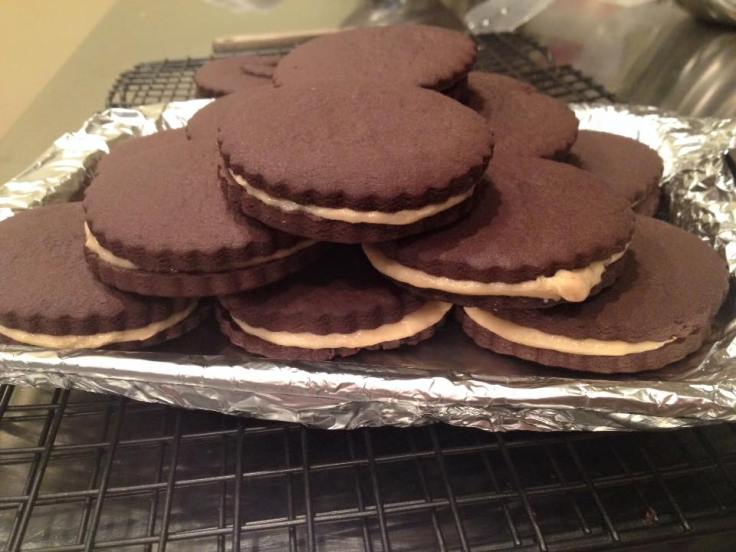
It is my mother’s birthday this week and I felt that it would be wise and nice to bring some baked thing when we go visit her. Since traveling with cake is a dicey prospect, I thought cookies would be the way to go. I don’t know why but the idea of a chocolate sandwich cookie, like an Oreo, but with peanut butter filling (because my mom likes peanut butter) sprang to mind. I voiced these thoughts to my husband, who said skeptically that it sounded “awfully experimental,” but I ignored him and plotted my next steps. Cracking Maida Heatter’s Book of Great Chocolate Desserts (which is a fabulous book, one of the first dessert-focused cookbooks I bought — in fact, I think it was the very first such book I bought), I found a recipe for chocolate wafers; grasping immediately that I had on hand everything it would take to make these, I moved forward. This is the list of ingredients:

2 oz. (2 squares) unsweetened chocolate
1 cup plus 2 tablespoons sifted all-purpose flour
3/4 tsp. baking powder
1/4 tsp. baking soda
Pinch of salt
2 oz. (1/2 stick) sweet butter
1 tsp. vanilla extract
1/2 cup granulated sugar
1 1/2 tsp. light cream or milk
1 large egg
 

So, naturally, the first thing I did was say, “Two ounces of unsweetened chocolate? Screw that, I’m using cocoa powder instead.”

I subbed in 5 tablespoons regular Hershey’s cocoa and one tablespoon Special Dark cocoa powder and added some extra butter to the bowl at the stand mixer — so it wound up being about 3/4 of a stick of butter, not 1/2 a stick of butter. (Three tablespoons cocoa powder plus one tablespoon of butter equals one ounce of unsweetened chocolate.)

But I otherwise did exactly as I was told. I preheated the oven to 400° and I lined cooky sheets with aluminum foil. I creamed the butter, added the sugar, threw in the vanilla and the egg, and then whisked all the dry ingredients together. I added the dry to the wet, mixed thoroughly, and cooed at the beautiful dark brown cooky dough (not that we’re told to do this explicitly, but it’s a totally natural reaction to such a beautiful dough). I then formed it into a brick, wrapped it in waxed paper, and put it in the fridge for not quite half an hour.

When the dough was chilled, but not hard as a rock, I took it out and referred back to Heatter’s instructions. She tells us to roll the dough out on a pastry cloth. Now, this may surprise you, but I had no idea what she was talking about. A pastry cloth? Do I own anything I can use as a pastry cloth? The answer of course was, “Yes.” A pastry cloth turns out to be a non-lint producing, flat-weave cloth you rub flour into and then use as your surface for rolling out dough; it makes it easy for you to move the prepared disc of dough onto your baking sheet. Apparently all pie bakers know this. Since I don’t really believe in pie, I’ve been ignorant, but now I’m converted.

My first thought was to use a particularly cute 1940s era dishtowel of mine as a pastry cloth — the weave is perfect — but I was leery of possibly staining it permanently with chocolate. So I took one of the old cloth diapers I use instead of cheesecloth and rubbed some flour onto it and then began to roll out the cooky dough. Then came the epiphany of the week: Rolled cookies should totally be rolled out on a pastry cloth. I don’t know why or how I never before grasped this, but it was awesome. The dough was so easy to work with; it didn’t stick; it rolled out in about two seconds to exactly the right thickness (1/8″) and was simple to remove from the cloth and put on the baking tray. Had I done this straight on the countertop, I’d’ve had to use so much more flour, and it would have been both messy and I’d’ve risked toughening the dough. It’s now clear to me that, were I a piecrust baker, I’d’ve already known about pastry cloth, but because I never make pie crusts, I had no clue. Well: now I know. And pastry cloth is my new hero.

(Incidentally: Because the very dark dough didn’t mark the cloth at all, not one bit, I’ve realized that I can in fact use my cute 1940s dishtowel as a pastry cloth, and I intend to dedicate it to this purpose from now on.)

So I rolled out the cookies and baked them. It doesn’t take long: 8 minutes, pausing at 4 minutes to rotate the trays of cookies (switching racks and rotating pans, necessary moves). Then you cool the cookies on a rack.

While the cookies cooled, I made the peanut butter filling. As it happened, I still had some leftover peanut butter sauce for ice cream sitting around, and so I felt perfectly confident that (despite the presence of corn syrup in the sauce) I could generate some peanut butter filling in about two seconds. Normally one would take peanut butter, some butter, and some confectioner’s sugar and just whizz that together. Today, I took some of the sauce, about a cup and a half of confectioner’s sugar, and a little bit of heavy cream (maybe 2 tablespoons) and whizzed that together. My husband tasted it and admitted grudgingly it was good. When the cookies were cool, I put some filling onto a cooky, glued another cooky onto it, and beheld my gorgeous creation. “Look at that!” I crowed to my husband. He came and looked and said, “Your mother will be very impressed,” he said, “but no one’s tasted them yet.”

“Oh ye of little faith,” I thought to myself, and placidly continued assembling the sandwich cookies. The last one, I thought, I will serve to my husband and child as a test cooky. I cut it in half — the cooky part shattered; it is a crisp cookie — and brought them to my family, who had varied reactions. My daughter declared them wonderful, with much enthusiasm and longing looks toward the tray of cookies to travel tomorrow. My husband, more restrained, admitted calmly, “They’re good.”

Damn straight they’re good. Happy birthday, Mom. Chocolate Peanut Butter Sandwich Cookies

Rolling the Leftovers Over, Again: Alfredo Sauce, Peanut Butter Sauce, but Don’t Worry, Not on the Same Plate

The Birthday Party of 2016 left me with some fairly high-quality leftovers to wrangle, most notably whipped cream and sugared strawberries. These were easily converted into strawberry shortcake. Strawberry ShortcakeSince I also had un-whipped heavy cream to use up, I figured the smart thing to do would be to use it to make the biscuits. To this end, I turned to Smitten Kitchen’s recipe for cream biscuits, which I’d never used before. It read as something of a gamble: this is a biscuit that has no butter or shortening of any kind in the dough. It’s just flour, baking powder, salt, sugar, and heavy cream. You do brush the tops of the biscuits with melted butter before baking, but — that’s it. It’s the kind of recipe I read with nervousness and think, “It could be great, or it could be a disaster.” I was not encouraged, as I set it up, by the fact that the amount of heavy cream required in the recipe did not produce a dough I could work with. I wound up adding water as I went along in order to create the soft, delicate dough. But these things baked beautifully, I have to admit. They were wide and puffy — maybe not as tall as one might like, but very tender and great with the berries and cream. My daughter couldn’t finish her serving, and ate the leftovers for breakfast the next morning before going to school.
There were other leftovers to deal with. The birthday dinner was — as requested — “pizza with beautiful ricotta and a Caesar salad.” My daughter’s words. (She is our child; this is really how she talks.)  Which meant that I had leftover beautiful ricotta to use up (which is no joke: anyone can tell you that a package of ricotta doesn’t last long once opened, and with beautiful ricotta, the life span is really, really short). I’d made a basic tomato sauce to put on the pizza, which meant I also had a tub of leftover tomato sauce. The salad greens got eaten up, thankfully, but still: the refrigerator became a strategic challenge. Elements leftover from Saturday’s birthday party, which were to become part of Monday night’s celebratory dinner, had to become something decent for Tuesday night. I rose to the challenge by taking from the freezer two slices of duck bacon, which I fried in a pan and then used as the base of a fake Alfredo sauce. (This is, by the way, pretty easy. You fry up the bacon, take the bacon out of the pan and set it aside, and then fry a minced onion in the bacon fat. Then you let it sit, and ignore it, while you boil your pasta water. While the pasta itself cooks, you whisk in the ricotta you’re using in with the onions and bacon fat, adding an egg if you have one sitting around, and some grated Parmesan. Cook the pasta and reserve more water than you’d guess to use to thin the Alfredo sauce — as much as a cup of water. Drain the pasta, combine with the sauce. Mince up the cooked bacon to sprinkle on top of the plates once you get around to serving, and serve with more Parmesan sprinkled on top.)

Tuesday night’s Pasta Alfredo was served with the last of the greens alongside it — a very plain salad, just lettuce and some cucumber sliced in with some dressing that I think was a mustard vinaigrette I made about a month ago. Who knows. It tasted fine.

Today it’s Wednesday, and I still have to make dinner. At nine o’clock this morning I found myself standing in the kitchen eating a leftover biscuit for breakfast (I warmed it up first so that it could be chewed — leftover biscuits are sad things) and looking into the fridge thoughtfully. “I’ve got about a cup and a half of leftover Alfredo sauce, and four cups of tomato sauce,” I said to myself. No one wants to have either thing on its own tonight, but: there’s no reason why I can’t combine them to make a new pasta sauce to serve on top of a different pasta shape! I can combine them and put it on some rotini, and with a green vegetable on the side (some broccoli rabe would be perfect), this will be a fine meal. If I am really clever about it, I will not only achieve clearing the fridge of several plastic tubs, but I will have made a sauce that is so good my family will demand to know why I don’t make this more often.

One problem remains, which is, We need to come up with a plan for using up the leftover marshmallow, peanut butter, and hot fudge sauces. I realize that the solution to this is obviously to buy ice cream and serve it with sauces, but what if I don’t want to buy ice cream? What else can I do with them? I have a feeling I could whip the peanut butter sauce into a cake frosting, or maybe a filling to use on sandwich cookies, if I baked a million little sandwich cookies. And I could do that. I’m capable of that. But basically I am soliciting ideas, now, so if you’ve got any, please comment below. (One idea pops up immediately: combine the marshmallow and peanut butter sauces to make a fluffernutter cooky filling! Mmmmmmmm.)

The Last of the Birthday Parties: A Post-Mortem

I am a second-generation mother who hates birthday parties; that is to say, much as my mother clearly didn’t relish having parties on her children’s birthdays, I too don’t much like holding birthday parties. But I have done it annually since 2009 and I’ve only let it make me totally psychotic a couple of times. It was nice when she was very young: we could invite whoever we wanted, babies can’t do too much damage to anything (and we didn’t have too much stuff to worry about damaging) and we could serve our guests bourbon punch and cupcakes and feel like we’d done a good job.

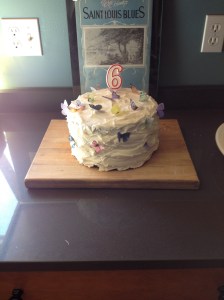
There were a couple of years when I made myself nuts trying to bake beautiful birthday cakes. The last year I did this, I pulled off a butterfly cake which was beautiful primarily because I bought these sugar-paper butterflies online — i.e., the cake was nice but the “butterfly” aspect of things was entirely out of my control — but the cake was, absolutely, a complete IMG_3072success. It was a four-layer cake with a cream cheese frosting and everyone loved it. I was very pleased with myself and had high hopes for how I’d handle cakes in years to come.

The year my daughter turned seven, however, her birthday fell during Passover, and because I refuse to do a kosher-for-Passover birthday cake (I mean, who are we kidding), we opted to do ice cream sundaes for the Big Event. We purchased tubs of good ice cream and I made hot fudge sauce and we bought cans of Reddi-Wip, an item my daughter had never before encountered. We had bowls of toppings — little M&Ms, Sno-Caps, Maraschino cherries. One of the mothers, attending the party with her daughter, volunteered to help squirt the Reddi-Wip, which I appreciated — we really had our hands full — and when all was said and done, the kids seemed happy and there was only one smear of hot fudge on the dining room wall.

This year, I asked my daughter what kind of cake she’d want on her birthday (since it’s weeks yet until Passover, so we could do whatever she wanted), and she asked to do ice cream sundaes again. She obviously felt it was way more of a novelty than any cake could ever be. I admit that I was slightly disappointed by this request — I mean, if there’s one thing I can do, it’s bake cakes that taste good and look decent on a cake stand — but she wanted what she wanted. So my husband and I said, “Ok, ice cream sundaes it is.” But, she added, “I want homemade whipped cream.” My husband, who’s usually in charge of whipped cream, was fast to say that wouldn’t be a problem. We laid in Maraschino cherries, without stems, as requested; mini M&Ms were purchased, as were Sno-Caps; I chopped some strawberries and doused them with sugar. I made three sauces to serve hot: fudge, marshmallow, and peanut butter.

This year’s event was a Superhero Party, in deference to my daughter’s love of the Christopher Reeve “Superman.” (I want to be clear: she loves the movie not only for Reeve, though he’s definitely the primary draw — she also takes great pleasure in watching Gene Hackman be a jerk.) Her interest in superheroes basically begins and ends with Superman, and she accepts only Reeve. Originally, she wanted us to screen “Superman” for all her friends; this was, we explained to her, a great idea, but totally impractical for so many reasons. “What if we just had a lot of superhero stuff around,” I said, “and then when the party’s over, if anyone wants to stay and watch “Superman” we can watch it together?” This was good enough. The challenge for me, then, was to come up with superhero themed stuff that would suffice from both my daughter’s perspective and also from the perspective of her guests, whose ages range from 5 to 9. Considering that keeping children entertained has never been a strong suit of mine, this was a real problem. I Googled “superhero birthday parties” looking for ideas, and found a million ideas that I would never get involved with — “Have your kids make Spidey Webs with silly string!” — NOT IN MY HOUSE.

But I went online and ordered some supplies (satin capes priced exorbitantly, paper masks the kids can color) and then I went to the dollar store downtown. At the dollar store I spent an hour and a half very carefully perusing the shelves and I finally came away with some gear that was, happily, even more perfect than I could have hoped for. Little tiny towels-in-a-tablet things printed with images of Superman and Batman; superhero coloring books with perforated pages so I could make a drawing table for the kids who didn’t want to be raving maniacs (only a couple of kids took advantage, but my daughter turns out to be enjoying them after the fact); and three superhero jigsaw puzzles. The real score, as far as I was concerned, was what I did with the closet up there.

I created a FIMG_6470ortress of Solitude in the large walk-in closet on the third floor —  which is so badly designed that I turned it into a reading nook for my daughter — by covering the cedar blanket chest in there with tinfoil, hanging signage, and installing blue lights so it seemed “icy and cold” in there, instead of just “dark and stuffy,” which is how I’d normally describe it.
The kids showed up and zoomed immediately to the room on the third floor I’d set up as the playroom. (I want to emphasize: this room is not actually a playroom, and it never will be. We don’t have a playroom. We have a room with our stuff in it that happens to be big enough to function as a playroom, sort of, once a year.) The children launched into decorating their masks with varying levels of interest; all donned capes excitedly, except for one little boy who seemed to find the idea of a cape and mask offensive. When everyone was suited up, my husband came upstairs with a CD of Superhero music (i.e., the John Williams’ “Superman Theme”) and a game of musical chairs was played. I, in the meantime, worked to set up the sundae bar. We had three kinds of Ashley’s Ice Cream on hand: cherry vanilla, marshmallow Peeps (no, really), and Oreo. While I dealt with the food — which involved a noble attempt to rescue the marshmallow sauce, which had separated upon being ever-so-gently reheated, and could only be rescued at a fraction of its original volume — my husband started the kids on the Superhero Jigsaw Puzzle contest. The kids divided into three teams, each was given a 100 piece puzzle to solve, and the deal was, whoever finished their puzzle first would be first in line for ice cream.

The children came charging down to the first floor and I began to serve ice cream as quickly as I could. Another parent manned the hot sauces station at the stovetop, where we’d jerry-rigged several double boilers; another parent handled whipped cream. When all the children had eaten, my daughter cried, “AND NOW: HIDE AND SEEK!” I thought, “uh, no,” but it took me a few minutes to be able to distract them into a slightly less treacherous activity. The Twister set was pulled out. As expected, my daughter’s best friend, a little one who loathes all activity requiring motion, said, “Can I be the one who calls the spots?” and I handed her the spinning board. She settled herself happily on the rocking chair and began to boss the more physically vivacious children around. I picked up half-drunk juice boxes and recapped magic markers and put jigsaw puzzle pieces back into their boxes. Soon enough, it was four o’clock, and the wee guests, still wearing their satin capes, were bundled up into their coats. Carrying their masks, and holding Superman or Batman washcloths, some asked me if they were going to get goody bags. “You’re wearing your goody bags,” I told them all, and the parents whisked them away, probably all praying that the kids would calm down once home and maybe eat a good supper that night. I don’t know if any of them did. At our house, though, things were astonishingly quiet, once the nine wee guests were gone. My daughter opened a few of her presents: she hugged and kissed the Calvin & Hobbes books from her grandparents. My husband ordered some takeout pizza for dinner, god bless him, and the event was quiet. Pizza. Christopher Reeve in Superman. Bedtime.

There’s good news out of all of this. My daughter had a great time at her birthday party. The house was restored to order within a few hours. The Fortress of Solitude will remain present for months to come, and I expect it will continue to entertain us all even after the sign comes down. But the best thing is, we have enough leftover whipped cream and strawberries that I think I can make strawberry shortcakes for dessert tonight.

The Disappointment of the Polyester Cloth Napkin

You might not expect Paul Fussell, the literary critic and belles lettrist, to’ve been a source for any useful information regarding running a household, but in fact, his book Class let slip a few related thoughts on the matter that I somehow absorbed (pun intended; you’ll get it later) and have found more and more true as the years have gone by.

We’re going to talk, here, of the polyester napkin, which Fussell abhorred. He hated polyester napkins, I think, because he viewed them as low-class, but also because, as much as you can ascribe a moral quality to napery, I think he felt that they were morally bankrupt. A polyester napkin is a thing that is pretending to be a thing it by definition cannot be. (He felt the same way about polyester towels, by the way, which is completely correct and reasonable.)

You may be asking, “Jeez, Ms. Hausfrau, why are you being such a snob?” A fair question, but one which has a fast answer. The napkin (or towel) has one job: to absorb schmutz and water. Polyester does neither. Hence, a polyester towel or napkin is literally useless. Furthermore, a polyester towel or napkin doesn’t feel as good to use as  cotton napkin (or linen, but who has linen napkins anymore? almost no one) or towel. So there is really nothing gained by using a polyester napkin. On the contrary: it lowers the quality of one’s dining experience. A polyester napkin feels oddly greasy when you hold it, when you press it to your mouth to dab at sauce at the side of your lip, and it inevitably falls from your lap to the floor because the fabric is so slippery. And a napkin that has slipped off your lap and landed on the floor by your feet is something you don’t want to put up to your mouth or try to clean your hands with.

There is no point to these things. People buy them because they are inexpensive, but it is a false economy, because a cheap product that doesn’t perform well is an item you have wasted money on.

Cheryl Mendelson gets this, and as I recall, she explains at some length in one of her home management books why polyester towels and napkins are a farce. I mention it because I realize that some of my readers may not really want to trust Paul Fussell’s opinion on the matter, but would give Mendelson a little more weight. Which would be fair enough.

You are possibly wondering, “Hausfrau, why are you all bent out of shape about polyester napkins? Who cares?” I’ll tell you: I’m all bent out of shape because I occasionally am in a situation where I have to use polyester napkins, and I don’t like it, and it makes me angry sometimes, but it really makes me angry when I’m in a fancy restaurant, paying ludicrous sums of money to dine out, and the restaurant is using polyester napkins. If we’re looking at appetizers in the $10-20 range, and anticipating spending upwards of $100 on dinner (which is a real splurge to the Hausfrau, something I take seriously, because believe me, it doesn’t happen real often), I expect napkins to be absorbent. Seriously. I don’t require cotton or linen napkins, I really don’t. But I expect a napkin that will function. I’d be happy with ‘good’ paper napkins (Paul Fussell may scoff, but I know what people mean when they say that, and it makes sense to me), I really would. But polyester napkins, to me, say: “We wanted it to look fancy here but we weren’t willing to actually think it through.”

My husband and I had occasion to eat at Tarry Lodge a few nights ago. This was a big deal. Tarry Lodge is a restaurant in New Haven (and other places, I gather) owned by Big Star Chef Mario Batali, about whom I know almost nothing except that he’s a Big Star Chef and I’m supposed to pay attention when he does stuff. This Tarry Lodge restaurant opened on Park Street in the fall of 2014, and I was interested in it for a few reasons. One, it was billed as a pizza restaurant, and if there’s something New Haven doesn’t need, it’s some fancy pants chef coming here to open a pizzeria. I mean, New Haven already has a lot invested in pizza, and we don’t need help from Mario Batali or anyone else in that department. Another reason I was interested in this place is that it is located on Park Street, which is not exactly a high-profile location for any restaurant, and certainly not where one might expect a famous chef to open a business. At some level, I thought, “Ok, so, this is interesting. There is a challenge being made here, on more than one front, a dare being taken. I wonder what the place will do.”

I was skeptical, to put it mildly. But since we don’t often eat out, I really had nothing to say on the subject of Tarry Lodge for a very long time. In the meantime, many of my friends went to eat there and came out crowing over how delicious, what service, just amazing. There was also a small group of outliers who said they found it, to be polite, lacking. Poor service; food not cooked properly (one guy said his pasta wasn’t merely al dente but was actually crunchy, a very undesirable quality in a pasta dish); food over salted, too greasy, and on and on. It seemed clear to me that it was a place that inspired strong feelings one way or another. People would either dine there once and never go back, or instantly have it be their Number One Favorite Restaurant in town, and return as often as possible.

Then my husband got to go there with his co-workers for lunch one day. He came home raving about it. “This pizza,” he said. “It sounded weird but it was delicious.” Something about truffle honey and pistachios. “We should really go sometime,” he said. “Yeah, let’s go!” I said cheerily, but we never went. Until last Friday night, when we were trying to think of a place to go before we attended a party at eight o’clock. “Let’s go to Tarry Lodge!” he suggested, and I thought, “Brilliant!” Since Yale is on spring break, it meant we’d have a shot at getting a table at 6.30, which normally, I am sure, is out of the question unless you’ve made a reservation in advance.

We got to the restaurant and while it was busy, there were plenty of empty tables; we were seated immediately. On sitting down, we took our napkins from the table, and my husband and I looked at each other. “Tarry Lodge,” we were thinking, “You have just lost 100 points.”

The napkins were polyester.

Mario Batali’s restaurant — a place where, presumably, the money existed to invest in cotton napkins — uses 100% cheap, sleazy, polyester napkins.

Which means that when I wanted to dab some spicy olive oil from the corner of my mouth, all I could do was use the napkin to massage it into my skin. It meant that when I got my hands dirty eating the pistachio, goat cheese, and truffle honey pizza — which was delicious, and had a crust very different from what we usually think of as pizza crust, here in New Haven — the napkin was utterly useless. My husband, who had tagliatelle bolognese, had to be extra careful with his meal, because, let’s face it, bolognese is the kind of thing you just assume will result in disaster of some kind. (He got lucky.) It meant that when we were served our Valrhona chocolate and olive oil ice creams (with honey on top, no goddamned fennel pollen — why do I want it on ice cream?), we were very, very careful with each spoonful we took from the dish at the center of the table, because if we spilled any on ourselves, there was sure to be no good way to blot it up.

I feel like I should be allowed to expect more from Mario Batali and Tarry Lodge. Tarry Lodge wouldn’t have lost any points with me had they just been forthright and set the tables with heavy paper napkins. Hell, we were once in a restaurant, a casual pizza place, where they avoided the whole napkin issue by simply putting rolls of paper towels at every table, and I thought it was an ingenious solution to the problem of how a pizzeria should deal with napery. Eating pizza is a greasy, messy operation, no matter where you are. Even if you’re the kind of person who insists on using a knife and fork to eat it, you’re going to want a napkin. And we all know those little narrow tri-folded paper napkins are terrible; we tolerate them in inexpensive restaurants and diners, but we all know they don’t work that well. At a place like Tarry Lodge, though, I want a napkin that works, that will not slide off my lap and land on the floor, that will serve me well in my time of need.

So I will dine at Tarry Lodge again, I imagine; I do want to try the ravioli filled with beef short ribs. But if I don’t go back — well, it won’t be the end of the world.

I hope you’ll excuse me while I go fold laundry. I did three loads of laundry this morning, including the kitchen towels and, yes, the cloth (100% cotton, as God intended) napkins. Anyone at my house who needs a napkin will find themselves supplied with something soft, handsome, and effective. At Tarry Lodge? Bring Your Own Napkin.

The Overwritten Recipe: Another Book Edward Gorey Forgot to Write and Illustrate

If you are reading a recipe, and the instructions seem over-written to you, the novice recipe reader, you should bear in mind that the person who wrote the recipe is probably trying to save you some angst by being so precise. Don’t sign angrily and insist that the writer is an asshole or just trying to get your goat. He or she is trying to explain to you why you should take step A before step B, lest you veer in the wrong direction and wind up in the Museum of Tsuris. It is true that longwindedness in recipes can be due to mere literary preciousness, or culinary pretention, but in my own case? It’s really just that I’m trying to convey to my reader, in entertaining manner, the good reasons why something is done a certain way. In other words, I’m not trying to piss you off, I’m trying to be helpful, dammit.

Conversely, an underwritten recipe can be nearly useless. We’ve all seen old index cards tucked into books or found in boxes of random stuff in our grandmother’s junk drawer. The recipe is titled, “Angela’s Spice Cookies — very good!” and it’s a list of ingredients but then there’s no instruction for how to combine them. The card’s text ends, “Bake in hot oven for 12 minutes.” Thanks, Angela.

I’ve also met another sneaky bastard, the Secretly Underwritten Recipe, that you really have to watch out for, because it’s a sneaky bastard that can ruin your day. This is the recipe that comes from a normally reliable source, but that turns out to have some crucial ingredient or step left out. Like, it tells you that you need four eggs to make the recipe, but then doesn’t tell you what to do with them. Ever. Or it neglects to advise you that not only should you grease the pan, but that you should put some parchment paper down before you pour in the batter, otherwise you will never get the cake out of the pan.

I am thinking about all of this because the other day I was doing some online research about madeleines. Specifically, I was wondering, “Can you make madeleines without a madeleine pan? I mean, of course you CAN, but is there any reason to seriously feel bad about not using a special pan?” I arrived at the conclusion that if what you want is little puffy lemon cookies, you should absolutely not feel bad about not using a madeleine pan. But in the process, I stumbled on a website maintained by a young woman who clearly has it in for food writers who use more than one sentence to describe a process.

At http://goutaste.com/a-modified-madeleines-recipe/ we read the madeleine recipe of Deb Perelman (Smitten Kitchen — an exceptionally fine blog, known to everyone who’s reading this, I am sure, except my mother, and, Mom, even you might even like reading Smitten Kitchen, if you were in the right mood, because Deb Perelman’s pretty flippant and sassy about cooking). Goutaste Lady (E. Grossman) feels that Deb Perelman uses too many words to write her recipes, which makes me think of the Emperor who moans that Mozart used too many notes. Grossman pouts, “I finally found one that looked just about right, except that this chef clearly has way too much time on her hands! Who has time to read – let alone WRITE – paragraphs of instruction??”
It makes me think of the Emperor who moaned that Mozart used too many notes.

The reason why Perelman uses those words is to get you to create a thing that is Correct, that is not a Disappointment. There are reasons why she wants you to combine ingredients in a certain order. Like, science reasons.

anigif_enhanced-buzz-17498-1400688809-8

I can’t always explain them, but I know for a fact that there are reasons why we combine certain ingredients together at certain times. It isn’t just that recipe writers are persnickety for the fun of it.

There are really good reasons why Smitten Kitchen has been such a success: Perelman’s writing is clear and precise and works to make intimidating enterprises less intimidating. She’s following in the footsteps of people like Irma Rombauer and Marion Rombauer and Ethan Becker (Joy of Cooking), and Julia Child — someone who Ms. Grossman should have heard of, what with being such a Francophile and all. Where would any food writer today be without these people, who used a lot of words in their recipes, as role models? It is nearly unthinkable.

Deb Perelman doesn’t talk down to her readers and she doesn’t dumb recipes down needlessly or pointlessly. She assumes that someone wants to make something and then says, basically, “Ok, is this easy? Is it hard? Can it be done in a tiny kitchen, possibly an ill-equipped kitchen?” Then she goes about and explains how the thing can be made, whether it’s churros (which she had assumed were a pain to make, but assures us are totally easy, but even so, I’m not gonna bother, well, maybe someday) or babka (which is a pain to make, no matter how you do it, but it is worth doing, and the SK recipes are a good way to go). It seems clear to me that she assumes a certain level of competence in the kitchen, but it’s also clear from the comments that if a novice baker has a question, she’ll answer it, no matter how obvious the answer may seem to her or her more experienced-cook fellow-commenters. Many, many of the comments on Smitten Kitchen are written by people who would never have tried to bake or cook at all, if not for her website. Even I — I’m pretty comfortable in the kitchen, but when I am daunted by the prospect of baking a particular thing, I will turn to Smitten Kitchen for reassurance that I can do this.

Ms. Grossman’s recipe for madeleines may work; I don’t know, and I never will, because I don’t want to make madeleines. I know that her attitude is amusing. But I also know that there are recipes where if you get too flip about method, the product will fail. The end result will not be what you want. There is, for example, a real difference between “folding in” an ingredient and “mixing in” an ingredient. God help Ms. Grossman if she ever decides to make something involving whipped egg whites. If she decides to just mix them into her flourless chocolate gateau, instead of carefully folding them in, she is going to wind up with a very, very fallen cake. And there will not be enough whipped cream in the world to make up for the fact that she didn’t respect the ingredients and how they have to be handled.

So, missy, don’t get all high and mighty about those overwritten recipes. Because, come the day when you really, really fuck something up in the kitchen, and you’re crying and screaming, “Why did this happen to me? Why does God hate me?” you will seek out that overwritten recipe, and it will calmly explain to you, “If you are not careful with this step, your cake will fall/your butter will taste burned and you will have to start all over/your beef will be tough and stringy and you will want to just throw it to the dog rather than serve it to your loved one on your anniversary.” Ms. Grossman, be flip. But respect the people who’re doing the heavy lifting, to whom you will run crying like a baby in times of trouble and sadness.

In the meantime, I will keep a light on for Ms. Grossman in a small room in the northern part of the guest wing (where visiting scholars may rest their weary heads) of the Museum of Tsuris.

Create a free website or blog at WordPress.com.

Up ↑