Pound cakes.

The days right before Passover I began to want pound cake more than anything in the world, and I swore that as soon as Passover was over I was going to start making pound cakes. It took me about a month to bake anything, after Passover was through — I’ve been really busy — but I did finally bake two pound cakes. One of them was a real pain to make (it involved separating eggs and whipping the whites to soft peaks, in addition to everything else) and one of them was pretty easy. One of them was sublime, and one of them was, despite my best efforts, entirely mediocre.

I want to say, “The lesson learned is, good pound cakes require effort like whipping egg whites,” but I know this isn’t the case. The Gourmensch remembers as well as I do that about ten years ago I occasionally made a really excellent chocolate chip poundcake; the recipe was in a cookbook I cooked out of all the time. I used to make this cake every couple of months, a big cake it was, baked in a tube pan, and it would disappear within about three days. This means, by the way, that he and I were eating truly revolting quantities of cake every day. But it was so good, we didn’t care.

Problem is, I can’t remember which of my books had that recipe.

So I’m thrown back to hunting for good pound cake recipes. We will eat up the last of the bad one I made — because my husband and child declared it perfectly good and we have no intention of throwing it out; it has chocolate chips in it, after all (which sank! and they weren’t supposed to sink! I coated them in flour before mixing them in, why’d they sink?), so it isn’t just trash. And when it is gone, I will start working again. I will figure out if there is a way to make a truly excellent poundcake without having to whip egg whites.

There is probably a book somewhere which is nothing but poundcake recipes. If there isn’t, perhaps I should start assembling one.

The Unusual Seder of 2015

We normally celebrate Passover by hosting a Seder that’s got anywhere from 10-20 guests, depending on how many Special Guest Stars show up. And we are fine with it; we think it’s fun, though it is admittedly a whole lot of work to make our dining table fit that many people. The truth is, it takes the dining table, fully extended, plus two more tables added on, to sort of be able to squish everyone in. It’s not ideal, but, you know, we manage. This year, however, we had very few guests, and with that in mind, we made a few editorial decisions to alter the menu. Because we were cooking for fewer people, we decided we could make a different entree (one we could never do in reasonable fashion for a lot of people), and that we’d also skip the matzo ball soup. I KNOW how people feel about matzo ball soup, but I think it’s a pain to make. And, all right, fine: I forgot to save chicken broth in the freezer a few weeks ago, when I made a huge pot of it. I used it all up making risotto and Cincinnati chili. So. No matzo ball soup. No soup at all.

We did serve gefilte fish from a jar (as is traditional), and I did (as is also traditional) wonder why everyone grouses about gefilte fish, when, if we called them fish quenelles, everyone would oooo and aaaah over them. Well, it’s fine. Whatever. Gefilte fish for starter, and then, for the entree, we served a braised flank steak (cooked with vermouth, a ton of garlic, tomato paste, and onion, with carrots added in toward the end to lend a tzimmes-like quality to things), roasted asparagus goldenrod (because I had some egg yolks in the fridge and thought it would be fun to poach them — it was fun — but then I had to use them up somehow), and the man of the house, the Gourmensch, made latkes a la minute. I whizzed up a kind of faux chimichurri sauce in the food processor to serve alongside the flank steak; it seemed to me we needed something jazzy on the table, and chimichurri would do the trick.

Dessert was Smitten Kitchen’s chocolate coconut macaroons, which I recommend highly.

Saturday was the kid’s birthday and in lieu of cake (because there is no cake in the world that is both kosher for Passover AND acceptable as a child’s birthday cake, in my experience) we invited the guests to make their own ice cream sundaes. So we had three flavors of ice cream, and a vat of hot fudge sauce, and cans of Reddi-Wip (because, sure, I’m crazy, but I’m not making homemade whipped cream for small children, they don’t care), and about six little bowls of toppings. Reese’s Pieces, Sno-Caps, Junior Mints, rainbow sprinkles…. I did not agonize over whether or not any of these things were kosher for Passover because I have my limits. For more reasonable snacks, pre-game, so to speak, we offered the little ingrates a huge, huge bowl of cheese popcorn (the Gourmensch was in charge of this: we use the cheese powder you can get at considerable cost from King Arthur Flour; no, it is not cheap, and yes, it is worth every penny, because otherwise you’d go broke buying Smartfood in such quantity), and matzo pieces to dip in a tub of hummus (store-bought) and guacamole (homemade).

In the course of things, come Saturday evening, we were too exhausted to think about dinner, and so we got Indian takeout. Sunday night, we had stuffed baked potatoes, prepared from the recipe in Honest Pretzels, one of the kid’s birthday presents (and more on that later). Monday night, though, I was back on duty, and when I opened the fridge today and had to decide what I was going to feed us today, it was absolutely crystal clear what had to happen:

1. I had to use up leftover food; 2. I had to make something that would last us through two dinners; 3. I had to make something with the avocados still in the fridge (three perfectly ripe avocados, because I’d bought seven and only used four for the birthday party) — avocados, once ripe, last a while in the fridge, but not indefinitely.

The solution was clear. Chili with leftover flank steak; guacamole made with avocados, lime juice, and chimichurri sauce; to be served over rice. The chili was assembled in about 15 minutes; the chili simmered while I did the rice in the rice cooker and made the guacamole; and It Was Good. Furthermore, the dishes were done and the kitchen cleaned up by 7.45, which has to be a kind of This Old Hausfrau record. (Normally, we’re not done until 8.15, by which time we’re ready for bed, because we are Sad Old People.) With that extra half hour tonight, the three of us played a few games of Uno and made fun of the cat for a while.
The beauty part is, there’s enough leftover chili and guacamole, we can have this for dinner tomorrow night too. That’s right: I barely have to do anything to get dinner served tomorrow. Hallelujah.

Brisket spread or Biscoff Spread: When the child creates a new food item by misunderstanding language

My daughter is almost seven. I wouldn’t call her an omnivore, but, in broad terms, she likes eating, she’s curious about trying new food, and there aren’t many things she won’t eat. We’ve never had to really fight with her about food. Which is good, because I don’t know what I would have done if we’d had one of those kids who was all “texture sensitive” or had allergies or whathaveyou. Well, I imagine we’d have managed to deal with it, the way everyone does, but it would have been really really annoying.

All young children mispronounce words with funny results when they’re little: how many children have asked for “pasketti and meatballs,” for example? My child used to ask for “cucumbums” instead of cucumbers. The older she gets, the less this kind of thing happens, but recently we had a humdinger of a food/language issue that caused major confusion in our household.

It began a few months ago when I bought a jar of Biscoff spread. I’d never had the stuff before, but friends of mine were crowing about it on Facebook and I felt very out of it for having no idea what they were talking about. Evidently in Trader Joe’s they have their own version of it called Speculoos, which I find distinctly off-putting because it makes me think of a speculum, which is something I don’t want to eat, but thanks for asking. Anyhow, when I was at P&M, a favored grocery store on Orange Street, I saw a jar of Biscoff spread and thought, “You know, I”ll buy it. I probably wouldn’t like it, but others in the household will.” I thought my husband, in particular, would like it. It turned out I was wrong: he had no interest in it. So the jar sat in the drawer, dabbed at but unappreciated, for several months. Then one day I offered to make my daughter a treat with it: I had some graham crackers and said, “What if I put some of this stuff on it? It looks like peanut butter but it tastes like cookies.” “What’s it made out of?” she asked warily. “Well, it’s cookies, actually,” I said. “They mash up all these cookies and turn it into cooky spread.” She nodded eagerly, and when I gave her the graham cracker with cooky spread, she gobbled it down.

Then she got into the habit of, when asking for a treat, asking me for something with cooky spread on it. Piece of bread; apple; whatever. With cooky spread. This didn’t happen every day, but maybe once a week, she’d remember the jar, and ask. And I would always give her some, because, well, someone has to eat this stuff up.

Eventually I told her that the real name for the stuff in the jar is Biscoff spread. She absorbed this information and then moved on with her life.

A few days ago, the three of us were sitting around debating what we might cook for Passover and it was suggested that we might do a brisket this year. (I should call the butcher at P&M to see if he can get me one.) This prompted my daughter to announce that she felt hungry and could use a snack. My husband asked her what she’d like, and she said, “Brisket spread.”

“Brisket spread?” he repeated. I laughed.

“She means Biscoff spread,” I explained. He didn’t know what it was. I said, “It’s that cooky spread you don’t like.” “Oh,” he said. “Okay.”

But now I’m thinking about brisket spread, and thinking, If you had a little bit of leftover brisket, not enough to make a meal out of, but just a few slices of meat, maybe it’d be good to remember Peg Bracken, and make a brisket spread. I must remember to do this. Into food processor, I’d put the meat, a little bit of mayonnaise, and some dry mustard, and then I’d whizz it until it formed a nice gloppy paste. Then I’d fold in, by hand, some pickle relish. I have a feeling that would be a really good thing to eat on a sandwich. Brisket spread. And for dessert, shortbread with Biscoff glaze? There’s potential here.

Double V Chicken, and Cooking by Instinct

IMG_4845Friday I had this idea that I was going to cook chicken using vanilla and vermouth. I wasn’t sure exactly what I was going to do, I just knew that it would involve those things and that it was going to be AWESOME.

I went to the butcher a few blocks away. His name is Jimmy, he’s a great guy. He’s been butchering in this store for probably more than 30 years. He saw me standing there staring into the meat case and asked me if I knew what I wanted, or if I was still thinking. I said, “No, I’m ready, I know what I want.” I placed my order for the chicken and he asked, “What’re you gonna do with it?” I said, “Well, I’m gonna cook it with vanilla and vermouth.” He looked at me appraisingly. “You sure about that?” he asked. “I am,” I said. “You got a recipe, or are you….” “No, I’m just making shit up,” I said happily, “but I’ve got a feeling it’s gonna be good.”
He bagged up the chicken and wrapped it in paper. “You know what could go good with that,” he said. “A little of that Chinese spice, what’s it called, the little stars.” “Star anise!” I said. “That’s an interesting idea, but I think first time I’m gonna keep it simple.”

“That’s probably a good idea,” Jimmy admitted. “Let me know how it goes, I’m curious to hear.” I said I’d be sure to tell him. Then I went home and I put the chicken in the fridge and I thought about it and thought about it. I went online and did some poking around to see if a recipe like what I had in mind was already out there. There were definitely chicken recipes  that called for vanilla, but none I saw matched what I had in my head. I considered the possibilities for how to create this, and took action. Step 1: put chicken into freezer, to make it freeze just enough so it’d be easier to slice into nice even medallions. Step 2: put some flour into a bowl, add about a teaspoon of vanilla powder and a half teaspoon of salt. Mix together with a fork, set aside.

After about twenty minutes, I took the chicken out of the freezer and cut the medallions, which I then put into the bowl of flour. I tossed the chicken around to coat it all nicely. Then I took out a big pan and heated up some butter and began to fry the medallions. I let each side brown nicely and then put them on a sheet in the (preheated) oven to stay hot. When the chicken was all taken care of, I deglazed the pan with about 1/3 of a cup of sweet vermouth mixed with two teaspoons of vanilla extract. I let this cook for a moment, and then whisked in cream, maybe a cupful (I didn’t measure). In a separate pan, I sautéed until nicely browed a package of little baby bella mushrooms. (If I’d not forgotten the mushrooms, which were sitting, prepped and ready in a colander on the other side of the sink, I’d’ve done them in the first pan after cooking the chicken but before deglazing it: next time, I’ll save myself the trouble of dirtying a second pan. This time, though, it wasn’t the end of the world: I wound up using the second pan to cook a side of broccoli anyhow.) When the mushrooms were done, I let them simmer a while in the brought-to-a-boil and then just keeping warm cream sauce.

In the meantime, I cooked broccoli and made mashed potatoes. Both were fine. But the chicken was, I have to say, really really good. My husband expressed some skepticism that any leftovers would make for good sandwiches, but I waved this away: I knew they would be great. And they were. In fact, the next day, at lunch, he sat down and declared the chicken sandwich he’d built (leftover chicken; mayo; sliced green olives) very good indeed. “This chicken makes for a superlative chicken sandwich,” he said. Quote, unquote. So the naysayers can go back into their kitchens and stare glumly at their pieces of raw chicken and ponder. I say, I would never have believed it, but there is a chicken dish that has no onion and no garlic that’s really good. This is it. Chicken with vanilla and vermouth. You heard it here.

The problem still remains, however: what will we eat for dinner now that it’s Sunday night. Some takeout Chinese would really be great.

and sometimes, you find something you thought you’d used up, but you didn’t: Descoware

Like a jar of, um, caramel you burned three months ago, sitting at the way back of the top shelf of the fridge, I found this piece on Descoware which I wrote a couple years ago. I really thought I’d used it, but it seems I didn’t, so I’m putting it out there.

There seems to come a moment in the life of every home cook: you realize you want an enamelled cast iron pot. The circumstances vary. Maybe you were watching Christopher Kimball dipping a spoon into a huge red Le Creuset pot on America’s Test Kitchen, and you thought, “Well, I could make perfect short ribs if I had a pretty pot like that.” Maybe you were walking through a department store looking to buy new towels, and you saw the cookware displays a few feet away: that glossy blue enamelled saucepan would look beautiful filled with lemon curd, wouldn’t it? And you’ve always wanted to make lemon curd, too.

You look at the price tag of that pretty Le Creuset pot, and you blanch. You consider: you could buy a less expensive brand. There are other options. Some of them are quite good, too, even if they lack the snob appeal of the Le Creuset offerings. Sadly, though, you go home to do research, and learn that some of the lines are really not worth their prices. You read, grimly, about enamelled cast iron pots that chip, that don’t heat evenly due to sloppy manufacturing…. and if you’ve already bought a set of these pieces, it means you’ve wound up with a lot of pretty but not useful pots which will only collect dust.

There is another route, and it’s a good, solid solution to the problem. How do you acquire really good enamelled cast iron pots without spending a fortune? You hit the second-hand marketplace, and scare yourself up Descoware pots.

I can actually hear you scratching your head. What is Descoware? Descoware was a company that made enamelled cast iron pots and pans in Belgium. The company started manufacturing in the 1930s and developed quite a following. The goods were high quality — as good as Le Creuset — with one crucial difference, which was that they were not quite as thick, and hence, not nearly as heavy. The weight of Le Creuset (and similarly-made) pots is legendary. Descoware was noteworthy because it provided cooks with the same sorts of designs as Le Creuset, and the same ability to go from stove-to-oven, but without being so incredibly difficult to heft. Julia Child, not someone known for being cavalier about her equipment, favored Descoware. The company’s line grew in popularity in the United States through the 1950s and 1960s — especially after Child encouraged her viewers to purchase Descoware — and Le Creuset knew they had to respond. Respond they did: they bought Descoware, and shut down the line after appropriating some of their glazing techniques. By the 1970s, Descoware was in a lot of American kitchens, but could no longer be purchased new.

Many people would recognize Descoware pieces immediately, if they saw them on a shelf at the local Goodwill — which is where you can, now, often find Descoware for sale, at prices you have to giggle at. The smooth, creamy colors, ranging from a buttery yellow to the familiar orange-red known as “flame,” are as appealing now as they were in 1961. Descoware never developed the range of colors that Le Creuset has done over the years. But the colors they did manufacture retain their appeal. Some Descoware saucepans have wooden handles, which may or may not have worn so well, but the pieces that have contiguous cast iron enamelled handles may well look as though they just came out of the box. On the whole, Descoware has worn extremely well.

I began to cook with Descoware after I inherited pieces from my grandmother. I already owned quite a bit of Le Creuset, and didn’t leap at the Descoware, but I took it because I thought, “This might be useful — I should hang onto this.” That was six years ago. Now, I find that the Le Creuset is a little hard on my wrists: making caramel in a Le Creuset saucepan is a breeze, but lifting the pot to pour out the caramel is not. With the Descoware pot, however, I have no trouble whatsoever.

Finding Descoware today is the kind of challenge that would appeal to those who go for the thrill of the hunt. As with collecting anything — rare books, old 45s, vintage linens — a lot of the fun is in keeping your eyes open all the time. Of course, in this day and age, a simple trip to eBay can net those with little patience an awful lot of Descoware choices very quickly. The cost of shipping cast iron enamelware can be daunting, but comparing overall costs — buying Descoware secondhand on eBay vs. purchasing almost any comparable brand, new, online, and having it shipped — buying the Descoware is obviously the less expensive way to go.


Friday Night Dinner. A vague plan, then I’m out the door.

This morning my daughter asked me what I was going to make for Shabbat tonight. Since I was in the middle of serving her breakfast, I felt this was really a case of her jumping the gun, but it’s true, it’s the kind of thing I usually have sort of planned out by seven in the morning. “I was thinking chicken,” I said, “and, um, potatoes? Sliced up potatoes, roasted in the oven?” I know everyone likes it when I do potatoes, because I hardly ever cook them and it’s regarded as a Big Deal.
“MASHED potatoes,” she said.
“I’m not making mashed potatoes, it’s a pain in the ass,” I said. “MAYBE potatoes.”
But she didn’t ask, you’ll note, what method I would use to prepare the chicken. So she doesn’t know that I’ve got something kind of weird in mind. I am going to go buy some boneless breasts of chicken and then cook them very simply and serve in a vermouth and vanilla sauce.
I guess I better come up with a really good pot of mashed potatoes, ’cause this could be pretty bad.

9 Bonne Maman Jars, and Not an Ounce of Jam.

I counted, last week: I had nine Bonne Maman jam jars in my refrigerator, and not one of them was holding jam. What is in these jars: Leftover bits of this and that. Shall I make a list?

Bamboo shoots; chocolate ganache; the last of the caramel I burned at the end of December; leftover coffee; pickled ginger; coconut chocolate cooky crumbs; chicken fat; raspberry sauce; raspberry vinegar.

I decided that this was all rather a bit ridiculous, and tried to think what I could make for dinner that would use up at least one of these jars. I’d bought some boneless chicken breasts for Shabbat dinner, and had a vague plan to braise them in a barbecue sauce when it occurred to me that I could use the caramel and the coffee in the sauce.

So I did. Now we’re down to seven Bonne Maman jars, we have some wonderful leftover chicken (I’ll be shredding the rest of it this evening to serve over rice noodles, converting them to some kind of Thai or Malaysian type of thing), and I’m starting to be able to see light inside the refrigerator.

On Minginess, Environmentalism, and Lifestyle Trends

Last Wednesday’s New York Times has an article in the food section about the latest thing is to use your food and kitchen materials absolutely to the maximum so as to avoid putting scraps and unnecessary waste into landfills. http://www.nytimes.com/2015/03/04/dining/efficiency-in-the-kitchen-to-reduce-food-waste.html?_r=0 is the article, and it’s chockablock with good intentions, sensible advice, and sanctimony. The idea is easy to grasp: the more thoroughly and efficiently you use up things you use and produce in the kitchen, the less waste will be generated, and the less trash will go into landfills. Now, I am not someone who goes to great lengths in any particular way to do good for the Green Agenda. I don’t drive, which I feel exonerates me from the get-go. I do other things that are not Green, but, you know, Not Driving is such a big thing that I basically feel my little (size 8.5) carbon footprint is smaller than average, so it’s ok. I may be wrong about that, but I have a friend who is entirely rabid on the subject of global warming and Green Green Green everything and she has assured me more than once that I am, compared to most Americans, a paragon of environmental virtue, which is really quite comical because all I want to see in my environment is good sidewalks, little cafes and bookstores, and very little in the way of shrubbery, at least, shrubbery I have to think about or maintain at all. My dream house has a backyard that is paved in herringbone brick, with maybe an urn or two for growing rosemary bushes in. And someone else will tend those.

This Old Hausfrau does not compost, but I’ve been paying attention to how much garbage our three-person household generates, and basically, we produce about one white Hefty bag of trash per week, assuming a normal week (i.e., we don’t have anything like Passover or Thanksgiving going on, nor a birthday party for the child, or any big social event that would throw us out of our routine).

Anyhow. This article, “Starve a Landfill,” has a little photo chart called “Extending That Shelf Life,” and I read it eagerly. It shows a loaf of sliced bread, a carrot (with green tops), and a chicken carcass, and lists ways for you to make the most of these items. I read happily and then grew depressed as I realized that I already do probably 80% of the things they’re advising us to do. I do cook with scrubbed-and-not-peeled carrots, as I find the outer skin of a carrot is unfailingly awfully bitter, and that peeling is simply necessary. What’s more, since I don’t buy carrots with tops on them, I never have to think of what to do with the tops. I would never make a mayonnaise substitute out of carrots, because I am perfectly happy using mayonnaise. But I do take vegetable scraps and save them in plastic bags in the freezer for making stock. This goes for carrots, for onions, for parsley…. any vegetable I’m working with that I regard as “neutral,” the scraps get saved for stock. Corn cobs get saved in special bags all summer long, because corn stock is, truly, one of the best things in the world to keep in the freezer. (To make that, you don’t really have to add anything: you just simmer the corn cobs in water for a while. The smell is heavenly. And then you freeze the stock in little bags or ice cube trays or whathaveyou and this is stuff you can use all winter long as a base for wonderful things like Chinese-inspired velvet corn soups, or chicken corn chowders made with frozen corn kernels. Just take my word for it.)

Bread: I hoard ends of bread in the freezer and periodically take them all out, thaw them, and whizz them in the food processor to make bread crumbs. Once in a blue moon I will make croutons, because my husband and child enjoy them very much (I’m not really a fan). Bread crumbs are used regularly here: made into a panade, they are the base of my meatloaves and meatballs. They go on top of casseroles. I might dust a cake pan with them. Sometimes I make a separate bag of seasoned bread crumbs, by adding, say, a small onion and a clove of garlic and some black pepper into the food processor. As long as you label the bag (don’t use those seasoned bread crumbs for dusting a pan you’re about to make a chocolate cake in), you’re golden. (While we’re talking about crumbs and cake pans: I do, yes, have a bag of chocolate cake and cooky crumbs that I use in the pans when I’m baking chocolate cakes. This is the kind of crazy I am. So be it.)

Ms. Severson of the New York Times advises us on how to handle a chicken carcass, and, again, what she recommends is precisely what the Balabusta does. Freeze the carcass until you are ready to make the stock. Easy peasy. The one thing she suggest doing with leftover chicken meat and bones that I don’t do: I have yet to render the fat and skin to make schmaltz. But something tells me there will come a day when I break down and do this. It might be next winter; our winter seems to finally be ending, here, and I don’t expect to be inspired in this direction for quite some time. But I take her point: if I were a perfect person, I’d be utilizing the skin and fat of the bird to a greater degree.

Reading this article made me feel, at once, very thrifty, in a good way: I’ve always known that it was stupid to just throw out stale bread, and that bread crumbs were useful. But it also made me feel really…. trendy, in a stupid way. I mean, it seems to me that this kind of way of running a kitchen is merely sensible. It is, I am sure, how housewives of the 1930s would have run their kitchens, assuming they were comfortable enough to have sufficient food to begin with. I suppose I should just accept the mantle of “trendy” and get on with my life. But my readers should know: it’s not that I do this stuff merely because I am a whackjob. It is part of a circumstance that, actually, Ms. Severson writes about:

“Eating better may cost more, but an efficient cook can make up the difference.” It’s true. If I spend $15 on an organic chicken to roast for dinner, you are damned straight I want to get my $15 out of that bird. So the meat will give us two or maybe three meals, depending on what I do with it; and the stock I make with that carcass will flavor at least two or three more meals, again, depending on what I do with it. That is efficiency.
I worry about my kitchen habits and whether or not they make economic sense. Is it saving us any money at all, the fact that I bake the majority of the bread we eat? I am confident, but not sure, that the answer is “No.” On the other hand, my husband (who is far more the economist than I am) advises me that over time, yes, there would be savings. I’ve not purchased a Pullman loaf in about six months now. We used to go through a little more than a loaf a week, and it could cost anywhere from $5 to $2.50, depending on sales and coupons and so on. I’m picky about what brand I’d buy, so I got stuff as good as I could get, but frankly: the bread I bake is a lot better than the best of the grocery store brands, which, for a Pullman loaf, is (in our opinion) Pepperidge Farms. I mean, a LOT better. So if each loaf winds up costing us about $4 to bake…. and I’d be astonished if it did cost that much in terms of ingredients….  its being intrinsically of such higher quality has to count for something. It’s clear to me that if I were able to purchase a freshly made Pullman loaf made from the ingredients I use, it would cost me at least $7 in a store.

The caramel I make for the hell of it now and then, and store in the fridge in old Bonne Maman jars — it is perfect stuff. The other day, I was at a fancy teashop in Hamden, Connecticut, a nearby suburb, and saw for sale there little jars of caramel. I initially assumed it was made at the teashop, but no — it’s made by some company in Maryland. Mouth Party. A 10 oz. jar of their caramel sells for $9 online — at the teashop, I think they wanted $9.50.

It’s astonishing, then, that I could make a comparable product — and one I’d almost certainly prefer, because it has no weird ingredients. Here’s what’s in the plain Mouth Party caramel sauce: INGREDIENTS: CREAM, SUGAR, CORN SYRUP, HIGH FRUCTOSE CORN SYRUP, BUTTER (CREAM, SALT), VANILLA EXTRACT, SALT, CARRAGEENAN, MONO-DIGLYCERIDES, CELLULOSE GUM, POLY SORBATE 80.

I don’t want mono-diglycerides or carrageenan or cellulose gum or polysorbate 80 in my caramel. Here’s what I want in my caramel: cream, sugar, butter, vanilla, and maybe some corn syrup, depending on what I’m doing. (Sometimes you do need some corn syrup in your cooking to get the texture just so.)
So it’s clearly more efficient for me to make my own caramel. I suppose that it is, given my quirks, less efficient for me to bake my own bread, but I’m able to do it, for now, and I’m good at it, and I’m mostly glad to do it.

My fear of kitchen waste, you may recall, the reason why I made a pot roast flavored with a caramel sauce I’d ruined by burning it. Maybe Kim Severson should interview me on how to make the most out of kitchen disasters. Pot roast is expensive, no matter what, but damn, that was a hell of a pot roast.

But I Used an Egg Wash! Or, Why the FUCK can’t I get Hamantaschen to work right?

I am going to be 45 years old this year, and I’ve been attempting to make perfect hamantaschen irregularly since I was a teenager and discovered that you could buy cans of poppy seed filling in supermarkets. Prior to that, I’d assumed it was a big secret thing that only Jewish bakeries could do. Well, I’m a middle-aged kitchen hack now, and I’m still convinced that there’s something about hamantaschen that only Jewish bakeries know how to do.

There’ve always been issues. First off, I’ve never found the right cooky recipe. Most hamantaschen recipes call for a dough I find completely unacceptable because they require orange juice, to which I reply, “Over my dead body.” But then, there are other issues. Sometimes the dough results in just some hard, not too sweet thing that is, frankly, strong enough to hold the filling in place, but otherwise has nothing to recommend it.

I’ve spent years hunting for hamantaschen recipes, always thinking, “it’s out there, the perfect recipe it out there, I just know it.” And I am pretty sure that in 2014, I scored, with the Smitten Kitchen hamantaschen recipe. http://smittenkitchen.com/blog/2008/03/hamantaschen/

This, minus the orange zest, natch, is the thing I think I used last year, and it was wholly successful. I believe this because I remember that I gave hamantaschen to people, even people I didn’t know very well; I even mailed cookies to people. I wouldn’t do that if I hadn’t thought they’d come out beautifully. Right? Right?
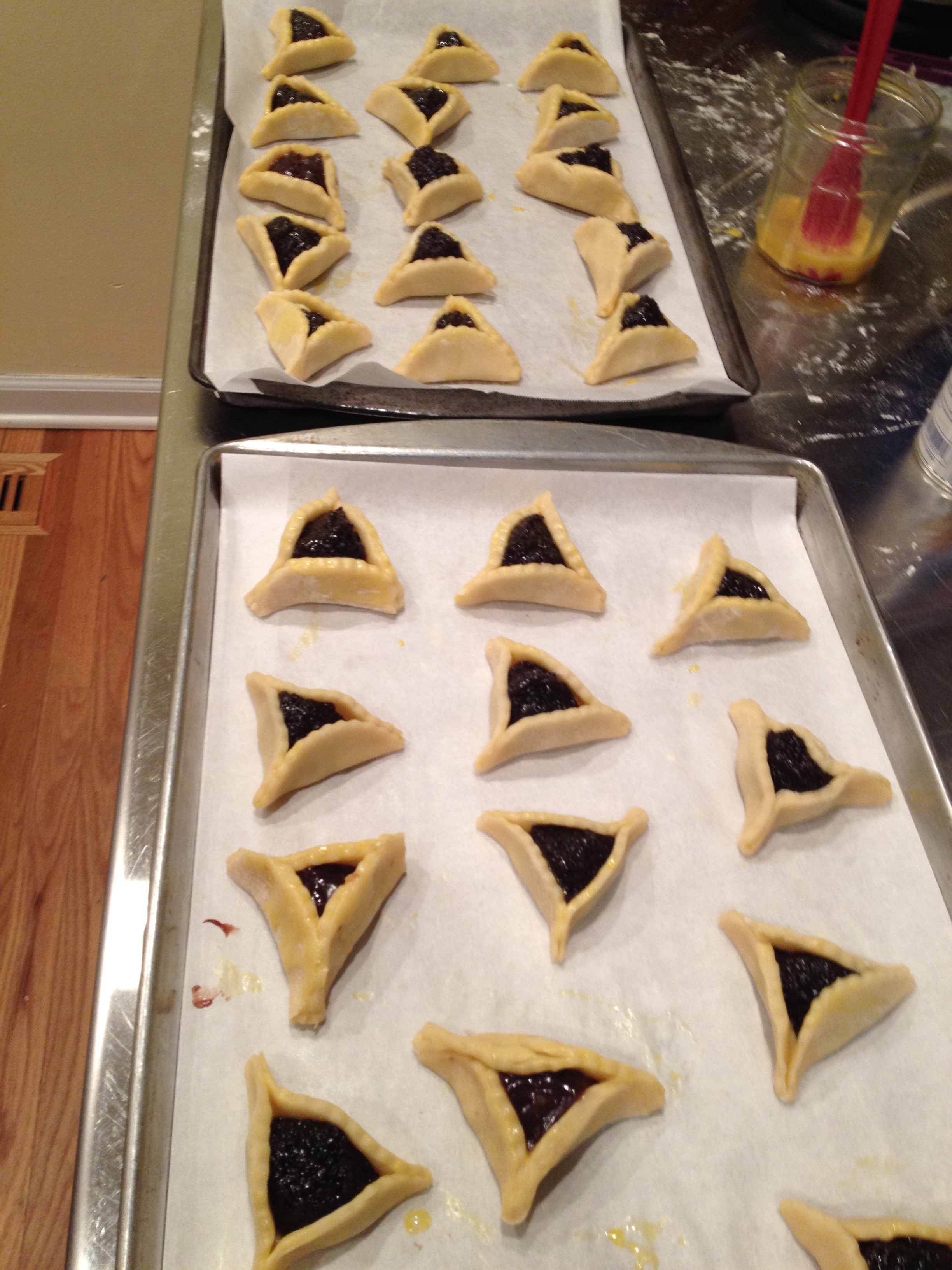
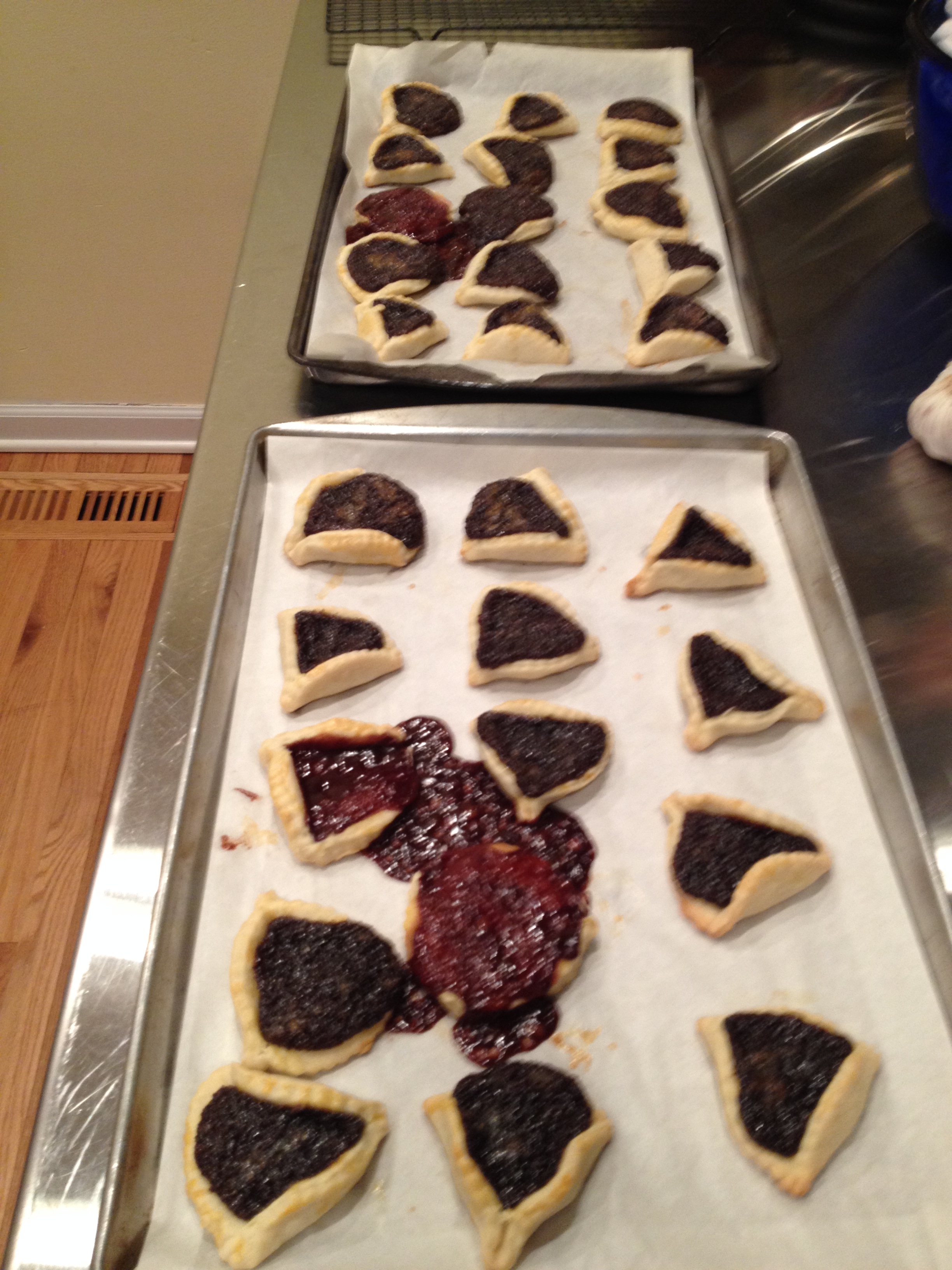
So this year, I dug up the recipe again and I set them up and I did an egg wash around the circle of dough before I closed the triangles and then I did an egg wash over each cooky and I pinched shut and I thought, “we are good to go!” I ran out of poppyseed filling and took a gamble, I admit, by filling the last three circles of dough with some leftover hot fudge sauce I had around — that was stupid, even I will admit. But I thought, “If the cookies stay closed, the filling will bubble up and maybe burn a little but it’ll hold still in the cup of dough and it’ll be okay.”

Well, let me tell you. These are some uglyass hamantaschen. IMG_4745 IMG_4746


I don’t do anything all day long while the kid’s in school.

Nope, I don’t do a damned thing.
This morning I dropped off my daughter at her school and came home and spent about fifteen minutes on the phone with a contractor and then emailed tenants to ask them to let me know if it would be ok if I had the new countertops for their kitchen installed this week. (This will, of course, mean that for several hours, I will be in their apartment, making sure everything goes ok.) I had a 9.30 appointment to have a windowsill installed in our kitchen window. It’s been windowsill-less for, oh, two years? And this is a deep sill — 17″ deep. So the sight of it, unfinished, is deeply unattractive, and god knows how much heat has been evaporating out of the house as the result of the work being unfinished. But the contractor has been a pain in the ass to work with. Nonetheless: ok, today’s the day. 9.30 comes and goes, no windowsill guys… but then, finally, at 9.45, they show up.

Then we discover that if they install the sill, it’ll mean we’re not able to operate the cranks that open our casement windows. So they have to go outside and re-mill (is that a word? is it correct?) the slab of marble so that it is shallow enough to fit into the little slot where it needs to go.

I have an actual, paid writing gig that I want to finish up today, but I know I can’t do it with these guys crashing around in here, so I’m working on this post instead. Things I’ve not yet done today, as the result of all this mishegas:

eaten breakfast; run dishwasher, filled with dishes from yesterday and the day before; laundry; read the two newspapers I do, yes, read every day without fail.
It’s now 10.30. I’d hoped to spend some time today baking hamantaschen, but it might have to wait. When I do, though, I’ll get back to you all. We’re going to be doing poppy-seed. I am very excited about it.

Blog at WordPress.com.

Up ↑