Mayonnaise: A Science Project. You know, for kids

Recently my family had the kind of day (and the kind of evening) where the only sane thing to do come dinnertime was have us all assemble sandwiches. The schedule had been bonkers all day long and there was no chance of my being able to cook something decent; it made loads of sense to just buy some cold cuts and rolls and a couple bags of potato chips and pretend that it was the kind of hot summer night when no one even pretends that a hot meal is a good idea. Never mind that in fact it was a cool 40 degree evening and that none of us were feeling at all summery. Some nights, you just say “uncle.”

The three of us built our sandwiches, and as we sat down at the table a large-scale discussion commenced on the virtues of mayonnaise. Now, many people fear mayonnaise. Some fear it for health-related reasons and some have what I guess we’d call “sensory issues” about it — they don’t like any food that’s white, or they find it slimy, or something — I don’t know what the problem is, I just know that there are a lot of people out there who won’t eat mayonnaise. And then on the other side of things, there’s a whole other crowd that regards mayonnaise as an essential food group unto itself. In other words, people have strong feelings about mayonnaise. My husband and I are vehemently pro-mayonnaise and I have been known to make it from scratch once in a blue moon. Our daughter, when smaller, accepted mayonnaise happily as the thing that bound her tuna salad together, but if you asked her if she wanted mayonnaise on, say, her turkey sandwich, she would protest loudly and declaim that mayonnaise was bad. In other words, she wasn’t quite grasping the situation, when it came to mayonnaise. Fortunately, in the last couple of years, she’s come around, and making good sandwiches for her is a lot easier now.

I voiced my relief that my daughter is no longer mayonnaise-phobic, and mused, “It’s so depressing when people make sandwiches and skimp on the mayonnaise. It makes for a very sad and uninspiring sandwich.” My husband agreed. Our daughter asked, “Can you make mayonnaise? I mean, can you make it at home?” My husband looked at me, and I looked at him and then at my daughter, and I said, “Kid, you were born into the right household.” I realized it had been quite a long time since I’d last made mayonnaise, if she was asking me this question, and said that over the weekend, I’d show her how to make mayonnaise.
So the weekend came, and I called the girl to the kitchen and showed her what we were going to do. “It is not hard to make mayonnaise,” I said, “but there are a few things you have to get absolutely right before you start, or it will not work at all.”

“Ok,” she said. I showed her what we needed. “We’ve got some olive oil, some vegetable oil, two eggs at room temperature, vinegar, a little bit of salt, and some mustard.”

“That isn’t a lot of food,” she said.

“No, it isn’t,” I said, “but you’ll see what happens.”

First I separated the eggs, explaining that if the eggs were cold, the mayonnaise would not happen. They have to be at room temperature. If you’ve not planned ahead and taken the eggs from the fridge an hour in advance, you can run them under hot tap water to get them ready. But it’s obviously easier to just let them sit on the counter a while. The whites were set aside in a little plastic tub; we wouldn’t need them. The yolks went into a large steel mixing bowl. I got out a big whisk and said, “Ok, I want you to whisk these together.” She held the bowl steady with one hand and began to awkwardly whisk the yolks. I said, “Now I’m going to add some stuff. You keep whisking.” I measured a couple of teaspoons of white vinegar into the bowl, and added a pinch of salt and a small dab of Colman’s prepared mustard (because I’m out of dry mustard). “Keep whisking,” I said. She kept whisking. “My hand’s getting tired,” she complained. I said, “Ok, let me take over,” and I finished the first round of whisking. “See how it’s all one nice thick yellow thing?” I said. She nodded. “Ok, so now we take some oil and we pour a tiny, thin stream of it in. I want you to whisk while I do this.” I took the bottle of olive oil and began to pour in a very, very thin trickle of oil while my daughter whisked like crazy. My husband ambled into the kitchen. “You’re not doing this in the blender or something?” he asked. “No,” I said, “because I want her to really be able to see what’s happening. This is Science!” “True,” he said, and ambled out of the room.

“What’s science about this?” asked our daughter.

“Well, what we’re doing is called making an emulsion,” I said. “That’s when you take two things that wouldn’t normally combine together, and you get them to become one new thing. We’re taking oil and eggs — the eggs are mostly water — and we’re making it so that they will combine into one new thing.”

As I said this, I was pouring in more oil (having switched to vegetable oil after a while), and I’d taken over the whisking. About three minutes later, we had a big bowl of mayonnaise. How did this happen? Naturally. The action of whisking the oil and the yolks forced the two to form an emulsion, i.e., mayonnaise. Homemade mayonnaise in my experience is not the creamy white color that Hellman’s is — it’s yellower, and definitely has a more pronounced taste — so I don’t regard it as interchangeable with Hellman’s. But it is good stuff, no question. My daughter was impressed. “Now what do we do with it?” she asked. “Well, you can taste it with a spoon,” I said. She did, and was even more impressed. “But what are we going to do with all of this?”

“I don’t know,” I said. The thing about homemade mayonnaise is, it doesn’t keep very well: you have to use it up fast. Fortunately, my husband had a plan: we would be making steak frites for dinner. More accurately, I would cook steak and he would cook the frites. Dinner at home was luxurious. It turns out, the road from a turkey and cheese sandwich and potato chips to steak frites is very short indeed.

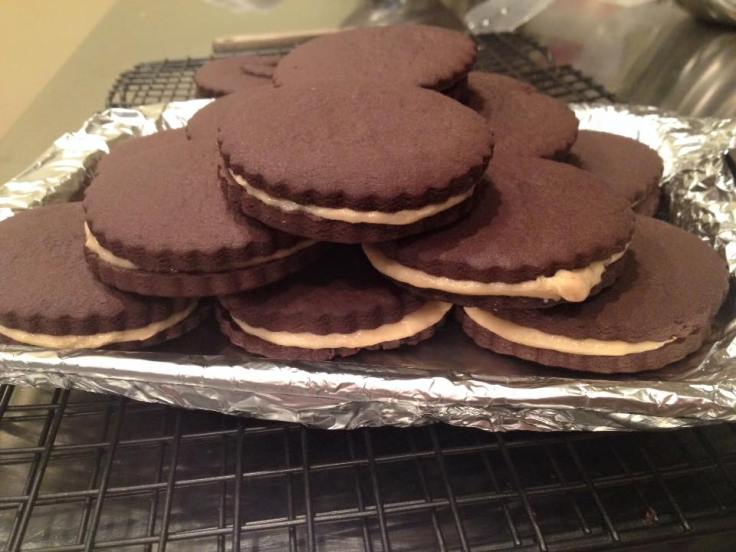
Breathtaking Chocolate Sandwich Cookies

Oreos, I love you, but you may never be purchased again, not that I can even remember the last time I bought Oreos anyhow.

It is my mother’s birthday this week and I felt that it would be wise and nice to bring some baked thing when we go visit her. Since traveling with cake is a dicey prospect, I thought cookies would be the way to go. I don’t know why but the idea of a chocolate sandwich cookie, like an Oreo, but with peanut butter filling (because my mom likes peanut butter) sprang to mind. I voiced these thoughts to my husband, who said skeptically that it sounded “awfully experimental,” but I ignored him and plotted my next steps. Cracking Maida Heatter’s Book of Great Chocolate Desserts (which is a fabulous book, one of the first dessert-focused cookbooks I bought — in fact, I think it was the very first such book I bought), I found a recipe for chocolate wafers; grasping immediately that I had on hand everything it would take to make these, I moved forward. This is the list of ingredients:

2 oz. (2 squares) unsweetened chocolate
1 cup plus 2 tablespoons sifted all-purpose flour
3/4 tsp. baking powder
1/4 tsp. baking soda
Pinch of salt
2 oz. (1/2 stick) sweet butter
1 tsp. vanilla extract
1/2 cup granulated sugar
1 1/2 tsp. light cream or milk
1 large egg
 

So, naturally, the first thing I did was say, “Two ounces of unsweetened chocolate? Screw that, I’m using cocoa powder instead.”

I subbed in 5 tablespoons regular Hershey’s cocoa and one tablespoon Special Dark cocoa powder and added some extra butter to the bowl at the stand mixer — so it wound up being about 3/4 of a stick of butter, not 1/2 a stick of butter. (Three tablespoons cocoa powder plus one tablespoon of butter equals one ounce of unsweetened chocolate.)

But I otherwise did exactly as I was told. I preheated the oven to 400° and I lined cooky sheets with aluminum foil. I creamed the butter, added the sugar, threw in the vanilla and the egg, and then whisked all the dry ingredients together. I added the dry to the wet, mixed thoroughly, and cooed at the beautiful dark brown cooky dough (not that we’re told to do this explicitly, but it’s a totally natural reaction to such a beautiful dough). I then formed it into a brick, wrapped it in waxed paper, and put it in the fridge for not quite half an hour.

When the dough was chilled, but not hard as a rock, I took it out and referred back to Heatter’s instructions. She tells us to roll the dough out on a pastry cloth. Now, this may surprise you, but I had no idea what she was talking about. A pastry cloth? Do I own anything I can use as a pastry cloth? The answer of course was, “Yes.” A pastry cloth turns out to be a non-lint producing, flat-weave cloth you rub flour into and then use as your surface for rolling out dough; it makes it easy for you to move the prepared disc of dough onto your baking sheet. Apparently all pie bakers know this. Since I don’t really believe in pie, I’ve been ignorant, but now I’m converted.

My first thought was to use a particularly cute 1940s era dishtowel of mine as a pastry cloth — the weave is perfect — but I was leery of possibly staining it permanently with chocolate. So I took one of the old cloth diapers I use instead of cheesecloth and rubbed some flour onto it and then began to roll out the cooky dough. Then came the epiphany of the week: Rolled cookies should totally be rolled out on a pastry cloth. I don’t know why or how I never before grasped this, but it was awesome. The dough was so easy to work with; it didn’t stick; it rolled out in about two seconds to exactly the right thickness (1/8″) and was simple to remove from the cloth and put on the baking tray. Had I done this straight on the countertop, I’d’ve had to use so much more flour, and it would have been both messy and I’d’ve risked toughening the dough. It’s now clear to me that, were I a piecrust baker, I’d’ve already known about pastry cloth, but because I never make pie crusts, I had no clue. Well: now I know. And pastry cloth is my new hero.

(Incidentally: Because the very dark dough didn’t mark the cloth at all, not one bit, I’ve realized that I can in fact use my cute 1940s dishtowel as a pastry cloth, and I intend to dedicate it to this purpose from now on.)

So I rolled out the cookies and baked them. It doesn’t take long: 8 minutes, pausing at 4 minutes to rotate the trays of cookies (switching racks and rotating pans, necessary moves). Then you cool the cookies on a rack.

While the cookies cooled, I made the peanut butter filling. As it happened, I still had some leftover peanut butter sauce for ice cream sitting around, and so I felt perfectly confident that (despite the presence of corn syrup in the sauce) I could generate some peanut butter filling in about two seconds. Normally one would take peanut butter, some butter, and some confectioner’s sugar and just whizz that together. Today, I took some of the sauce, about a cup and a half of confectioner’s sugar, and a little bit of heavy cream (maybe 2 tablespoons) and whizzed that together. My husband tasted it and admitted grudgingly it was good. When the cookies were cool, I put some filling onto a cooky, glued another cooky onto it, and beheld my gorgeous creation. “Look at that!” I crowed to my husband. He came and looked and said, “Your mother will be very impressed,” he said, “but no one’s tasted them yet.”

“Oh ye of little faith,” I thought to myself, and placidly continued assembling the sandwich cookies. The last one, I thought, I will serve to my husband and child as a test cooky. I cut it in half — the cooky part shattered; it is a crisp cookie — and brought them to my family, who had varied reactions. My daughter declared them wonderful, with much enthusiasm and longing looks toward the tray of cookies to travel tomorrow. My husband, more restrained, admitted calmly, “They’re good.”

Damn straight they’re good. Happy birthday, Mom. Chocolate Peanut Butter Sandwich Cookies

The Hamantaschen Chronicles: 2016

Once again, we began our Hamantaschen enterprise this year full of good intention, tons of thought, and feeling ready for the challenge. And at about nine in the morning, I got a message from my friend S., who said, “I’ve never baked hamantaschen before, but I really want to do it. Can I really use whole wheat flour to make hamantaschen?”

This, friends, is not how a hamantaschen novice should start out, by worrying about whole wheat flour. As any experienced hamantaschen baker knows, one of the biggest challenges about baking these cookies is that most recipes — and I really do mean about 90% of them, in my experience —  produce a dough that bakes up into tough, tasteless things that you really have to suffer through to before you get to the good part (the filling). This is just wrong. It’s not how it’s supposed to be. In an ideal situation, both the cooky and the filling are both delicious and a pleasure to eat.

I fell to all caps and said NO NO NO NO WHOLE WHEAT FLOUR FOR GOD”S SAKE DON”T DO IT.

I explained to S. that the tenderness of the cooky is an Issue even under the best of circumstances, and that whole wheat flour is never, ever, going to make matters better. I then spent about an hour at the computer, sifting through recipes I’d emailed to myself, through old blog posts about hamantaschen, looking at websites, side by side with S.

“I think I’ll do the Smitten Kitchen recipe,” she said.

“Which one?” I asked. “I have three different SK tabs open now.” Proof that any hamantaschen baker worth his or her salt is always, always hunting for The One. If Deb Perelman is still looking, we’re all still looking.

S. thought that the big issue was going to be folding them so that they stay folded. I said that this is a big issue, and that failure is very frustrating, but that I’d learned that doing an egg wash on the cooky rounds before folding makes a huge difference. I emphasized that producing hamantaschen is a giant pain in the ass, and tedious, and full of tragedies. “You have to be prepared for the results to be ugly,” I said. “You have to NOT MIND THIS. You have to be ZEN AS FUCK about it. And you have to hope that the cooky part at least tastes good, not dull and floury.”

We then went to our respective kitchens and began baking. In my case, I discovered quickly that I had sorely miscalculated how much butter I had in the house. While I thought I had at least a pound stored away in the freezer, and several sticks left in the fridge, it turned out I did not, and I had to cobble together ends of various bits of butter (including using the hideously expensive Arethusa Farm Dairy butter I bought a while ago, which I was saving for Something Special) to come up with a scant pound. I got out my kitchen scale and weighed and re-weighed. No matter what I did, I had not quite a pound of butter. “No matter!” I said. “I can still do this.” I then put the butter I had into the Kitchen Aid bowl and put on the paddle attachment with the silicone edges — a handy thing because it scrapes the sides of the bowl for you as it beats the butter. I turned the machine on, and immediately heard a nasty crack. The butter was not as soft as it perhaps should have been, and I broke my paddle attachment.

I went to Facebook and typed, “This is a sign of some kind.”

Then I got out my old metal paddle attachment and started over. Cream the butter, I thought placidly. Double the recipe, cream the butter. Not quite a pound of butter, I’ll just do a little less flour, everything should be fine. The butter was creamed, and so I smoothly added sugar to the mixer bowl. I looked again at the recipe I was using, which was from a blog post I had written myself a couple of years ago. And then I caught my breath. “Double the recipe,” I’d been reciting in my head. But the recipe called for four ounces of butter, which was one stick. And it said to use a little more than a cup of sugar.

I’d managed to get myself messed up about whether a stick of butter is 4 ounces of 8 ounces. It’s four ounces, friends. Not eight.

I hadn’t doubled the recipe, I had quadrupled the recipe. If I had almost 16 ounces of butter, that meant I’d have to use significantly more than one cup of sugar. And more of…. everything.

I thanked god that I had two cans of poppyseed filling, because I was going to need them.

And then I took my own advice, and got Zen as fuck.

Because I realized that the instructions I was so carefully following were about to mess me up again, I stopped everything and tried valiantly to think hard. If I doubled the recipe, I would be using…. eight cups of flour. Which was impossible. Eight cups of flour is what I’d use to bake a couple loaves of bread, not to make hamantaschen. Not even a LOT of hamantaschen.

So I got even more zen, and I took a deep breath, and I carefully measured out three cups of flour and brought the flour canister over to the counter where I was working. “You can always add more, but you cannot take away,” was my mantra. I added the three cups of flour to the mixture and while it clearly was not enough — the dough was so soft as to be completely unworkable — I had no idea how much more I needed. I began to take flour from the canister in small quantities and work them in gently with a wooden spoon. The mixer was getting tired and the dough was crawling up the neck of the paddle. I didn’t count how many more cups I added, but it was probably a little over five cups, total, that I used. I then very smartly put the mixing bowl into the fridge to let the dough rest and chill (because it’s impossible to work at room temperature, but when it’s cold, it’s very easy) and began to prepare the baking trays. Four trays with four sheets of parchment paper were readied and stacked nearby. I floured the countertop heavily, pulled a hunk of dough out of the mixing bowl, and gingerly began to work with it.

The dough rolled out beautifully. It cut perfectly. I added the scraps back to the mixing bowl, so they could rest and re-chill, and I focused on brushing on the interior egg wash. (One jumbo egg took care of all the egg washing, inside and out, that all these cookies required.) Cut; wash; fill; fold; wash; make sure folds are sealed. The cookies — a dozen on each tray — went into the hot oven, and I let ten minutes go by before I looked nervously through the glass door to see how they were doing. This is the moment when you really have to steel yourself for disaster. There is no guarantee that what you’ve put together will, in fact, work.

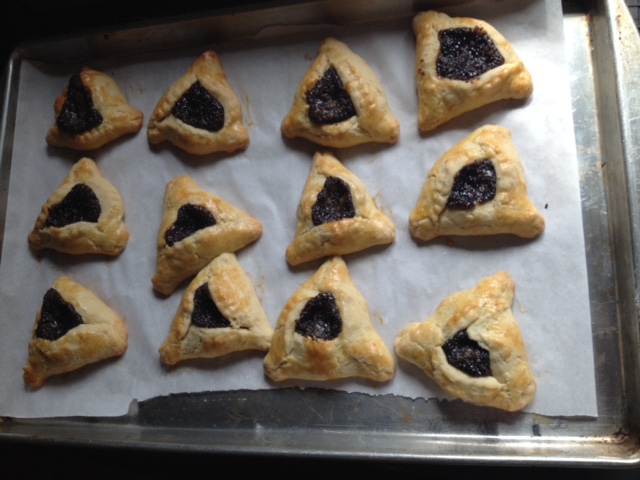
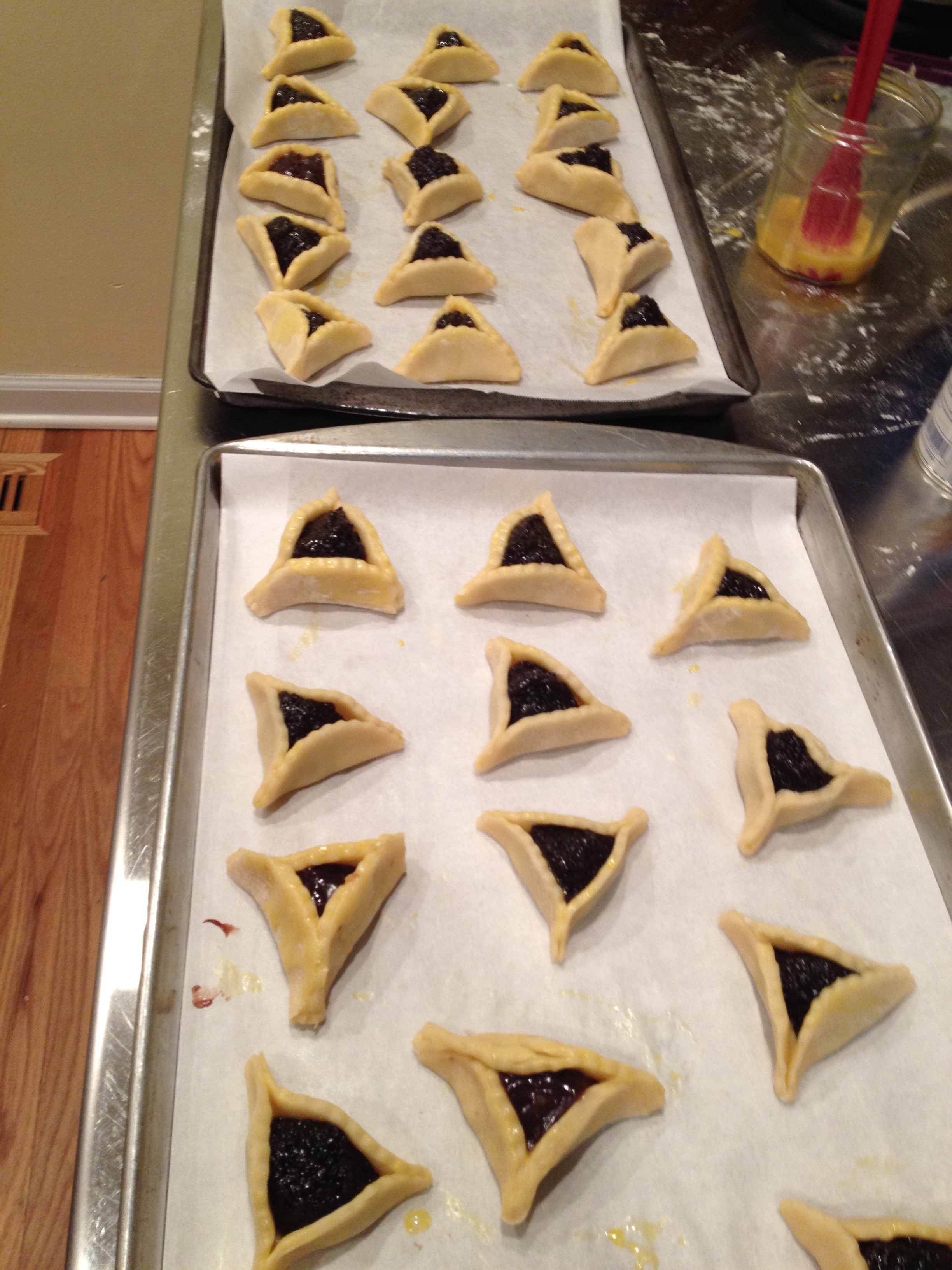
To my considerable joy, the cookies looked great. A little puffier than I’d expected, somehow, but better they be puffy than that they look hard and sad. These were big, happy, fluffy kittykats of hamantaschen, and the filling was staying exactly where it was supposed to.

IMG_6441

I let the trays bake for 25 minutes and then took them out. They were perhaps a little less golden than I might have liked, but to leave them in longer would mean risking burning; so onto the cooling racks went the cookies, and I slammed the next round in.

I spent the next few hours breathing calmly. I cut, washed, filled, folded, and washed again. And in the end I had I think 67 hamantaschen, and only two of them weren’t quite perfect little triangles. (One of them had four corners. I don’t know why it happened but when I started folding it, somehow I couldn’t get it to do what I wanted, and it turned into a square, and by then I didn’t want to fight with the dough anymore, so I let it bake as it. The other imperfect one was made with the last scrap of dough, which I pressed into a circle by hand, and since I was by then quite tired, I just curled up the edges a little and put filling on top of it and said, “Baker’s treat.”) In the end, 65 hamantaschen worthy of being served to family and given to friends. I took a picture and sent it to my husband, who was impressed. When the cookies were all on the racks and cooling, I then turned around and baked the two loaves of bread I’d been working on, which had waited with great patience in their pans on the kitchen floor right in front of the fridge (don’t ask). (One glory of the Pullman loaf is that, since it is tightly covered, you can do things like let it rise on the kitchen floor and it’s totally fine.) All of this was achieved, mind you, before I went to pick my daughter up at school at 4 p.m. (later than usual because of a special event), which is nothing short of a miracle.

That night my husband ate several cookies while my daughter and I attended services at a nearby synagogue. “They’re perfect,” he said after we got home. “It’s very impressive. Your hamantaschen success rate is about 60%, but these are perfect.” The cooky was a sweet, crumbly, soft shortbread-like cooky — it was so good that, in fact, my daughter asked if I could make the cooky again but without the poppy seeds. Could I bake it with, say, sprinkles on it instead? The filling was wonderful because, of course, it came from a can, and I had nothing to do with it. I claimed victory all over the place, and we delivered a couple dozen cookies around the neighborhood feeling triumphant.

Late that night S. checked in with me. She’d made her hamantaschen, and sent me a photo. They looked perfect, and I told her so. “The cooky is tough,” she wrote sadly. “Tough hamantaschen are endemic,” I said. “Next year, you’ll do better.” I can say this because I know from experience. I told her she did great and not to worry.

As for my perfect hamantaschen: If I can pull this off again next year, it’ll be a miracle, but on the other hand, I really think I can do it. I think I’ve got it licked. (Famous last words. Tune in, in mid-March 2017, for the next episode of the Hamantaschen Chronicles.)

You’d Think It Wouldn’t be Hard: Peanut Butter Brownies

IMG_6211
The first one. Not so great.

I suppose that out of my couple thousand cookbooks I probably have at least thirty different reliable recipes for peanut butter brownies, but the other day when I decided on a whim that I had to bake peanut butter brownies, I did not turn to any of my utterly reliable cookbooks, but instead went to the internet. I found a recipe that seemed plausible and, after making sure that I in fact had all the ingredients on hand, I set to work. I had this idea that I would make peanut butter brownies and put some chocolate chips in them.

But when I stopped to think for a moment, I realized that I had in the refrigerator a little tub with leftover chocolate babka filling, and that, instead of using chocolate chips,  I should swirl the babka filling into the brownie batter. So I melted the chocolate filling in the microwave (because that stuff hardens to rock in the fridge) and poured it atop the brownie batter. My daughter watched me. “Mmmmmmmmm,” she said approvingly. “Yeah,” I said. “But you know what, this was dumb of me, I should have put half the batter in the pan, then put the chocolate, and then put the rest of the batter on top of the chocolate.” “Well who cares,” said the wise one. “I do,” I said, “but never mind, I can do it next time.”

I baked the pan of brownies and they came out…. fine, but not at all brownie-like. They were more like peanut butter cake, and rather dry peanut butter cake at that. We ate them, but none of us loved them. I was disappointed, but immediately grasped the problem. Too much flour, by 50%. “I will fix this,” I said to everyone, and everyone paid no attention at all.

The other day, having baked a lovely loaf of chocolate bread, I then returned to the peanut butter brownie problem, which sounds like it would be a really good episode of Peg + Cat, except probably peanuts aren’t allowed on PBS shows. This time, I revised the recipe, cutting the flour dramatically. So now it went like this:

1/2 cup peanut butter

1/3 cup butter (original recipe called for margarine, but get real)

2/3 cup white sugar

1/2 cup brown sugar

2 eggs

1/2 tsp vanilla extract

1/2 cup flour

1 tsp baking powder

1/4 tsp salt

You cream the peanut butter and butter together in a mixer and when it’s smooth you add the sugars. Then you add the eggs and vanilla. Whip it all up so it looks fluffy. In a separate little bowl, whisk together the dry ingredients and add them to the butter/sugar/eggs.

Prepare an 8×8″ baking pan by taking the wrapper from a stick of butter and lightly rubbing it on the bottom of the pan. Then make a sling of parchment paper and lightly coat the paper with butter, too. The grease on the wrapper will be enough to achieve this, you don’t need to slice any actual butter or get your hands messy to do this; you just need a microscopic film of butter on the pan and paper.

Put half the batter in the pan, then put most of your chocolate filling (or chocolate chips) over the batter. Cover the layer of chocolate with the rest of the peanut butter batter, then add the rest of the chocolate to form the top layer. Swirl with a knife until it looks however you think it looks best, then bake at 350° for about 30 minutes. I kept thinking 20 minutes would do the trick, but it didn’t, and I kept adding time, six minutes at a time, and I think I wound up at 30 minutes. Let cool a while in the pan (about 20 minutes) on a rack; then remove from pan using edges of parchment, and place the brownie, still on the paper, on the rack. It needs to cool all the way before removing the paper and slicing.

This peanut butter brownie is far superior to the one I made the first time around. “Much more chewy, peanut-buttery,” said one reviewer. “Mmmm, really good,” said another reviewer. It was felt that chocolate chips would be preferable chocolate element over the leftover babka filling, so when I work on this again, I’ll be doing it with chocolate chips.
However, there is an argument to be made for making babka again, and, again, making too much chocolate filling, and starting this vicious cycle all over again, because some of us like the chewy, rich, chocolate sludge…

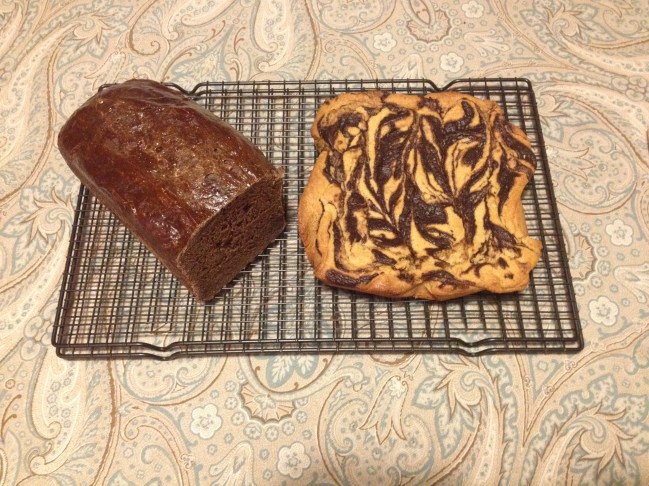
IMG_6223
Much better. Peanut butter swirl brownies, and half a loaf of chocolate bread for good measure.


When My Lunacy Pays Off: Beef Soup for a Sick Child

I occasionally wonder why I do things like hoard beef bones in the freezer for months and then spend a few hours slowly simmering them with parsley and celery and carrot and onion peels. It would be really easy to just throw a cube of beef bouillon into whatever I’m cooking, right?

Except that I find those bouillon cubes so aggressively salty, it hurts me to eat them. I’m not being hyperbolic; it literally hurts my mouth to eat that stuff. (Though I admit, when I was little, I loved those little cubes, and they are sooooooo cuuuuute  that I still kind of like them in principle.)

A couple of weeks ago I spent some time making this beef stock, and it came out beautifully, and I got all organized and froze it into ice cube trays and then cracked all the beef cubes into plastic bags which I then stored in the freezer and I felt all smug but wondered, “What am I gonna do with all of this?” The last two cups of stock that I didn’t freeze, I used in a really good risotto. Would all of this just go into another risotto? It wouldn’t be the worst use, but would it really the best use of this kind of specialty food item?

Fortunately, my daughter came to my rescue. She came down with some kind of creeping crud over the weekend. Fever, sore throat. General malaise. And I thought, “What this child needs is beef broth with little bitty alphabet noodles in it.” I always have alphabet noodles around, but reserve them for very special uses — I only serve them when she’s feeling sick. When the child didn’t want to eat anything for lunch on Sunday, I said, “hey, what if I make you some beef soup with alphabets?” she croaked, “yes, please,” and it took me almost no effort. I put about eight icy beef cubes into a pot, put it on the stove, and melted them down in about two minutes; it quickly came to a boil. I added to it maybe a quarter of a teaspoon of Chinese mustard powder, an equal amount of salt, and three teaspoons of alphabet noodles. Then I walked away, letting it simmer, and took the child’s temperature and told her to wash up for lunch. In five minutes, the soup was ready.

Monday she stayed home from school. Walking home from the doctor’s office — she doesn’t have strep, we’re pleased to report — she asked, “Can I have beef soup for lunch again? With alphabets? and with the mustard?” Because God forbid I leave out the mustard…

Kitchen Competence: The Update

This is the result.
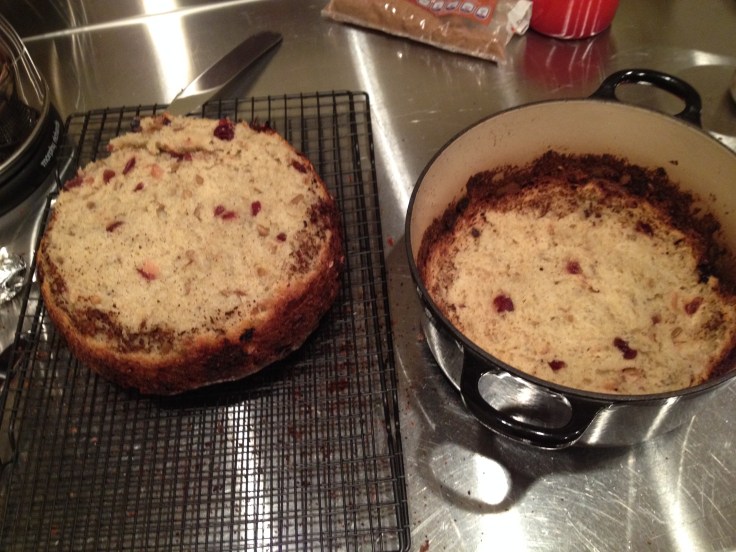
IMG_6149

Last night I took care of the last steps to prepare this dough to bake. I kneaded it one last time — very sticky stuff, I had to use a dishrag to get my hands clean — and I set the dough into a pot to rise overnight in the fridge, as per the King Arthur Flour directions for their No-Knead Harvest Bread, which was one of the recipes I was taking as a model. This morning, when I went to make the coffee, I took the pot out of the fridge and set it on the counter to come up to room temperature (or closer to). When I was back home after taking my daughter to school, I did as King Arthur said: I put the pot, covered, in a cold oven, turned the oven to 450 degrees, and baked it for 45 minutes, after which point I took off the lid. I baked until it registered 205 on a thermometer (actually, it said 206°) and then I tried to get it out of the pot.

Well, here, we ran into trouble. This thing did not want to leave its house. It was a like taking a cat to the vet. “I know what’s happening next, and I don’t like it, and I’m staying here.” In the end I had to take a plastic knife and shove it all around the edge of the bread to separate it from the pot, and when I turned the pot over to shake out the bread, it came out, but, as you can see, it left the bottom crust of the bread behind in the pot.

So this isn’t a complete success. It’s not a very handsome product. However, it occurred to me immediately that this bread would make a fabulous stuffing, and so if we don’t want to eat a mangled, ugly loaf of cranberry-sunflower seed bread, we will happily consume it alongside a roasted chicken.

I’m now eating a slice of this bread with some butter. It’s pretty good. I think the solution to baking this is one of two things: 1. line the bottom of the baking pot with parchment paper, don’t just rely on the pot being greased to do the trick; or, two, bake it as a messily-shaped loaf on a big cooky sheet, again with parchment underneath it. Because I can already tell this is worth making again, even if I messed it up this time.

Baking Can Be Discouraging

Even when you think you’ve got it nailed, even when you are sure you can get it right, things happen.
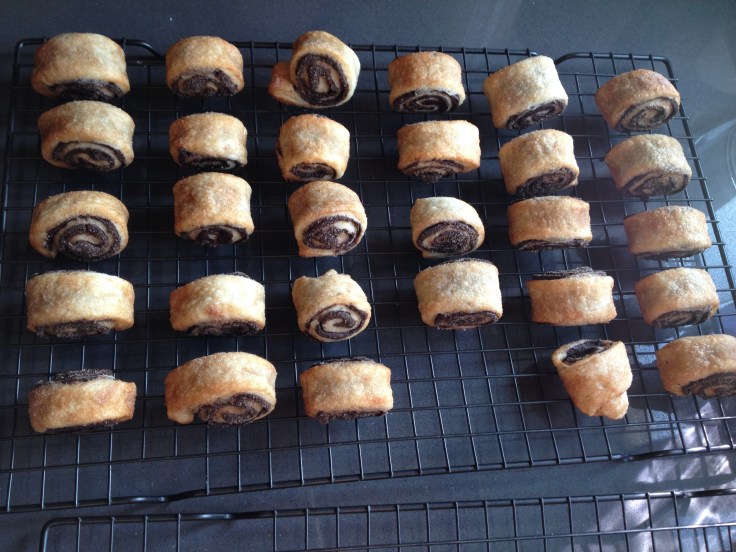
The other day, I thought I had rugelach down. I produced these. They looked perfect and they tasted perfect.

IMG_5887

Then this morning I made more rugelach. Granted, the filling was slightly, slightly different. But I used the exact same technique and this is what happened.

IMG_5923

The good news is twofold. One: the burnt chocolate filling smells and tastes great. Two: no one in my family will mind eating these.
The bad news is, the failure means I had to come up with something else to bake, fast, to mail to people this week. Fortunately, I was able to put together the Chocolate Crunch Shortbread from last weekend’s Wall Street Journal, and I’ve baked them, and they came out of the oven looking the way they’re supposed to. So I can wrap and ship this afternoon, once they’ve cooled.
I think I’ll stop baking for a couple of days. I think I need a break.

The Sad Story of the Grape-Nuts: How Some Things are Worth Making at Home, and Others are Not.

I was not one of those people who automatically liked Grape-Nuts. As cold cereals go, it is not friendly. These are hard little pellets that look like nothing so much as crumbled bits of hamster poo. They taste like vaguely sweet yeast pellets. But when I was about twenty years old I decided I really liked them and that they were worth the expense — because, for reasons I don’t really understand, they are distinctly more expensive than most of the cold cereals out there. And then I married someone who also likes Grape-Nuts. This means that we’re capable of going through a rather alarming number of boxes of Grape-Nuts in the space of a week. So it’s a splurge. Cold cereal as splurge: a sad state of affairs, but so it goes.
There was a time when I was in an Expect Discounts store and saw Grape-Nuts on sale for $1.50 a box. I bought seven boxes of them. My husband was appalled when he saw that our cabinet had been filled with nothing but Grape-Nuts, but I said, “What’s your problem? They were cheap, and they’ll get eaten!” Which they did, in a shockingly short time frame.
Now, during the days when I was pregnant and working part time and then working even less than what I’d always thought of as respectably part time, it became clear we were going to have to trim our household costs a little. To that end, I thought, “What if I could make my own Grape Nuts?” Since the internet had been invented, I was able to Google up some recipes, and I hit on one that sounded plausible, and one day I set to making homemade Grape Nuts. This involved lots of mixing and types of flour normal people don’t keep around the house (I think graham flour was involved) and baking and crumbling up slabs of unappetizing brown baked stuff and then baking some more and crumbling some more. It was labor intensive. But I had the time, and I’m the sort of person who, when determined to do something like this, will see it through to the bloody end.
The bloody end, in this case, resulted in a strange nubbly bin of stuff that even I wouldn’t eat. It was horrid. It was so horrid that we had to just laugh at how horrid it was. I attempted it a second time, if I remember correctly, and it came out inedible a second time. And then the inedible horror grew mold. Cold cereals aren’t supposed to grow mold. It was clear that this was something that was just beyond my ability. Our trash was rich with the spoils of my noble attempts.
By this point in our relationship, my husband had gotten used to my kitchen misadventures and was pretty cheerful about it, but this particular episode was so bizarre he began to tell people at his office that I was going around trying to make homemade Grape-Nuts. Naturally, everyone clucked, “Well, women who are very pregnant get odd ideas in their head. It goes with nesting.” “No, no,” he would say. “You don’t understand: she’s like this anyway.” And they’d look at him with an expression that said something like, “wait, you married this person? Because it seemed like a good idea?”
Well, making homemade Grape-Nuts is not a good idea. But making homemade granola is. Making your own pain de mie is a very good idea. Making your own Twix bars is a very good idea. This week we’ve established that making your own Almond Joy bars is a good idea. It’s not that I think everyone should drop whatever they’re doing and go make these things: it’s that if you happen to be the sort of person who likes to kill a few hours in the kitchen doing something really tasty that doesn’t directly relate to what you’re having for dinner, these are things that are really good if you make them yourself. They are even, according to my husband, better than the versions you’d buy at the store.
So, my husband has pointed out to me, it should follow that since I’m someone who wouldn’t bat an eye at making Grape-Nuts or Twix Bars or Almond Joy bars, I might as well try my hand at making croissants from scratch. I’ve now spent some quality time with the King Arthur Flour recipe for making croissants, and have decided that when the weather cools down (it’s 95 degrees outside today), I will give it a shot.

I will let you know if it turns out to be a good idea.

But I Used an Egg Wash! Or, Why the FUCK can’t I get Hamantaschen to work right?

I am going to be 45 years old this year, and I’ve been attempting to make perfect hamantaschen irregularly since I was a teenager and discovered that you could buy cans of poppy seed filling in supermarkets. Prior to that, I’d assumed it was a big secret thing that only Jewish bakeries could do. Well, I’m a middle-aged kitchen hack now, and I’m still convinced that there’s something about hamantaschen that only Jewish bakeries know how to do.

There’ve always been issues. First off, I’ve never found the right cooky recipe. Most hamantaschen recipes call for a dough I find completely unacceptable because they require orange juice, to which I reply, “Over my dead body.” But then, there are other issues. Sometimes the dough results in just some hard, not too sweet thing that is, frankly, strong enough to hold the filling in place, but otherwise has nothing to recommend it.

I’ve spent years hunting for hamantaschen recipes, always thinking, “it’s out there, the perfect recipe it out there, I just know it.” And I am pretty sure that in 2014, I scored, with the Smitten Kitchen hamantaschen recipe. http://smittenkitchen.com/blog/2008/03/hamantaschen/

This, minus the orange zest, natch, is the thing I think I used last year, and it was wholly successful. I believe this because I remember that I gave hamantaschen to people, even people I didn’t know very well; I even mailed cookies to people. I wouldn’t do that if I hadn’t thought they’d come out beautifully. Right? Right?
So this year, I dug up the recipe again and I set them up and I did an egg wash around the circle of dough before I closed the triangles and then I did an egg wash over each cooky and I pinched shut and I thought, “we are good to go!” I ran out of poppyseed filling and took a gamble, I admit, by filling the last three circles of dough with some leftover hot fudge sauce I had around — that was stupid, even I will admit. But I thought, “If the cookies stay closed, the filling will bubble up and maybe burn a little but it’ll hold still in the cup of dough and it’ll be okay.”

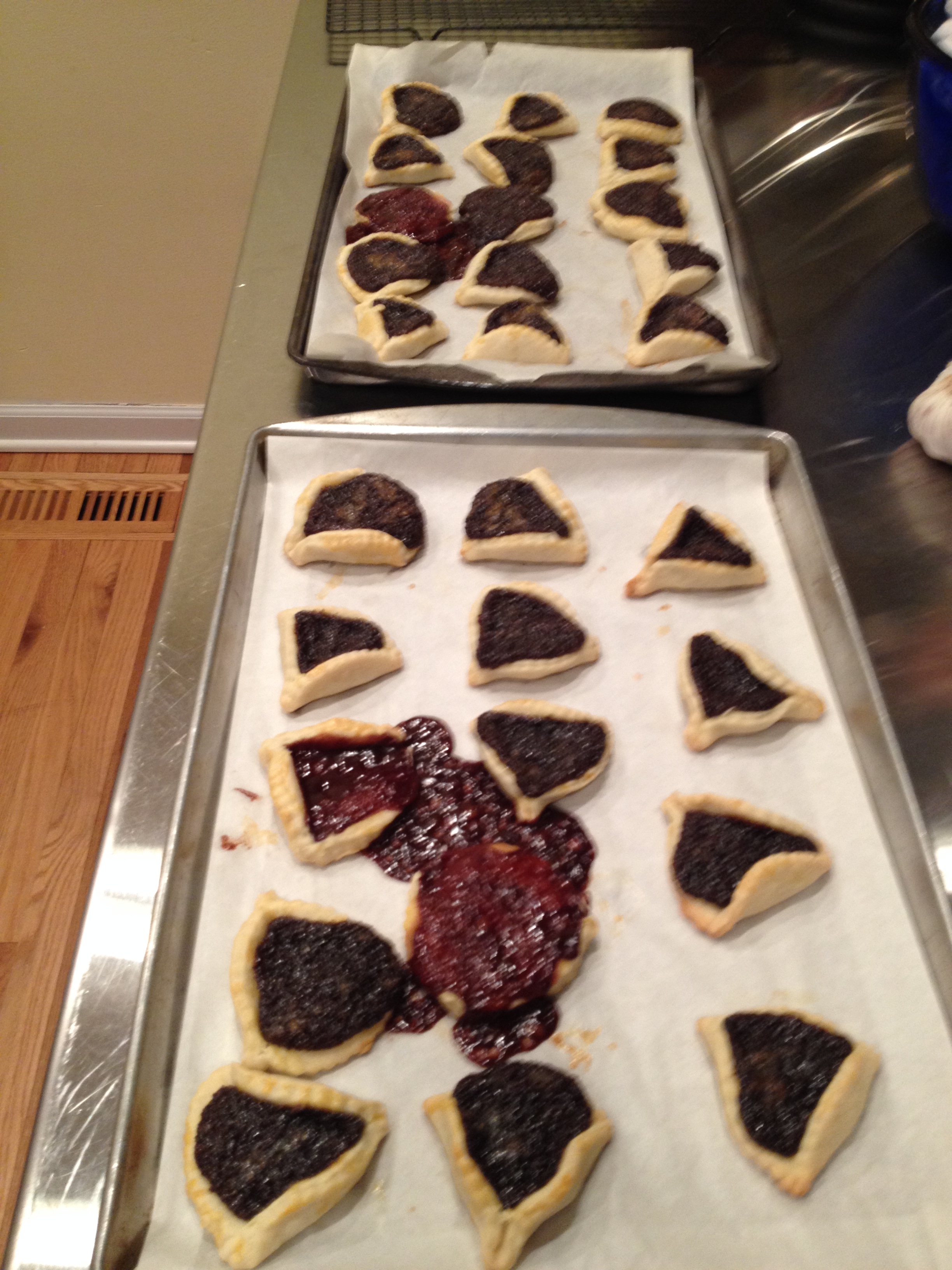
Well, let me tell you. These are some uglyass hamantaschen. IMG_4745 IMG_4746


Blog at WordPress.com.

Up ↑